
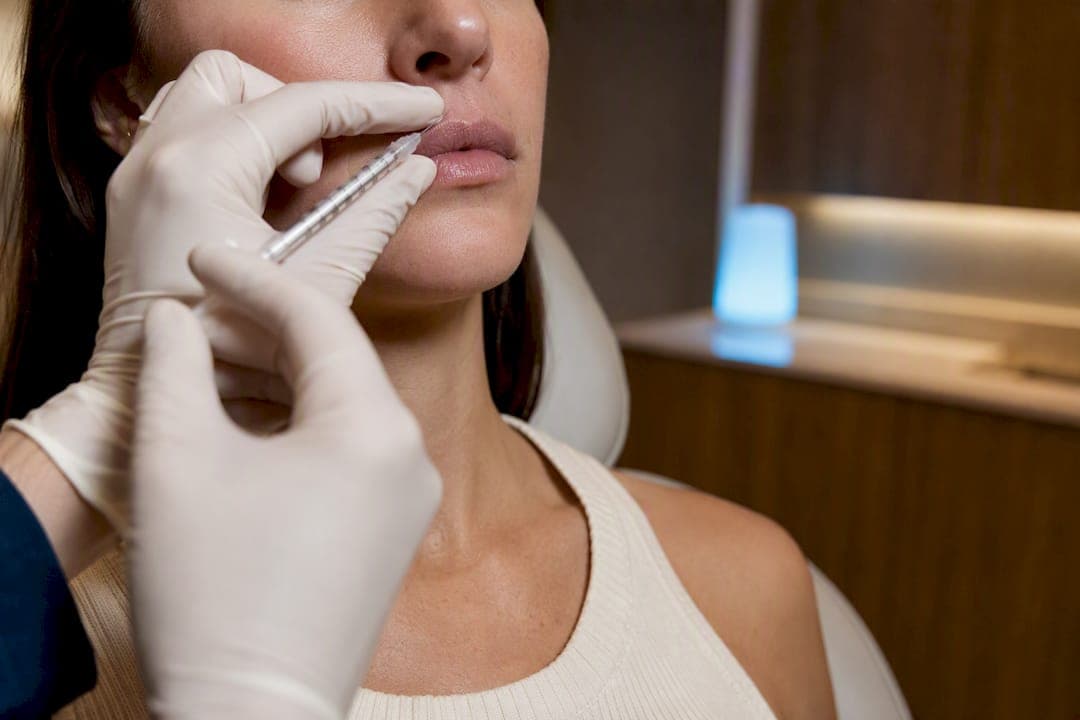
A lip flip typically lasts 6 to 10 weeks, with some patients seeing effects stretch to about 5 months depending on dose and metabolism. You'll notice initial changes within 3 to 5 days, and the result fully settles by 10 to 14 days. Because the fade is gradual rather than sudden, it's best to book your appointment well in advance before any event where you want the final look.
TL;DR:
- The typical lip flip lasts between 6 to 10 weeks, with some patients experiencing effects up to five months depending on dose and muscle activity.
- Objective measurements show peak changes around 15 days, with results usually fully settled by 10 to 14 days, making timing crucial for events.
- Higher doses, injection site precision, and individual factors like metabolism and muscle use significantly influence how long the results last.
- Lip flip effects fade gradually as muscle activity returns, and consistent re-treatment every 2 to 3 months is common for maintaining results.
- Overdosing beyond 4 units increases risks without extending duration, so conservative, personalized dosing under medical supervision is safest.
Table of Contents
- Lip Flip Duration Timeline: Onset, Settling, and Fade
- How Long Does a Lip Flip Last: Ranges, Evidence, and What's Actually Known
- What Determines How Long Your Results Last
- Lip Flip vs. Lip Filler: Why One Fades Faster
- What to Expect in the First Two Weeks
- How Often You'll Need to Repeat It
- Dosage Guidance and the Risk of Overdoing It
- What a Clinic Recommends Before You Book
- What I'd Tell a Friend Before Their First Lip Flip
- Book a Consult With a Provider Who Doses Conservatively
- Sources
- FAQ
Lip Flip Duration Timeline: Onset, Settling, and Fade
The first thing to understand about lip flip duration is that nothing happens overnight. Botulinum toxin needs time to bind to nerve receptors and relax the targeted muscle fibers, so the flip doesn't show up the moment you leave the treatment chair.
Most patients see the earliest visible changes within 3 to 5 days. The lip starts to relax and roll slightly outward, creating that subtle fuller appearance without any added volume. By 10 to 14 days, the effect has fully settled, which is when providers assess the final result and decide whether any touch-up is needed, according to Cleveland Clinic's guidance on lip flip procedures.
Here's what the timeline looks like in practice:
- Days 1 to 2: Minimal visible change; any swelling from the injections themselves is still resolving.
- Days 3 to 5: First signs of the eversion effect appear as the muscle begins to relax.
- Days 10 to 14: Peak, settled result. This is the "true" look you should judge and photograph.
- Weeks 6 to 10: The effect gradually diminishes as muscle activity returns.
- Months 3 to 5: For some patients, subtle residual softening persists at the outer edges of the effect.
That fade is a slow taper, not a light switch. You won't wake up one day with your old lip shape back. The muscle regains function incrementally, which is exactly why scheduling matters. If you have a wedding, a photoshoot, or any date you're building toward, treat the 10 to 14 day settling window as your real deadline. Booking two weeks out gives your provider room to fix asymmetry or add a small touch-up before the event, rather than scrambling the week before.
How Long Does a Lip Flip Last: Ranges, Evidence, and What's Actually Known
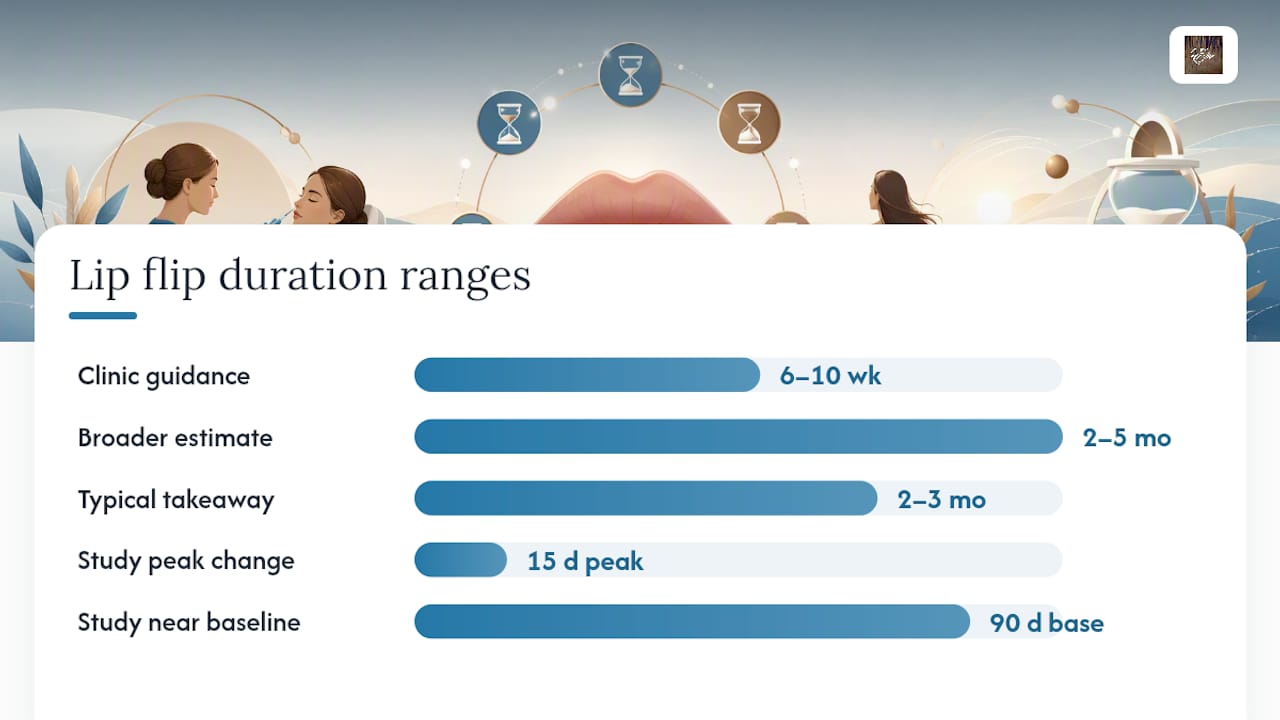
Ask five different clinics how long a lip flip lasts and you'll get answers ranging from 6 weeks to 5 months. Both numbers are technically accurate. The tighter 6 to 10 week window shows up most often in practical clinic guidance, while the broader 2 to 5 month estimate accounts for lower-dose treatments and patients whose perioral muscles are naturally less active, per WebMD's overview of lip flip treatments.
By the numbers: A 2026 prospective study using stereophotogrammetry measured objective changes in upper lip height after a standardized 4-unit onabotulinumtoxinA lip flip. Peak measurable change occurred at 15 days. By 90 days, many of the tracked variables had returned close to baseline, even though patients still reported high satisfaction.
That study matters because it's one of the few pieces of objective data in a field mostly built on clinic observation. Most duration claims you'll read, including the commonly quoted 6 to 10 week range, come from providers tracking patient-reported outcomes over years of practice rather than controlled trials with measurement tools. That's not a knock on the guidance. It's just a reason to treat any specific duration as an informed estimate, not a guarantee.
The honest takeaway: expect somewhere in the two-to-three-month range for most people, understand that objective change fades faster than subjective satisfaction, and don't panic if your results run shorter or longer than a friend's.
What Determines How Long Your Results Last
Duration isn't fixed. It shifts based on a handful of variables you can actually discuss with your injector before treatment.
- Dose matters most. A conservative 2 to 4 unit treatment tends to relax the orbicularis oris just enough to create eversion, and it wears off faster than higher doses. Some practitioners use 4 to 6 units for a slightly stronger, longer-lasting effect, but every added unit trades duration for a higher risk of the muscle feeling stiff or your smile looking off.
- Injection site and technique. Precise placement on the superficial fibers of the orbicularis oris produces the rolled, evented look. Sloppy placement can miss the target muscle entirely or spread to muscles that control speech and eating.
- How much you use your mouth. The orbicularis oris fires constantly during talking, eating, drinking, and smoking. Patients with high perioral muscle activity, think frequent speakers, wind instrument players, or heavy smokers, tend to metabolize the effect faster than people with lower muscle usage.
- Your metabolism. Faster metabolic rates generally clear botulinum toxin sooner, which is one reason two people getting the identical dose can see different timelines.
- Prior neuromodulator exposure. Patients who've had frequent Botox treatments elsewhere sometimes build a degree of resistance over years, which can shorten how long new treatments last.
- Provider skill and dilution. How the product is diluted and how precisely it's injected both affect how evenly the muscle relaxes and how predictable the fade will be.
Pro Tip: Ask your injector for their exact unit count and write it down. If you liked how long a treatment lasted, you want to replicate that number next time, not guess.
Lip Flip vs. Lip Filler: Why One Fades Faster
The core difference comes down to mechanism. A lip flip uses a neurotoxin to relax the muscle around your mouth, creating the appearance of fuller lips through eversion rather than added volume. Dermal filler injects hyaluronic acid directly into the lip tissue to physically increase volume, according to a review comparing neuromodulator and filler mechanisms.
That mechanical gap explains the duration gap. A lip flip typically lasts weeks to a few months. Fillers, depending on the specific product and your metabolism, often last 6 to 18 months, sometimes even longer before they're fully gone.
Which one fits your goal depends on what you're actually trying to fix:
- Choose a lip flip if your upper lip disappears when you smile (a "gummy smile") or you want subtle eversion without more volume.
- Choose filler if you want your lips objectively bigger, not just better shaped.
- Some patients combine both, using a lip flip for shape and a small amount of filler for volume, though that combination should be planned with your provider rather than assumed.
Swelling patterns differ between the two as well, which is worth understanding before you book either treatment. Filler swelling tends to run longer and more visibly than a lip flip's, as covered in this day-by-day filler recovery guide.
What to Expect in the First Two Weeks
Don't expect an instant transformation walking out of your appointment. The visible flip takes days to develop, and in the meantime you're dealing with normal injection aftermath.
- Right after treatment: Small injection bumps, mild redness, and possibly a touch of numbness around the lip line. This is cosmetic, not functional.
- First 24 to 72 hours: Most swelling and soreness resolve in this window, according to Cleveland Clinic's aftercare guidance. Avoid heavy facial massage or pressing on the treated area during this stretch.
- Days 3 to 5: The actual flip effect starts appearing as swelling fades and the muscle relaxation kicks in.
- Days 10 to 14: Full settled result. This is your checkpoint for evaluating whether the outcome looks right.
Follow your injector's specific instructions, which usually include avoiding strenuous exercise for the rest of the day and being cautious with NSAIDs if bruising is a concern. Call your provider if you notice asymmetry that hasn't improved by day 5, or any functional trouble (difficulty forming certain sounds, trouble drinking from a straw) that lasts more than a few days. Those aren't normal and deserve a follow-up look. More detail on managing the early days is covered in this Botox aftercare timeline.
How Often You'll Need to Repeat It
Most patients settle into a rhythm of repeating treatment roughly every 2 to 3 months once they know how their body responds, based on clinic-level tracking of lip flip patients.
The smartest way to decide when to rebook isn't a calendar reminder, it's watching your own mirror. Your provider's 10 to 14 day check-in is the natural moment to assess whether the result met expectations and roughly how long it's likely to hold, based on how quickly early muscle movement returns.
- Track how many weeks your specific dose lasted last time.
- Book your next appointment a week or two before you expect the effect to fully fade, not after it's already gone.
- Ask about bundling the lip flip with other injectables during the same visit if you're also treating forehead lines or crow's feet, since many patients find it more efficient to combine appointments.
Cost is generally lower than filler per session, which makes the shorter duration less of a financial sting for people who prefer a subtle, low-commitment result they can adjust every couple of months.
Dosage Guidance and the Risk of Overdoing It
Unit count is where a lip flip goes right or wrong. Most practitioners start conservatively with 2 to 4 units, targeting just enough of the orbicularis oris to create eversion while leaving normal lip function intact.
Experts interviewed for a Forbes feature on lip flip risks warn that doses climbing toward 10 to 20 units, well beyond typical practice, can cause temporary difficulty with speech or eating as the muscle becomes too weak to function normally rather than just relaxed.
That's the tradeoff worth understanding before you ask for "more" units hoping for a stronger or longer-lasting flip. Overdosing doesn't necessarily buy you more duration. It mainly raises your risk of a lip that looks stiff, feels strange when you talk, or struggles with tasks like drinking from a straw for a week or two while it wears off.
Safety practices that reduce this risk:
- Start with the lowest effective dose on your first treatment, especially if you've never had a lip flip before.
- Choose a provider under medical supervision who can adjust technique based on your muscle tone and lip anatomy.
- Schedule the standard follow-up around day 10 to 14 to assess symmetry and decide if a small touch-up is warranted, rather than immediately requesting a higher dose next time.
- Report any speech or eating difficulty that persists beyond a few days. Learn more about what's expected versus what's a warning sign in this breakdown of Botox side effects.
What a Clinic Recommends Before You Book
A conservative, well-documented approach produces the most predictable lip flip duration and the fewest surprises. At Elite Laser Center Medical Spa, injectable treatments are performed under medical supervision, with dosing customized to each patient's anatomy and goals rather than applied as a one-size-fits-all number.
The clinic workflow that tends to produce the best outcomes looks like this:
- A consultation to assess your lip anatomy, smile pattern, and whether a lip flip or filler (or both) actually fits your goal.
- A conservative starting dose, with room to adjust upward on a future visit once you know how your body responds.
- A 10 to 14 day follow-up to check symmetry and confirm whether the result matches expectations.
If you want to see how the clinic structures its injectable offerings, the injectables page outlines what's available, and the guide to consults walks through what a first visit typically covers.
What I'd Tell a Friend Before Their First Lip Flip
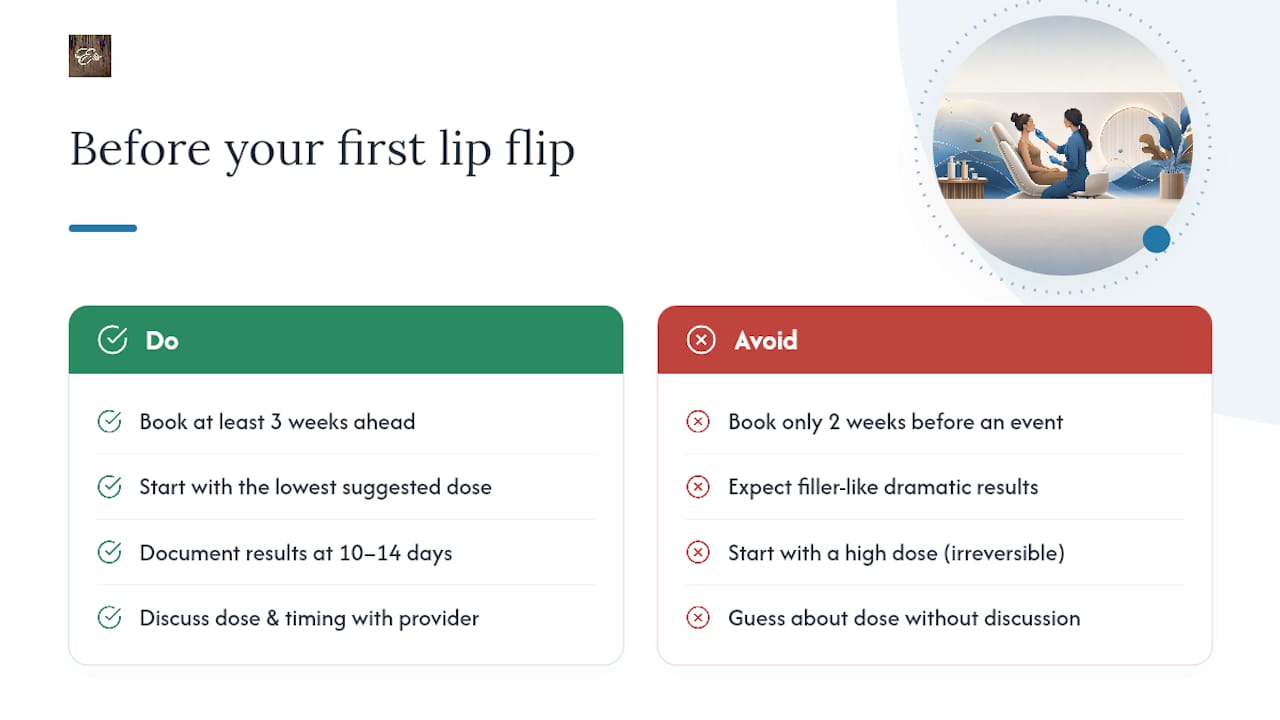
If you're booking a lip flip for a specific event, do it at least three weeks out, not two. That extra week of buffer covers the odd case where settling takes a little longer or a touch-up is needed. Start with the lowest dose your provider suggests. You can always add more next time. You can't un-inject a dose that turned out too strong.
The biggest misconception I see is people expecting lip flip results to behave like filler: dramatic, long-lasting, and stable for a year. It's a subtler, shorter-lived effect by design. That's not a flaw, it's the mechanism working as intended. Judge it on those terms, document your results at the 10 to 14 day mark, and keep a real conversation going with your provider about dose and timing instead of guessing each visit.
— Sharon
Book a Consult With a Provider Who Doses Conservatively
A medical spa offering injectable treatments provides consultations where providers assess your anatomy and build personalized dosing plans before treatment.
Injectable treatments are performed under medical supervision, with follow-ups to check results at the point when the lip flip settles, ensuring appropriate assessment before effects fade. If you're weighing a lip flip against filler, or you're not sure which fits your goals, that consult conversation is where it gets sorted out. Visit the injectables page to see current options, or reach out to schedule a consultation and get a dosing plan built around your own lip anatomy rather than a generic unit count.
This article is general information, not a substitute for advice from a qualified doctor. Consult a qualified healthcare professional about your own circumstances before acting on anything here.
Sources
- Lip Flip: What It Is, Botox®, Results & Precautions
- Lip Flip Revisited: Clinical Outcomes and Neuromodulatory Basis of Upper Lip Eversion | Aesthetic Plastic Surgery
- PMC review comparing mechanisms and durations of neuromodulators vs fillers
- Considering A Lip Flip? Here’s Why Experts Say Proceed With Caution — Forbes
FAQ
What Lasts Longer, a Lip Flip or Filler?
Filler lasts significantly longer. A lip flip typically holds for 6 to 10 weeks up to about 5 months, while dermal fillers commonly last 6 to 18 months depending on the product used.
How Long Does a Lip Flip Actually Last?
Most patients see results for 6 to 10 weeks, though some clinics report effects lasting up to 5 months depending on dose and individual muscle activity, according to Cleveland Clinic.
What Are the Downsides of a Lip Flip?
The main downsides are its temporary nature compared to filler, potential temporary speech or eating difficulty if overdosed, and the two-week wait to see the fully settled result before deciding if a touch-up is needed.
Is 8 Units of Botox a Lot for a Lip Flip?
It's on the higher end. Most conservative treatments use 2 to 4 units, and experts caution that doses climbing well beyond that range raise the risk of temporary functional issues without necessarily extending how long the result lasts.