

Stay upright for 3 to 4 hours, keep your hands off the treated area, and skip the gym, alcohol, and hot showers for the rest of the day. Those three rules protect the injection sites while the product settles into the muscle instead of migrating to nearby areas. Following botulinum toxin aftercare guidance from major medical centers matters more in these first few hours than at any other point in your recovery.
Pressure and heat both increase blood flow to the face. More blood flow near a fresh injection site means more bruising and, in rare cases, product movement you don't want.
- Stay upright, avoid lying flat or leaning forward for 3 to 4 hours
- Don't touch, rub, or massage the treated areas
- Skip strenuous exercise, saunas, and alcohol for the remainder of the day
Call your provider right away if you notice drooping eyelids that worsen over days, sudden vision changes, or trouble breathing or swallowing. Those symptoms are rare, but they're not something to wait out.
Key Takeaways
Successful Botox recovery depends on staying upright for 3 to 4 hours, avoiding pressure and heat for 24 hours, and waiting the full 14 days before judging results or requesting touch-ups.
| Point | Details |
|---|---|
| Stay upright early | Avoid lying down or bending forward for 3 to 4 hours to prevent product migration. |
| Hands off your face | Skip rubbing, massaging, or pressing treated areas for at least 24 hours. |
| Limit alcohol and NSAIDs | Both increase bruising risk; acetaminophen is a safer pain option if needed. |
| Wait for full results | Effects begin around day 3 and reach full strength by day 14 before assessing outcomes. |
| Space out other treatments | Delay facials, peels, and massages for around one to two weeks after injections. |
| Know your red flags | Worsening eyelid droop, vision changes, or breathing trouble need immediate provider contact. |
| Get a supervised plan | Elitelaserhair provides personalized aftercare guidance with every Botox treatment performed under medical supervision. |
Table of Contents
- What to Expect After Botox: Onset, Duration, and Normal Reactions
- The First 4 Hours: Protecting Placement
- Do's and Don'ts for the First 24 Hours
- Getting Back to Normal: 24 to 48 Hours and the Following Weeks
- Side Effects to Watch For and When to Call Your Provider
- What the Evidence Actually Supports
- Why We Talk Patients Through Every Step
- How Elitelaserhair Supports Your Botox Recovery
- Sources
- FAQ
What to Expect After Botox: Onset, Duration, and Normal Reactions
Botox doesn't work instantly. Most people notice the first softening of lines around day 3, with the full effect visible by day 14. If your forehead looks unchanged on day 2, that's normal. Judging results too early is the most common reason people think their treatment "didn't work."
The effect typically lasts a few months, though this varies by muscle strength, metabolism, and dose. Your provider will usually schedule a follow-up around the two-week mark to check symmetry and discuss touch-ups.
Full results take up to two weeks to appear. Booking a touch-up before then almost always means correcting something that hasn't finished developing yet.
Small bumps at injection sites, mild swelling, and light bruising are all common and usually fade within a few days to a week:
- Tiny raised bumps at injection points, gone within hours
- Mild swelling, typically resolved in a day or two
- Light bruising, which can linger up to a week in some patients
The First 4 Hours: Protecting Placement
The window right after your appointment is when aftercare matters most. Botox needs time to bind to the targeted muscle, and anything that shifts blood flow or applies pressure to the area can interfere with that process.
- Stay upright. Avoid lying down, bending over to pick things up, or resting your head on a pillow for 3 to 4 hours.
- Keep your hands off your face. No rubbing, pressing, or massaging, even if the area itches or feels tight.
- Plan around kids and pets before your appointment, not after. If you have young children who need to be picked up, arrange for someone else to handle that for the first few hours.
- If you must rest, sit upright in a chair rather than reclining on a couch or bed.
Pro Tip: Some clinicians suggest gently making expressive faces, raising your eyebrows, frowning, squinting, for the first hour after treatment. The idea is that light muscle activation may help the product distribute evenly into the targeted muscle. It's a small, low-effort habit that costs nothing to try.
Do's and Don'ts for the First 24 Hours
Your face needs a full day before you can treat it normally again. Here's what changes and what doesn't.
Washing your face is fine as long as you're gentle. Use your fingertips with light, patting motions rather than a washcloth dragged across the skin. Makeup is generally okay a few hours after treatment, but apply it with a light touch, dabbing rather than swiping a brush across injection points.
Exercise is where a lot of people slip up. Walking is fine. Spin class, weightlifting, or anything that spikes your heart rate and blood pressure should wait. WebMD's guidance points to a minimum of a few hours before resuming strenuous workouts, with many clinics recommending the full 24 hours to be safe.
- Avoid alcohol for the rest of the day, since it thins blood and increases bruising risk
- Skip NSAIDs like aspirin and ibuprofen if bruising is a concern; acetaminophen is a safer pain-relief option
- Stay away from hot tubs, saunas, and direct sun exposure the same day
- Ask your provider before resuming any prescribed blood thinners
Bruising affects a meaningful share of Botox patients, and most of it traces back to two controllable factors: blood-thinning substances and heat exposure that dilates blood vessels near the injection site.
Getting Back to Normal: 24 to 48 Hours and the Following Weeks
Most restrictions lift within a day or two, but a few things are worth spacing out further.
- Light exercise is typically fine after 24 hours; save intense training or anything involving inverted positions (yoga headstands, for example) for 48 hours
- Facials, massages, and any treatment involving direct pressure on the face should wait for about one to two weeks
- Hold off on requesting touch-ups until you hit the 14-day mark, since your provider needs to see the full effect before adjusting anything
- Chemical peels and microdermabrasion are best scheduled at least two weeks out to avoid interfering with settling product
If you already have a facial or peel booked, it's worth moving it rather than canceling. A short reschedule protects your Botox results without derailing your skincare routine entirely.
Side Effects to Watch For and When to Call Your Provider
Most side effects after Botox are minor and resolve on their own. Bruising, mild swelling, tiny bumps at injection sites, and an occasional mild headache are common and usually gone within a few days to a week. Ice for the first 24 hours, gentle cleansing, and acetaminophen for discomfort handle most of it.
- Bruising: apply ice in short intervals, avoid alcohol and NSAIDs
- Mild swelling: usually resolves within 48 hours, no treatment needed
- Headache: over-the-counter acetaminophen is generally safe
Peer-reviewed research on botulinum toxin safety consistently finds that adverse events are mostly mild, temporary, and tied to injection technique rather than the toxin itself.
That reassurance from published safety data doesn't mean every symptom is safe to ignore. Contact your provider immediately if you notice a drooping eyelid or eyebrow that worsens over several days, any change in vision, difficulty breathing or swallowing, or swelling that looks like it's spreading rather than settling. If you're unsure whether something is normal, take a photo, note when it started, and call the clinic. A quick picture texted to your provider is often faster and more useful than trying to describe it over the phone.
What the Evidence Actually Supports
The 3 to 4 hour upright rule and the ban on massaging treated areas aren't arbitrary. They show up consistently across hospital aftercare sheets and clinic protocols because pressure and gravity are the two variables most likely to move product before it binds to muscle tissue.

The facial-movement tip, gently activating the treated muscles in the first hour, has clinical backing as a reasonable practice, though it's more of a precaution than a rule with dramatic proven impact. Think of it as a low-risk habit rather than a guarantee.
For minimizing bruising specifically, the checklist is short and consistent across sources:
- Ice the area in short bursts, not continuous pressure
- Avoid alcohol for the rest of the day
- Skip aspirin and ibuprofen unless your doctor says otherwise
Pro Tip: If you bruise easily, mention it before your appointment. Providers can adjust injection technique and needle placement slightly to reduce your individual risk.
Why We Talk Patients Through Every Step
We tell patients the same thing every time: Botox rewards patience more than perfection. The rules exist to protect your results, not to make you paranoid for two weeks straight.
If anything about your recovery feels off compared to what we walked you through at your appointment, call us. That's what follow-up care is for.
How Elitelaserhair Supports Your Botox Recovery
Getting the aftercare right starts with getting the injection right. At Elitelaserhair, every Botox treatment is performed under experienced medical supervision, so you leave with a personalized aftercare plan instead of a generic printout.
That matters because no two faces respond identically. Someone with a history of easy bruising needs different guidance than someone on blood thinners, and a cookie-cutter checklist can't account for that. Our team walks you through your specific do's and don'ts before you leave, then stays reachable if a question comes up during your first 24 hours. If you're due for a treatment or have questions about timing your next injectables appointment, request a consultation and we'll build a plan around your skin, your schedule, and your goals.
Sources
- Botulinum toxin injections
- Botox and Cosmetic Fillers: Aftercare Instructions
- Post-Treatment Instructions for BOTOX Cosmetic and XEOMIN ®Injections
- Can You Exercise After Botox? Botox Aftercare Information and Tips
- PMC article on botulinum toxin (safety and adverse events)
FAQ
What should you not do after Botox?
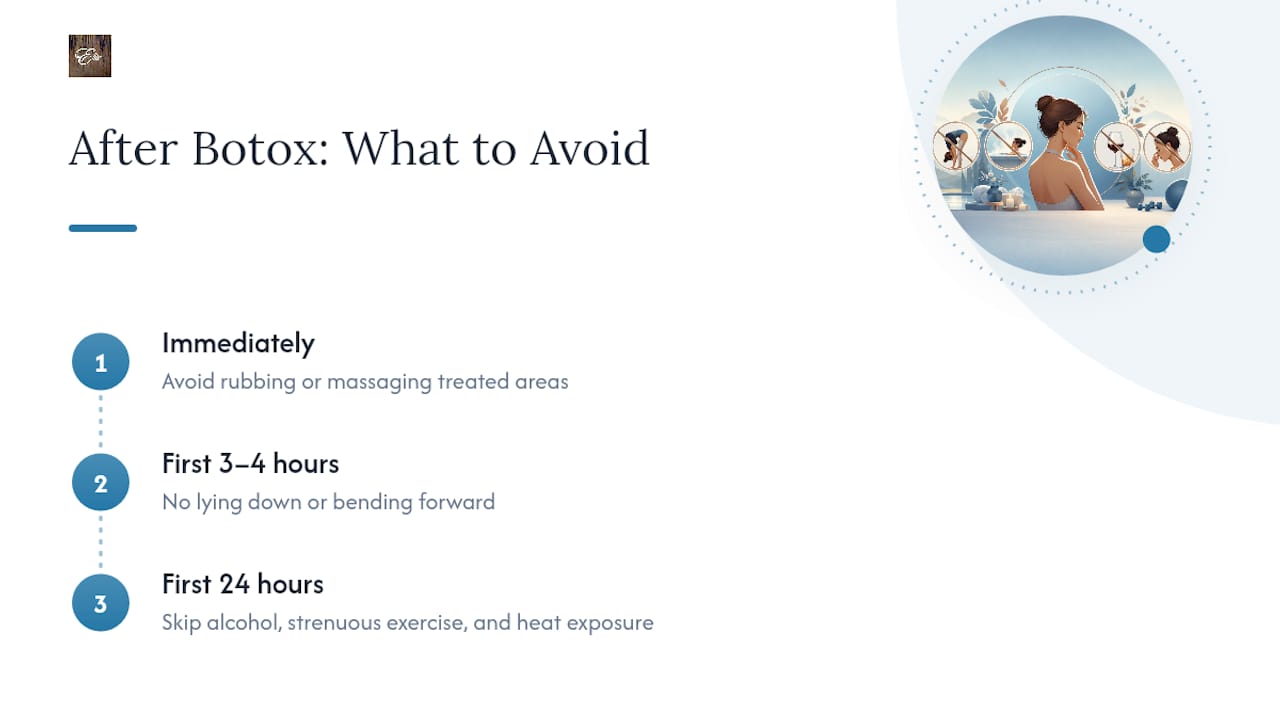
Avoid rubbing or massaging treated areas, lying down or bending forward for 3 to 4 hours, and skip alcohol, strenuous exercise, and heat exposure like saunas or hot tubs for 24 hours.
What is the 4-hour rule after Botox?
The 4-hour rule refers to staying upright and avoiding lying flat or leaning forward for the first 3 to 4 hours after injection, which helps keep the product in place while it binds to the targeted muscle.
Why drink lots of water after Botox?
Hydration supports overall skin health and recovery, though it's not a substitute for following the upright-time and activity restrictions that directly affect injection placement.
What's the best thing to do after Botox?
Stay upright for the first few hours, keep your hands off your face, and follow the personalized aftercare plan your provider gives you, including when it's safe to resume exercise and schedule other facial treatments.