

Most hyaluronic acid fillers deliver visible improvement for several months, but that number tells only half the story. MRI research shows the material itself can persist far longer, sometimes detectable up to 15 years after injection. Biostimulators like poly-L-lactic acid and calcium hydroxylapatite work differently, building your own collagen over a similar or longer window. If you ever need to reverse an HA filler, hyaluronidase remains a fast, established option.
TL;DR:
- Hyaluronic acid fillers can remain detectable in tissues for up to 15 years, even if they are no longer visible or felt on the surface.
- The longevity of fillers varies significantly by injection site, with areas like the lips experiencing faster breakdown and deeper, bone-supported areas lasting longer.
- Patient-specific factors, including metabolism, smoking, sun exposure, and injection technique, strongly influence how long results last.
- Combining conservative treatment plans with proper post-care, such as sun protection and avoiding strenuous activity, extends the longevity of filler results.
- MRI evidence highlights the importance of tracking residual filler to prevent overcorrection and unnecessary additional treatments.
Table of Contents
- How Long Does Filler Longevity Really Last by Type?
- Why Filler Duration Varies by Where You Inject
- What Determines How Long Your Filler Actually Lasts
- Practical Ways to Extend Your Filler Results
- How Medical Supervision Shapes Filler Longevity
- What the Research Actually Tells You to Prioritize
- Ready to Talk About Longevity With Someone Who Tracks It
- Sources
- FAQ
How Long Does Filler Longevity Really Last by Type?
The material you choose changes everything about how your results fade, and by how much. Understanding the mechanism behind each filler class helps explain why your injector recommends one product over another for a given goal.
Hyaluronic acid (HA) is the most common filler family, and it has the widest reported range because "how long it lasts" depends on what you're measuring. Patients typically notice visible improvement for 6 to 18 months. But that's the cosmetic clock, not the biological one.
Pro Tip: Ask your injector whether they're describing "visible" duration or "detectable" duration. They're not the same number, and mixing them up is the single biggest source of unrealistic expectations.
A systematic review of clinical durability studies found 3D volumetric imaging shows HA retention of roughly 50% to 86% at 24 months, and patient satisfaction tends to track that objective volume loss closely. Separately, an MRI study of 33 patients found hyaluronic acid detectable in the mid-face in every participant at the two-year mark, with some individuals still showing material 15 years later. That gap between "looks like it's gone" and "is actually gone" happens because the early, dramatic volume from a fresh HA injection comes partly from water binding to the gel. That hydrophilic swelling fades well before the underlying product mass fully resorbs.
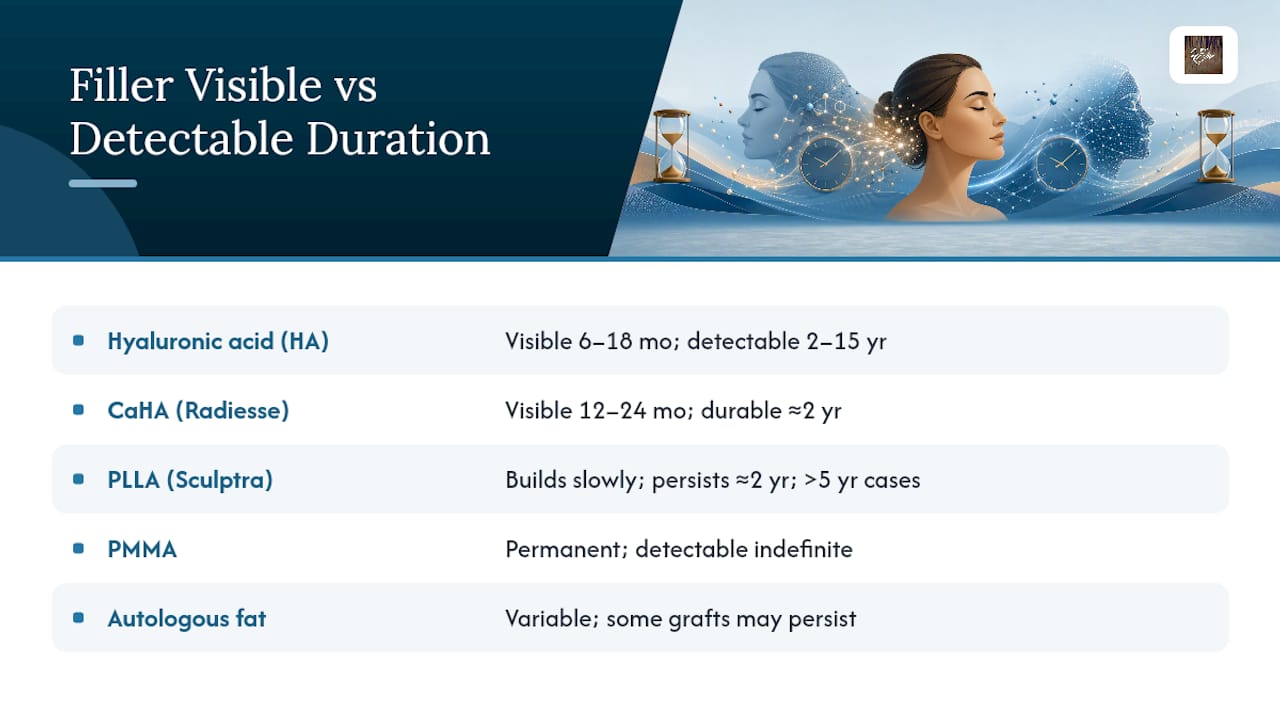
Calcium hydroxylapatite (CaHA), the biostimulator sold under names like Radiesse, works through a different mechanism entirely. Rather than just occupying space, it triggers your body to lay down new collagen around the particles. Visible results commonly run 12 to 24 months or longer, and because the tissue remodeling continues after the carrier gel breaks down, the durable effect is partly yours, not just product.
Poly-L-lactic acid (PLLA), the active ingredient in Sculptra, takes a slower path. There's no instant volume; results build gradually over weeks to months as collagen accumulates. A clinical review of semi-permanent fillers found PLLA and CaHA typically persist around two years, with detectable effects in specific cases beyond five years. What's actually being measured at that point is often host collagen, not the original injected material.
PMMA (polymethylmethacrylate) beads are the outlier: they're designed to be permanent. Microspheres suspended in a collagen carrier stay in place indefinitely once the body encapsulates them. That permanence is the appeal and the risk. Corrections are far harder than with HA, and delayed granuloma formation, while uncommon, is a real complication that can appear years after treatment.
Autologous fat grafting falls somewhere in between, and its outcome depends heavily on technique. Some transferred fat cells survive permanently once they establish blood supply; others get reabsorbed within months. Retention varies more by surgeon and processing method than any other filler category on this list, which makes it the hardest to predict from published averages alone.
Why Filler Duration Varies by Where You Inject
The same syringe of hyaluronic acid can behave completely differently depending on where it lands. Anatomy, not just product chemistry, drives a big share of how long your results hold.
- Lips move constantly, chew, talk, and have dense blood flow, all of which accelerate breakdown. Expect the shortest visible duration of any common treatment area, often at the lower end of the typical range.
- Midface and cheeks sit in relatively still tissue with less mechanical stress, which tends to extend visible retention and shows up clearly in imaging follow-up.
- Tear troughs clear filler slowly because lymphatic drainage in that area is limited, which is also why conservative volumes and an experienced injector matter more here than almost anywhere else on the face.
- Jawline and chin sit over bone with deeper injection planes and minimal motion, a combination that tends to produce some of the longest-lasting visible results.
Pro Tip: If you're injecting for the first time in a high-motion area like the lips, ask about a slightly firmer, less hydrophilic HA formulation. Softer gels feel more natural there but often need touch-ups sooner.
That depth-and-motion pattern lines up with guidance from the American Society of Plastic Surgeons, which notes that deeper injections generally last longer than superficial ones, partly because deeper tissue planes see less mechanical stress and slower enzymatic turnover. It's a big part of why the same product can read as "long-lasting" in one patient's cheeks and "gone in six months" in another's lips.
What Determines How Long Your Filler Actually Lasts
Several variables interact to decide your personal outcome, and some of them you can influence.
- Product chemistry. Crosslinking density and particle size change how resistant an HA gel is to enzymatic breakdown; more heavily crosslinked, higher-molecular-weight formulations generally resist degradation longer.
- Injection depth and technique. Deeper placement, correct anatomical plane, and even distribution all extend visible duration compared to superficial, uneven injection.
- Metabolic rate and activity level. Higher metabolism and intense exercise appear to speed filler turnover in some patients, though individual variation is significant.
- Smoking and sun exposure. Both accelerate collagen breakdown and oxidative stress, which shortens how long results look good even when the product itself is still present.
- Treatment history. Repeat top-ups scheduled without accounting for lingering material can create unexpected heaviness, since imaging shows product can remain well after visible effect fades. What feels like "I need more" may actually be a case of unmet expectations rather than an empty tissue plane.
- Immune response. Some people simply metabolize gel-based fillers faster due to individual immune and enzymatic activity, which is why two patients getting identical treatment can see different timelines.
On the safety side, hyaluronidase remains available to dissolve HA filler when a correction is needed, and the FDA's consumer guidance is worth reading before any procedure. Seek prompt medical review for skin blanching, unusual pain, or discoloration near the treated area. Those can signal a vascular complication that needs immediate attention, not a wait-and-see approach.
Practical Ways to Extend Your Filler Results
You can't rewrite your metabolism, but you can influence quite a bit about how long a treatment holds up.
Start with the plan itself. Conservative, well-spaced top-ups tend to outperform aggressive single-session overcorrection, both for how natural you look and for avoiding the cumulative heaviness that comes from layering new product onto material that hasn't fully cleared. Some patients do well combining a biostimulator like CaHA for structural longevity with HA for softer areas that need finer control.
Post-care matters more than most people expect. Strict sun protection limits the oxidative damage that breaks down both filler and your skin's own collagen. A broad-spectrum SPF and daily antioxidant serum are the two most evidence-supported topical habits for making results last. Skip strenuous exercise for about 24 to 48 hours after treatment, since elevated blood flow and swelling in the first day can affect final placement.
Pro Tip: Filler results always look better on healthy skin. Treatments that improve texture and tone, like regular HydraFacials, don't extend the filler chemically, but they make the surrounding skin look better, which extends how long the overall result reads as "fresh."
- Schedule maintenance before, not after, results fully fade to avoid dramatic before-and-after cycles.
- Avoid smoking, which accelerates collagen breakdown independent of filler type.
- Watch swelling and bruising in the days after treatment to confirm your recovery is on track.
- If you're unhappy with a result, ask about dissolution before assuming you need more product elsewhere.
Choosing between "wait it out" and dissolving early is a safety conversation, not a cosmetic one. Persistent lumps, asymmetry, or vascular symptoms warrant prompt evaluation rather than a wait-and-monitor approach.
How Medical Supervision Shapes Filler Longevity
Longevity isn't just about the product. It's about who's holding the needle and how carefully the plan is built around your anatomy.
At Elite Laser Center, every injectables consultation starts with an assessment of facial structure, skin quality, and treatment history before any product gets selected. That sequencing matters because the same syringe of HA placed in the wrong plane or the wrong volume can underperform regardless of its marketed duration.
- Assessment of goals, anatomy, and prior filler history to avoid cumulative overcorrection
- Product selection matched to the treatment area, not a one-size-fits-all default
- Documented technique and injection depth for consistent, trackable results
- Scheduled follow-up timed to actual product behavior, not a generic calendar reminder
Individualized product selection is the single most important variable a patient can influence. Manufacturing technology, tissue mobility, and metabolism all shape outcomes, but matching the right formulation to the right anatomy is where an experienced injector adds the most value.
Every treatment plan at Elite Laser Center is performed under medical supervision, with follow-up built around how the specific product and area are expected to behave. If you're weighing your options, the injectables page outlines the full range of services available.
What the Research Actually Tells You to Prioritize
The imaging data changes the conversation in a way most marketing never mentions. If HA filler can still be detected years after you've stopped noticing it, the honest question isn't "how long does filler last?" It's "how long do you want the visible effect to last, and are you willing to plan maintenance around material that may still be sitting there?"
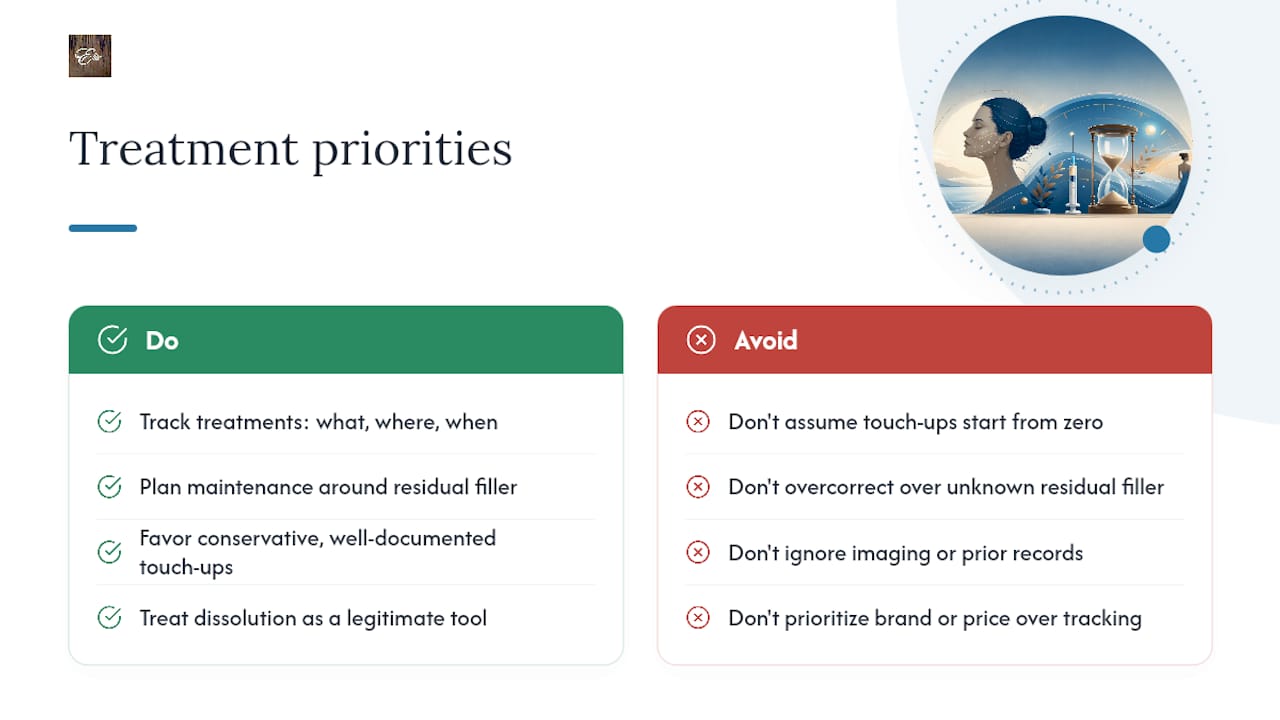
Conventional advice treats every touch-up as starting from zero. That's usually wrong. The MRI evidence suggests a meaningful share of patients requesting "more filler" actually have residual product they can't feel or see anymore in the mirror, but which still shows up on a scan. That's not an argument against maintenance. It's an argument for conservative, well-documented treatment history so nobody overcorrects on top of material that hasn't fully cleared.
If there's one thing worth prioritizing above product brand or price, it's this: work with someone who tracks what you've had, where, and when, and who treats dissolution as a legitimate tool rather than a last resort. Fillers going away is rarely the real problem. Losing track of what's already there is.
— Sharon
Ready to Talk About Longevity With Someone Who Tracks It
Choosing a filler isn't just about picking a brand name off a menu. It's about matching product chemistry, injection depth, and your own anatomy to a realistic timeline, then having someone actually document that plan so your next visit builds on it instead of guessing. Elite Laser Center's injectables consultations start with exactly that kind of assessment, under medical supervision, before any product gets recommended.

At your consult, expect a real conversation about your facial structure, treatment history, and goals, followed by a product recommendation suited to the specific area you're treating rather than a default choice. If skin quality is part of what's aging your results faster than it should, the team can also walk you through complementary options like facials and peels that support the skin sitting above your filler. Ready to build a plan around your actual timeline instead of a generic estimate? Visit the injectables page to schedule a consultation.
This article is general information, not a substitute for advice from a qualified doctor. Consult a qualified healthcare professional about your own circumstances before acting on anything here.
Sources
- Hyaluronic Acid Filler Longevity in the Mid-face: A Review of 33 Magnetic Resonance Imaging Studies
- Clinical durability of hyaluronic acid–based dermal fillers for facial application: a systematic review
- Dermal filler dos and don'ts — FDA
FAQ
Does filler ever fully go away after 2 years?
Visible effect often fades within that window, but imaging studies show HA material can remain detectable well beyond 2 years, sometimes for over a decade, even after you stop noticing it cosmetically.
Can fillers last 20 years?
Traditional HA fillers aren't marketed as permanent, though MRI research has found trace material detectable up to 15 years in some patients. PMMA is the one filler type specifically designed for permanent placement.
Does filler age you over time?
Overfilling or accumulating product without accounting for residual material can create an unnatural, heavy look. Working with an injector who tracks your treatment history and considers dissolution when appropriate helps avoid that outcome.
Why are people cutting back on fillers?
Many patients are shifting toward smaller, more conservative volumes and combining treatments that support skin quality, since research increasingly shows perceived aging tracks skin health, not just lost volume. Some are also opting for biostimulators over repeated HA top-ups to avoid cumulative product buildup.
Can hyaluronic acid filler be reversed if I don't like the results?
Yes. Hyaluronidase is an FDA-recognized option for dissolving HA filler when a correction or safety concern arises, and it works faster than waiting for natural resorption.