

Expect peak swelling around 24–48 hours after treatment, steady improvement by day 5, and near-final results by 2–4 weeks. Call your injector the same day if swelling worsens after 72 hours, becomes intensely painful, or you notice pale, gray, or bluish skin near the injection site.
Normal symptoms you'll likely see:
- Puffiness, tenderness, and firmness in the first 48 hours
- Mild to moderate lip filler bruising that shifts from red to purple to yellow over 5–7 days
- Slight asymmetry or lumpiness that smooths out by week 2
- Numbness or tingling that fades within hours
Signs that need urgent attention:
- Skin turning pale, gray, or mottled (livedo reticularis pattern) near or around the injection site
- Severe, worsening pain that does not ease after 24 hours
- Expanding redness, warmth, or fever (possible infection)
- Vision changes or severe headache immediately after treatment
Pro Tip: Take a photo in natural light, straight on, from the same distance, the day of your treatment. Repeat daily for the first week. Consistent photos are the single most useful tool for tracking normal progress and spotting problems early.
Key Takeaways
Lip filler swelling peaks at 24–48 hours, drops significantly by day 5–7, and fully settles by 2–4 weeks; vascular warning signs require same-day emergency contact, not watchful waiting.
| Point | Details |
|---|---|
| Peak swelling timing | Swelling is worst at 24–48 hours; lips may appear 30–50% larger than the final settled volume. |
| Best pain relief choice | Acetaminophen is preferred over NSAIDs because it does not increase bruising risk. |
| Key aftercare rules | Ice for 10 minutes on/off, head elevated, no alcohol or strenuous exercise for 24–48 hours. |
| Vascular emergency signs | Pale, gray, or mottled skin near the injection site requires immediate clinical attention, not monitoring. |
| Elitelaserhair follow-up | Elite Laser Center offers in-person post-filler assessments and hyaluronidase consultations in Stony Brook, NY. |
Table of Contents
- Why your lips swell after filler injections
- The lip filler swelling timeline, hour by hour
- What makes your swelling last longer than someone else's
- How to reduce lip filler swelling: an evidence-based aftercare plan
- Medical options and warning signs you should not ignore
- How to contact your injector effectively
- Clinician-verified aftercare checklist
- What I tell every patient worried about day-2 swelling
- Worried about your recovery? Elitelaserhair is here to help
- Sources
- FAQ
Why your lips swell after filler injections
Every lip filler treatment creates a controlled injury. The needle or cannula punctures tissue, triggering your body's inflammatory cascade: blood vessels dilate, fluid rushes in, and the area becomes swollen, warm, and tender. That response is not a sign something went wrong. It is your immune system doing exactly what it is designed to do.
Hyaluronic acid (HA), the most common filler material, adds another layer. HA is hydrophilic, meaning it actively draws water molecules into the surrounding tissue. A single gram of HA can bind up to 1,000 times its weight in water. That hydration is what gives lips their plump, smooth appearance long-term, but in the first 48–72 hours it amplifies the swelling you see.
Lips are also among the most vascular areas on the face. Dense blood supply means faster healing, but it also means more fluid can accumulate quickly after any injection trauma. Compared to cheeks or jawline, lips tend to swell more dramatically and more visibly.
Injection technique matters as much as the product itself. A higher number of entry points, larger needle gauge, or faster injection speed all increase tissue trauma and, in turn, the degree of post-treatment swelling. Softer, lower-viscosity HA fillers generally integrate with less initial swelling than firmer, more cross-linked products designed for structural support.
Filler volume plays a role too. A 1 mL treatment in a first-time patient will typically produce more noticeable swelling than a 0.5 mL touch-up in someone who has had fillers before, simply because the tissue is less accustomed to the product and the volume change is larger.
The lip filler swelling timeline, hour by hour
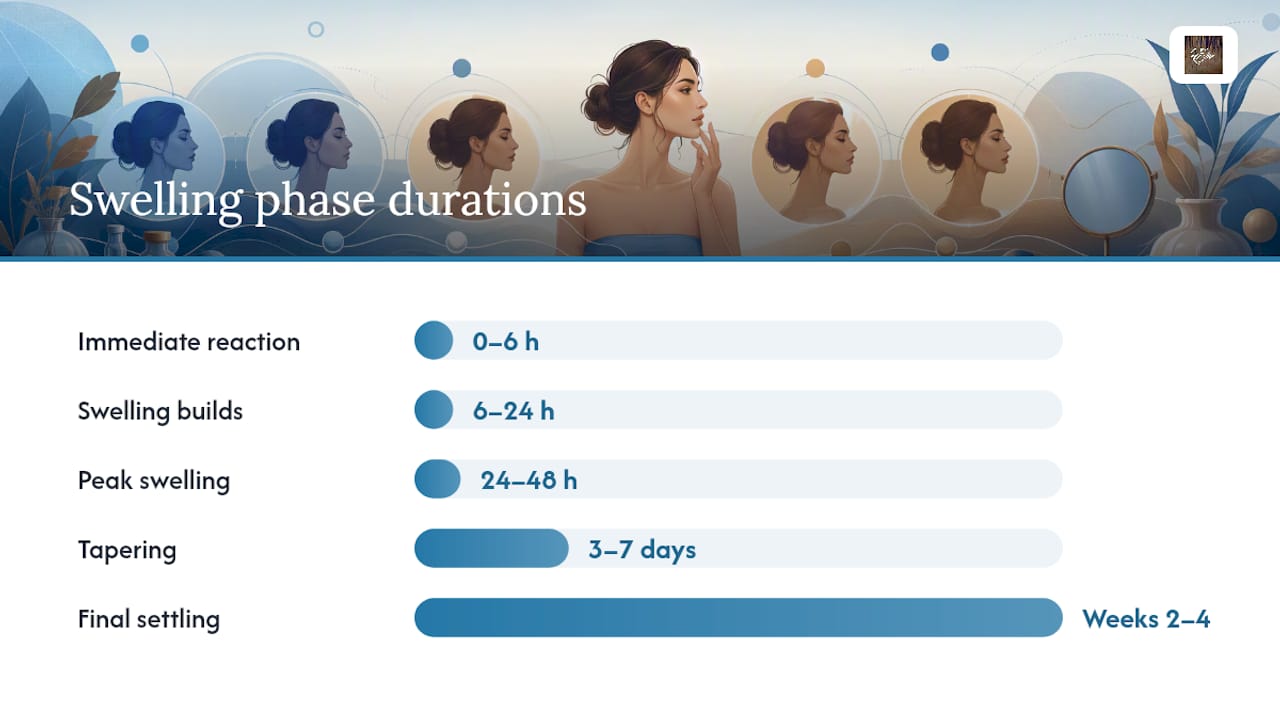
Understanding what is normal at each stage is what separates unnecessary panic from a genuine red flag. Here is what the lip filler healing process actually looks like, phase by phase.
Hours 0–6: The immediate reaction
Within the first hour, most patients notice puffiness beginning to build. Clinic timelines show that lips can appear 15–30% larger than their final settled volume within the first hour alone. Numbness from topical or injected anesthetic lingers for 1–3 hours. Early bruising may show as faint redness at entry points.
Hours 6–24 (Day 1): Swelling accelerates
This is when most patients get their first real surprise. Swelling continues to build overnight, and you may wake up looking significantly puffier than you did leaving the clinic. Early bruising becomes more visible. Lips feel firm, tender, and possibly itchy as the tissue responds to the filler. Asymmetry at this stage is common and almost always temporary.
Day 2 (24–48 hours): Peak swelling
Day 2 is the hardest day for most patients. At peak, lips can appear 30–50% larger than the final filler volume. Bruising is typically at its most colorful. Lumps or ridges may be palpable under the skin. This is the point where many patients worry they have made a mistake. They almost certainly have not. The lip filler swelling stages are working exactly as expected.
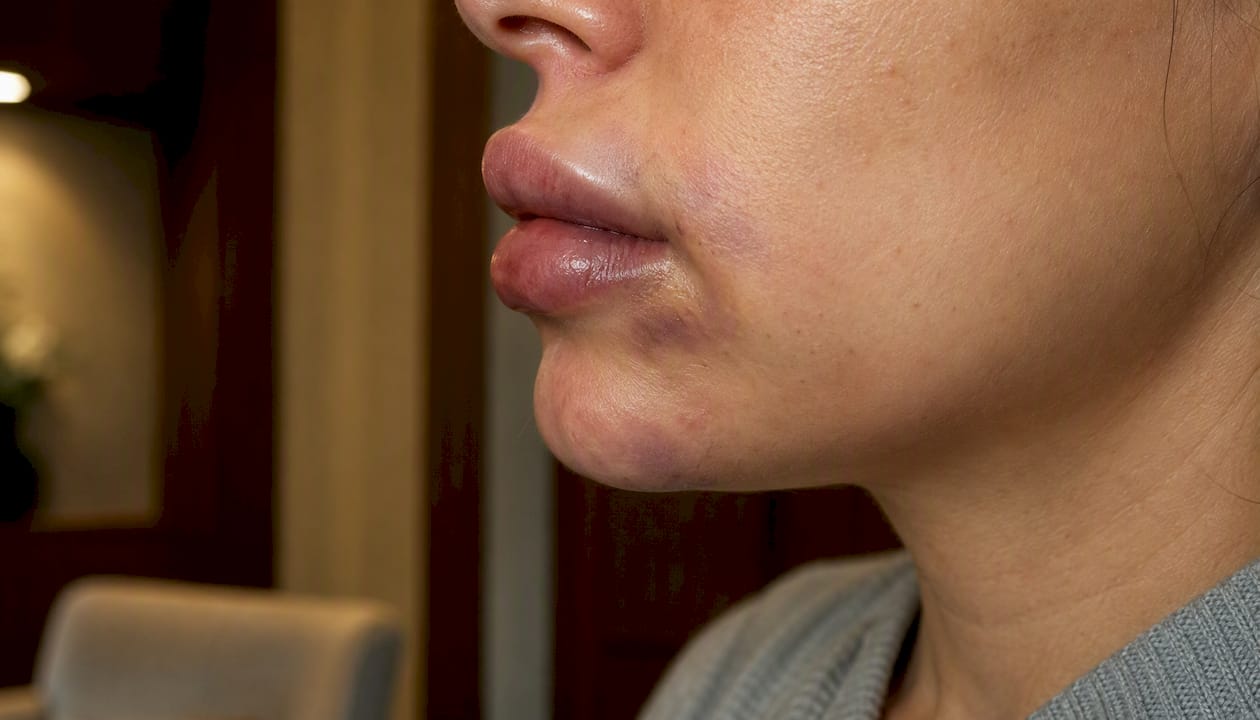
Pro Tip: Do not judge your results on day 2. The swelling you see at 48 hours has almost no relationship to what your lips will look like at 2 weeks. Take your photo, apply ice, and give it time.
Days 3–7: Steady improvement
Swelling drops noticeably from day 3 onward. Most patients see significant improvement by day 4–5, and by day 7 the dramatic puffiness is largely gone. Bruising shifts from purple to yellow-green as the body reabsorbs the blood. Lumps begin to soften. Lips start to feel more natural to the touch.
Weeks 2–4: Final settling
The filler integrates fully with surrounding tissue, and the true shape and volume become visible. Most clinicians recommend waiting a full 2 weeks before assessing results or considering any corrections. Final settling is typically complete by week 4.
| Phase | Timeframe | What You'll See |
|---|---|---|
| Immediate reaction | Hours 0–6 | Early puffiness, numbness, redness at entry points |
| Swelling builds | Hours 6–24 | Increasing puffiness, early bruising, firmness |
| Peak swelling | Day 2 (24–48 hrs) | Maximum size, bruising most visible, possible lumps |
| Tapering | Days 3–7 | Steady reduction, bruising yellowing, lumps softening |
| Final settling | Weeks 2–4 | Last 10% resolves, true shape visible |
What makes your swelling last longer than someone else's
Two patients can receive the same filler, from the same injector, on the same day, and have noticeably different recovery timelines. Several variables drive that gap.
Patient factors:
- First-time treatments almost always produce more swelling than touch-ups, because the tissue has no prior exposure to the product
- Patients who bruise easily (thin skin, fair complexion, or a genetic tendency) tend to see more visible bruising alongside swelling
- Poor hydration before and after treatment slows the body's ability to clear excess fluid
- Blood-thinning medications, supplements like fish oil, vitamin E, or aspirin, and even alcohol consumed in the days before treatment all increase bruising risk and can extend the swelling window
Product and procedural factors:
- Higher filler volumes produce more swelling, full stop
- Firmer, more cross-linked HA products (designed for structural lift) tend to cause more initial swelling than softer, more fluid formulations
- More injection entry points mean more tissue trauma
- Needle injections typically cause slightly more bruising than cannula techniques, though both are safe in skilled hands
Behavioral factors after treatment:
- Alcohol within 24 hours dilates blood vessels and worsens swelling
- Strenuous exercise in the first 24–48 hours increases blood flow to the face and prolongs inflammation
- Saunas, steam rooms, and high heat in the first 48 hours have the same effect
- Sleeping flat (rather than with the head elevated) allows fluid to pool in the face overnight
Pro Tip: If you have a big event coming up, schedule your lip filler appointment at least 2 weeks before it. That gives you the full settling window and time to address any minor asymmetry at a follow-up.
How to reduce lip filler swelling: an evidence-based aftercare plan
The right aftercare does not eliminate swelling, but it meaningfully shortens how long it lasts and how uncomfortable it feels.
Immediate actions (first 24 hours)
- Ice the area using a clean cloth or gel pack wrapped in a thin towel. Apply for 10 minutes on, 10 minutes off. Never place ice directly on the skin or lips, and do not press hard enough to displace the filler.
- Keep your head elevated. Sleep with an extra pillow the first two nights. Lying flat lets fluid pool in the face and makes morning swelling significantly worse.
- Avoid touching or pressing on your lips. No massaging, no pressing fingers to test firmness, and no kissing for at least 24 hours.
Medication guidance
Acetaminophen (Tylenol) is the recommended choice for post-procedure discomfort because it does not thin the blood the way NSAIDs like ibuprofen do, making it less likely to worsen bruising. Avoid ibuprofen, aspirin, and naproxen for at least 24 hours after treatment unless your treating clinician specifically tells you otherwise.
Behavior rules for the first 48–72 hours
- No alcohol for at least 24 hours after treatment
- No strenuous exercise for 24–48 hours
- Avoid saunas, steam rooms, and hot yoga for 48 hours
- Stay out of direct sun and avoid hot showers that steam up the bathroom
- Delay facials, peels, and any energy-based skin treatments for at least 2 weeks unless your injector clears you sooner
Adjuncts with clinical support
Arnica (topical gel or oral tablets) has a long history of use in aesthetic medicine for bruising and swelling, and many injectors recommend it starting the day before treatment. Bromelain, an enzyme derived from pineapple, is similarly used to reduce bruising. Neither is a substitute for the basics above, but both are low-risk additions.
Cold compresses remain the most practical tool for the first 48 hours. After day 3, a warm compress applied gently for a few minutes can help soften any small lumps or firm areas, but only after the acute swelling phase has passed.
Pro Tip: Pack a small recovery kit before your appointment: a gel ice pack, a travel-size arnica gel, acetaminophen, a soft straw for drinking, and a gentle fragrance-free lip balm. Having everything ready means you are not rummaging through cabinets with swollen lips.
Medical options and warning signs you should not ignore
Most lip filler swelling is normal inflammation. A small percentage of cases involve complications that need clinical attention, and knowing the difference is not optional.
When swelling signals something more serious
Signs of infection:
- Expanding redness or warmth beyond the injection site
- Fever above 100.4°F
- Pus or discharge
- Swelling that worsens after day 3 rather than improving
Signs of vascular occlusion (a medical emergency):
- Skin turning pale, white, gray, or developing a mottled (livedo reticularis) pattern
- Severe, disproportionate pain that does not ease
- Blanching of the skin that does not return to normal color within seconds of pressure
- Vision changes, severe headache, or neurological symptoms
Vascular occlusion occurs when filler is inadvertently injected into or compresses a blood vessel, cutting off circulation to the tissue it supplies. The FDA identifies this as a rare but serious complication of dermal fillers that requires immediate attention. Time is critical: the faster it is recognized and treated, the better the outcome.
If you see any vascular occlusion signs, contact your injector immediately and go to an emergency room if you cannot reach them within minutes. Do not wait to see if it improves on its own.
Hyaluronidase: the dissolving option
Hyaluronidase is an enzyme that breaks down hyaluronic acid. Clinicians use it to dissolve HA filler when there is a vascular event, a significant overcorrection, or a result the patient is unhappy with after the settling period. It works quickly, often within 24–48 hours, but it dissolves all HA in the area, including some of the body's own. Clinical literature supports early use of hyaluronidase in vascular occlusion cases as a key management strategy.
Other clinical interventions
- Steroid courses: A short oral or injected corticosteroid course can reduce severe inflammatory swelling or hypersensitivity reactions.
- Antibiotics: Prescribed when infection is confirmed or strongly suspected.
- Aspiration or drainage: Rarely needed, but an option for a significant hematoma (blood pooling under the skin).
When to call 911: Vision changes, difficulty breathing, or severe systemic symptoms after filler treatment are emergencies. Do not drive yourself.
When to call your injector: Any sign of vascular occlusion, worsening swelling after 72 hours, fever, or expanding redness. Same-day contact, not a message left for the next business day.
How to contact your injector effectively
A clear, organized message helps your injector triage your situation faster and give you better advice. Here is what to include.
- Time since injection: State the exact date and time of your treatment and how many hours or days ago that was.
- Progression: Is the swelling stable, improving, or getting worse since yesterday?
- Pain level: Rate it 1–10 and describe the character (dull ache vs. sharp, throbbing vs. constant).
- Discoloration: Describe any color changes. Purple bruising is normal; pale, gray, or mottled skin is not.
- Fever or systemic symptoms: Note any temperature above 100.4°F, chills, or unusual fatigue.
- Photos: Send at minimum a front-facing photo and one 45-degree angle photo, taken in consistent natural light. Add a timestamp if your phone allows it.
Decision checklist:
- Swelling stable or improving, no unusual color, no fever → monitor and follow your aftercare plan
- Swelling increasing after 72 hours, unusual pain, expanding redness → contact your injector today
- Pale/gray/mottled skin, severe pain, vision changes → emergency care immediately
Pro Tip: Save your injector's direct contact number in your phone before you leave the clinic. In a complication scenario, you do not want to be searching for it.
Clinician-verified aftercare checklist
The following checklist reflects standard aftercare practice for lip filler patients. Screenshot it or print it before your appointment.
First 24 hours:
- Apply ice (wrapped in cloth) for 10 minutes on, 10 minutes off
- Take acetaminophen as directed for discomfort; avoid NSAIDs
- Sleep with head elevated on an extra pillow
- Drink plenty of water; avoid alcohol entirely
- Avoid touching, pressing, or massaging the lips
- Eat soft foods; avoid extreme facial movements where possible
Days 2–7:
- Continue gentle icing if swelling remains significant
- Avoid strenuous exercise through day 2 at minimum
- Keep out of saunas, steam rooms, and direct high heat for 48 hours
- Use a gentle, fragrance-free lip balm to keep lips comfortable
- Monitor bruising color (normal progression: red → purple → yellow-green)
- Take daily photos in consistent lighting to track progress
Weeks 1–2:
- Avoid facials, chemical peels, and energy-based treatments until cleared by your injector
- Delay RF micro-needling and similar procedures for at least 2 weeks
- Schedule your follow-up appointment at the 2-week mark to assess final results
Follow-up timing: Most injectors schedule a check-in between days 10 and 14. At that visit, the clinician assesses symmetry, volume distribution, and whether any correction or touch-up is warranted. If you have concerns before that appointment, reach out rather than waiting.
Pro Tip: Hydration is underrated in recovery. Drinking adequate water helps your body process the inflammatory fluid more efficiently. Aim for your normal daily intake, and avoid high-sodium foods that encourage fluid retention in the first few days.
What I tell every patient worried about day-2 swelling
Day 2 is the appointment I get the most calls about, and I understand why. You went to sleep looking puffy and woke up looking like you asked for three times the filler you actually got. The bruising is purple. There might be a lump you can feel. It is alarming, and it is almost always completely normal.
What I want patients to understand is that the degree of day-2 swelling tells you almost nothing about your final result. The inflammatory response and the hydrophilic nature of hyaluronic acid are doing exactly what they are supposed to do. The tissue is adjusting. By day 5, most patients are already relieved. By week 2, they are seeing what they actually paid for.
That said, patience does not mean ignoring real warning signs. The vascular signs described above are not something to wait out. If your skin is changing color in a way that looks wrong to you, trust that instinct and call immediately. The difference between a normal bruise and a vascular event is usually clear once you know what to look for, and your injector would rather hear from you unnecessarily than have you wait too long on something that needed attention.
Final results at 2–4 weeks are worth the wait. The lip filler healing process is not always pretty in the middle, but the settling window is real and it works.
Worried about your recovery? Elitelaserhair is here to help
If you are in the middle of recovery and something feels off, or you simply want a professional set of eyes on your results, Elitelaserhair's injectables team in Stony Brook, NY is available for follow-up assessments, in-person checks, and clinical evaluation for complications including vascular concerns and hyaluronidase consultations.

Unlike a general urgent care, the team at Elite Laser Center understands filler anatomy, knows what normal recovery looks like at each stage, and can assess whether what you are seeing warrants treatment or reassurance. All injectable services are performed under medical supervision, with follow-up built into the process rather than treated as an afterthought. Whether you need a routine 2-week check or something more urgent, you can Elitelaserhair or call the Stony Brook office to speak with a team member today.
Sources
The following sources informed the medical and clinical guidance in this article:
This article is general information, not a substitute for advice from a qualified doctor. Consult a qualified healthcare professional about your own circumstances before acting on anything here.
FAQ
How long does lip filler swelling typically last?
Most of the visible swelling resolves within 5–7 days, with final settling complete by 2–4 weeks. Swelling is worst at 24–48 hours and drops steadily from day 3 onward.
What helps lip filler swelling go down faster?
Ice applied for 10 minutes on and 10 minutes off in the first 24–48 hours, sleeping with your head elevated, staying hydrated, and avoiding alcohol and strenuous exercise are the most effective steps. Acetaminophen is the recommended pain reliever because it does not worsen bruising the way NSAIDs can.
What are the first signs that lip fillers have gone wrong?
The most urgent warning signs are skin turning pale, gray, or developing a mottled pattern near the injection site, severe pain that does not ease, and vision changes. These can indicate vascular occlusion, which the FDA classifies as a rare but serious complication requiring immediate attention.
Will lips go back to normal if you don't like the results?
Yes. Hyaluronic acid fillers can be dissolved with hyaluronidase, an enzyme that breaks down HA, typically within 24–48 hours of the treatment. Most clinicians recommend waiting the full 2-week settling period before deciding whether a correction is needed, since much of what looks uneven at day 2 resolves on its own as swelling subsides.