
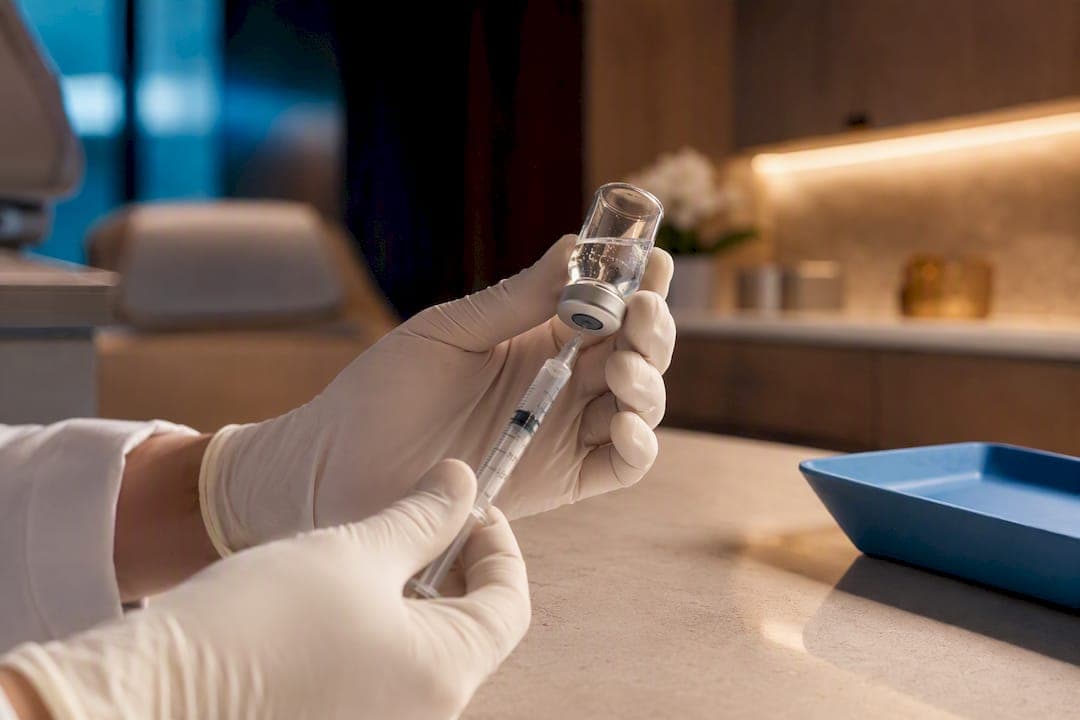
A Botox unit measures biologic potency, not liquid volume. It is a manufacturer-specific dose determined by a laboratory assay, so 20 units always means the same strength regardless of how much saline dilutes it. Most upper-face treatments run somewhere between 20 and 40 units combined, but the right number depends on your muscle strength, the area treated, and your injector's judgment. Prescribing guidelines also cap total treatment at 400 units within any three-month span.
TL;DR:
- Botox units measure biological activity, not volume, and are specific to each manufacturer’s assay, so units are not interchangeable across brands.
- The typical cosmetic treatment for the upper face ranges from 20 to 40 units, with actual dosing adjusted for muscle strength, area, and injector judgment.
- Reconstituted vials of Botox contain a variable volume of saline that influences injection volume but not the total biologic potency, which remains constant.
- Treatment area guidelines recommend about 20 units for glabellar lines and around 24 units for crow's feet, but actual doses depend on individual anatomy and muscle activity.
- Most clinics start with lower doses and adjust based on response, avoiding exceeding the maximum of 400 units within three months to reduce side-effect risks.
Table of Contents
- What a Botox Unit Actually Measures
- How Botox Vials Are Supplied and Diluted
- How Many Botox Units Per Treatment Area?
- What Factors Change Your Recommended Dose?
- Safety Limits and How to Vet Your Injector
- How Botox Units Translate Into Cost
- The Elite Laser Center Approach to Dosing and Safety
- Why Unit Charts Only Get You Halfway There
- Ready to Get a Personalized Botox Plan?
- Sources
- FAQ
What a Botox Unit Actually Measures
A unit of BOTOX Cosmetic is a measurement of biological activity, established through a potency assay run against the manufacturer's own reference standard. It has nothing to do with milliliters, drops, or syringe markings. Manufacturers determine potency using cell-based assays that quantify how strongly a given batch of onabotulinumtoxinA blocks nerve signal transmission at the neuromuscular junction, calibrated against a fixed benchmark so every vial performs consistently.
That precision matters because units are not interchangeable across brands. The DailyMed label for BOTOX Cosmetic states plainly that its potency units are specific to its own assay method and cannot be converted to units of other botulinum toxin products. A "unit" from one manufacturer's toxin doesn't equal a unit from another's, even though both are labeled in the same way. One older reference in the PMC review on dosing and standardization notes that roughly 20 units of BOTOX corresponds to about one nanogram of the neurotoxin complex, a figure specific to that formulation and testing method alone.
This is also why two clinics can draw noticeably different syringe volumes for what looks like "the same" treatment and still deliver identical results. One provider might reconstitute a vial to a more concentrated solution and inject a smaller volume per site; another might dilute it further and inject more fluid. Both can deliver exactly 20 units to your glabellar muscles. The unit count is the constant. The volume is just the vehicle. If you ever compare notes with a friend about how many "cc's" they got, you're comparing the wrong number. Ask about units.
How Botox Vials Are Supplied and Diluted
BOTOX Cosmetic ships as a sterile, dry powder in single-dose vials, available in two standard sizes: 50 units and 100 units, according to the FDA prescribing information. Neither size contains any liquid until a provider reconstitutes it with sterile, preservative-free saline shortly before use.
The concentration created during reconstitution determines how much fluid carries each unit. A common clinical approach dilutes a 100-unit vial with 2.5 mL of saline, producing a concentration of 4 units per 0.1 mL. Some injectors prefer more diluted mixtures for broader spread across a muscle like the frontalis, while others prefer a tighter, less diluted mix for precise, small-volume placement in areas like the crow's feet. Either choice changes the injection volume per site. Neither changes the total biologic potency delivered, provided the unit count stays the same.
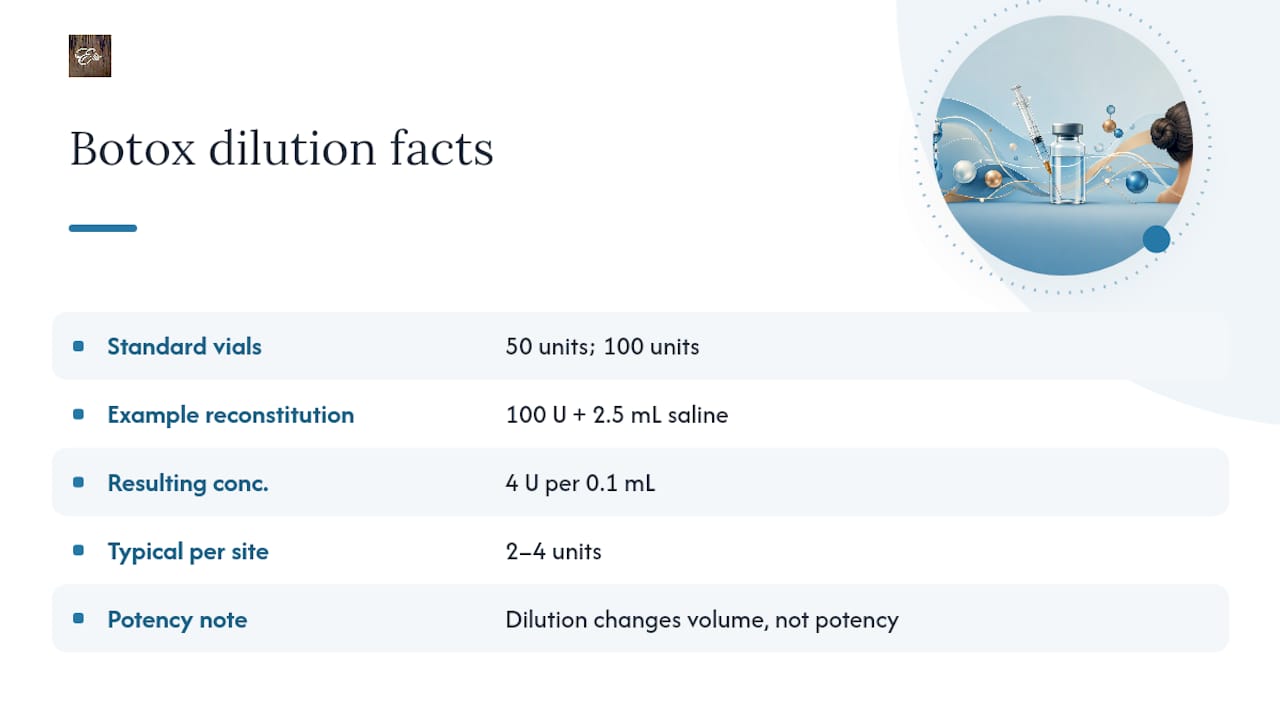
This is also where syringe choice matters practically, not just clinically. Insulin syringes, marked in fine 1 unit increments, let injectors measure small volumes with much more accuracy than a standard syringe, which matters when a single injection point might only receive 2 to 4 units. A provider drawing up units for seven or eight injection sites across the forehead needs that precision to land each site correctly without over- or under-shooting adjacent muscles.
How Many Botox Units Per Treatment Area?
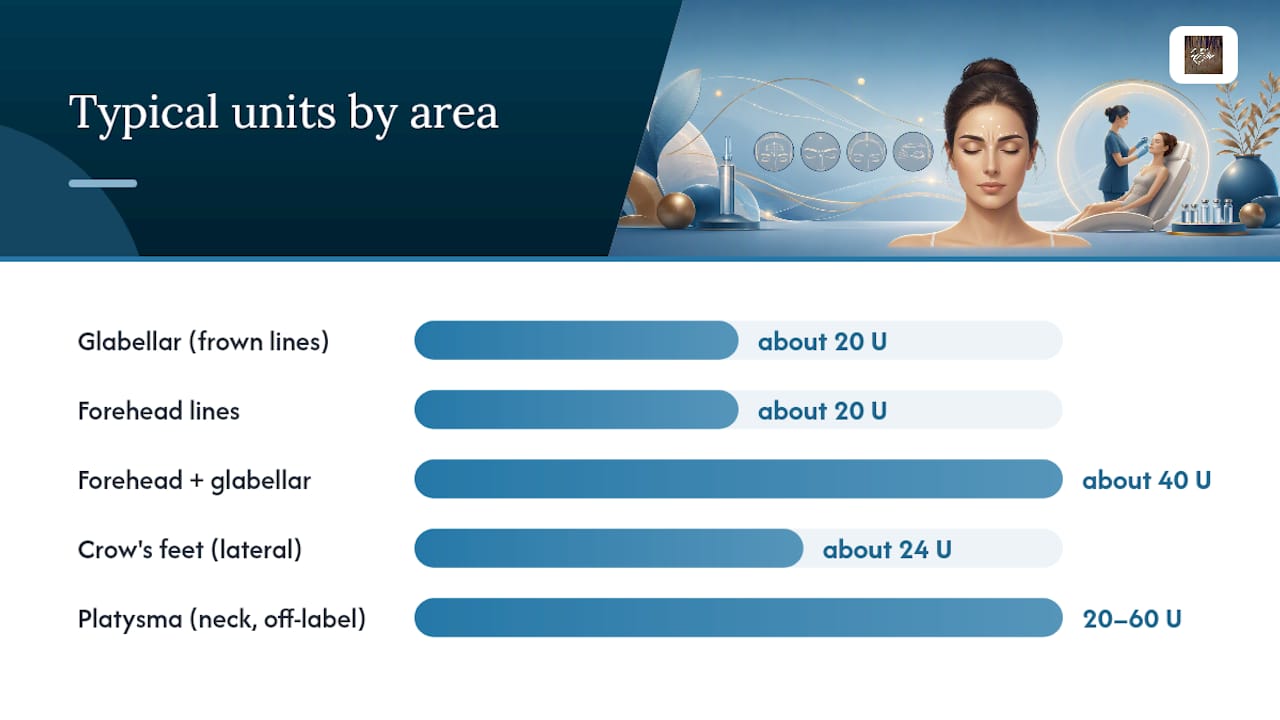
The FDA prescribing information lists specific recommended totals for each approved cosmetic area, based on clinical trial dosing. These numbers are the standard reference point every injector works from, though real-world totals shift based on your anatomy and goals.
| Treatment Area | FDA-Labeled Total (Units) | Typical Clinic Range (Units) |
|---|---|---|
| Glabellar lines (frown lines) | about 20 units | a common range around that dose |
| Forehead lines | about 20 units | a common range around that dose |
| Forehead + glabellar lines combined | about 40 units | a common range around that dose |
| Lateral canthal lines (crow's feet) | about 24 units | a common range around that dose |
| Platysma bands (neck) | Not FDA-labeled for cosmetic use | 20–60 U (off-label, provider-dependent) |
| Masseter (jaw slimming, off-label) | Not FDA-labeled for cosmetic use | 20–60 U per side |
The prescribing information for BOTOX Cosmetic sets 20 units as the trial-tested dose for glabellar lines, split across five injection points, and 24 units for crow's feet, split across three points per side. Combined forehead and glabellar treatment lands at 40 units total, which is why a "full upper face" quote from most clinics tends to sit in that 30 to 50 unit neighborhood once an injector adjusts for your specific muscle activity.
A few patterns show up consistently in clinic-typical dosing:
- First-time patients often start closer to the lower end of a range, since it's easier to add units at a follow-up than to remove them.
- Patients with strong, expressive frontalis or corrugator muscles frequently need the higher end of the forehead or glabellar range to achieve the same smoothing effect as someone with lighter muscle activity.
- Maintenance patients who've had several rounds of treatment sometimes need fewer units over time, as the muscle weakens with repeated use.
- Off-label areas like the masseter or platysma carry wider ranges precisely because there's no single FDA-labeled total to anchor against.
Context outside cosmetic use shows just how much the treated indication swings the number. Chronic migraine protocols often call for around 155 units spread across the head and neck, and overactive bladder treatment involves roughly 100 units injected into the bladder wall, according to a Healthline overview of Botox dosage. Those figures aren't relevant to a cosmetic consult, but they're a useful reminder that "how many units of Botox" has no single universal answer. It always depends on what you're treating and why.
When multiple areas are combined in one session, the math adds up fast. Forehead plus glabella plus crow's feet can land anywhere from 60 to 90 units total, which is well within the maximum cumulative dose guidance of 400 units in a three-month interval, but it's still a number worth tracking if you're getting touch-ups or treating additional areas like the masseter in the same window.
What Factors Change Your Recommended Dose?
No two patients get the exact same unit count for the exact same area, and that's by design, not inconsistency. Several variables shift the number an experienced injector recommends.
- Muscle strength and size: A larger, more active masseter or frontalis muscle typically requires more units to achieve visible relaxation than a smaller or naturally quieter one.
- Treatment history: First-time patients often start lower to gauge individual response, while patients on their third or fourth round may need dose adjustments based on how their muscles responded previously.
- Age and skin quality: Deeper, more established static lines sometimes need a slightly different approach than early, dynamic-only wrinkles that only show up with expression.
- Metabolic rate and activity level: Some patients metabolize the toxin faster and notice results fade sooner, which can factor into how a provider plans future sessions, though it rarely changes the starting dose itself.
- Injection technique: The number of injection points, not just the total units, affects how the toxin spreads through a muscle. More points at lower doses per point can create a smoother, more even effect than fewer points at higher doses.
Men frequently need more units than women in the same area, largely because average frontalis and glabellar muscle mass tends to run higher. That's not a hard rule, though. A provider assessing your specific muscle movement in person will catch differences a generic chart never could, which is exactly why online unit calculators are a starting point for conversation, not a prescription.
Safety Limits and How to Vet Your Injector
The prescribing information sets a clear outer boundary: providers should not exceed a cumulative dose of 400 units within any three-month interval across all treated indications combined, and treatment should begin with the lowest dose likely to be effective. That ceiling exists because higher cumulative exposure raises the risk of unwanted muscle weakness spreading beyond the intended area.
Most technique-dependent side effects trace back to injection precision rather than the toxin itself. Temporary eyelid or brow droop, mild asymmetry, and, when neck muscles are involved, changes in swallowing or speech are the complications injectors watch for most closely. These typically resolve within weeks as the toxin's effect wears off, and research on injection technique and safety consistently links lower complication rates to injector experience and precise anatomical placement rather than to dose alone.
Pro Tip: Ask your injector to walk you through their proposed unit range before treatment, area by area, and ask what happens if you need a touch-up. A provider who can't explain the number isn't the right one to inject it.
Before booking, confirm the provider works under medical supervision, has specific training in facial anatomy and neuromodulator injection, and takes time to assess your muscle movement rather than applying a flat, one-size dose. The American Society of Plastic Surgeons recommends limiting these injections to trained physicians or qualified medical professionals working under appropriate oversight, precisely because outcomes hinge so heavily on technique.
How Botox Units Translate Into Cost
Clinics price Botox one of two ways: a flat per-unit rate, or a package price for a defined area regardless of exact unit count. Per-unit pricing typically bundles the product cost with the injector's time and expertise, not just the toxin itself.
Here's the simple math. If a clinic quotes $12 per unit and your combined forehead and glabellar treatment lands at 40 units, that session runs $480 before any additional areas. Add crow's feet at 24 units and you're looking at another $288, bringing the visit to roughly $768.
The lowest quoted unit price isn't always the best deal. A less experienced injector charging less per unit may need more units, or more frequent touch-ups, to get the same result a skilled provider achieves in fewer units. Ask what's included, whether follow-up adjustments carry an extra charge, and how the clinic handles retreatment if results fall short.
The Elite Laser Center Approach to Dosing and Safety
Some medical spas build treatment plans around individualized assessment, not a fixed number pulled from a chart. Injections happen under medical supervision, with dosing based on specific muscle activity and goals rather than a generic average.
If you're weighing a masseter treatment or want to understand what recovery looks like, our guides on masseter Botox for jaw slimming and Botox aftercare in the first two weeks go deeper than any online calculator can. A consult remains the only reliable way to get a unit estimate specific to your face.
Why Unit Charts Only Get You Halfway There
Prescribing tables are useful, and every credible explainer, including this one, leans on them for a reason: they're the only standardized reference point that exists. But treating a chart like a prescription is where a lot of patients go wrong. The FDA's 20-unit glabellar dose was tested in clinical trials on a population, not on your corrugator muscle specifically, and the gap between "labeled dose" and "right dose for you" is exactly where an experienced injector earns their fee.
The bigger blind spot in most online explainers isn't the unit math. It's the assumption that more units always means better results. Overtreatment flattens expression and can cause spread to adjacent muscles, which is a real risk when patients push for a specific number they read somewhere instead of trusting an in-person assessment. The AAFP's practical approach to cosmetic injections backs starting with the lowest effective dose and reassessing at follow-up, a philosophy that runs counter to the "more is better" instinct a lot of first-time patients bring into a consult.
If there's one thing worth prioritizing over unit counts, it's provider judgment. The number matters less than who's holding the syringe.
— Sharon
Ready to Get a Personalized Botox Plan?
Reading dosing charts only gets you so far, since the number that actually matters is the one an injector determines by watching your muscles move in real time. Some providers offer consultations under medical supervision, where your treatment plan is built around your face, not a population average from a prescribing label.

At your first visit, you can expect a hands-on assessment of your facial movement, an honest conversation about your goals, and a tentative unit range specific to your anatomy, not a generic estimate pulled off a chart. If cost planning matters to you going in, our breakdown of per-unit and per-session Botox pricing is a useful starting point before your visit. Ready to see what your own dosing plan would look like? Book a consultation with Elite Laser Center and get a unit range built around your face instead of an average.
This article is general information, not a substitute for advice from a qualified doctor. Consult a qualified healthcare professional about your own circumstances before acting on anything here.
Sources
- HIGHLIGHTS OF PRESCRIBING INFORMATION — BOTOX Cosmetic (onabotulinumtoxinA)
- DailyMed - BOTOX COSMETIC (onabotulinumtoxinA) labeling
- Botulinum toxin procedures: A practical approach to cosmetic injections | AAFP
FAQ
How Much Is 40 Units of Botox in a Syringe?
There's no fixed volume answer, since 40 units is a potency measure, not a liquid amount. Depending on reconstitution, the volume that carries 40 units varies, with the exact amount set by how much saline the injector used to dilute the vial.
What Is 1 Unit of Botox Equivalent To?
One unit is a fixed dose of biologic potency defined by BOTOX's own laboratory assay against a reference standard, roughly equal to one nanogram of the neurotoxin complex in that specific formulation. It has no equivalent in other botulinum toxin brands, since each manufacturer's units are tied to its own testing method.
What Do 20 Units of Botox Look Like?
Twenty units is the FDA-labeled total dose for treating glabellar frown lines, typically split into five separate injection points across the corrugator and procerus muscles. It's a small enough amount that the injected volume itself, often less than half a milliliter, is barely noticeable at the injection site.
What Will 40 Units of Botox Cover?
Forty units is the labeled combined dose for treating the forehead and glabellar lines together, addressing both horizontal forehead creases and vertical frown lines between the brows. It won't typically stretch to cover crow's feet as well, which carries its own separate 24 unit recommendation.