

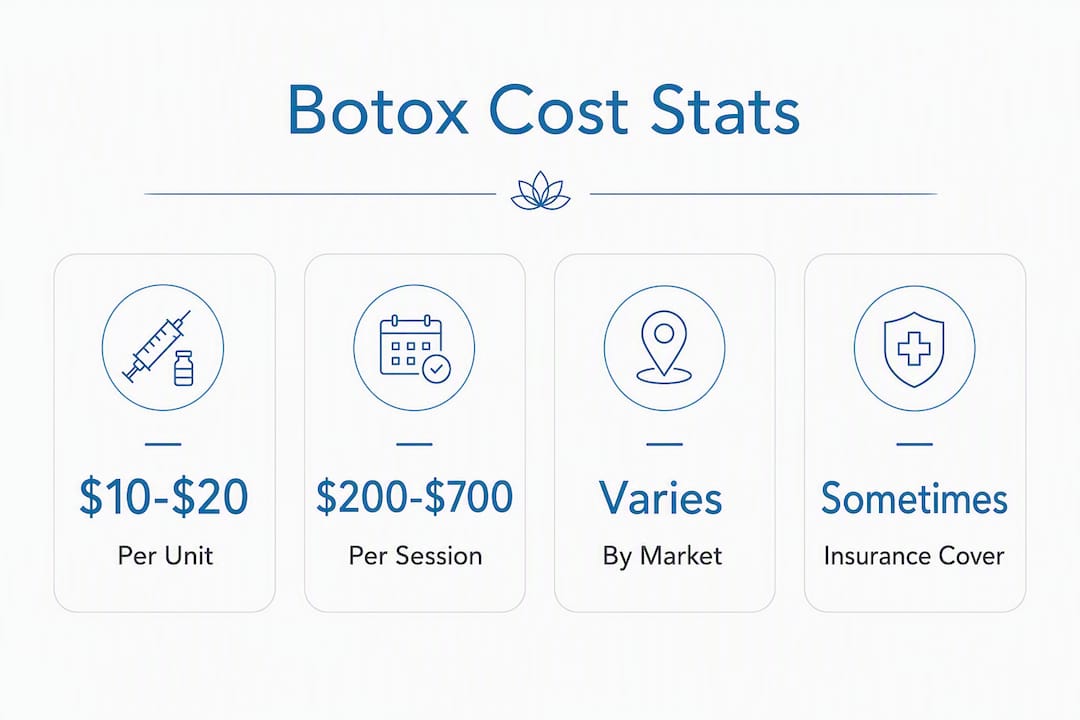
Botox typically runs in a national range of about ten to twenty dollars per unit in the U.S., with most metro clinics landing in the low teens per unit. A typical cosmetic session uses multiple tens of units, putting the average session cost in the few hundred dollars range. The American Society of Plastic Surgeons puts the national average at $435 per treatment. Cosmetic Botox is almost always out-of-pocket. Insurance may cover it only for FDA-approved medical uses like chronic migraines or hyperhidrosis, and only with a formal diagnosis and prior authorization.
Quick reference:
- Per unit: $10–$20 nationally; $12–$18 in most metro markets
- Per session: $200–$700 depending on units used and treatment area
- Annual cost: $1,500–$3,500 for upper-face maintenance at 3–4 sessions per year
- Insurance: Cosmetic use is out-of-pocket; medical indications may qualify with documentation
- Savings programs: AbbVie's Allē rewards program and clinic membership packages can reduce per-session costs for repeat patients
Table of Contents
- What does Botox cost per unit and per session?
- How do providers set Botox prices?
- How many units does each area need?
- What drives price differences between clinics?
- When does insurance cover Botox?
- How much does Botox cost per year?
- How to get an accurate Botox quote at consultation
- Medically supervised Botox in Suffolk County
- Key Takeaways
- The real cost of chasing the lowest per-unit price
- Useful sources
What does Botox cost per unit and per session?
The numbers below reflect national averages and common treatment area examples. Use them as a starting budget, not a firm quote.
| Treatment Area | Typical Units | Low ($10/unit) | Mid ($15/unit) | High ($20/unit) |
|---|---|---|---|---|
| Glabella (frown lines) | 15–25 units | $150 | $250–$375 | $300–$400 |
| Forehead lines | 6–30 units | $60–$300 | $90–$400 | $120–$600 |
| Crow's feet (both sides) | 10–24 units | $120–$240 | $150–$360 | $200–$480 |
| Full upper face combo | 40–64 units | $400–$640 | $600–$960 | $800–$1,200 |
| Lip flip | 4–8 units | $40–$70 | $60–$120 | $80–$160 |
| Masseter (jaw slimming) | 40–60 units | $400–$600 | $600–$900 | $800–$1,200 |
| Neck bands (platysma) | 25–50 units | $250–$500 | $375–$750 | $500–$1,000 |
A few things to keep in mind when reading that table:
- Forehead lines have the widest unit range because providers often treat them conservatively to avoid brow drop, especially on first visits.
- Masseter treatments require significantly more product than facial wrinkle work, which is why jaw slimming sessions often surprise people with a higher bill.
- The "full upper face" line is what most patients end up spending when they treat glabella, forehead, and crow's feet together in one visit.
Price variation across markets is real. State-level averages show that cost differences between the most and least expensive states can be significant, driven by rent, labor, and the mix of physician-led practices in dense metro areas. In premium urban markets like New York City, per-unit rates of $15–$25 are common. Suffolk County and Long Island generally track closer to the metro New York range than to national averages.
How do providers set Botox prices?
Three pricing models dominate the market, and they are not equally transparent.
Per-unit pricing is the most straightforward. You pay a fixed dollar amount for each unit injected. The math is simple: units used × price per unit = your bill. If a provider charges $15/unit and uses 25 units on your glabella, you pay $375. Per-unit pricing is the only model that lets you verify exactly how much product you received.
Per-area pricing quotes a flat fee for a treatment zone regardless of how many units go in. A $350 "forehead" price sounds clear until you realize one provider uses 10 units and another uses 25. The per-area model can work in your favor if you need more product than the average patient, but it routinely obscures dosing and makes comparison shopping nearly impossible.
Per-session or flat pricing bundles multiple areas into one number. A "$600 full face" package might include 40 units or 65 units. Without knowing which, you cannot evaluate whether it is a good deal.
Converting a flat price to an effective per-unit rate: If a clinic quotes $450 for your forehead and frown lines and you ask how many units that covers, they say 30 units. That is $15/unit, which is reasonable. If they say 20 units, you are paying $22.50/unit, which is on the high end. That one question changes everything.
Pro Tip: Before any injection, ask the provider to state the product brand, the number of units per area, and the per-unit price. Get it in writing on your receipt. This is the only way to compare quotes across clinics and track your dosing history over time.
Questions to ask at every consultation:
- What product brand will you use (BOTOX®, Dysport®, Xeomin®, Jeuveau®, or Daxxify®)?
- How many units are you planning for each area?
- What is your per-unit price?
- What is your touch-up policy if results are uneven at two weeks?
- Are there any follow-up fees?
- Do you offer membership pricing or loyalty programs?
How many units does each area need?
Unit counts vary more than most people expect, and the range is not arbitrary. Muscle mass, gender, and individual anatomy all play a role. Men typically need 20–30% more units than women for the same area because facial muscles tend to be larger and stronger.
Common unit ranges by area give you a practical starting point:
- Glabella: 15–25 units
- Forehead: 6–30 units
- Crow's feet: 10–24 units (both sides combined)
- Full upper face: 40–64 units total
Three worked examples at 20 units:
| Per-Unit Rate | 20 Units Cost |
|---|---|
| $10/unit | $200 |
| $15/unit | $300 |
| $20/unit | $400 |
That $200 spread on a single 20-unit session is exactly why per-unit rate matters so much when you are comparing clinics.
A critical note on brand comparisons: The five main neurotoxins on the U.S. market are BOTOX® (onabotulinumtoxinA, made by AbbVie), Dysport®, Xeomin®, Jeuveau®, and Daxxify®. Their unit scales are not equivalent. Dysport uses a smaller unit denomination, so a Dysport quote of 60 units is not the same as 60 units of BOTOX®. Daxxify often carries a higher per-unit price but typically lasts longer than the standard 3–4 months. Comparing per-unit prices across brands without accounting for dosing equivalence is a common mistake that leads to false conclusions about which clinic is cheaper.
What drives price differences between clinics?
Several factors push prices up or down, and not all of them signal quality.

Geography and market density account for the biggest swings. Dense metro markets with high commercial rent and a concentration of physician-led practices push averages higher. State-level variation alone produces a roughly 2× spread between the most and least expensive markets. Long Island and Suffolk County sit in the higher-cost Northeast corridor.
Provider credentials matter in both directions. A board-certified plastic surgeon or dermatologist typically charges more per unit than a nurse injector at a medspa. That premium often reflects deeper anatomical training and liability coverage, though many experienced RNs and NPs deliver excellent results.
Clinic setting shapes overhead. A hospital-affiliated plastic surgery practice carries different costs than a standalone medspa. Neither is automatically better, but the overhead difference shows up in the per-unit rate.
Dilution and reconstitution technique is the factor most patients never think to ask about. When a provider reconstitutes a freeze-dried vial of BOTOX®, they add saline to create the injectable solution. How much saline they add changes the concentration. A more diluted vial spreads further but delivers less product per injection point. Reconstitution technique and injector experience directly affect how natural your results look and how long they last, independent of the per-unit price you paid.
Warning signs for suspiciously low pricing:
- Per-unit rates below $10 with no explanation
- Refusal to disclose unit counts or product brand
- Extremely low advertised rates that correlate with high-pressure upselling once you are in the chair
- "Botox parties" or pop-up injection events without a supervising physician on site
- No written documentation of units injected
A $9/unit rate is not a deal if the provider uses 15 units where a skilled injector would use 20 to achieve the same result. You pay less and get less.
When does insurance cover Botox?
Cosmetic Botox is out-of-pocket for the vast majority of patients. That is not a gray area. Insurance coverage is reserved for FDA-approved medical indications, and even then it requires documentation, a formal diagnosis, and prior authorization.
FDA-approved medical indications that may qualify for coverage:
- Chronic migraine (15 or more headache days per month)
- Primary axillary hyperhidrosis (excessive underarm sweating)
- Cervical dystonia
- Upper limb spasticity
- Overactive bladder
- Strabismus and blepharospasm
Steps to pursue insurance coverage:
- Get a formal diagnosis from the appropriate specialist (neurologist for migraines, dermatologist for hyperhidrosis).
- Ask your provider for the relevant CPT and ICD-10 codes for the indication.
- Submit a prior authorization request to your insurer before treatment.
- Document that other treatments have failed, if required by your plan.
- If denied, file an appeal with supporting clinical notes and the FDA indication documentation.
Do not assume coverage based on what a friend was told or what a clinic's front desk says. Verify directly with your insurance carrier and get the authorization in writing before the appointment.
Manufacturer and patient assistance programs offer a separate savings route. AbbVie's Allē program is the loyalty and rewards platform for BOTOX® Cosmetic, and it lets patients accumulate points toward future treatments. Clinic membership packages at medspas can also reduce the effective per-session cost for patients who return regularly, sometimes meaningfully.
This article provides general information, not medical or insurance advice. Verify your specific coverage and eligibility with your insurance carrier and a qualified healthcare provider.
How much does Botox cost per year?
A single session is rarely the full picture. Botox effects typically last several months, which means most patients schedule a few treatments per year to maintain results. That math changes the conversation from "how much is one session" to "what is my annual budget."
Sample annual cost estimates:
- Frown lines only (glabella, ~20 units/session at $15/unit): $300/session × 3–4 sessions = $900–$1,200/year
- Upper face combo (glabella + forehead + crow's feet, ~50 units/session at $15/unit): $750/session × 3–4 sessions = $2,250–$3,000/year
- Jaw/masseter (50 units/session at $15/unit): $750/session × 2–3 sessions = $1,500–$2,250/year (masseter treatments often last longer)
Annual maintenance costs for upper-face work commonly run $1,500–$3,500 depending on market and unit needs.
Several factors affect how long your results last:
- Frequency of treatment (patients who stay on schedule often notice longer-lasting effects over time)
- Metabolic rate and activity level (high-intensity athletes sometimes metabolize neurotoxins faster)
- Treatment area and muscle strength
- Product brand and reconstitution technique
Pro Tip: Think of your annual Botox budget the way you think about a gym membership. The per-session number feels manageable; the annual number is what you need to plan for. If a clinic membership or loyalty program reduces your per-session cost by $50–$75, that is $150–$300 back in your pocket annually.
The financial case for staying with a skilled injector who knows your anatomy is stronger than it looks. Switching providers to save $2/unit often means starting the dosing conversation over, which can lead to under-treatment on the first visit and a touch-up that costs more than the savings.
How to get an accurate Botox quote at consultation
Most pricing confusion is avoidable. The right questions, asked before the needle goes in, give you a verifiable quote you can compare across clinics.
Call or consult script:
- "What product brand do you use for this treatment?"
- "How many units are you planning for each area I want to treat?"
- "What is your per-unit price?"
- "Is there a touch-up policy if I'm not satisfied at two weeks?"
- "Are there any fees beyond the per-unit cost, such as consultation or follow-up charges?"
- "Do you offer membership pricing or a loyalty program?"
Red flags that should give you pause:
- Provider refuses to state unit counts or quotes only by area
- Pressure to prepay a large package before your first treatment
- Per-unit pricing below $10 with no explanation of brand or dilution
- No supervising physician on site or available for questions
- No written receipt showing product name and units injected
Documentation matters more than most patients realize. Experienced injectors emphasize tracking dosing history because it improves outcomes and makes future quotes directly comparable. Ask for a written receipt that lists the product name, units per area, and per-unit price. Keep a simple log of each visit: date, provider, product, units, areas treated, and how long the results lasted. After two or three sessions, you will have a clear picture of your personal dosing needs and a benchmark for evaluating any new clinic's quote.
Pro Tip: When a clinic quotes a flat price, convert it yourself. "We charge $400 for the forehead" — ask how many units that includes. Divide $400 by the unit count. If it comes out above $20/unit, you are paying a premium. If it comes out below $10/unit, ask why.
Mini example: A clinic quotes $525 for glabella and forehead combined. You ask how many units. They say 35. That is $15/unit, which is right in the national mid-range. Another clinic quotes $400 for the same areas but uses only 20 units, giving an effective rate of $20/unit. The lower headline price is actually the more expensive option per unit of product.
Medically supervised Botox in Suffolk County
If you are ready to move from research to a real consultation, the injector's credentials and the clinic's transparency on unit counts matter as much as the per-unit price.
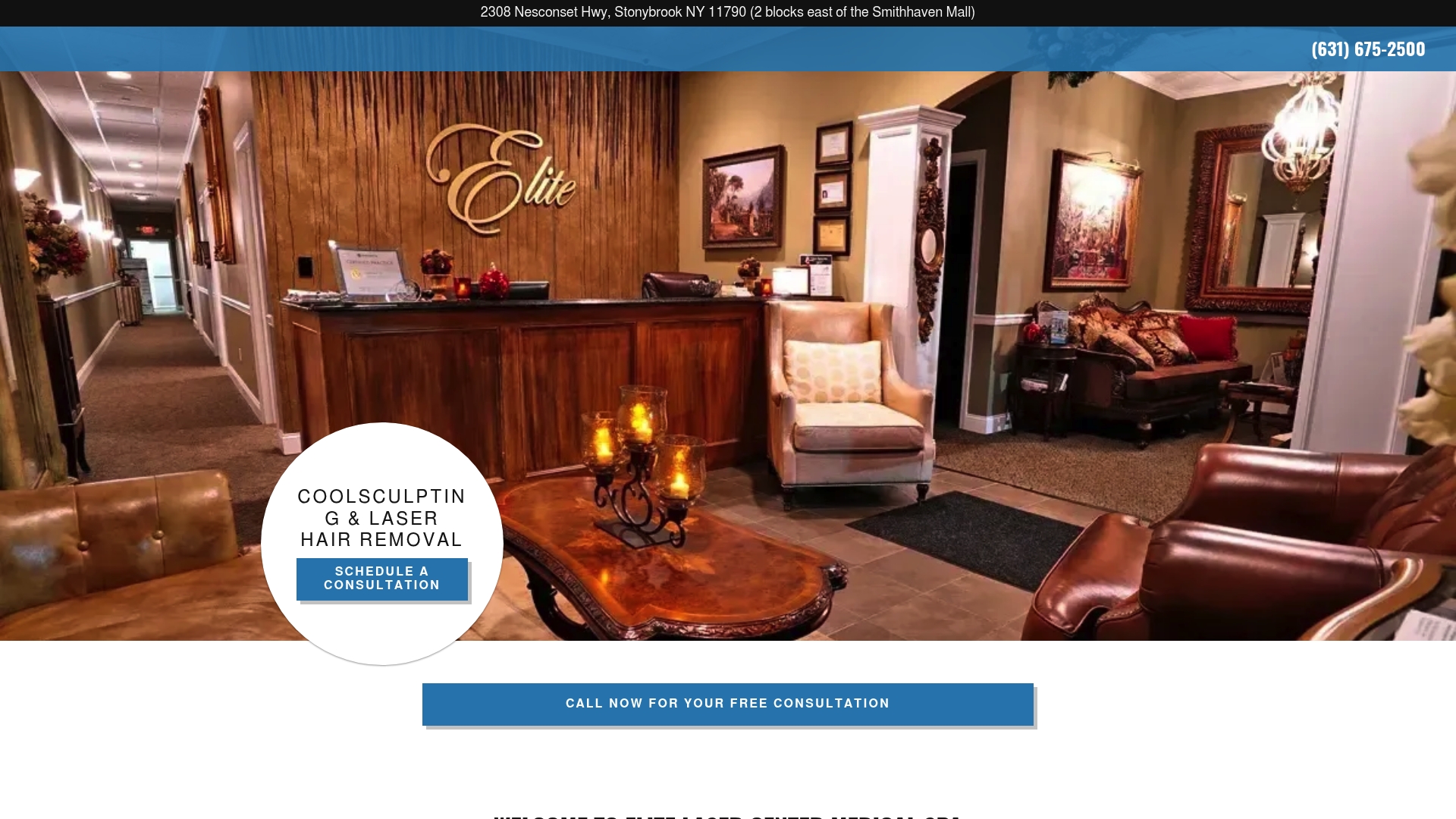
Elitelaserhair's injectables program at Elite Laser Center in Stony Brook, NY offers Botox and wrinkle correction under experienced medical supervision, with documented unit counts and a clear pricing structure. For patients in Suffolk County and across Long Island, that combination of medical oversight and transparent dosing is exactly what separates a clinic worth returning to from one worth avoiding.
What sets Elite Laser Center apart for injectable patients:
- All treatments performed under medical supervision
- Experienced injectors with documented aftercare protocols
- Transparent unit reporting so you can track your dosing history
- Skincare club membership options starting at $99 that help offset annual treatment costs
- Recognized as a top aesthetic facility in Suffolk County, with a full-service medspa offering complementary treatments
To book a consultation, visit elitelaserhair.com or call the Stony Brook location directly. Bring your list of questions from the consultation checklist above, and ask for a written unit breakdown before your first treatment.
Key Takeaways
Botox costs $10–$20 per unit nationally, with most metro clinics charging $12–$18 per unit; typical sessions run $200–$700 and annual upper-face maintenance commonly reaches $1,500–$3,500 at 3–4 treatments per year.
| Point | Details |
|---|---|
| Per-unit rate is the benchmark | National range is $10–$20/unit; metro markets like Long Island typically run $12–$18/unit. |
| Session cost depends on units | Multiply units needed by per-unit rate; a 40-unit upper-face session at $15/unit costs $600. |
| Annual budget matters more | At 3–4 sessions per year, upper-face maintenance commonly runs $1,500–$3,500 annually. |
| Insurance rarely applies | Cosmetic Botox is out-of-pocket; medical indications require diagnosis and prior authorization. |
| Elitelaserhair for local patients | Elite Laser Center in Stony Brook offers medically supervised injectables with transparent unit reporting in Suffolk County. |
The real cost of chasing the lowest per-unit price
The pricing conversation around Botox tends to fixate on per-unit rate, and that fixation misses the more important variable: how many units a skilled injector actually uses, and whether the result holds for a full 3–4 months.
A $10/unit rate sounds like a win. But if that provider uses 15 units where a more experienced injector would use 22 to achieve the same correction, you paid $150 for a result that fades in 8 weeks instead of $330 for one that lasts 14. The math on the "cheap" option is worse. And that is before accounting for the touch-up visit that often follows under-dosed treatment.
The providers who refuse to disclose unit counts are not protecting a trade secret. They are protecting a pricing model that does not survive scrutiny. Per-unit transparency is the baseline, not a bonus feature. Any clinic that treats it as optional is telling you something important about how they operate.
There is also a continuity argument that rarely gets made explicitly. An injector who has treated you three or four times knows your anatomy, your metabolism, and how your muscles respond. That knowledge has real value. Switching providers to save $2/unit means starting that learning curve over, and the first session with a new provider is almost always the most conservative one. You may end up paying for a touch-up that a familiar injector would not have needed to do.
None of this means the most expensive option is always the best one. Board-certified surgeons charge more, and for many cosmetic Botox patients, a skilled and experienced nurse injector at a reputable medspa delivers equivalent results at a lower price point. The credential that matters most is not the degree on the wall. It is whether the provider documents units, explains their technique, and has a clear policy for addressing results that fall short.
Useful sources
The cost ranges and unit figures in this article come from national per-unit band data, provider-reported unit counts, market sampling across U.S. states, and published statistics from professional societies. Ranges reflect real variation across markets and provider types. Always verify local pricing through a direct consultation.
Primary sources used:
- American Society of Plastic Surgeons: Botulinum Toxin Cost — National average cost data ($435 average) from ASPS annual statistics, the most widely cited professional society benchmark for cosmetic procedure pricing in the U.S.
- FDA MedWatch Safety Information — FDA safety reporting program; relevant for understanding counterfeit product risks and the importance of sourcing Botox from licensed, medically supervised providers.
- FDA: Counterfeit Botox Alert — FDA advisory on counterfeit BOTOX® found in multiple states, underscoring why provider credentials and product sourcing matter beyond price.
- Medical Spa Reviews: Per-Unit Price Guide — Aggregated per-unit and per-session ranges from clinic-reported data; source for the $10–$20/unit national band and area-specific unit ranges.
- ClearPath AI: Botox Pricing by State — Market analysis showing state-level variation; source for the approximately 2.0× spread between highest- and lowest-cost state averages.
- Tampa Mommy Makeover: Botox Pricing Overview — Clinic-reported pricing and insurance coverage guidance; source for annual maintenance cost ranges and the insurance/out-of-pocket distinction.
- Find Your Beautiful: How Much Does Botox Cost — Practitioner-sourced guidance on red flags, dilution practices, and low-price promotional risks.
- Aesthetic Med Guide: Per Unit vs Per Area Pricing — Explanation of pricing model transparency and why per-unit is the most reliable basis for comparison.
How to use these ranges: The figures here represent national averages and market bands. Your actual cost depends on your treatment area, the number of units your anatomy requires, your provider's per-unit rate, and your market. A consultation with a qualified injector is the only way to get a reliable personalized estimate.