
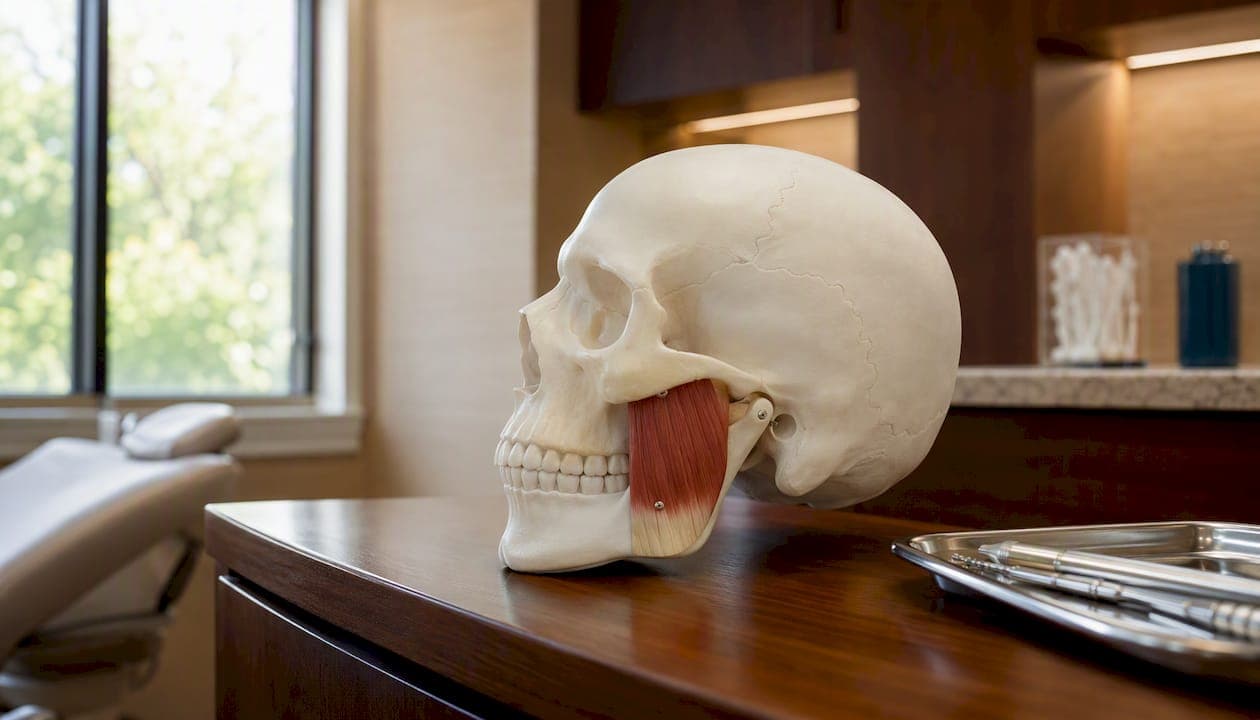
Masseter Botox temporarily relaxes the large chewing muscles on either side of your jaw to reduce clenching and, over several weeks, slim a wide or square jawline. It's one of the few aesthetic treatments that delivers both a cosmetic and a functional payoff from the same injection.
People who benefit most fall into three groups:
- Those with true masseter hypertrophy who want a softer, more oval jawline without surgery
- People with bruxism or temporomandibular disorder (TMD) whose clenching causes jaw pain, headaches, or tooth wear
- Patients who want a non-surgical option with no downtime and reversible results
One caveat applies to all three groups: the technique matters as much as the toxin. Choosing an experienced, medically supervised injector is the single most important safety decision you'll make.
Key Takeaways
Masseter Botox delivers meaningful jaw slimming and functional bruxism relief, but results depend on correct dosing, precise technique, and realistic timelines.
| Point | Details |
|---|---|
| Dual benefit, different timelines | Functional relief commonly begins within a week; visible jaw slimming takes 6–12 weeks and peaks at 3–4 months. |
| Conservative dosing is standard | Starting doses in a conservative range per side (Botox/Xeomin) are typical; titrate at the 4–6 week follow-up. |
| Technique prevents most complications | Smile asymmetry and paradoxical bulging are technique errors, not inherent risks — choose an injector with lower-face experience. |
| Cost per session varies widely depending on location, provider, and dosage | Per-unit prices vary by brand and market; always ask for total bilateral units, not just a session price. |
| Elitelaserhair | Offers medically supervised masseter Botox in Stony Brook, NY with structured consultations, conservative dosing, and documented follow-up. |
Table of Contents
- What masseter Botox is and how it works
- Who makes a good candidate and who should avoid it
- The clinical and cosmetic benefits of jaw Botox
- What to expect during the treatment process
- Dosing ranges and injection technique
- When results appear and how long they last
- Side effects and complications to know before you book
- What masseter Botox costs in the U.S.
- How to choose a safe, qualified injector
- How a medically supervised med spa approaches this treatment
- The case for conservative dosing over maximum slimming
- Medically supervised masseter Botox at Elitelaserhair
- Sources
What masseter Botox is and how it works
Masseter Botox refers to botulinum toxin injected directly into the masseter muscle, the thick, rectangular muscle that runs along the side of your jaw and powers chewing. For cosmetic jaw slimming, this is an off-label use in the United States — meaning the FDA has not specifically approved it for that indication, though the procedure is legal, widely practiced, and must be disclosed during informed consent.
The mechanism is called chemodenervation. The toxin blocks acetylcholine release at the neuromuscular junction, temporarily preventing the muscle from contracting at full force. Two things happen on different timelines. Within days, the muscle contracts less forcefully, which reduces clenching pain and headache frequency. Over weeks, reduced workload causes the muscle to atrophy slightly, producing the visible narrowing of the lower face that jaw slimming patients are after. Practitioner guidance describes this as a dual timeline: rapid functional change, then slower aesthetic atrophy.
Three botulinum toxin formulations are used in U.S. practice for this purpose:
Units are not interchangeable across brands. Dysport requires roughly 2.5–3 times as many units as Botox to achieve a comparable effect, so comparing per-unit prices across brands without knowing total dose tells you almost nothing useful about actual cost.
Dual-timeline insight: Functional relief (less clenching, fewer headaches) typically arrives within 2–7 days. Visible jaw slimming takes 6–12 weeks and peaks around 3–4 months. Patients who expect slimming in the first week will be disappointed — counseling on this timeline prevents early dissatisfaction.
Who makes a good candidate and who should avoid it
The ideal candidate has measurable masseter hypertrophy. The simplest test: clench your back teeth and feel the muscle bulge outward at the angle of your jaw. If it's prominent, you have enough muscle mass to see a meaningful cosmetic change. Candidates also include:
- People with symptomatic bruxism or TMD that hasn't responded adequately to night guards or physical therapy
- Patients who want non-surgical facial contouring with no recovery time
- Adults in good general health with realistic expectations about gradual, not immediate, aesthetic change
Absolute contraindications are non-negotiable:
- Pregnancy or breastfeeding
- Active infection at or near the injection site
- Known neuromuscular disorders such as myasthenia gravis, Lambert-Eaton syndrome, or ALS
- Allergy to botulinum toxin or any component of the formulation
- Recent facial surgery in the treatment area
Relative cautions require a careful conversation with your injector. Older patients with already-low facial volume risk hollowing at the jaw angle. Very low body weight carries a similar risk. Athletes or people whose work involves heavy chewing may notice functional weakness that affects daily life.
Pro Tip: Before your consultation, write down every medication you take, including supplements and anticoagulants. Muscle relaxants and aminoglycoside antibiotics can potentiate toxin effects. Neuromuscular disease history — even a family history — should be disclosed before any botulinum toxin treatment.
The clinical and cosmetic benefits of jaw Botox
The case for masseter Botox rests on two distinct categories of benefit, and the evidence behind each is different in strength.
Cosmetic jaw contouring. For patients with true hypertrophy, the reduction in muscle bulk produces a measurable narrowing of the lower face. The effect is gradual and subtle rather than dramatic, which is actually a feature: it looks natural. Patients with minimal hypertrophy, or those whose wide jaw is primarily skeletal rather than muscular, will see little to no cosmetic change.
Functional relief for bruxism and TMD. This is where the clinical evidence is strongest. A randomized controlled trial found that low-dose masseter botulinum toxin injections reduced nocturnal bruxism symptoms compared with control. Additional RCT and clinical data support symptomatic improvement, though study sizes and protocols vary enough that the evidence is best described as suggestive rather than definitive. The Mayo Clinic notes that botulinum toxin is among the therapeutic options clinicians consider for muscle-driven TMD symptoms, alongside night guards, physical therapy, and anti-inflammatory medications.
Patient-centered outcomes from functional treatment include reduced jaw pain, fewer tension headaches, less tooth wear, and better sleep quality. These improvements often appear before any visible aesthetic change.
Patients who come in primarily for jaw slimming and leave with fewer morning headaches are often the most satisfied — the functional benefit they didn't expect ends up mattering more than the contour change they came for.
Before-and-after photos from your clinic should show standardized lighting, consistent angles, and a minimum 8–12 week post-treatment interval to accurately reflect the aesthetic result.
What to expect during the treatment process
Before your appointment
Your provider should take a full medical history, photograph your face from multiple angles, and perform a clench test to assess masseter size and symmetry. You'll discuss whether your goals are primarily cosmetic, functional, or both, and agree on a starting dose. First-time patients almost always receive a conservative dose with the option to add units at a follow-up visit.
During the procedure
The injector marks a safe zone on the lower-posterior portion of the masseter, away from the smile muscles. Most providers place 3–5 injection points per side. The needle must reach the deep muscle belly, not just the superficial layer. The whole procedure takes 10–15 minutes. Discomfort is minimal — most patients describe it as a brief pinch.
After the procedure
- Apply a cold pack gently to reduce swelling; avoid pressing or massaging the area.
- Skip strenuous exercise for 24 hours.
- Avoid hard, chewy foods for 24–48 hours.
- Don't lie face-down for several hours post-injection.
- Expect mild soreness and possible light bruising for a few days.
- Return for a follow-up at 4–6 weeks so your provider can assess the response and adjust dosing if needed.
Maintenance sessions are usually scheduled every few months, with intervals adjusted based on individual responses. Many patients find the interval lengthens after several rounds of treatment.
Pro Tip: Schedule your appointment at least two weeks before any major event. Bruising is uncommon but possible, and the full aesthetic result won't be visible for 6–8 weeks anyway.
Dosing ranges and injection technique
Getting the dose right is where experience separates a good outcome from a problematic one. Conservative starting doses for first-time patients are standard practice; the goal is to achieve the desired effect with the minimum effective dose.
| Goal | Starting dose (per side) | Typical bilateral total |
|---|---|---|
| Cosmetic slimming (mild hypertrophy) | 20–25 units (Botox/Xeomin) | 40–50 units |
| Cosmetic slimming (moderate hypertrophy) | 20–50 units (Botox/Xeomin) | 60–80 units |
| Therapeutic bruxism/TMD relief | 20–50 units (Botox/Xeomin) | 20–50 units |
| Severe hypertrophy or combined goals | Up to 50 units (Botox/Xeomin) | 20–50 units |
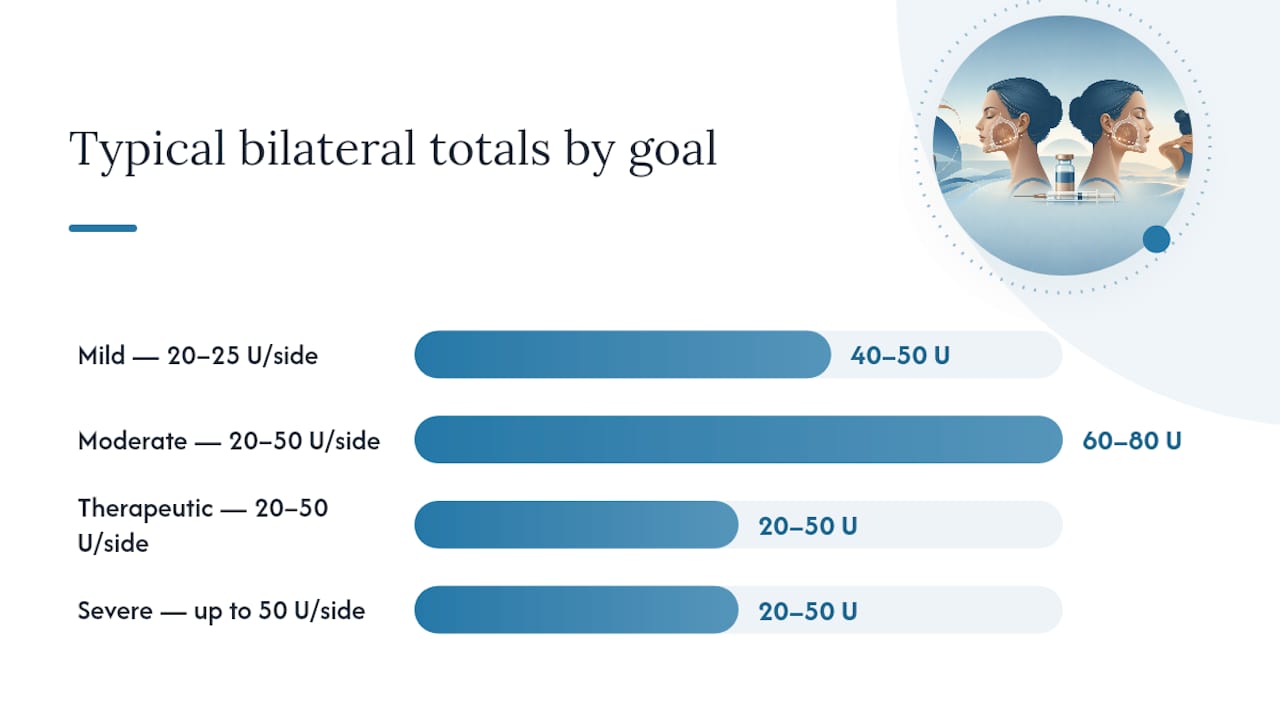
Clinical guidance places common dosing at roughly 20–50 units per side for both aesthetic and therapeutic purposes, with titration at follow-up.
Unit non-equivalence across brands means these Botox/Xeomin figures translate to roughly 60–150 units of Dysport per side. A quote of "20 units of Dysport" is not the same as "20 units of Botox" — they are different scales entirely.
Technique is where most complications originate. The injection must land in the lower-posterior safe zone, and the needle must advance deep enough to reach the muscle belly. Practitioner-level guidance is explicit: injecting too far anteriorly risks diffusion into the zygomaticus or risorius muscles, causing smile asymmetry. Injecting too superficially, without reaching the deep belly, leaves the deep fibers active while the surface is weakened, producing paradoxical bulging on clenching — a visible lump that looks worse than the original hypertrophy.
Safety callout: Smile asymmetry and paradoxical bulging are both technique errors, not inherent risks of the procedure. They are almost entirely preventable with correct point selection and needle depth. Ask your injector specifically how they approach the deep muscle belly.
When results appear and how long they last
The timeline unfolds in stages, and conflating them is the most common source of early disappointment.
- Days 2–7: Functional relief begins. Clenching force decreases, jaw tension eases, and headache frequency often drops.
- Weeks 6–8: Visible slimming becomes noticeable as the muscle begins to atrophy from reduced use.
- Month 3–4: Peak aesthetic effect. The jawline is at its narrowest and most contoured.
- Month 3–6: Results begin to fade as the neuromuscular junction recovers and muscle activity returns.
Practitioner guidance consistently places the functional onset at days and the aesthetic peak at 3–4 months. Maintenance is typically needed every 3–6 months, though many patients report that after several treatment cycles, the interval between sessions extends because the muscle has undergone some cumulative atrophy.
First-time patients should expect to need a touch-up at their 4–6 week follow-up. Repeat patients who have been maintaining for a year or more often find their dose requirements decrease over time.
Side effects and complications to know before you book
Most side effects are mild and short-lived. The ones that matter are the technique-dependent complications.
Common, expected effects:
- Soreness at injection sites for 2–5 days
- Mild bruising (uncommon but possible, especially in patients on blood thinners)
- Transient chewing weakness or fatigue when eating tough foods, lasting 2–4 weeks
- Slight asymmetry in the first 2–3 weeks as the toxin distributes unevenly before full onset
Technique-dependent complications:
- Smile asymmetry from anterior diffusion into smile muscles
- Paradoxical bulging from superficial-only dosing that leaves the deep fibers active
Both of these resolve as the toxin wears off, but they can persist for 2–4 months. Additional targeted injections can partially correct paradoxical bulging; smile asymmetry usually requires waiting out the treatment cycle.
Red flags that warrant immediate contact with your provider: A sudden, marked asymmetry in your smile that appears within the first week. Difficulty swallowing or speaking. Signs of infection at injection sites (increasing redness, warmth, swelling, or discharge). Severe generalized weakness. These are uncommon but require prompt evaluation — do not wait for your scheduled follow-up.
Pro Tip: If you notice mild chewing fatigue in the first few weeks, switch to softer foods temporarily. This is the toxin working, not a complication. It resolves on its own as your muscle adapts to reduced workload.
Long-term overuse carries a separate risk. Research published in Nature indicates that excessive or very frequent masseter denervation can alter lower-face soft-tissue support and may contribute to earlier jowl formation in susceptible patients. This is why conservative dosing and planned maintenance pauses matter, especially for patients who have been treating for several years.
What masseter Botox costs in the U.S.
Pricing varies by location, provider credentials, units used, and the brand of toxin. U.S. market data places typical bilateral session costs between $400 and $1,200, with per-unit prices commonly reported around $10–$25 depending on the market and brand.
Concrete estimates using a mid-range per-unit price of $15 (Botox/Xeomin):
- 20 units bilateral (10 per side): approximately $300 — a very conservative starting dose, appropriate only for mild cases
- 40 units bilateral (20 per side): approximately $600 — a common first-session dose for moderate cosmetic goals
- 80 units bilateral (40 per side): approximately $1,200 — typical for significant hypertrophy or combined cosmetic and therapeutic goals
Pricing analysis confirms these ranges and notes that city-by-city variation is substantial: New York and Los Angeles practices typically charge at the higher end, while mid-market cities may come in closer to $400–$600 for a standard bilateral session.
Practical guidance before you book:
- Ask for the total units planned per side, not just a session price
- Confirm which brand will be used, since unit counts mean different things across brands
- Ask whether the follow-up visit at 4–6 weeks is included or billed separately
- Inquire about package pricing for patients who plan to maintain long-term
- Check whether your clinic provides written documentation of the off-label use disclosure
Insurance note: Cosmetic jaw slimming is not covered by insurance. Therapeutic use for diagnosed bruxism or TMD may be partially reimbursable with proper documentation. Coordinating with your dentist or a TMD specialist to establish medical necessity in writing improves reimbursement outcomes significantly.
How to choose a safe, qualified injector
The injector's skill determines your outcome more than any other variable. Here's what to verify before booking:
- Board certification or physician supervision. The injector should be a board-certified physician (dermatologist, plastic surgeon, or oral and maxillofacial surgeon) or an advanced-practice provider working under direct physician supervision.
- Lower-face injection experience. Ask specifically about masseter injections, not just general Botox experience. The lower face has different risk anatomy than the forehead.
- Before-and-after photos. Request photos of actual patients, taken at standardized angles, at least 8 weeks post-treatment.
- A clear dosing plan. Your provider should tell you exactly how many units per side, which brand, and why that dose fits your anatomy.
- Written informed consent noting off-label use. This is not optional — it's a professional and ethical standard.
- Emergency protocols. Ask what happens if you develop a complication. Is there a physician available? What's the follow-up pathway?
For men specifically, guidance on choosing a local aesthetic clinic emphasizes verifying that the provider has experience with male facial anatomy, where masseter hypertrophy is often more pronounced and dosing requirements are higher.
Red flags to walk away from:
- A quote of fewer than 20 units total bilateral without a clear clinical rationale
- No medical history intake before treatment
- No before-and-after photos available
- Inability to explain what happens if you develop smile asymmetry
- No written follow-up plan
How a medically supervised med spa approaches this treatment
At a clinic like Elitelaserhair, the process is structured around safety checkpoints rather than a single injection visit. The pathway looks like this:
- Consultation: Full medical history, current medications, neuromuscular disease screening, and a discussion of cosmetic versus functional goals
- Assessment: Standardized photographs from multiple angles, clench test to measure masseter prominence and symmetry, and review of any dental or TMJ records the patient brings
- Conservative first-dose plan: Starting at the lower end of the dosing range, with explicit documentation of the off-label use and a written consent form
- 4–6 week follow-up: Reassessment of functional response and aesthetic change, with dose titration if needed
- Ongoing maintenance: Scheduled every 3–6 months based on individual response, with periodic reassessment of whether dose reduction is appropriate
The key differentiator at a medically supervised facility is access to a managing physician if a complication arises. Smile asymmetry or paradoxical bulging requires clinical judgment to manage correctly, and that judgment needs to be available, not just theoretically on call.
At a properly structured medical spa, the consultation is where most of the safety work happens. A provider who spends 10 minutes on history and anatomy before touching a needle is doing the job correctly. One who moves straight to injection is skipping the steps that prevent complications.
For patients interested in complementary treatments, injectables at Elite Laser Center are performed under medical supervision, with documented consent and a clear follow-up pathway. Patients concerned about lower-face volume loss over time may also benefit from discussing PDO thread lifts or skin tightening options as adjuncts to long-term masseter management.
The case for conservative dosing over maximum slimming
The most common mistake in masseter Botox isn't a bad injection — it's a goal that's set too aggressively. Patients who want the maximum possible jaw reduction in the shortest time are the ones most likely to end up with a hollowed lower face that looks older, not better.
The masseter isn't just a cosmetic structure. It contributes to lower-face volume and soft-tissue support. Research has shown that long-term excessive atrophy can alter that support and accelerate jowl formation. The jaw you're trying to slim is also holding up the lower third of your face.
A better framework: treat masseter Botox as a tool for periodic reassessment, not a permanent fix you max out at every session. Start conservative, evaluate the result at 6–8 weeks, and adjust incrementally. Once you've achieved the contour you want, consider extending maintenance intervals rather than repeating the same dose on a rigid schedule. Some patients do well on a twice-yearly plan; others find that annual treatment with a slightly higher dose gives them the same result with less cumulative muscle impact.
The goal is facial harmony, not the narrowest possible jaw. Those are different targets, and the second one often overshoots the first.
Medically supervised masseter Botox at Elitelaserhair
Elitelaserhair at Elite Laser Center in Stony Brook, NY offers masseter Botox under full medical supervision, with a structured consultation process that covers anatomy assessment, conservative dosing, and a documented follow-up plan. Every treatment begins with a clench test and standardized photos so your provider can track your actual response rather than guessing at it.
If you're coming in for jaw slimming, functional bruxism relief, or both, the consultation will cover your goals, your anatomy, the specific units and brand planned for your treatment, and what to expect at each stage of the timeline. Bring any dental or TMJ records you have — they help establish medical context and, for therapeutic cases, support insurance documentation.
To schedule your consultation or learn more about available injectable treatments, visit Elite Laser Center or contact the Stony Brook office directly. Same-day consultations are often available.
Sources
These sources provide primary literature, clinical guidelines, and authoritative patient information for anyone who wants to go deeper before their consultation.
- Evaluation of the Efficacy of Low-Dose Botulinum Toxin Injection Into the Masseter Muscle for the Treatment of Nocturnal Bruxism: A Randomized Controlled Clinical Trial
- Masseter Botox®: Jawline Slimming & Face Sculpting Guide
- TMJ - Symptoms and causes - Mayo Clinic
- How Much Is Masseter Botox? 2026 Prices + What Clinics Don’t Tell You
- How Much Does Masseter Botox Cost? 2026 USA Guide
- Nature article on long-term effects of muscle atrophy
Bring any of these to your consultation if you want to discuss the evidence directly with your provider.
This article is general information, not a substitute for advice from a qualified doctor. Consult a qualified healthcare professional about your own circumstances before acting on anything here.