

Most patients see immediate lift with visible swelling and some bruising, then a settling period over roughly two weeks, with final results shaping up by six weeks. The priority list is simple: sleep elevated, keep hands and pillows off your face, and skip the wide yawns and chewy foods for a bit. Call your clinic if pain gets worse after 48 hours instead of better, or if you notice spreading redness, warmth, or drainage.
TL;DR:
- Recovery varies depending on the number of threads, treated area, tissue thickness, and use of blood thinners, often taking up to six weeks for final results.
- Swelling and bruising peak within the first three days, then gradually subside, with most visible swelling resolving by two weeks and final settling confirmed at six weeks.
- Avoid massaging or applying pressure to the area, strenuous exercise, and wide mouth opening for at least two weeks to prevent dislodging the threads.
- Using cold compresses and keeping your head elevated in the first 48 hours effectively control swelling, while medications like acetaminophen manage soreness.
- A six-week checkup provides the most accurate assessment of treatment success, as early results may be misleading due to swelling and tissue adjustment.
Table of Contents
- PDO Thread Lift Recovery Timeline: Day 0 to Week 6
- Aftercare Checklist for the First Two Weeks
- Managing Pain and Choosing the Right Medication
- When to Call Your Clinic
- How Results Change Over Time
- Elite Laser Center's Clinic Aftercare Summary
- The Overrated Advice and the Underrated Discipline
- Recover Smarter With Elite Laser Center's Thread Lift Program
- Sources
- FAQ
PDO Thread Lift Recovery Timeline: Day 0 to Week 6
Recovery from a PDO thread lift doesn't move in a straight line. The mechanical lift you see on day one is at its most dramatic before your face has even started to settle, and that can be misleading if you don't know what's coming next.
Day 0 to day 3 is peak swelling territory. Expect the tightest, most "lifted" look you'll have in the early going, often paired with visible bruising and some genuine discomfort when chewing or talking a lot. Swelling and bruising commonly peak within the first 24 to 72 hours, according to the Cleveland Clinic, and cold compresses during this window make a real difference. Rest with your head elevated and skip anything that raises blood pressure to the face, including bending over or lying flat.
Days 3 to 7 bring gradual relief. Swelling starts to recede, bruises shift from purple to yellow-green as they mature, and any dimpling or puckering along the thread paths tends to improve on its own. That puckering unnerves a lot of patients, but it's a normal part of the process and usually resolves within 7 to 14 days without any intervention, based on clinical observation published in a peer-reviewed article on PMC. Keep activity light through this window.
Weeks 2 to 4 are when things start to look like "you," not "you right after a procedure." Tightness eases, minor asymmetry from swelling generally corrects itself, and this is the stretch where a clinician would check for any thread that's still palpable under the skin, since that usually means more time is needed for the anchor points to settle.
The six-week mark is the real assessment point, not the two-week mark most people assume. Because mechanical lift and tissue settling move on different clocks, checking too early gives a false read on whether the vectors actually held. A six-week review is a better diagnostic moment for lingering asymmetry or a thread you can still feel.
Individual recovery speed varies more than people expect:
- Number of threads placed: more threads generally mean more swelling and a longer settling window.
- Treated area: jawline and neck often bruise more visibly than mid-face lifting.
- Tissue thickness: thinner skin shows bruising and thread outlines more readily than heavier tissue.
- Anticoagulant use: blood thinners, whether prescribed or over-the-counter, extend bruising noticeably.
| Phase | What's happening | What to do |
|---|---|---|
| Day 0 to 3 | Peak swelling, bruising, chewing discomfort | Cold compress, rest, sleep elevated |
| Day 3 to 7 | Swelling drops, puckering improves | Gentle cleansing, continue restrictions |
| Week 2 to 4 | Tightness and asymmetry resolve | Watch for persistent palpable threads |
| Week 6 | Clinical review | Assess vectors, plan touch-up if needed |
Aftercare Checklist for the First Two Weeks
The first 14 days set the tone for how your results hold. Most complications trace back to one of two mistakes: touching the treated area too much, or going back to a hard workout schedule too soon.
Do this:
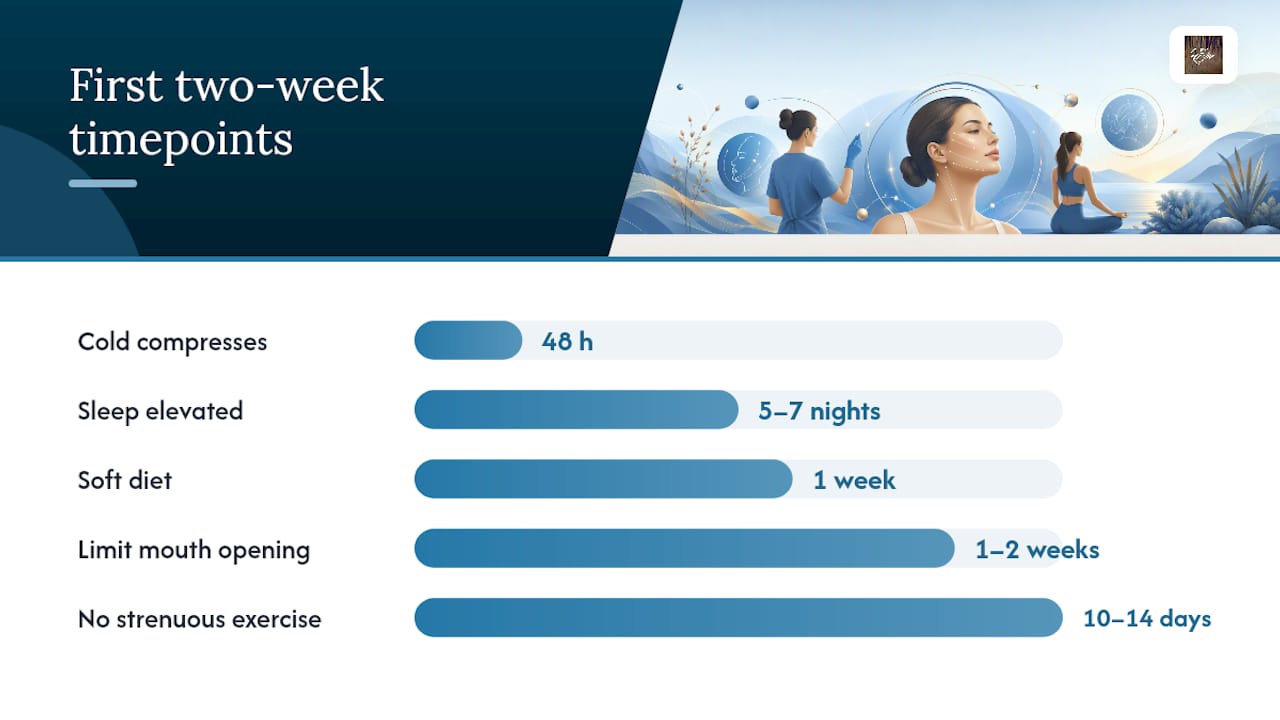
- Sleep on your back with your head elevated using an extra pillow or a travel pillow for the first 5 to 7 nights.
- Apply cold compresses for the first 48 hours to control swelling.
- Use topical antibiotic ointment at entry points exactly as your clinician directs.
- Cleanse gently, patting rather than rubbing the treated skin.
- Keep your six-week review appointment even if everything looks fine.
Don't do this:
- No facial massage or firm pressure on the treated area, since it can dislodge the thread anchors.
- No strenuous exercise, sauna, or steam rooms for roughly 10 to 14 days.
- No wide mouth opening, big yawns, or dental work for 1 to 2 weeks.
- No laser treatments or chemical peels over the area for at least 4 weeks.
A soft diet for the first week takes pressure off your jaw muscles, and sunglasses do double duty: they protect your eyes and keep your hands from absentmindedly touching your cheeks. If you're planning a wedding, reunion, or anything photo-heavy, book your thread lift at least three weeks ahead so bruising and swelling have time to clear.
Pro Tip: Skip the arnica and bromelain supplements unless your clinician specifically recommends them. Ice genuinely speeds swelling reduction, but the evidence for supplements accelerating recovery is thin at best, according to a RealSelf clinical overview.
For a more detailed rundown, our PDO thread aftercare guide walks through the first-week routine step by step.
Managing Pain and Choosing the Right Medication
Most patients describe the discomfort as mild to moderate tightness and soreness rather than sharp pain, and it's usually manageable without anything stronger than what's already in your medicine cabinet.
- Acetaminophen is generally the preferred pain reliever because it doesn't carry a bleeding risk.
- NSAIDs like ibuprofen can increase bruising, so talk to your provider before reaching for them.
- Short courses of oral steroids are sometimes prescribed if swelling is more pronounced than expected.
- Topical antibiotics at entry points lower infection risk during the first days when the skin is still healing.
- Blood thinners and supplements such as fish oil or high-dose vitamin E should never be stopped or started without checking with your clinician first, since either move can affect bruising or bleeding control.
When to Call Your Clinic
Most of what you'll feel in the first two weeks is normal. Mild asymmetry while swollen, occasional puckering, and soreness when chewing don't need a phone call. A different pattern of symptoms does.
- Pain that gets worse after 48 hours instead of easing up.
- Redness that spreads rather than staying localized.
- Warmth over the treated area, fever, or pus-like drainage.
- A thread visibly emerging through the skin surface.
- A lump that's rapidly growing and increasingly tender.
Clinics report that many patients notice significant swelling and a smaller share experience bruising, so seeing either on its own isn't a red flag, according to Hampstead Aesthetics. What matters is the direction things are moving. If symptoms are trending toward worse rather than better, call the clinic. For fever or fast-spreading infection signs, treat it as urgent and seek care right away rather than waiting for a callback.
How Results Change Over Time
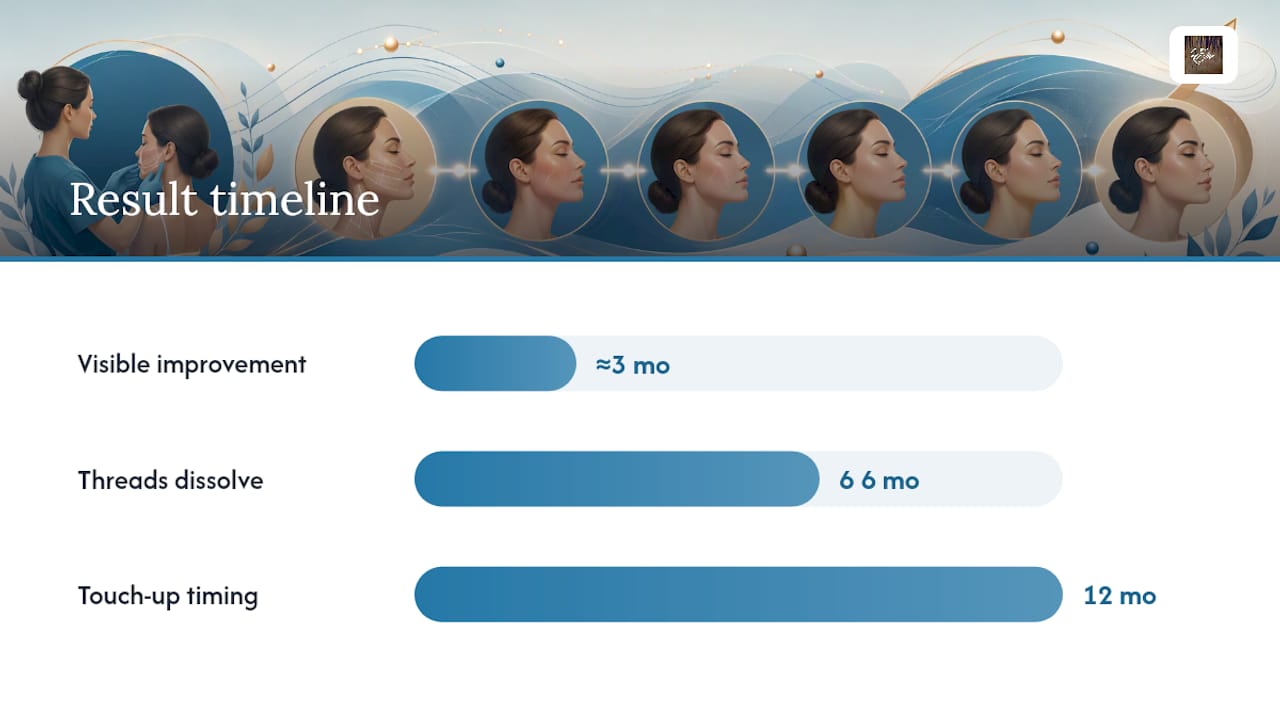
What you see on day one and what you'll have at month three are two different things, driven by two different mechanisms. The immediate lift is purely mechanical, the physical effect of threads pulling and anchoring tissue, and it can recede somewhat as swelling goes down over the first couple of weeks. That's expected, not a sign something failed.
Collagen remodeling is the slower, longer-lasting part of the story. It builds gradually over the following months, with visible improvement continuing out to three months and sometimes beyond, according to RealSelf's clinical summary. The threads themselves typically dissolve within about 6 to 9 months, and many patients start thinking about a touch-up around the 12-month mark as the mechanical effect fades and they want to refresh the collagen response.
- Pairing threads with volume restoration, like dermal fillers, before jawline threading often produces a more natural result than threads alone.
- Skin tightening treatments can extend the visual effect between thread sessions.
- Spacing combined procedures by two or more weeks helps manage cumulative swelling.
Elite Laser Center's Clinic Aftercare Summary
Our clinicians walk every thread lift patient through the same core aftercare points before they leave, because consistency in the first two weeks is what protects the result.
- Sleep elevated for the first week.
- No massage or pressure on the treated area.
- Stick to a soft diet for several days.
- Follow topical antibiotic instructions at entry points precisely.
- Keep your six-week review on the calendar.
| Priority | Recommendation |
|---|---|
| Sleep position | Elevated, on your back, first 5 to 7 nights |
| Diet | Soft foods for about a week |
| Follow-up | Six-week clinical review |
| Contact rule | Call if pain worsens or redness spreads |
Every thread lift at Elite Laser Center is performed under medical supervision, and our team would rather hear from you early than have you wait out a symptom that turns out to matter. If something feels off before your scheduled review, call or book a check-in.
The Overrated Advice and the Underrated Discipline
The internet's biggest miss on thread lift recovery is treating the two-week mark like a finish line. It's not. Two weeks is when swelling clears and you stop looking like you had a procedure done, but it tells you almost nothing about whether the threads actually held their vectors. That verdict comes at six weeks, once mechanical swelling is fully out of the picture and collagen response has started.
The other pattern worth pushing back on: patients who panic over normal puckering and start massaging the area to "smooth it out." That instinct is understandable and almost always counterproductive, since pressing on fresh thread anchors is one of the more reliable ways to undo a good placement. Puckering that looks alarming on day four is frequently gone by day ten with zero intervention.
What actually deserves your attention in the first two weeks isn't the swelling, it's sleep position and keeping your hands off your face. Those two habits, more than any supplement or fancy skincare step, determine whether your results look intentional or uneven at the six-week check.
— Sharon
Recover Smarter With Elite Laser Center's Thread Lift Program
Elite Laser Center approaches PDO thread lift recovery the way it should be handled: with a clear protocol, a scheduled six-week review already built into your treatment plan, and a medical team you can actually reach if something feels wrong. That's different from going somewhere that hands you a printed aftercare sheet and no direct line back to the person who placed your threads.

If you're considering a thread lift or you're already scheduled and want to know exactly what your specific treatment plan involves, our PDO thread lift page covers the procedure details, and it's the place to start if you have questions about combining threads with fillers or skin tightening down the line. Book a consultation to talk through your treatment areas, thread count, and a recovery timeline built around your schedule, not a generic estimate.
This article is general information, not a substitute for advice from a qualified doctor. Consult a qualified healthcare professional about your own circumstances before acting on anything here.
Sources
- Thread Lift — Cleveland Clinic
- PMC article on thread lift clinical observations
- What to expect after a PDO thread lift — Hampstead Aesthetics
FAQ
How long does it take to look normal after a thread lift?
Most swelling and bruising resolve within 5 to 14 days, and by the six-week mark you should see your final settled result, according to the Cleveland Clinic.
What are the do's and don'ts after a PDO thread lift?
Do sleep elevated, use cold compresses for the first 48 hours, and keep your six-week follow-up; don't massage the area, do strenuous exercise for about two weeks, or open your mouth wide for dental work during the first 1 to 2 weeks.
Why do some plastic surgeons hesitate to recommend PDO threads?
Some surgeons prefer surgical facelifts for longer-lasting, more dramatic correction, since thread lift results are more subtle and typically last around 12 months before a touch-up is worth considering as the mechanical effect fades.
How long will my face hurt after PDO threads?
Most patients have mild to moderate soreness and tightness that eases significantly within the first week, and it's usually manageable with acetaminophen rather than anything stronger.
When should I actually call my clinic during recovery?
Call if pain worsens after 48 hours instead of improving, or if you notice spreading redness, fever, drainage, or a thread visible at the skin surface.