

For the first few nights, sleep on your back with your head slightly elevated. Skip facial massage, pressure, saunas, and hard workouts until your provider clears you. Call your clinic immediately if pain gets worse after the first two days, redness spreads, you develop a fever, or a thread becomes visible under the skin.
TL;DR:
- Keeping the head elevated and avoiding facial massage, strenuous workouts, and certain skincare ingredients are critical during the first week to prevent thread migration or dimpling.
- Swelling and bruising peak within the first three days, but most of the visible discomfort resolves within a week, with subtle asymmetry common during tissue settling.
- Avoid alcohol, hot foods, and heavy mouth movements in the first two weeks to reduce swelling and mechanical stress on healing threads.
- Persistent or worsening pain, spreading redness, fever, or a visible thread poking through the skin require immediate medical consultation.
- Long-term results depend on collagen formation, with noticeable lifting lasting around six months and full absorption of threads occurring in six to eight months, often requiring touch-ups after a year.
Table of Contents
- Your Day-by-Day PDO Thread Aftercare Checklist
- What to Expect: The PDO Thread Recovery Timeline
- Warning Signs That Mean You Should Call Your Clinic
- Protecting Your Results Long After the Threads Dissolve
- Planning Your Follow-Up Visits
- Cleaning the Treated Area Without Disturbing the Threads
- Managing Pain Beyond the First Few Days
- Eating to Support Healing and Reduce Swelling
- Supplements and Medications That Can Interfere With Healing
- Elite Laser Center's Take on Supervised Aftercare
- Book a PDO Thread Consultation With Elite Laser Center
- Where to Learn More About Thread Lift Safety and Recovery
- Sources
- FAQ
Your Day-by-Day PDO Thread Aftercare Checklist
Recovery from a thread lift moves fast compared to surgical facelifts, but the first two weeks still demand real discipline. Miss a step and you risk a dimple that won't settle or a thread that migrates.
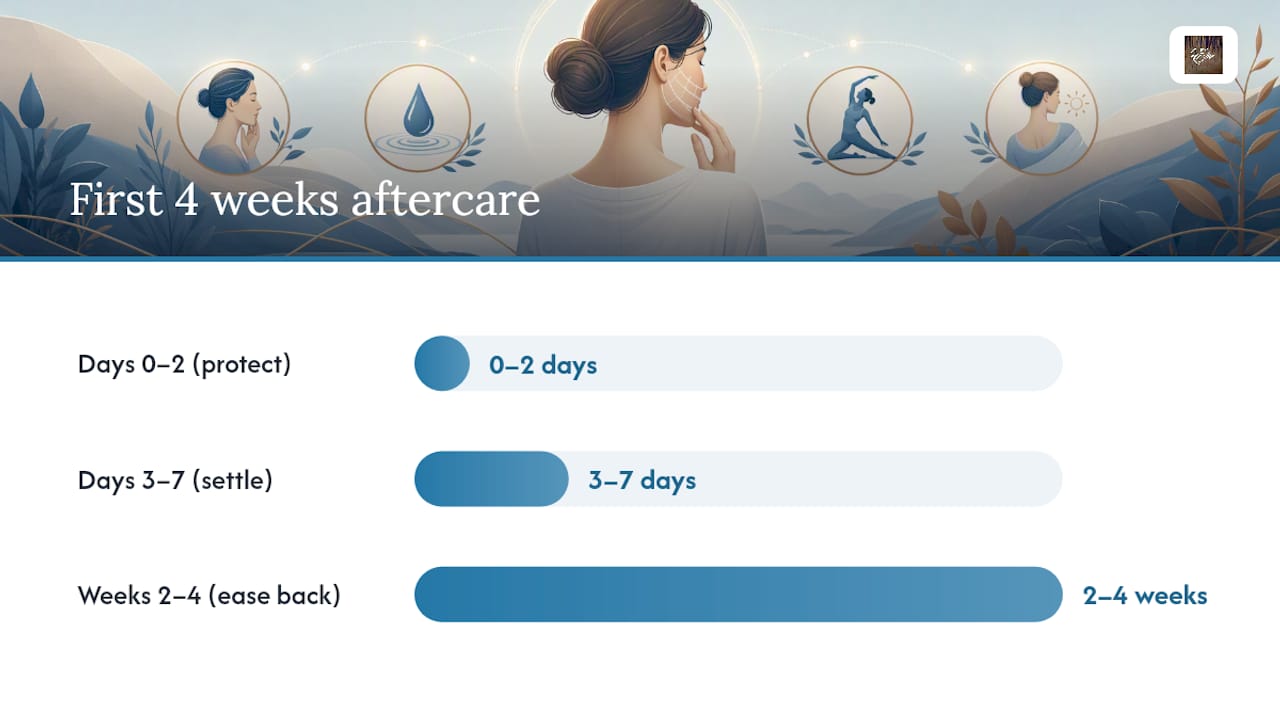
Days 0 to 2: protect the setup
- Apply cold compresses gently in short intervals to manage swelling and discomfort.
- Leave your face unwashed for the first 12 to 24 hours unless your provider says otherwise.
- Keep your hands off the treatment sites entirely. No touching, no rubbing, no "checking" with your fingers.
- Take the analgesic your provider recommends. Clinicians commonly suggest acetaminophen and steer patients away from NSAIDs like ibuprofen early on, since NSAIDs raise bruising risk during the first days.
- Hold off on any blood thinning medication or supplement unless your provider has explicitly cleared it.
Days 3 to 7: settle into a routine
- Keep sleeping with your head elevated. A travel pillow or an extra pillow wedge works.
- Stick to a soft diet. Wide mouth opening during this window can tug on threads that haven't anchored yet.
- Skip dental cleanings and facial massage if you can reschedule them.
- Wear makeup only once the skin is intact and your provider says it's fine.
- Hold off on retinol, glycolic acid, and other active ingredients for at least a week.
Weeks 2 to 4: ease back in
Once your provider clears you, ease into low-impact movement first, walking or light stretching, before returning to anything more intense. Wear sunscreen daily and avoid prolonged heat exposure like saunas or hot yoga for at least 2 to 4 weeks. Save laser treatments, microneedling, and deep-tissue facial massage for 4 weeks out or longer, based on what your clinic recommends.
The short list of "don'ts" that trips people up: no side-sleeping, no rubbing the treated area, no heavy lifting or cardio, no steam rooms, no aggressive skincare, and it's smart to limit alcohol in the early days since it thins blood and worsens bruising.
Pro Tip: Set a phone reminder for "no side-sleeping" the first week. Most people don't realize they've rolled onto their side until they wake up, and by then the damage to a healing thread is already done.
What to Expect: The PDO Thread Recovery Timeline
Swelling and bruising peak around 24 to 72 hours after treatment, and most of that visible puffiness resolves within days to about a week. Some tightness, mild puckering, or asymmetry during this window is completely normal. It looks alarming. It usually isn't.
- Days 1 to 7: Swelling and bruising peak early, then fade. Puckering and slight asymmetry are common while tissue settles.
- Weeks 2 to 6: Visible swelling is mostly gone. The lift starts looking natural instead of "done." Dimpling that appeared right after treatment resolves in many patients by the 2 to 4 week mark.
- Months 1 to 6: Collagen builds around the threads, adding structural support beyond what the thread itself provides. Peak cosmetic improvement tends to show up around 2 to 3 months.
- Months 6 to 18: Threads hydrolyze, meaning they break down and absorb into the body, typically within about 6 to 8 months. The collagen scaffold they triggered keeps supporting the lift for a while after that. Most patients notice results fading after about a year, which is when many schedule a touch-up.
That gap between "thread gone" and "results gone" surprises a lot of patients. The thread is doing scaffolding work early on, but the collagen it stimulates is what actually carries the lift once the suture material is gone.
Warning Signs That Mean You Should Call Your Clinic
Most thread lift recovery is boring in the best way: mild swelling, some tenderness, done. But certain signs mean you stop waiting and pick up the phone.
Watch for these red flags:
- Pain that gets worse, not better, after the 48 hour mark
- Redness that's spreading rather than staying localized, or skin that feels warm to the touch
- Fever
- Discharge that's persistent or getting worse, especially if it has an odor or changes color
- A thread visibly poking through the skin or otherwise exposed
- Bruising that's expanding rapidly rather than slowly fading
- Asymmetry that's getting more pronounced instead of settling down
If you spot any of these, photograph the area right away so you and your provider can track changes. Don't try to manipulate or remove a thread yourself, and stop applying any topical products until you've talked to the clinic. Reserve emergency care for systemic signs like a high fever or infection that's spreading fast.
Most clinics triage this over the phone first, often reviewing your photos, before deciding whether you need to come in. In-clinic evaluation might lead to antibiotics or, rarely, a small incision to address a specific issue. Serious complications are uncommon when an experienced provider places the threads, which is exactly why choosing where you get this done matters as much as how you take care of it afterward.
Pro Tip: Keep a simple photo log on your phone from day one, dated and timestamped. If something looks off in week two, having a clear "before" reference from day three makes the phone call to your provider ten times more productive.
Protecting Your Results Long After the Threads Dissolve
The habits that protect your results in month one are different from the ones that matter in month six, and confusing the two is a common mistake.
Early on, limit large mouth movements and heavy chewing. A soft diet for about a week takes real strain off tissue that's still settling. Daily sunscreen matters just as much, since UV damage breaks down the collagen your results now depend on. Gentle moisturizers are fine from the start; save retinol and acids until your provider gives the green light.
Once you're fully healed, longevity becomes a conversation to have with your provider rather than a solo decision. Some patients space out repeat thread placements every 12 to 18 months as the collagen effect fades. Others combine threads with neuromodulators to reduce the muscle pull that speeds up sagging in certain areas, or add noninvasive skin tightening as a complementary step rather than a replacement.
Planning Your Follow-Up Visits
Good aftercare doesn't end when the swelling does. Most clinics offer immediate triage access if something feels wrong, an optional check-in around 48 to 72 hours, and a fuller review somewhere between 2 and 6 weeks out, depending on the clinic's protocol.
Come to that follow-up with real questions: When can you resume fillers or laser treatments? What symptoms would justify moving up your next visit? What does a touch-up cost if you need one? Review your provider's detailed post-treatment instructions and know who to call after hours.
Keep it simple on your end: save dated photos, jot down any medication you've taken, and keep your clinic's number and aftercare sheet somewhere you'll actually find them, not buried in an email you'll forget to search for.
Cleaning the Treated Area Without Disturbing the Threads
Cleaning sounds straightforward until you realize the wrong technique can undo a week of careful healing. Most clinics ask patients to skip washing entirely for the first 12 to 24 hours, giving entry points time to close.

After that window, use a gentle, fragrance-free cleanser and lukewarm water, never hot. Pat the skin dry with a clean towel instead of rubbing, since friction is exactly the kind of mechanical stress that can shift a thread before it's anchored. Avoid exfoliating cleansers, cleansing brushes, or anything with acids until your provider clears active ingredients, usually after the first week.
If your provider prescribed a topical antiseptic or ointment, apply it exactly as directed, no more and no less. Skip makeup wipes in the first few days even if they feel gentler than washing, since the pulling motion works against you. Wash your hands before touching your face for any reason during this period, and change your pillowcase more often than usual since it sits directly against the treated skin every night.
If you notice discharge, unusual odor, or a wound that isn't closing the way you'd expect, that's a cleaning issue that's crossed into a clinical one, and it belongs on the phone with your provider, not solved with more soap.
Managing Pain Beyond the First Few Days
Most patients find the sharpest discomfort fades within the first week, but it's common to feel intermittent tightness or tenderness for longer, especially with facial expressions or chewing. That's tissue and thread settling, not a sign something's wrong.
For pain past the initial swelling phase, acetaminophen remains the safer choice over NSAIDs like ibuprofen or aspirin, which can increase bruising and, in some cases, interfere with healing. Follow the dosage on the label or whatever your provider specifically recommends, and never exceed the maximum daily amount, particularly if you're also taking other medications that contain acetaminophen.
If over-the-counter pain relief isn't cutting it by week two, that's worth a call rather than pushing through it. Persistent or worsening pain past 48 hours is one of the clearest signals something needs a look, not just patience. Heat should stay off the table during this stretch too. Warm compresses can feel tempting once the initial swelling calms down, but heat encourages blood flow in a way that can prolong bruising and swelling rather than easing it. Stick with cold compresses in the earliest days and let time handle the rest.
Eating to Support Healing and Reduce Swelling
What you eat in the first two weeks genuinely affects how your face heals, and it's one of the more overlooked pieces of PDO thread aftercare.
Lean toward anti-inflammatory foods: fatty fish, leafy greens, berries, and foods rich in vitamin C, which plays a role in collagen production, the very process your results depend on. Staying well hydrated helps reduce swelling and supports tissue repair generally.
On the restriction side, alcohol is the big one. It thins blood and dilates vessels, both of which make bruising worse and can prolong swelling you'd otherwise not have to deal with. Most providers recommend avoiding it for at least the first few days, if not the full first week. Excess sodium is worth watching too, since it contributes to fluid retention that can make swelling look worse than it actually is. Very hot foods and drinks, along with anything requiring aggressive chewing, work against the soft-diet recommendation for the same reason wide mouth opening does: mechanical stress on tissue that hasn't settled yet.
Supplements and Medications That Can Interfere With Healing
This is the section patients most often overlook, and it's one of the easiest to get wrong without realizing it.
Certain supplements thin the blood or interfere with clotting in ways that raise bruising and bleeding risk after thread placement. Fish oil, vitamin E, ginkgo biloba, and high-dose garlic supplements all fall into this category. So do prescription blood thinners, and even some over-the-counter pain relievers like aspirin and ibuprofen carry the same risk profile during early healing.
The rule here is simple: tell your provider about everything you're taking before your appointment, and don't stop or start anything without checking first, especially anything prescribed for an unrelated condition. Some providers ask patients to pause certain supplements for a week or two before and after treatment specifically to reduce bruising risk. If you're on a prescribed blood thinner for a medical condition, that's a conversation for your provider and prescribing physician together, not a decision to make solo based on an aftercare sheet.
Elite Laser Center's Take on Supervised Aftercare
Thread lifts reward providers who take aftercare seriously, not just the injection itself. Elite Laser Center's non-surgical treatments are performed under medical supervision with clear follow-up availability, which is exactly the infrastructure that catches a minor issue before it becomes a real one. Choosing a provider who answers the phone and gives you a real escalation path matters more than most patients realize going in.
— Sharon
Book a PDO Thread Consultation With Elite Laser Center
Elite Laser Center treats PDO thread lifts as a supervised medical procedure from consultation through the final follow-up, not a one-and-done appointment. Every treatment plan is built around your specific skin and goals, with clear aftercare instructions and a real person to call if something feels off during recovery.

That kind of follow-up access is the difference between guessing whether swelling is normal and getting a straight answer from someone who placed your threads. If you're considering a thread lift or you want to talk through what recovery will look like for your specific case, visit the PDO thread lift page to schedule a consultation and get a personalized aftercare plan before you book.
Where to Learn More About Thread Lift Safety and Recovery
For deeper reading beyond this guide, the FDA's device clearance records cover PDO suture status, and Cleveland Clinic's overview walks through what to expect during recovery.
This article is general information, not a substitute for advice from a qualified doctor. Consult a qualified healthcare professional about your own circumstances before acting on anything here.
Sources
- Thread lift: What to Expect, Benefits & Complications — Cleveland Clinic
- PDO Threads: Results, Risks and Cost — GLPbase
FAQ
What Should You Avoid Doing After a PDO Thread Lift?
Avoid facial massage, pressure on the treated area, side-sleeping, strenuous exercise, high heat exposure like saunas, and aggressive skincare products for at least the first 1 to 4 weeks depending on your provider's specific guidance.
How Long Does It Take to Heal After PDO Threads?
Initial swelling and bruising typically improve within days to about a week, while full settling of the lift and resolution of any dimpling usually happens within 2 to 6 weeks.
How Long Until My Face Feels Normal After a Thread Lift?
Most patients feel back to normal within a week for daily activities, though subtle tightness or awareness of the treated area can linger for several weeks as collagen builds around the threads.
Why Are Some Plastic Surgeons Skeptical of PDO Threads?
Some surgeons note that PDO sutures are FDA cleared for wound closure rather than cosmetic lifting, meaning their lifting use is off-label, and that results are temporary compared to surgical alternatives, typically fading within 12 to 18 months.