
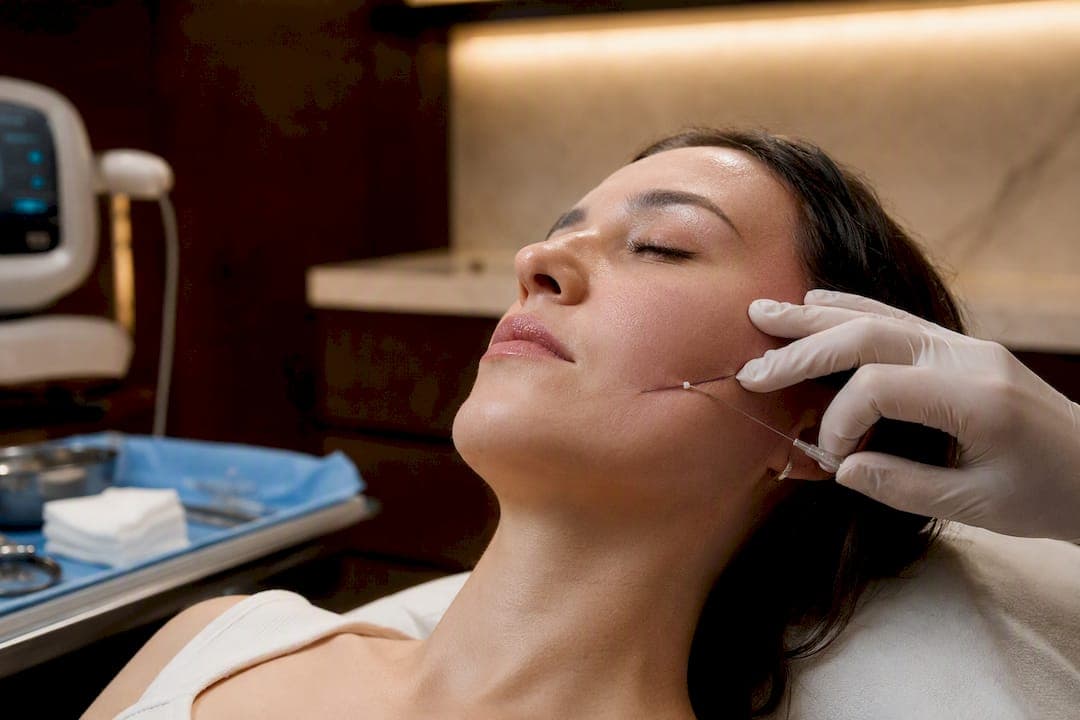
Most patients see a visible mechanical lift that peaks in the first month and starts fading by 6 months, while collagen-driven firming can stretch the total visible benefit to 12 to 18 months. The threads themselves dissolve faster than that. PDO material typically breaks down within several months, so the tissue support you notice after that period comes from collagen your body built around the thread, not the thread itself. Genetics, skin quality, and aftercare all shift that window in either direction.
TL;DR:
- Most visible effects from a PDO thread lift fade within 6 to 12 months as the threads dissolve and collagen support diminishes.
- The longevity heavily depends on thread material, with PDO lasting 6 to 8 months, PCL roughly longer, and PLLA potentially extending results beyond a year.
- Individual factors such as skin quality, age, genetics, and aftercare significantly influence how long results last and should be considered before treatment.
- Proper aftercare, including sun protection, avoiding smoking, and maintaining stable weight, can help extend the duration of visible improvements.
- Combining thread lifts with other treatments like skin tightening and injectables often provides longer-lasting and more natural results.
Table of Contents
- What Is PDO Thread Lift Longevity, and Why Does It Vary So Much?
- What Happens Month by Month After a Thread Lift?
- What Factors Actually Determine How Long Your Results Last?
- What Does the Clinical Research Say About Thread Lift Durability?
- How Do You Maintain PDO Thread Lift Results Longer?
- When Should You Repeat Threads vs. Consider Fillers or a Facelift?
- How Elite Laser Center Approaches Thread Lift Longevity
- Ready to Talk PDO Thread Lift Longevity? Book a Consultation
- Sources
- FAQ
What Is PDO Thread Lift Longevity, and Why Does It Vary So Much?
A PDO thread lift works two ways at once, and understanding both explains why longevity numbers swing so widely between clinics and studies.
The first mechanism is mechanical. Barbed or cone threads grip the underside of the skin and physically reposition sagging tissue the moment they're placed, similar to how a small internal scaffold props things up. Smooth threads skip that grip entirely and rely on a different mechanism: they irritate the tissue just enough to trigger a healing response.
That healing response is the second mechanism, and it's the one that outlasts the thread. PDO (polydioxanone) sutures provoke collagen production that peaks around 12 weeks after placement, then gradually tapers as the thread itself dissolves.
Material choice changes the math:
- PDO absorbs fastest, typically within 6 to 8 months, making it the most common but shortest-acting option.
- PCL (polycaprolactone) degrades more slowly, often provoking a longer tissue response.
- PLLA (poly-L-lactic acid) breaks down slowest of the three, which is why some providers position it as the longer-lasting choice for patients wanting extended collagen stimulation.
What Happens Month by Month After a Thread Lift?
Results follow a fairly predictable arc, though individual timelines shift based on skin quality and technique.
- Days 0 to 14: You'll see immediate lift right after the procedure, alongside swelling, mild bruising, and possibly some visible dimpling near entry points. This is normal healing, not a sign the treatment failed.
- 1 to 3 months: Swelling resolves and the initial "too tight" look softens into something more natural. Collagen synthesis is actively ramping up during this window, which is why many providers ask patients to wait until the 3 month mark before judging final results.
- 6 months: PDO threads are largely absorbed by this point. The mechanical traction that gave you that first-week snap has usually faded substantially, sometimes disappearing altogether. A 2019 study in the Aesthetic Surgery Journal tracked this exact pattern, finding the mechanical lift had declined noticeably by 6 months.
- 12 to 18 months: Most patients notice a gradual softening of results as collagen support wanes. Some retain modest residual firmness from tissue remodeling, but in the longer term the lift effect diminishes considerably.
Outliers exist in both directions. Younger patients with thicker, more elastic skin sometimes hold visible improvement closer to 18 months. Patients with thinner skin, higher sun exposure, or smoking history often see fading well before the 6 month checkpoint.
What Factors Actually Determine How Long Your Results Last?
Some variables are baked in before you ever sit in the treatment chair. Others are choices you make afterward.
What you can't change much:
- Age and baseline collagen production, since collagen synthesis naturally slows over time
- Skin thickness and elasticity, which affects how well tissue holds a repositioned shape
- Genetic factors influencing how fast your body metabolizes PDO material
What technique and provider choices control:
- Thread material selection (PDO vs PCL vs PLLA) based on your goals and budget
- Vectoring and anchoring strategy, meaning the direction and depth threads are placed to work with your facial anatomy rather than against gravity
- Total thread count, though more isn't automatically better
That last point surprises a lot of patients. A randomized clinical trial comparing thread quantity found no significant difference in sustained outcomes between three and six threads per side of the face at 60-day follow-up. Adding threads increases cost and treatment complexity without reliably extending how long results last.
What you control after treatment:
- Daily sun protection, since UV exposure breaks down collagen faster than almost anything else
- Avoiding smoking, which impairs the microcirculation your skin needs to build new collagen
- Weight stability, since significant fluctuations can stretch or slacken the tissue threads are meant to support
Pro Tip: If you're weighing thread material options, ask your provider directly how many threads of each type they typically place and why, rather than assuming a higher number automatically means a longer-lasting result.
What Does the Clinical Research Say About Thread Lift Durability?
The gap between marketing claims and published data is real, and it's worth understanding before you book anything.
That evidence gap explains why you'll see wildly different longevity claims across clinic websites. A large multicenter review covering more than 110,000 thread lift cases found average durable effects landed in the 6 to 12 month range for PDO-dominant placements, with PDO threads degrading in roughly 6 to 8 months and PCL threads lasting longer. That's a meaningfully shorter window than the 12 to 18 months many clinics quote, and the review's authors attribute the discrepancy partly to best-case patient selection in smaller studies and partly to material mixing in cases that combine PDO with slower-degrading threads.
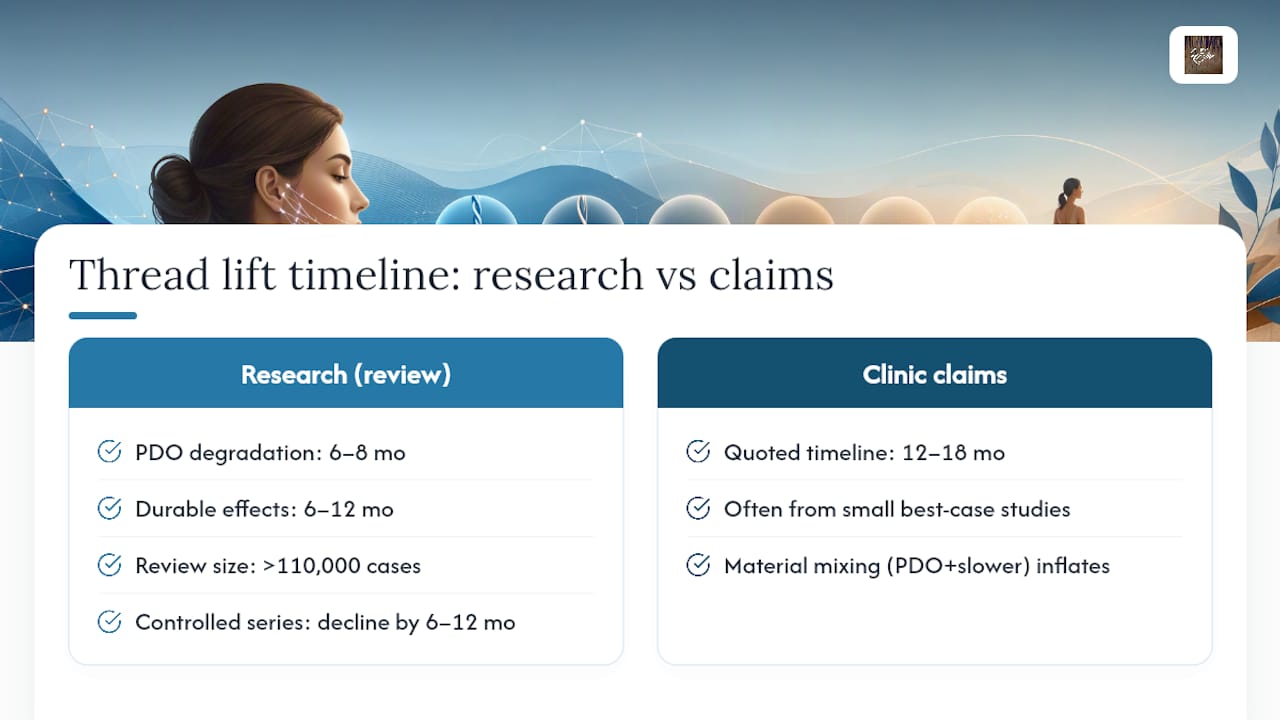
The earlier Aesthetic Surgery Journal study reinforces this pattern at the individual-patient level, tracking mechanical lift decline through the 6 month and 1 year marks in a controlled series. Systematic reviews of patient satisfaction echo the same trend: satisfaction runs high immediately post-procedure and drops measurably at longer-term follow-up, which is exactly why transparent counseling about realistic timelines matters more than optimistic marketing copy.
How Do You Maintain PDO Thread Lift Results Longer?
Aftercare in the first two weeks sets the foundation for everything that follows. Sleep on your back with your head slightly elevated, skip strenuous exercise and facial massages for 7 to 14 days, and avoid excessive jaw movement or dental work if possible during that window. Our clinician-backed recovery plan walks through the full early-healing checklist in more detail.
Beyond the initial recovery window, daily habits matter more than most patients expect:
- Wear SPF every day, since UV damage accelerates collagen breakdown regardless of any procedure you've had
- Introduce retinoids gradually once initial healing is complete, since they support ongoing collagen turnover
- Prioritize protein intake and hydration, both of which feed the collagen synthesis process
- Consider antioxidant-rich skincare to help protect the collagen your threads helped stimulate
Combining thread lifts with other treatments often extends visible results more effectively than adding more threads. Neuromodulators reduce dynamic wrinkling that can undercut a lifted appearance, while skin tightening treatments support the same collagen remodeling pathway threads rely on. For full aftercare specifics, see our guide on PDO thread aftercare.
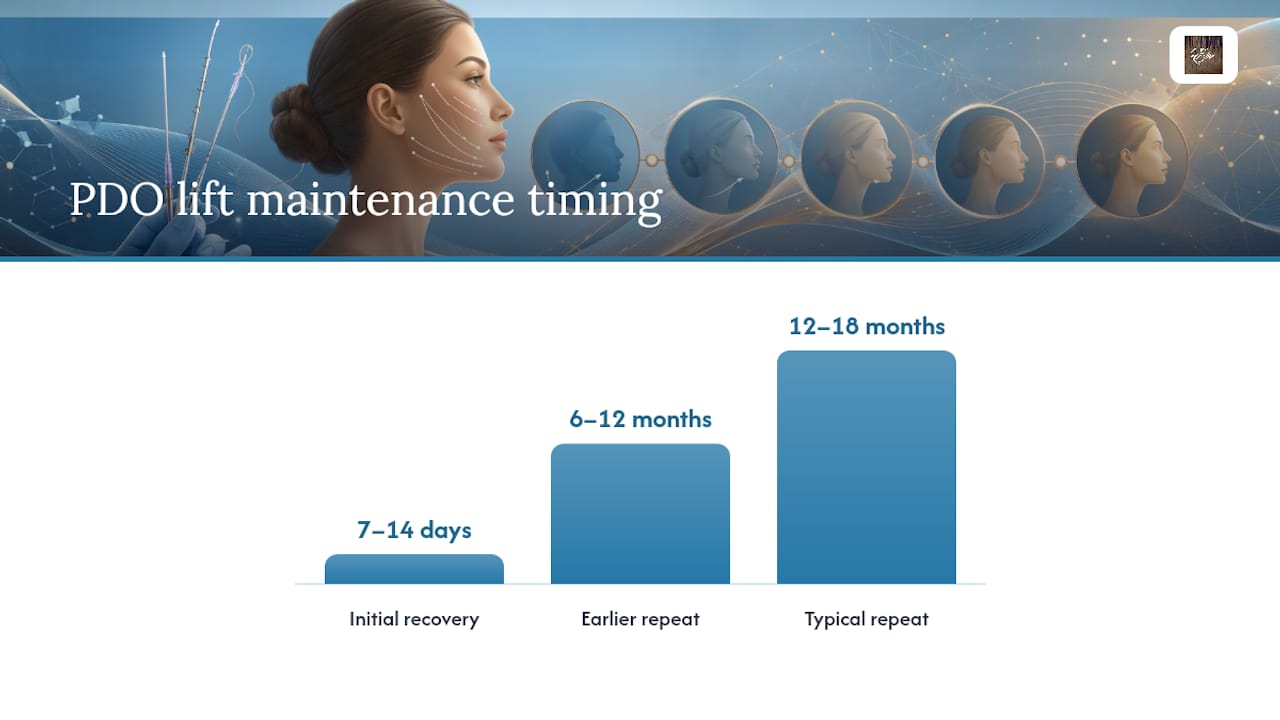
Most patients consider a repeat treatment at 12 to 18 months, though some return earlier, around 6 to 12 months, if their goals call for maintaining a more dramatic lift.
When Should You Repeat Threads vs. Consider Fillers or a Facelift?
Repeat treatment makes sense once you notice softening along the original lift vector or a return of laxity in the treated area, particularly if your goals haven't changed. Combining threads with injectables makes more sense when volume loss, not sagging, is driving the changes you see.
Broad longevity comparison:
- PDO thread lifts: months to roughly 1 to 2 years, per Cleveland Clinic's overview, with most real-world durability at the shorter end of that range
- Dermal fillers: typically 6 to 18 months depending on the product and treatment area
- Surgical facelift: results measured in years, not months, because surgery physically removes and repositions tissue rather than relying on temporary support
Threads suit mild to moderate laxity best. If you're dealing with significant sagging or excess skin, a facelift consultation is the more honest conversation to have, and a good provider should tell you that upfront rather than oversell what threads can do.
How Elite Laser Center Approaches Thread Lift Longevity
We treat candidacy conversations as the most important part of the process, not a formality before booking. That means an honest look at your skin laxity, realistic expectations about the 6 to 18 month window, and a maintenance plan built around your specific goals rather than a one-size-fits-all package. Our team plans combination treatments, including fillers or skin tightening, at the point they'll do the most good, and every patient leaves with a clear recovery roadmap. Our six-week recovery guide covers what that looks like in practice.
— Sharon
Ready to Talk PDO Thread Lift Longevity? Book a Consultation
Unlike clinics that quote a flat 18-month promise regardless of your skin type, Thread lift plans should be built around individual biology, considering baseline collagen quality and lifestyle factors that affect fading. Treatments should be performed under medical supervision with thorough consultation about thread material options before committing.

A consultation starts with an honest assessment of your skin laxity and candidacy, not a sales script. If threads aren't the right fit, we'll say so and talk through alternatives like skin tightening or RF micro-needling instead. If you're ready to see what a personalized plan looks like, visit our PDO thread lift page to book your consultation and get a maintenance timeline built specifically for your skin.
This article is general information, not a substitute for advice from a qualified doctor. Consult a qualified healthcare professional about your own circumstances before acting on anything here.
Sources
- Aesthetic Surgery Journal study (2019)
- Multicenter review (2025) — PMC article
- NCBI / PMC article on thread materials and tissue response
- Cleveland Clinic — Thread lift overview
FAQ
How long do PDO threads actually last?
The threads themselves dissolve in about 6 to 8 months, but visible lift can persist longer through collagen support, typically totaling somewhere between 6 months and 18 months depending on your skin and technique.
Why do plastic surgeons not like PDO threads?
Some surgeons view threads skeptically because the evidence base is thinner than for surgical facelifts, with much of the durability data coming from case series rather than large randomized trials, and because results are temporary compared to surgery.
What is the best age for a thread lift?
Threads work best on mild to moderate laxity, which typically makes relatively younger patients better candidates than those with significant sagging that usually requires surgical correction.
Which thread lift lasts the longest?
PLLA and PCL threads tend to outlast standard PDO threads because they degrade more slowly, provoking a longer collagen response, though PDO remains the most widely used material for its versatility and lower cost.