
Liposuction wins when you want a major, one-session change across one or more areas. CoolSculpting wins when you want modest, targeted fat reduction with zero surgery and no downtime. Neither one is a weight-loss tool, so if the scale is your main concern, this comparison isn't the answer you're looking for.
TL;DR:
- CoolSculpting reduces about 20 to 25 percent of fat in each area per cycle, with results appearing gradually over two to three months.
- Liposuction removes significantly larger fat volumes in a single session, with results visible within four to six weeks after swelling subsides.
- CoolSculpting carries a low risk of side effects, mainly mild and short-lived, but rare cases of paradoxical adipose hyperplasia may require liposuction correction.
- Liposuction involves surgery with longer recovery times and potential complications like bleeding, infection, and skin laxity, requiring careful provider verification.
- The total cost of CoolSculpting can quickly add up over multiple sessions and areas, while liposuction entails a higher upfront surgical fee but often achieves more dramatic one-time results.
Table of Contents
- CoolSculpting vs Liposuction: A Side-by-Side Snapshot
- How Do CoolSculpting and Liposuction Actually Work?
- How Much Fat Do You Actually Lose, and How Fast?
- What Are the Real Risks and Side Effects?
- How Long Is Recovery for Each Procedure?
- What Does Each Option Cost Over Time?
- How Do You Choose Between CoolSculpting and Liposuction?
- Elite Laser Center's Approach to CoolSculpting
- The Bottom Line on Choosing Between These Two
- An Editorial Take on the CoolSculpting vs Liposuction Debate
- Sources
- FAQ
CoolSculpting vs Liposuction: A Side-by-Side Snapshot
The core trade-off is invasiveness versus how dramatic a change you actually want. CoolSculpting is a noninvasive, applicator-based treatment done in a med spa chair. Liposuction is a surgical procedure done in an operating room, usually by a board-certified plastic surgeon.
- Invasiveness: CoolSculpting is noninvasive; liposuction is surgical, typically with local or general anesthesia.
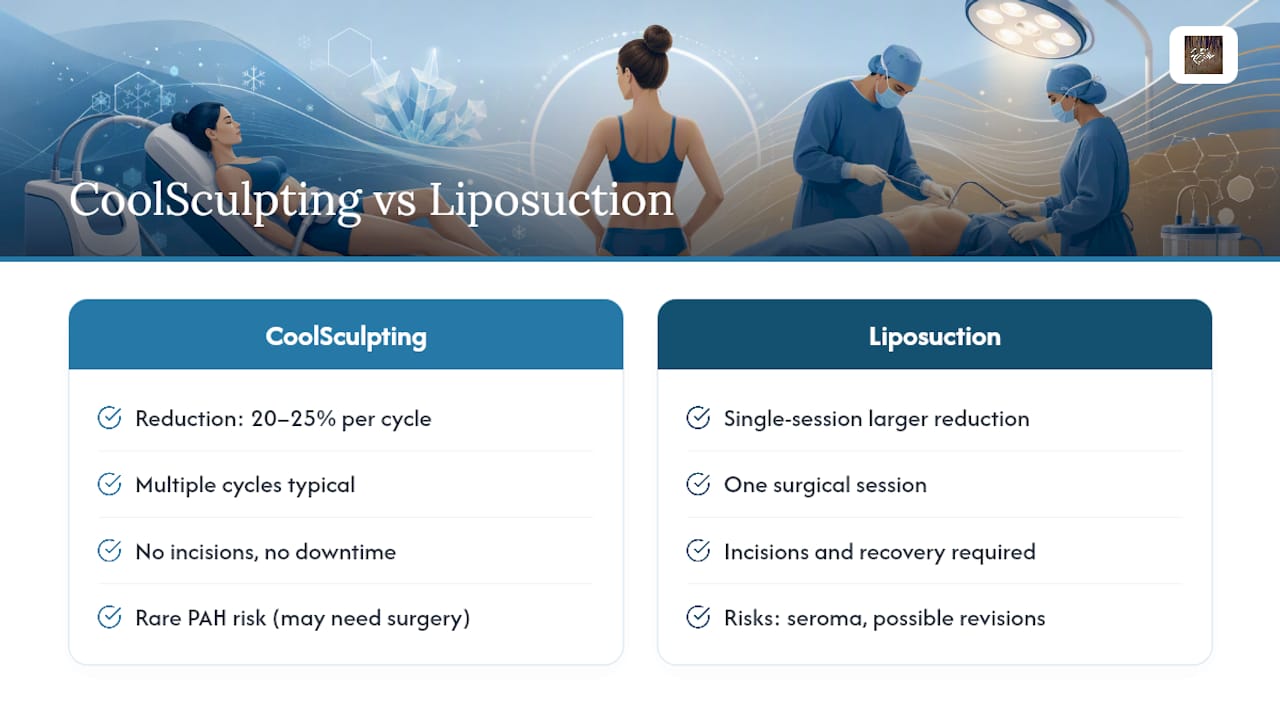
- Fat reduction per treatment: CoolSculpting reduces roughly 20 to 25 percent of fat in the treated area per session; liposuction removes a much larger volume in one procedure.
- Sessions and timeline: CoolSculpting often needs multiple cycles spaced weeks apart; liposuction is usually a single procedure with a defined recovery window.
- Downtime: CoolSculpting allows same-day activity; liposuction typically requires several days off and weeks of restricted exercise.
- Cost pattern: CoolSculpting is billed per cycle and adds up with repeat sessions; liposuction is a larger one-time surgical fee.
- Common areas: Both treat the abdomen, flanks, thighs, and submental area (chin); liposuction also handles arms, back, and larger multi-zone cases more efficiently.
How Do CoolSculpting and Liposuction Actually Work?
CoolSculpting uses a process called cryolipolysis. An applicator pulls the skin and fat into a chamber and cools it to a temperature that damages fat cells without harming skin. Over the following weeks, your lymphatic system clears out those damaged cells the same way it processes other cellular waste. There's no cutting, no needles for fat removal, and most sessions run 35 to 60 minutes per area.
Liposuction works by mechanical extraction. A surgeon inserts a thin cannula through small incisions and physically suctions fat out of the body. Techniques vary: tumescent liposuction floods the area with fluid to reduce bleeding and ease extraction, power-assisted liposuction vibrates the cannula to loosen fat faster, and VASER liposuction uses ultrasound energy to liquefy fat before removal. Most procedures happen under local anesthesia with sedation or general anesthesia, depending on the treated area and volume, and can run anywhere from one to several hours in a surgical setting.
The mechanism gap explains almost everything else in this comparison. One process asks your body to slowly clean up dead cells; the other removes the fat directly, on the table, that day.
How Much Fat Do You Actually Lose, and How Fast?
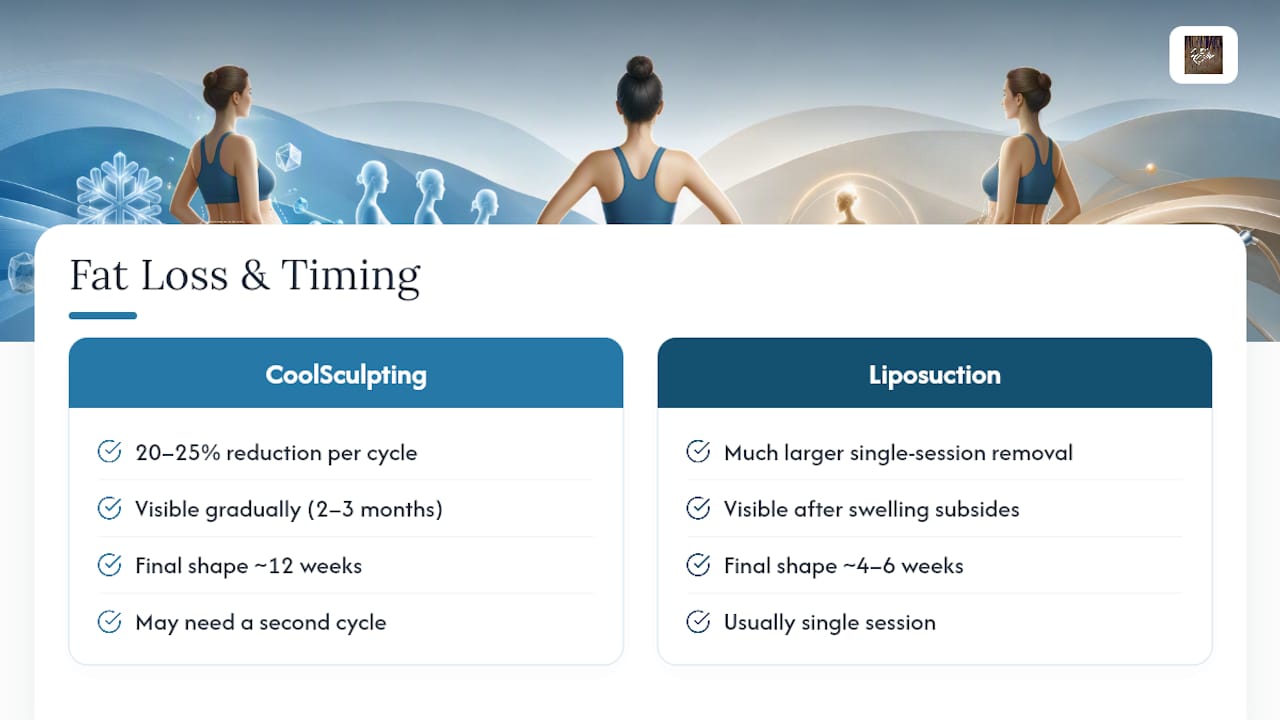
Expect roughly 20 to 25 percent fat reduction per CoolSculpting cycle in the treated pocket, appearing gradually over two to three months. Liposuction's single-session reduction is considerably larger, since surgical imaging studies consistently show much higher volume removal than any noninvasive alternative achieves.
The timelines diverge just as sharply. CoolSculpting results build slowly because your body needs time to metabolize the damaged fat cells. You won't see the final shape until around the 12 week mark, and many providers recommend a second cycle if the first pass didn't fully address the pocket. Liposuction results, by contrast, become visible almost immediately once postsurgical swelling subsides, usually within four to six weeks.
Neither procedure touches visceral fat, the kind packed around your organs. Both only affect subcutaneous fat, the layer you can pinch. And both depend on weight stability afterward. Gain a meaningful amount of weight post-treatment, and remaining fat cells anywhere on your body can expand and undercut the results you paid for.
What Are the Real Risks and Side Effects?
CoolSculpting's side effect profile is mild and short-lived for most people: temporary numbness, redness, bruising, and swelling in the treated area. These usually resolve within one to two weeks. The rare exception is worth knowing before you book: paradoxical adipose hyperplasia (PAH), a complication where treated fat tissue actually enlarges instead of shrinking in the months following treatment. It is uncommon, but when it happens, correction usually requires liposuction.
Liposuction's risk list is longer because it's surgery. Possible complications include bleeding, infection, adverse anesthesia reactions, contour irregularities, and seroma (fluid pooling under the skin that sometimes needs drainage). Skin laxity also matters here. Patients with looser skin can end up with a saggier result if the skin doesn't retract well after fat removal.
- Ask any provider directly about their PAH incidence and how they'd handle it if it occurred.
- Confirm the surgical facility's accreditation and the surgeon's board certification before scheduling liposuction.
- Review real before-and-after cases from the same treatment area you're considering, not just flattering full-body shots.
Pro Tip: Ask specifically how many months a provider monitors CoolSculpting patients for delayed complications like PAH. A provider who tracks patients for three to six months post-treatment is taking that rare risk seriously, not just mentioning it in the consent form.
How Long Is Recovery for Each Procedure?
CoolSculpting recovery is close to nonexistent. Most people go straight back to work, the gym, or errands the same day, with maybe some tenderness or numbness that fades within a week or two.
Liposuction asks more of your schedule. Plan for a few days away from desk work, compression garments worn for several weeks to control swelling and support the skin, and a wait of four to six weeks before returning to strenuous exercise. Follow-up visits typically happen at one week, one month, and three months post-surgery. Contact your provider immediately if you notice fever, spreading redness, unusual drainage, or pain that gets worse instead of better.
What Does Each Option Cost Over Time?
CoolSculpting is priced per cycle, and most treatment plans call for multiple cycles per area to reach the result you're picturing. That per-session model is convenient upfront but adds up fast across multiple areas or touch-up rounds. Liposuction is priced as a surgical fee that already accounts for the full transformation in one procedure, though it also carries facility fees and anesthesia costs on top of the surgeon's fee.
Here's where the math gets interesting: someone treating a single small area with one or two CoolSculpting cycles will likely spend far less than surgery. But someone treating multiple areas over two or three years of touch-up cycles can end up spending close to, or more than, a one-time liposuction fee, without ever matching liposuction's single-session volume reduction.
How Do You Choose Between CoolSculpting and Liposuction?
Three questions should drive your decision before you even book a consult.
- How dramatic a change do you want? A subtle refinement points toward CoolSculpting; a major reshaping points toward liposuction.
- How many areas are you treating? One small pocket favors CoolSculpting's simplicity; multiple zones favor liposuction's efficiency in a single session.
- How much downtime can you tolerate? Zero downtime means CoolSculpting; a few weeks of recovery is fine means liposuction stays on the table.
Once you know your answer, vet the provider with the same rigor. Confirm board certification and facility accreditation, ask to see real before-and-after photos from patients with your body type, and get a direct answer on how complications, including PAH, are handled and disclosed. Plastic surgery guidance consistently notes that candidacy discussions should happen with a board-certified provider who evaluates your skin laxity, anatomy, and expectations in person. Some patients stage their approach, starting with CoolSculpting on a smaller area, then moving to a surgical consult if the results don't go far enough. Others combine both over time, using CoolSculpting for maintenance between surgical touch-ups.
Elite Laser Center's Approach to CoolSculpting
Elite Laser Center treats CoolSculpting as a medical procedure, not a spa add-on. Every session runs on FDA-approved cryolipolysis devices under medical supervision, with a provider mapping applicator placement to your specific anatomy rather than a one-size-fits-all pattern. Internal protocol reviews, including documented arm-treatment outcomes, have shaped how the practice sequences cycles and sets patient expectations against published fat-reduction benchmarks. Bring a list of your target areas and any prior treatment history to your consult so the plan reflects what your body actually needs.
The Bottom Line on Choosing Between These Two
Pick liposuction for major, multi-area transformation; pick CoolSculpting for modest, no-downtime refinement. Either way, schedule a consult, bring your decision checklist, and let a qualified provider confirm you're a good candidate.
An Editorial Take on the CoolSculpting vs Liposuction Debate
The industry sells this as a binary choice, and that framing does readers a disservice. The real variable isn't which technology is "better," it's how much change you actually want and how much you're willing to trade for it. A 20 to 25 percent reduction per CoolSculpting cycle sounds unimpressive next to liposuction's single-session results, until you remember that number comes with zero incisions and zero recovery time. That's not a consolation prize. It's a completely different value proposition.
Where I think most comparison content undersells the conversation is PAH. It's rare, but it's the one CoolSculpting risk that can require the very surgery patients were trying to avoid in the first place. Any provider who glosses over it in a consult is giving you incomplete information, and that same standard should apply on the surgical side. Ask about seroma rates and revision policy just as directly as you'd ask a med spa about PAH incidence.
My honest read: the smartest patients don't pick a technology first. They pick a goal, then let that goal point them toward the procedure, the provider, and the timeline that actually fits it.
— Sharon
This article is general information, not a substitute for advice from a qualified doctor. Consult a qualified healthcare professional about your own circumstances before acting on anything here.
Sources
FAQ
Can I lose 20 pounds with CoolSculpting?
No. CoolSculpting is a body-contouring treatment for localized fat pockets, not a weight-loss method, and it typically reduces about 20 to 25 percent of fat in a treated area per session rather than producing overall weight loss.
How much do 4 sessions of CoolSculpting cost?
Pricing varies by provider, treatment area, and applicator count, so four sessions can range widely; ask your provider for a written quote based on your specific treatment plan before committing.
Is CoolSculpting or liposuction better for loose skin?
Neither procedure tightens skin, but liposuction can sometimes worsen the appearance of loose skin since it removes the fat that was filling it out; patients with significant skin laxity should discuss skin-tightening options with their provider.
What is paradoxical adipose hyperplasia?
PAH is a rare CoolSculpting complication where the treated fat area enlarges instead of shrinking in the months following treatment, and it typically requires surgical correction such as liposuction.
How many CoolSculpting sessions will I need?
Most patients need multiple cycles per area, often spaced four to eight weeks apart, since each session only reduces about 20 to 25 percent of the fat in that specific pocket.