

Most people spend several thousand dollars to complete CoolSculpting on a single body area in the United States, with per-area totals reflecting the number of applicator cycles needed, not a flat session fee. Multi-area regimens can reach higher total costs. Some industry summaries report a national average near $3,200 per treatment area, though that figure shifts depending on whether the source is measuring per-cycle physician fees or full per-area completion costs.
- How pricing is quoted: Most clinics charge per applicator cycle, with prices varying widely, and your total depends on how many cycles each area needs (usually 1–3).
- Insurance: CoolSculpting is elective. No major insurer, Medicare, or Medicaid covers it, so the full cost is out of pocket.
Each cycle reduces fat-cell thickness in the treated zone by a notable percentage, which means most people need more than one cycle to see the result they want.
Table of Contents
- How much does CoolSculpting cost per area?
- What is CoolSculpting and what can it realistically do?
- What actually changes your CoolSculpting bill?
- How many sessions will you need, and what does that cost?
- Does insurance cover CoolSculpting, and what are your payment options?
- How does CoolSculpting compare to other fat-reduction options?
- What to expect after treatment: timeline and how long results last
- Are you a good candidate, and what should you ask at your consult?
- Why provider skill matters, and how Elitelaserhair approaches CoolSculpting
- Key Takeaways
- The real cost calculation most people miss
- Ready to see what CoolSculpting costs for your specific goals?
- Useful sources
How much does CoolSculpting cost per area?
The cleanest way to understand CoolSculpting pricing is to separate the per-cycle rate from the per-area total. A single applicator cycle on a small zone might run $700–$900. That same zone treated twice costs $1,400–$1,800. Add a second body area and you're already at $2,800–$3,600 before any add-ons.

Per-cycle costs vary, with national averages typically ranging within a moderate price band per cycle across most markets.
| Body Area | Avg. Cost per Cycle | Typical Cycles Needed | Estimated Total Range |
|---|---|---|---|
| Abdomen | $700–$900 | 2–3 | $2,000–$4,500 |
| Flanks / love handles | $700–$900 per side | 2–3 per side | $2,000–$4,500 |
| Inner / outer thighs | $700–$900 per side | 1–3 | $2,000–$4,500 |
| Upper arms | $600–$900 per arm | 1–2 | $2,000–$4,500 |
| Under chin (submental) | $700–$900 | 1–2 | $2,000–$4,500 |
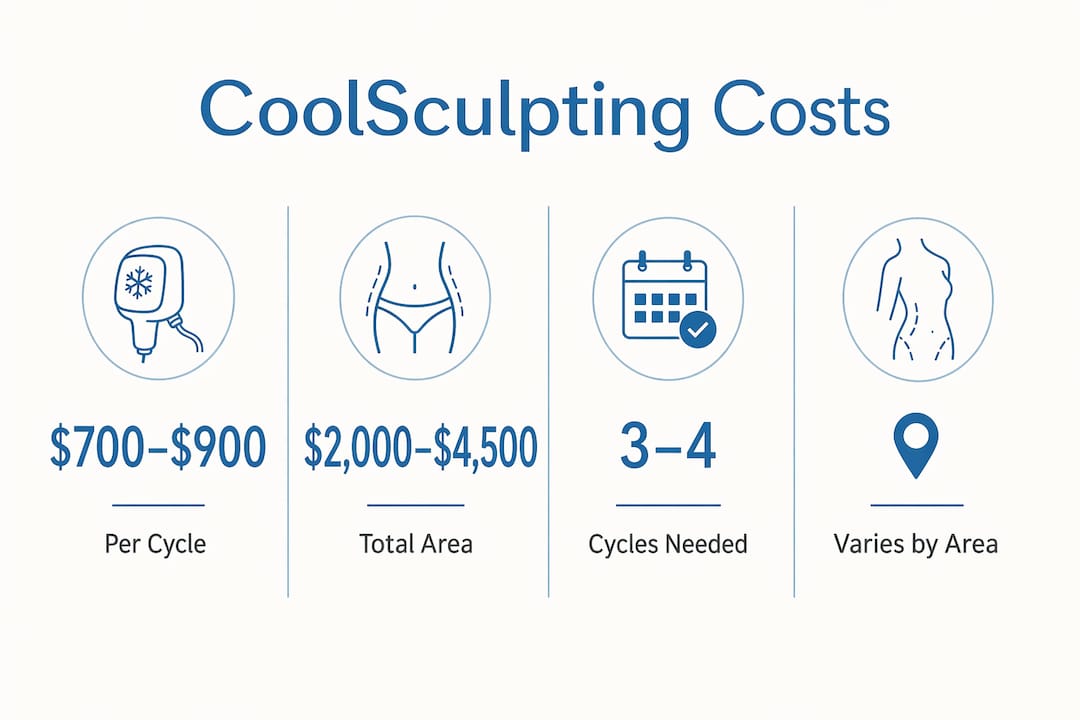
A few things the table doesn't capture: geography matters a lot. Metro areas like New York and Los Angeles typically carry a 20–40% premium over smaller markets, which means the same two-cycle abdomen plan that costs $2,000 in a mid-size city might run $2,800 in Manhattan.
Sample price scenarios:
- Small plan (double chin, 1 cycle): $700–$900 total
- Medium plan (abdomen, 2 cycles): $1,600–$2,400 total
- Combo plan (abdomen + flanks, 2 cycles each): $4,200–$7,200 total
These are estimates. The only way to get an accurate number is a consult where a provider counts the applicator cycles your specific anatomy requires.
What is CoolSculpting and what can it realistically do?
CoolSculpting is the branded name for cryolipolysis, a non-surgical procedure that applies controlled cooling to a targeted fat pocket until the fat cells crystallize and die. The body then clears those cells over the following weeks through its natural metabolic process. The FDA cleared cryolipolysis for fat reduction in multiple body areas, and the technology is manufactured by Allergan/AbbVie.
Clinical expectation: Each applicator cycle reduces fat-layer thickness in the treated zone by approximately 20–25%. Visible improvement typically appears within 4–8 weeks; final results settle around 3–4 months post-treatment.
The budget implication is direct: if you want a 40–50% reduction in a given area, you're planning for two cycles, not one. More aggressive goals cost more, not because the price per cycle changes, but because you need more of them.
What CoolSculpting is not:
- A weight-loss treatment. The scale may not move at all.
- A substitute for liposuction when large fat volumes are involved.
- A one-and-done procedure for most people.
The best candidates are already near their goal weight with specific, localized fat pockets that don't respond to diet and exercise. That distinction matters for budgeting because people who expect dramatic body-wide changes often end up needing far more cycles than they planned for.
What actually changes your CoolSculpting bill?
Price variation between clinics is real and sometimes dramatic. Understanding the drivers helps you evaluate quotes rather than just compare headline numbers.

Provider credentials and facility type. Board-certified dermatologists and plastic surgeons typically charge more per area than med spa technicians. That premium usually reflects more precise applicator placement and better management of uneven results.
Applicator count and type. Each applicator cycle requires a manufacturer-authorized single-use chip, which is why providers charge per cycle rather than per visit. The CoolMini applicator for small zones like the chin costs less per cycle than large-area applicators. Clinics with dual-applicator capability (treating two zones simultaneously) can reduce your total chair time but may or may not reduce your total cost.
Geography and clinic overhead. New York City adds a 4.5% cosmetic service tax; Texas collects none. Rent, wages, and local market competition all feed into the per-cycle rate.
Add-ons and hidden fees. Post-treatment lymphatic massage may incur an additional fee per session. Consultation fees sometimes appear as a separate line item, though many reputable clinics charge $50–$100 for the consult and credit it toward your first treatment if you book.
Pro Tip: Ask every provider for the total applicator cycle count in their recommended plan, not just the per-session price. Then ask whether the consultation fee is credited toward treatment. Those two questions let you compare quotes on equal footing.
How many sessions will you need, and what does that cost?
Most areas require 1–3 sessions, and most sessions involve more than one applicator cycle. Here's how the math plays out in practice.
Worked examples:
-
Double chin, single cycle: One CoolMini cycle at $800. Total: $800. This is the entry-level scenario, and it's realistic for someone with a modest submental fat pocket.
-
Abdomen, two cycles: Two applicator cycles at $900 each. Total: $1,800. This covers a moderate abdominal bulge. A larger abdomen requiring a third cycle adds another $900, bringing the total to $2,700.
-
Multi-area regimen (abdomen + both flanks, two cycles each): Abdomen at $1,800 (two cycles) + flanks at $1,800 per side × two sides = $5,400. Total: $7,200. This is a common full-midsection plan, and it's where costs climb fast.
Simple estimate formula: Cycles per area × per-cycle price × number of areas = estimated total (before consult fee and add-ons)
A few additional cost considerations:
- Touch-up cycles, if results are uneven or insufficient, add extra cost per area.
- Spacing sessions 4–8 weeks apart means a multi-session plan can stretch over several months.
- Bundling multiple cycles upfront often results in savings compared to single-session bookings.
Does insurance cover CoolSculpting, and what are your payment options?
No insurer, Medicare, or Medicaid program covers CoolSculpting. It's classified as elective cosmetic treatment, full stop. FSA and HSA funds are also generally not eligible unless a physician documents medical necessity, which is rare for body contouring.
Common financing options:
- CareCredit: A healthcare credit card widely accepted at med spas, with promotional 0% APR periods (typically 6–24 months depending on the amount and provider).
- Clinic payment plans: Many practices offer in-house installment plans, sometimes interest-free for shorter terms.
- Multi-cycle packages: Buying a bundle upfront is the most straightforward way to reduce per-cycle cost.
| Financing Option | Typical Terms | Best For |
|---|---|---|
| CareCredit | 0% APR for 6–24 months | Spreading cost over time |
| In-house clinic plan | Varies; often 3–4 months | Smaller total balances |
| Multi-cycle package | — | Patients committed to a full plan |
| Pay in full | No interest | Lowest total cost |
Money-saving tactics that actually work:
- Ask about seasonal promotions. Many clinics run discounts in January and late summer.
- Inquire about a skincare club membership that bundles services at a reduced rate.
- Book multiple areas in a single visit. Providers often discount the second area when treated the same day.
- Vet any deal that seems unusually cheap. A per-cycle rate well below $600 often signals fewer cycles in the plan, not a genuine discount.
How does CoolSculpting compare to other fat-reduction options?
CoolSculpting isn't the only non-surgical fat-reduction option, and for some goals, it isn't the most cost-effective one. Here's how the major alternatives stack up.
| Method | Typical Price per Area | Sessions Required | Downtime | Permanence |
|---|---|---|---|---|
| CoolSculpting (cryolipolysis) | $700–$900 | 2+ | None | Permanent (lifestyle-dependent) |
| Laser lipolysis (heat-based) | $1,400–$1,800 | 2–3 | None | Lifestyle-dependent |
| Deoxycholic acid injection (submental) | — | 2–4 visits | Swelling 2–3 days | Permanent (small areas) |
| Radiofrequency body contouring | — | 4–6 | None | Modest, lifestyle-dependent |
| Surgical liposuction | — | 1 | 1–2 weeks | Permanent |
A few honest observations:
- Deoxycholic acid injections are a strong alternative for the double chin specifically. They're less expensive per treatment and produce permanent results in a small zone, though swelling after each session is significant.
- Laser lipolysis works well for smaller areas but tends to underperform CoolSculpting on larger, thicker fat deposits.
- Surgical liposuction costs more upfront and requires real downtime, but a single procedure can address large fat volumes that would take 6–8 CoolSculpting cycles to approximate. For patients with substantial fat deposits across multiple areas, surgery can actually be more cost-effective over a 2–3 year horizon.
- Radiofrequency contouring produces milder fat reduction and is better suited to skin tightening than significant fat removal.
For most people targeting one or two localized pockets with no tolerance for downtime, CoolSculpting sits in a practical middle ground. For those with larger goals, a frank conversation with a board-certified surgeon about liposuction costs versus a full CoolSculpting regimen is worth having before committing either way.
What to expect after treatment: timeline and how long results last
CoolSculpting has essentially no downtime. Most people return to normal activity the same day. The treated area may feel sore, numb, or swollen for a few days to a few weeks, and temporary redness or bruising is common. None of these effects typically require time off work.
Typical results timeline:
- Weeks 1–4: Little visible change; the body is still clearing crystallized fat cells.
- Weeks 4–8: Initial improvement becomes noticeable.
- Months 2–4: The most significant visible change occurs during this window.
- Month 4+: Final result. Most providers recommend waiting the full four months before deciding whether a touch-up cycle is needed.
The 20–25% fat-layer reduction per cycle is permanent in the sense that treated fat cells don't regenerate. But remaining fat cells in the area can still enlarge if you gain weight, which is why lifestyle maintenance is part of the long-term picture. Patients who stay near their treatment weight tend to hold results for years.
Side effects to budget for:
- Compression garments (optional but sometimes recommended): $30–$60
- Post-treatment lymphatic massage: $40–$80 per session
- Follow-up consult to assess results: sometimes included, sometimes billed separately
Are you a good candidate, and what should you ask at your consult?
Candidate checklist:
- Near goal weight with stubborn, localized fat pockets
- Good skin elasticity in the target area
- Realistic expectations: contouring, not dramatic weight loss
- No cold-sensitivity conditions (cryoglobulinemia, cold agglutinin disease, paroxysmal cold hemoglobinuria)
- Not pregnant or breastfeeding
If you check those boxes, a consult is the right next step. What you ask at that consult determines whether you can actually compare quotes between providers.
Questions to ask every provider:
- How many applicator cycles are you recommending for my specific anatomy?
- What is the per-cycle price, and what does it include?
- How many sessions does your plan involve, and what is the spacing?
- Who will perform the treatment, and what are their credentials?
- Is the consultation fee credited toward treatment if I book?
- What is your retreatment policy if results are uneven or insufficient?
- Are there package discounts for booking multiple cycles upfront?
Red flags to watch for:
- A per-applicator rate significantly below $600 with no explanation
- A quote given as a single total with no cycle count attached
- No medical supervision disclosed
- Pressure to book same-day without a written treatment plan
A provider who can't answer questions 1 and 2 clearly is not giving you a complete quote.
Why provider skill matters, and how Elitelaserhair approaches CoolSculpting
Provider experience affects outcomes in ways that don't show up in the per-cycle price. Precise applicator placement determines how evenly fat is reduced. The choice between applicator sizes affects both comfort and result quality. Post-treatment massage, performed immediately after the cycle, has been shown in clinical literature to improve fat-layer reduction. These are technique decisions, not equipment decisions, and they vary significantly between providers.
Elitelaserhair operates as a medically supervised facility in Suffolk County, recognized as the top CoolSculpting facility in New York. Every treatment plan is customized, with applicator selection and cycle count determined by a trained clinician rather than a standard menu. The clinic uses FDA-approved CoolSculpting technology and structures its consultations to give patients a written cycle count and total cost estimate before committing.
What a reputable clinic consult should include:
- A physical assessment of the target areas, not just a photo review
- A written recommended cycle count per area
- A clear per-cycle price and total estimate
- Disclosure of who performs the treatment and their credentials
- Financing options presented upfront
At Elitelaserhair, the consult is where the real planning happens. Patients leave with a written treatment plan that includes applicator count, session spacing, and a total cost figure — so there are no surprises on the day of treatment. That level of transparency is what separates a clinic focused on outcomes from one focused on filling appointment slots.
Explore the full range of body contouring services available at Elitelaserhair, including CoolSculpting and the complementary CoolTone muscle toning treatment for patients who want both fat reduction and muscle definition.
Key Takeaways
CoolSculpting costs $2,000–$4,500 per area to complete in the US, with per-cycle pricing of $700–$900 driving the total, and no insurance coverage applies.
| Point | Details |
|---|---|
| National cost range | Most patients spend $2,000–$4,500 per area; multi-area regimens reach $6,000–$12,000. |
| Per-cycle pricing | Clinics charge $700–$900 per applicator cycle; most areas need 1–3 cycles to complete. |
| Fat reduction per cycle | Each cycle reduces fat-layer thickness by approximately 20–25%; plan your cycle count accordingly. |
| Financing options | CareCredit, in-house plans, and multi-cycle packages are the main ways to spread cost. |
| Elitelaserhair | Recognized as New York's top CoolSculpting facility, offering medically supervised, custom treatment plans with written cost estimates at consult. |
The real cost calculation most people miss
There's a version of the CoolSculpting cost conversation that goes: "I found a place doing it for $500 a session." And technically, that might be true. One cycle, one small zone, promotional pricing. What that number doesn't tell you is how many cycles the provider actually recommends for your anatomy, whether the consult fee is included, or what happens if the result is uneven and you need a touch-up.
The honest truth about CoolSculpting pricing is that the per-cycle rate is almost a distraction. What matters is the total cycle count for your specific goals, delivered by someone with the clinical judgment to place applicators correctly and the integrity to tell you when surgery would serve you better. A $900-per-cycle plan with three cycles and a touch-up policy is a better deal than a $600-per-cycle plan with no follow-up protocol and vague retreatment terms.
Chasing the lowest headline price in aesthetic medicine rarely ends well. The patients who get the best value from CoolSculpting are the ones who ask for a written plan with a cycle count before they hand over a credit card. That one habit separates a good outcome from an expensive disappointment.
Ready to see what CoolSculpting costs for your specific goals?
Elitelaserhair is Suffolk County's top-rated CoolSculpting facility, recognized as the leading provider in New York. A consult at the clinic means a real clinical assessment, a written treatment plan with your exact applicator cycle count, and a transparent total cost figure before you commit to anything. Financing options including CareCredit are available, and consultation fees may be credited toward your first treatment when you book.
If you've been comparing quotes and finding that the numbers don't add up, that's exactly the kind of conversation the team at Elitelaserhair is built for. Book your CoolSculpting consult and leave with a written plan, not just a ballpark.
Useful sources
- RealSelf: How Much Does CoolSculpting Cost? — Patient-reported cost data, insurance coverage details, and per-cycle pricing context from thousands of real treatment reviews.
- AestheticMedGuide: CoolSculpting Cost — Detailed breakdown of per-area vs. per-cycle pricing, provider-level cost drivers, and the clinical fat-reduction percentage data.
- MedSpa Scout: CoolSculpting Cost Realistic Breakdown — Per-cycle national averages, package discount data, and candidate guidance for body contouring.
- SurgeryCostGuide: CoolSculpting Cost — National average figures and per-area cost ranges drawn from aggregated US clinic data.
- American Society of Plastic Surgeons: Nonsurgical Fat Reduction — Clinical background on cryolipolysis, procedure standards, and what to expect from board-certified providers.