
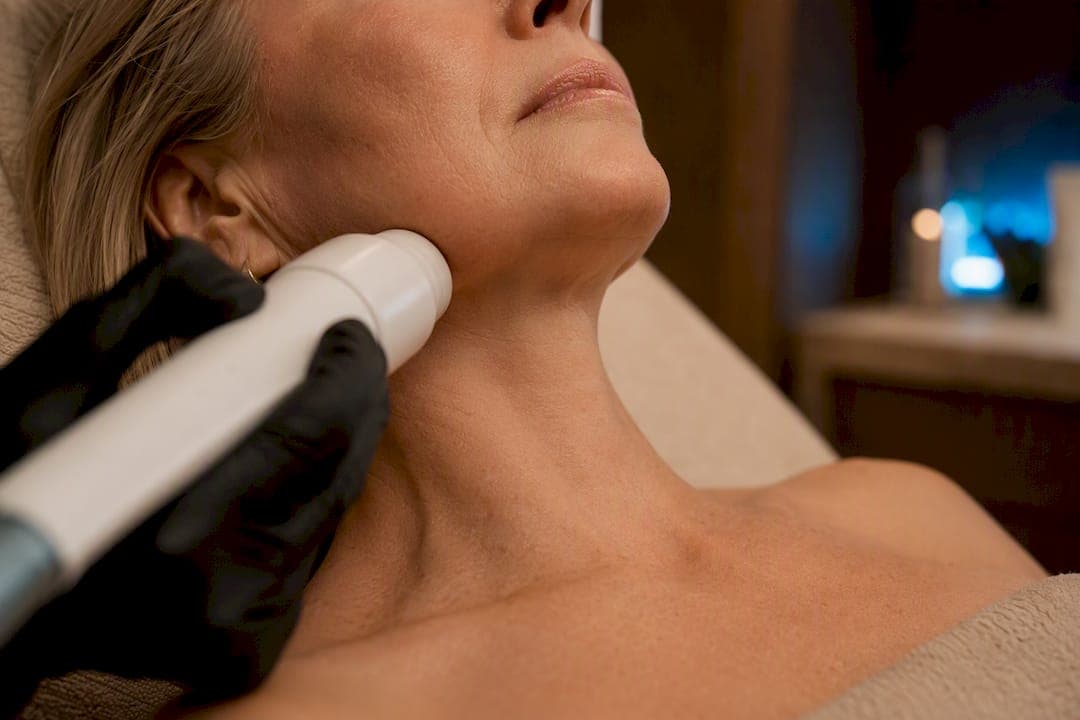
Radiofrequency skin tightening uses controlled heat to warm the deeper layers of skin, triggering the body to produce fresh collagen and tighten existing fibers. It works best on mild to moderate sagging around the face, neck, and jawline rather than significant excess skin. Most people see gradual firming over two to six months, need three or more sessions for a visible change, and experience little to no downtime beyond mild redness. It won't replace a facelift for someone with a lot of loose neck skin, but for early laxity, it's a legitimate, well-studied alternative to surgery.
TL;DR:
- RF skin tightening is most effective for early, mild to moderate skin laxity and typically requires three or more sessions for visible results.
- Deeper treatments like monopolar RF produce more collagen remodeling but come with increased discomfort and risk, requiring skilled operator oversight.
- Full, noticeable tightening results usually appear between two and six months post-treatment and can last from one to three years with proper skin care.
- Serious side effects like burns are rare when devices are used properly by experienced, FDA-cleared practitioners, but risks increase with inadequate training or improper settings.
- Choosing a provider with medical supervision, device FDA clearance, and transparent outcome documentation is crucial for safe, effective RF skin tightening.
Table of Contents
- What Is Radiofrequency Skin Tightening and How Does It Work?
- What Happens Before, During, and After an RF Treatment Session?
- How Long Do RF Skin Tightening Results Last?
- What Are the Risks and Side Effects of RF Skin Tightening?
- How Do You Choose a Safe RF Provider?
- Why Elite Laser Center Approaches RF Treatment the Way It Does
- What Most People Get Wrong About RF Skin Tightening
- Ready to Explore RF Skin Tightening or RF Micro-Needling?
- Sources
- FAQ
What Is Radiofrequency Skin Tightening and How Does It Work?
RF skin tightening works by heating the dermis with electromagnetic energy, which causes existing collagen fibers to contract immediately and pushes the body to build new collagen and elastin over the following weeks. The Cleveland Clinic describes RF energy as low-frequency electromagnetic waves that reach the deep dermis without damaging the surface of the skin, which is why there's usually no open wound and minimal recovery time.
Think of it like a controlled, low-grade sunburn on the inside of your skin instead of the outside. Your body reads that heat as an injury signal and responds by manufacturing more structural protein where it counts, in the layer that actually holds your skin's shape.
Not every RF device does this the same way, and the differences matter more than most marketing pages let on.
Monopolar RF sends energy from a single electrode deep into tissue, often reaching the subcutaneous layer. It's the choice for global laxity across larger areas like the lower face and neck, because it penetrates further than other formats.
Bipolar RF runs current between two electrodes placed close together, which limits penetration to roughly 1 to 4 millimeters. That shallower reach makes it a gentler option for thinner or more sensitive skin, though it treats a smaller volume of tissue per pass.
Multipolar RF spreads energy across several electrodes at once, distributing heat more broadly across a treatment area. It's frequently used in body contouring and larger-surface facial work.
Fractional or microneedle RF pairs tiny needles with RF energy delivered directly at a set depth, combining mechanical micro-injury with thermal remodeling. A PMC review of radiofrequency technology notes that because needle length can be adjusted, practitioners can target very specific depths, which makes this format useful for acne scarring and textural concerns as well as laxity.
Here's how those categories tend to sort by use case:
- Monopolar: broad, deep coverage for jawline and neck laxity
- Bipolar: superficial treatment for delicate or thin-skinned areas
- Multipolar: wider surface coverage, often used on the body
- Fractional/microneedle: precision depth control for scarring and texture alongside tightening
The trade-off across all four is depth versus comfort. Deeper energy generally produces more collagen remodeling, but it also means more sensation during treatment and, in inexperienced hands, more risk. That's part of why device choice is really an operator decision, not just a marketing spec.
What Happens Before, During, and After an RF Treatment Session?
A good RF appointment starts well before the handpiece touches your skin, and skipping that groundwork is where a lot of disappointing outcomes begin.
- The consultation. Expect a review of your medical history, current skincare, and any prior cosmetic procedures. A qualified provider will take photos, assess your skin type and degree of laxity, and talk through what RF can and can't realistically do for your specific concern.
- Skin type discussion. Because darker skin tones carry a higher theoretical risk of post-treatment pigment changes, an experienced practitioner adjusts energy settings and sometimes favors microneedle RF with tighter parameter control for those patients.
- Numbing, if needed. Topical anesthetic is common for microneedle RF, since the needles add sensation on top of the heat. Non-needle RF treatments are usually tolerable without it.
- The treatment itself. The provider moves the handpiece across the treatment area in repeated passes, often with a cooling tip or gel to protect the surface while the deeper tissue heats up. Most sessions run 20 to 45 minutes depending on the area. Patients typically describe the feeling as a warm, deep massage that occasionally peaks into a brief hot sensation.
- Immediate aftermath. Mild redness and a warm, flushed feeling are normal and usually fade within a few hours.
- Aftercare. Gentle cleansers, sun protection, and avoiding intense heat exposure (saunas, hot yoga) for a day or two help the skin settle. There's no real "recovery" period in the surgical sense.
- Scheduling the next session. Providers generally space RF treatments two to four weeks apart, since collagen remodeling takes time and stacking sessions too closely doesn't speed that biology up.
If you're considering microneedle RF specifically, the day-by-day healing pattern looks a little different from standard RF, since the needling adds pinpoint scabbing that resolves over about a week; a detailed downtime breakdown walks through what that actually looks like.
How Long Do RF Skin Tightening Results Last?
Collagen remodeling isn't instant, and expecting overnight results is the single most common reason people write off RF treatment as ineffective.
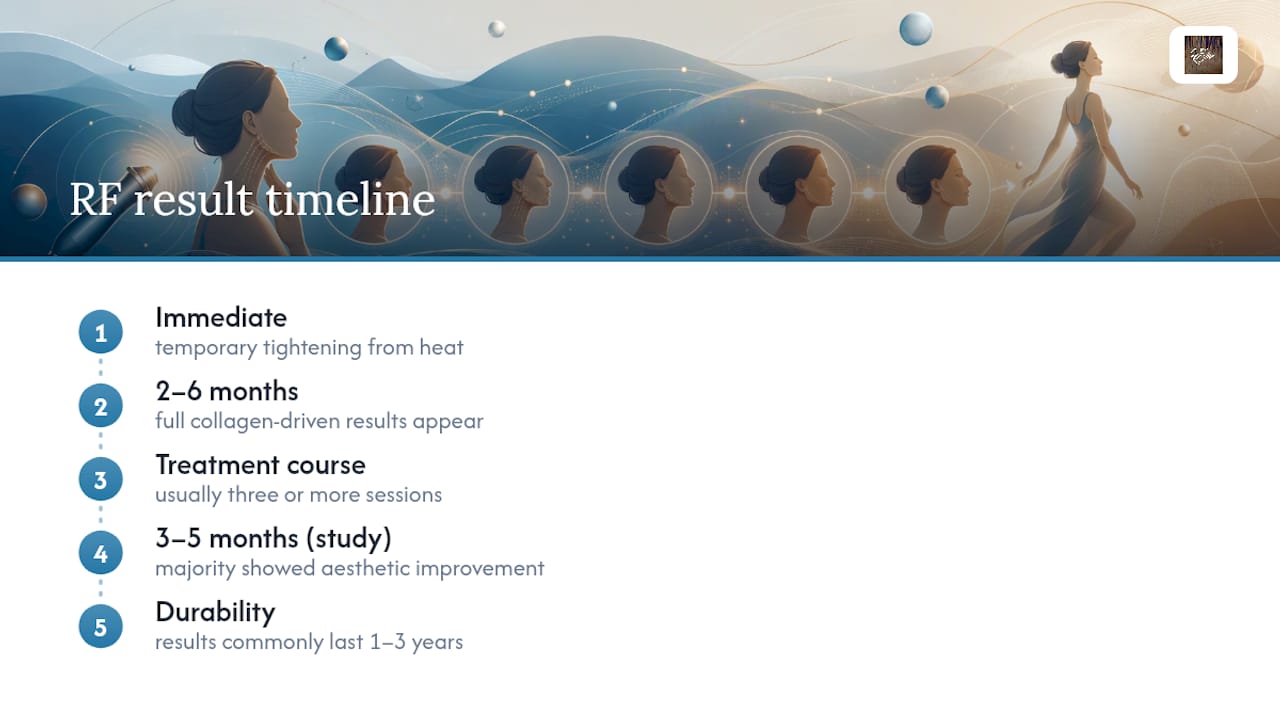
Initial tightening from tissue contraction is sometimes visible right after a session, but that's a temporary effect from heat, not the real outcome. The change that actually lasts, the collagen your body builds over time, shows up gradually. The Cleveland Clinic notes patients typically see full results between two and six months after treatment, which lines up with how long neocollagenesis takes to mature.
By the numbers: A 2026 clinical study on RF tolerability found that 88.5% to 92.11% of patients showed global aesthetic improvement at the 3 to 5 month mark, 80.26% reported less than a full day of recovery time, and intraoperative pain scores stayed at or below 3 out of 10 for most participants.
That data point matters for two reasons. First, it confirms RF isn't just a cosmetic industry talking point, it's producing measurable change in a majority of treated patients within a predictable window. Second, the low pain scores and minimal recovery help explain why RF has become a go-to option for people who want visible improvement without booking time off work.
Most practitioners recommend a course of three or more sessions rather than a single visit, since each treatment builds on the collagen response from the last. A multicenter trial on monopolar RF reported measurable improvements in skin laxity at intervals between 30 and 180 days post treatment, reinforcing that this is a cumulative process rather than a one-and-done fix.
As for durability, results commonly hold for one to three years, though that range depends heavily on factors outside the treatment itself: your age, how much ongoing sun exposure your skin gets, and whether you maintain results with periodic touch-up sessions. Skin that's already aging quickly from UV damage will need more frequent maintenance than skin that's well protected. It's worth noting the research base still has gaps. Studies vary in device settings and protocols, and a systematic review of RF parameter variability points out that inconsistent reporting across trials makes it hard to name one universal "best" setting, which is exactly why individualized treatment plans matter more than a generic protocol.
What Are the Risks and Side Effects of RF Skin Tightening?
Most side effects from RF are minor and short lived, but the rare ones deserve honest attention rather than a quick dismissal.
Expect some combination of these in the hours after treatment:
- Redness that typically fades within 24 hours
- Mild swelling, especially around the eyes or jawline
- Temporary soreness or tenderness at the treated site
- A warm, sunburn-like sensation for the rest of the day
More serious complications exist but are uncommon when treatment is done correctly. Thermal burns are the primary safety concern with RF, and they happen almost exclusively when energy settings are too aggressive, the device passes too slowly over one spot, or the operator lacks proper training. Pigment changes, particularly in people with darker skin tones, are a secondary risk that a skilled provider manages by adjusting energy levels and treatment approach rather than using a one-size-fits-all setting; a guide to skin type categories breaks down how Fitzpatrick classification shapes those adjustments.
Cleveland Clinic's own review confirms that severe burns remain rare specifically when treatments use FDA-cleared devices operated by experienced practitioners, which is the through line connecting nearly every safety recommendation in this space. Best practice includes test spots before full treatment, conservative energy on the first pass, and continuous monitoring of how the skin responds in real time rather than running the device on autopilot.
Pro Tip: Before you book, ask directly whether the device being used is FDA cleared for skin tightening and who will be operating it. A device's clearance status and the operator's training matter more to your safety than the treatment brand's name.
Skin sensitivity assessment before any heat- or light-based procedure isn't unique to RF. The same logic applies across aesthetic treatments generally, and a partner resource on procedural safety for sensitive skin covers similar pre-treatment screening principles worth understanding regardless of which procedure you're considering.
How Do You Choose a Safe RF Provider?
The single biggest variable in RF outcomes isn't the device model, it's who's holding the handpiece.
RF should be performed under medical supervision, ideally by a provider working within a practice that has a physician overseeing treatment protocols. Estheticians and technicians can be well trained, but the setting matters: a medical spa with documented oversight gives you a layer of accountability that a standalone kiosk treatment doesn't.
At your consultation, ask these questions directly:
- What specific device are you using, and is it FDA cleared for skin tightening?
- How do you decide which energy settings to use for my skin type?
- How many sessions will I realistically need to see change?
- What does recovery look like for me specifically, given my skin and treatment area?
- How do you manage pain or discomfort during treatment?
Watch for red flags that suggest a provider is cutting corners:
- No mention of medical supervision or a supervising physician
- No informed consent process or written treatment plan
- Heavy pressure to book a large package before you've had a single session
- No before-and-after documentation of real patients, or reluctance to show any
A provider confident in their results won't hesitate to walk you through device specifics, show real outcome photos, and explain exactly why they've chosen a given energy setting for your skin. Vague reassurance without specifics is the clearest sign to keep looking.
Why Elite Laser Center Approaches RF Treatment the Way It Does
Elite Laser Center Medical Spa builds its non-surgical treatments, including RF micro-needling and skin tightening, around FDA-approved technology and customized planning rather than a one-size-fits-all protocol. Every treatment is performed under experienced medical supervision, which matters given how much RF outcomes depend on operator skill and correct parameter selection.
The center backs its laser hair removal packages with a three-year guarantee, reflecting its confidence in the results across its treatment menu. Its RF micro-needling service combines mechanical and thermal remodeling for texture and laxity concerns, and its blog on non-surgical skin tightening breaks down the same device and safety considerations covered here, tailored to what the clinic actually offers patients.
What Most People Get Wrong About RF Skin Tightening
The biggest misconception isn't about safety, it's about timing. People book one RF session expecting a facelift-level change and walk away unimpressed, when the actual clinical pattern points to three or more sessions with results building over months, not days.
Conventional advice tends to oversell RF as a universal anti-aging fix, and that framing sets people up to fail. RF stimulates remodeling; it doesn't remove tissue. Someone with significant loose neck skin will not get a surgical result from any RF device, no matter how advanced the marketing sounds. Where RF earns its reputation is in the mild-to-moderate laxity zone, the early jowl softening, the slightly crepey neck skin, the texture that's started to lose bounce but hasn't sagged.
If you take one thing from the research, take this: the device brand matters less than you'd think, and the operator's judgment matters more. Ask about training and FDA clearance before you ask about the machine's name. That single habit will filter out more bad providers than any amount of online research into device specifications ever will.
— Sharon
Ready to Explore RF Skin Tightening or RF Micro-Needling?
If mild sagging around your jawline, neck, or cheeks has you researching non-surgical options, RF micro-needling and medically supervised skin tightening are worth a real look rather than another late-night scroll through before-and-after photos. Elite Laser Center's RF micro-needling combines the mechanical and thermal remodeling described earlier in this piece, and it's suited to people dealing with early laxity, uneven texture, or acne scarring who want a treatment plan built around their actual skin, not a generic protocol.
A consultation starts with the same groundwork any responsible provider should follow: a review of your skin type, history, and goals, followed by a customized plan that accounts for how your skin specifically responds to heat-based remodeling. Every treatment happens under medical supervision, which matters given how dependent RF outcomes are on correct settings and operator experience. If you're ready to find out whether RF micro-needling fits your skin, visit the RF Micro-Needling page to see what a session involves and book a consultation.
This article is general information, not a substitute for advice from a qualified doctor. Consult a qualified healthcare professional about your own circumstances before acting on anything here.
Sources
- Radio Frequency (RF) Skin Tightening: Benefits & Dangers — Cleveland Clinic
- Clinical findings on RF tolerability and outcomes (Springer article, 2026)
- The Landscape of Radiofrequency Technology for Skin Rejuvenation — PMC review (2025/2026)
FAQ
Does Radiofrequency Skin Tightening Really Work?
Yes, for mild to moderate laxity.
How Long Does RF Skin Tightening Last?
Results commonly last one to three years, depending on your age, sun exposure, and whether you maintain results with periodic sessions. Full collagen-driven results typically appear between two and six months after your treatment series.
What Is the Average Cost of RF Skin Tightening?
Pricing varies widely by provider, device, and treatment area, so there's no single reliable average to quote. Elite Laser Center's RF micro-needling pricing is available directly on its RF Micro-Needling page.
What Is the Strongest Skin Tightening Treatment Available?
Among non-surgical options, monopolar RF and microneedle RF tend to produce the most significant remodeling because they reach deeper into the dermis than bipolar devices. For severe skin laxity, though, surgical excision remains the more reliable solution, since RF tightens tissue rather than removing it.
Recommended
- Non Surgical Skin Tightening: What You Need to Know
- Skin Tightening After Weight Loss: What Actually Works
- RF Microneedling Downtime: What to Expect Day by Day
This article was produced with AI assistance and reviewed for accuracy. It is provided for general information, and it is not professional advice.