
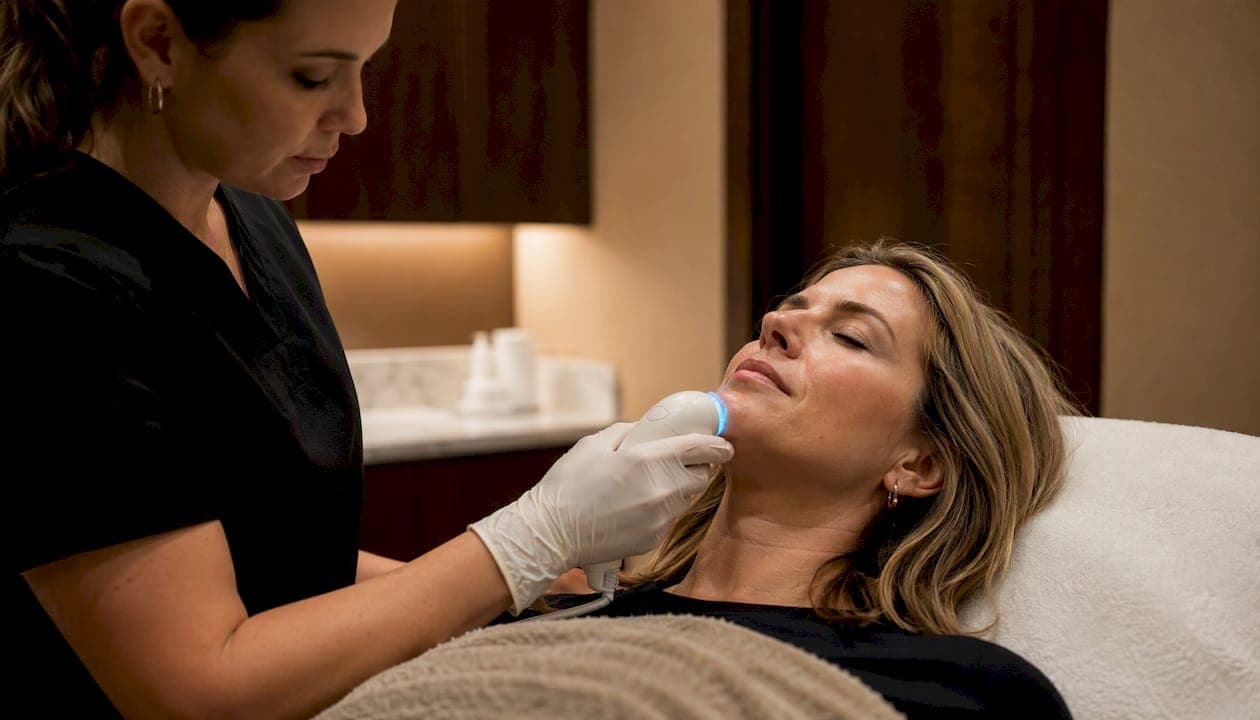
Non-surgical skin tightening uses focused energy — ultrasound, radiofrequency, laser, or combinations of these — to heat the deeper layers of skin and stimulate collagen and elastin production, producing gradual firming over weeks to months. The American Board of Cosmetic Surgery is clear on the scope: these procedures work best for mild-to-moderate laxity and are not a substitute for a surgical facelift when sagging is advanced.
Who benefits most:
- Adults in their 30s–60s noticing early jowling, mild neck looseness, or subtle under-eye sagging
- People who want gradual, natural-looking improvement with minimal downtime
- Those maintaining a stable weight who want to address mild body-area looseness (abdomen, inner arms, thighs)
- Patients who had a surgical lift and want to extend results over time
Who should consult a surgeon first:
- Anyone with pronounced, heavy sagging that has lost significant structural support
- People with significant excess skin after major weight loss
- Those whose primary goal is a dramatic, immediate transformation
If you are unsure which category you fall into, a consultation with a board-certified dermatologist or plastic surgeon is the right starting point. FDA-cleared devices exist across every major technology category, and a qualified provider will match the device to your anatomy rather than the other way around.
Key Takeaways
Non-surgical skin tightening produces real but gradual results for mild-to-moderate laxity, with most improvement appearing between 2 and 6 months after treatment and maintenance sessions typically needed to sustain outcomes.
| Point | Details |
|---|---|
| Best for mild-to-moderate laxity | These treatments firm early sagging; they cannot replicate surgical results for advanced or heavy laxity. |
| Results take months, not days | Peak collagen-driven improvement appears 2–6 months post-treatment; immediate post-session tightening is largely swelling. |
| Session count varies by device | Expect 1–2 sessions for ultrasound or monopolar RF, up to 3–5 for IPL/RF combinations or RF microneedling courses. |
| Provider skill drives outcomes | Device selection, energy settings, and operator experience matter as much as the technology itself. |
| Elitelaserhair | Offers medically supervised RF microneedling, RF skin tightening, IPL/RF therapies, and PDO thread lifts in Suffolk County. |
Table of Contents
- How energy-based skin tightening actually changes your skin
- The main non-surgical skin tightening options, device by device
- What these treatments can and cannot realistically do
- Are you a good candidate? A practical self-screening checklist
- What to expect: sessions, timeline, and cost
- Side effects, safety, and what to know about home devices
- How to choose a qualified provider
- What the clinical evidence actually shows
- A clinic perspective on getting this right
- Elitelaserhair offers supervised, personalized skin tightening in Suffolk County
- Sources
How energy-based skin tightening actually changes your skin
The mechanism is straightforward: controlled heat delivered to the dermis or subdermis triggers a wound-healing response without breaking the skin surface. Healthline cites research showing that maintaining tissue temperatures around 115°F (46°C) for several minutes promotes the release of heat-shock proteins, which in turn signal fibroblasts to produce new collagen. That collagen remodeling is what creates the firming effect you see weeks later, not the heat itself.
Depth matters enormously here. Different technologies reach different tissue layers, and that determines what kind of result is achievable. Micro-focused ultrasound can penetrate up to approximately 5 millimeters below the skin surface, reaching the same fascial layer that surgeons address in a facelift. Radiofrequency energy typically targets the epidermis and dermis at shallower depths, though RF microneedling and subdermal RF devices extend that reach by delivering energy through needles or small incisions.
A simple way to picture it: ultrasound goes deep and lifts, surface RF heats broadly and tightens, and RF microneedling splits the difference by combining mechanical stimulation with targeted thermal energy. Each has a role, and the best choice depends on how deep the laxity sits and what the skin can tolerate.
The main non-surgical skin tightening options, device by device
Ultherapy (micro-focused ultrasound)
Ultherapy is the only FDA-cleared device for non-invasive lifting of the brow, chin, and neck. It uses micro-focused ultrasound with real-time imaging to deposit energy at precise depths, typically 1.5 mm, 3 mm, and 4.5 mm. Most patients need a single session, though a second treatment at 6–12 months is common for maintenance. Expect redness and mild swelling for a day or two; the deeper energy delivery can cause temporary nerve sensitivity. Results build over 2–3 months as collagen remodels.
Thermage (monopolar radiofrequency)
Thermage delivers monopolar RF energy across the full thickness of the dermis in a single pass. It is FDA-cleared for skin tightening on the face, eyes, and body. One session is usually sufficient, with results appearing gradually over 2–6 months. Downtime is minimal, though the treatment can be uncomfortable without topical anesthetic. Thermage tends to suit patients who want a broad, diffuse tightening effect rather than focal lifting.
Profound RF
Profound RF uses bipolar radiofrequency delivered through microneedles to heat the dermis at a precise temperature for a controlled duration. It is designed specifically to stimulate elastin and hyaluronic acid in addition to collagen, which sets it apart from surface RF devices. Typically one to two sessions are needed. Expect 3–5 days of swelling and bruising; the recovery is more significant than surface RF but still far less than surgery. Results are often more pronounced than with non-invasive alternatives.
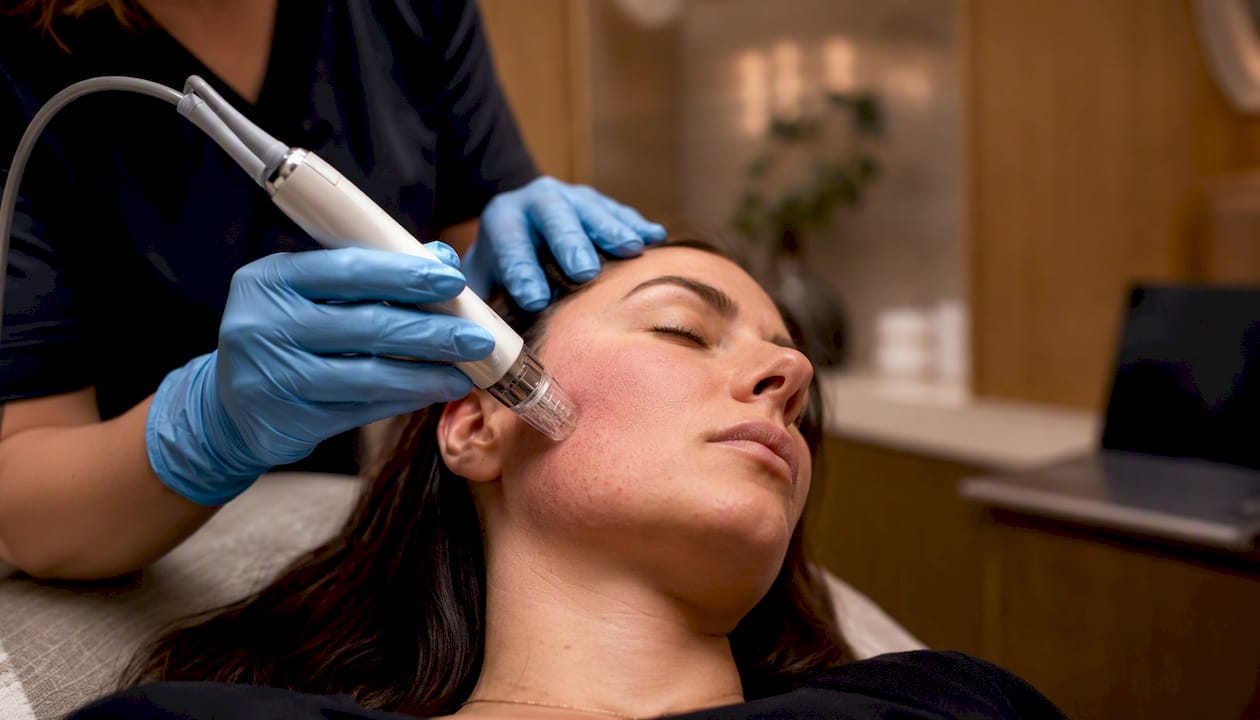
Morpheus8 (RF microneedling)
Morpheus8 combines fractional microneedling with bipolar RF energy, reaching depths of up to 8 mm with its deepest tip setting. According to Medical News Today, RF microneedling approaches like this allow more focused heating of deeper tissue layers and can produce stronger tightening than surface RF alone, though they require more training and occasionally local anesthesia. It works well for facial contouring, acne scarring, and body areas. Plan for 1–3 sessions with 2–3 days of redness and pinpoint marks.
VelaShape (RF + infrared + vacuum)
VelaShape combines bipolar RF, infrared light, and mechanical massage (vacuum and rollers) to address skin laxity and the appearance of cellulite, primarily on body areas like the abdomen, thighs, and buttocks. It typically requires 3–4 sessions, with maintenance treatments every few months. Downtime is essentially zero; the treatment feels like a warm deep-tissue massage. Results are modest and most visible in circumference reduction and skin texture rather than dramatic lifting.
Venus Versa (IPL + RF combination)
Venus Versa pairs intense pulsed light (IPL) with multi-polar RF energy, allowing providers to address both skin tone and laxity in the same session. Laser and IPL-based treatments typically require 3–5 sessions for visible tightening. Venus Versa is well-suited for patients dealing with pigmentation alongside mild laxity. Darker or recently tanned skin requires careful parameter adjustment; a test spot before full treatment is standard practice.
EmbraceRF (subdermal RF)
EmbraceRF is a minimally invasive subdermal RF device that delivers energy beneath the skin surface through small insertions under local anesthesia. It targets the subdermal tissue directly, producing a degree of tightening that approaches surgical results in some cases. Recovery involves 3–7 days of swelling and bruising. It sits in a category between non-invasive surface treatments and a full surgical lift, making it a reasonable option for patients who want more than surface RF can deliver but are not ready for surgery. A PDO thread lift is another minimally invasive option that can be combined with subdermal RF for patients seeking stronger structural support.
Comparison of major device categories
| Technology | Target depth | Typical sessions | Downtime | Common side effects |
|---|---|---|---|---|
| Micro-focused ultrasound | Up to ~5 mm | 1–2 | 1–2 days | Redness, temporary nerve sensitivity |
| Monopolar RF | Dermis (surface) | 1–2 | Minimal | Redness, mild swelling |
| RF microneedling | 1–8 mm (tip-dependent) | 1–3 | 2–4 days | Redness, pinpoint marks, swelling |
| Subdermal RF | Subdermal tissue | 1–2 | 3–7 days | Bruising, swelling, temporary numbness |
| IPL/RF combination | Epidermis/dermis | 3–5 | Minimal | Redness, temporary pigment changes |
| RF + infrared + vacuum | Dermis/subcutaneous | 3–4 | None | Temporary redness, warmth |
Always confirm FDA-cleared indications for the specific device and treatment area with your provider. Some uses are cleared; others are off-label.
What these treatments can and cannot realistically do
Non-surgical approaches give real, visible improvement for the right candidate. No incision, no general anesthesia, no weeks of recovery, and costs that are a fraction of surgery. For someone in their 40s with early jowling or mild neck looseness, a well-chosen treatment can turn back the clock by a meaningful margin.
The ceiling is real, though. These treatments cannot remove excess skin, reposition deep facial fat compartments, or replicate the structural correction a facelift achieves. The American Board of Cosmetic Surgery is direct about this: surgery remains the gold standard for pronounced laxity. Promising surgical-level results from a non-invasive device is a red flag, not a selling point.
Best-use cases for non-surgical firming:
- Early jowling and mild jawline softening
- Mild-to-moderate neck laxity
- Under-eye crepiness and mild hooding
- Mild abdominal, inner arm, or inner thigh looseness
- Post-weight-loss maintenance (mild residual looseness, not significant excess skin)
- Extending and maintaining results after a prior surgical lift
For moderate-to-severe sagging, the honest conversation is about surgery. A good provider will tell you that directly rather than sell you a package that will underdeliver.
Are you a good candidate? A practical self-screening checklist
The best candidates for non-invasive skin firming are healthy adults with mild-to-moderate laxity, stable weight, and realistic expectations. A few factors determine whether a given technology is appropriate.
Candidate checklist:
- Mild-to-moderate skin laxity (not heavy, pendulous sagging)
- Stable weight for at least 3–6 months (ongoing weight fluctuation undermines results)
- No active skin infections, open wounds, or inflammatory conditions in the treatment area
- Realistic expectations: gradual improvement, not a surgical transformation
- Willingness to complete a full treatment course and maintenance schedule
Common contraindications:
- Pregnancy or breastfeeding
- Active infection, open wounds, or rosacea flare in the treatment area
- History of isotretinoin use within the past 6 months (impairs healing)
- Implanted electronic devices (pacemakers, cochlear implants) near the treatment area for RF-based treatments
- Metal implants or fillers in the treatment zone for certain RF devices
- Recent significant sun exposure or active tan (especially for IPL/laser)
- Certain autoimmune conditions or blood-thinning medications (requires medical clearance)
Skin tone considerations: Darker skin tones carry a higher relative risk of pigment changes with IPL and some laser-based treatments. RF-based approaches, including RF microneedling, are generally safer first-line options for skin of color. A test spot before full treatment is standard practice, and choosing a provider experienced with diverse skin tones matters as much as device selection.
What to expect: sessions, timeline, and cost
Results from non-surgical skin tightening are gradual. Most people see the most noticeable improvement between 2 and 6 months after treatment, as collagen remodels progressively. The AAD notes that multiple sessions are often recommended for optimal results, and the Cleveland Clinic confirms that RF treatments may require 2–6 sessions depending on the device and treatment area.
One important distinction: the mild tightening some patients notice immediately after a session is largely from tissue swelling, not collagen. The real, lasting result comes later.
Typical timeline:
- Immediately post-treatment: possible mild tightening (swelling-related), redness, warmth
- 4–8 weeks: early collagen remodeling begins; subtle changes may be visible
- 2–6 months: peak improvement for most technologies
- 12–18 months: maintenance treatment typically recommended to sustain results
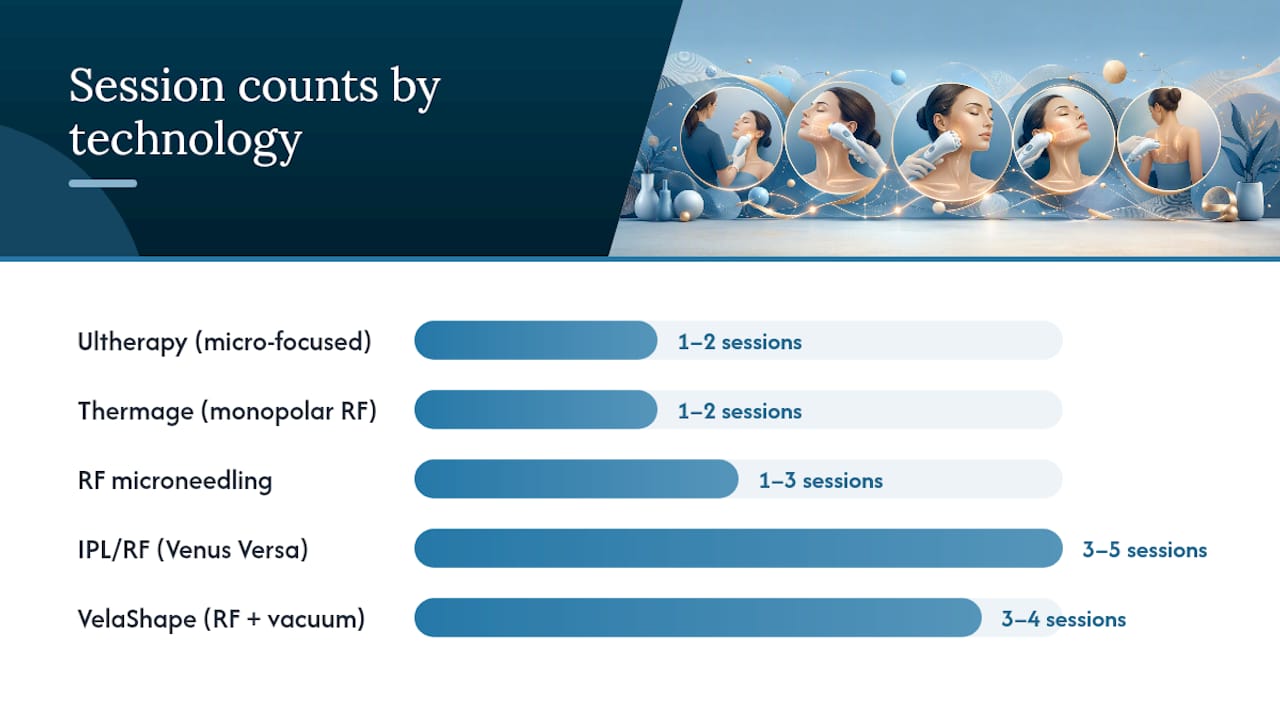
Session counts by technology:
- Micro-focused ultrasound (Ultherapy): 1–2 sessions
- Monopolar RF (Thermage): 1–2 sessions
- RF microneedling (Morpheus8, Profound RF): 1–3 sessions
- IPL/RF combination (Venus Versa): 3–5 sessions
- RF + vacuum (VelaShape): 3–4 sessions, plus periodic maintenance
Cost ranges: Prices vary by treatment area, device, provider expertise, and geography. As illustrative examples only:
- Single-session face RF (e.g., Thermage): roughly $1,000–$4,000 per session
- Ultherapy full face and neck: roughly $2,000–$5,000 per session
- RF microneedling (Morpheus8, 1–3 sessions): roughly $700–$2,000 per session
- Multi-session body package (VelaShape, 3–4 sessions): roughly $1,500–$3,500 total
These are illustrative ranges; your provider will give you a specific quote based on your anatomy and goals. Most non-surgical skin tightening treatments are not covered by insurance.
Side effects, safety, and what to know about home devices
These treatments are generally low-risk when performed by trained providers using FDA-cleared devices. Serious adverse events are uncommon in clinical settings. The risk profile changes significantly with unregulated home devices or undertrained operators.
Common side effects (expected and temporary):
- Redness and warmth lasting a few hours to a day
- Mild swelling, particularly around the eyes or jawline
- Temporary numbness or tingling in the treated area
- Pinpoint marks or mild bruising with RF microneedling
Rarer but real complications:
- Burns from excessive energy delivery or inadequate cooling
- Post-inflammatory hyperpigmentation or hypopigmentation, particularly in darker skin tones
- Scarring (rare, typically associated with improper technique or device settings)
- Paradoxical fat atrophy (rare, reported with some ultrasound devices at incorrect parameters)
- Temporary nerve sensitivity or weakness (more common with deep ultrasound)
FDA clearance and what it means: An FDA-cleared device has been reviewed for safety and effectiveness for a specific indication. That clearance does not automatically extend to every body area or every use case a clinic might offer. Ask your provider specifically which indication the device is cleared for in your treatment area. Off-label use is not inherently unsafe, but it deserves a transparent conversation.
Home devices: Consumer RF and LED devices sold for home use operate at much lower energy levels than clinical devices. Healthline notes that in-office treatments under trained providers have low rates of serious adverse events, while home-use devices require caution because unregulated settings and improper technique increase the risk of burns and pigment problems. If you are considering a home device, consult a provider first to understand what it can and cannot do.
How to choose a qualified provider
The device is only part of the equation. Operator skill, device calibration, and treatment planning account for a large share of the outcome. A provider who knows how to maintain therapeutic temperature for the correct duration, select appropriate energy settings for your skin type, and document results objectively will consistently outperform one who simply owns the right machine.
Provider checklist:
- Board-certified dermatologist, plastic surgeon, or a medically supervised clinic with licensed, trained operators
- Demonstrated experience with the specific device being used (ask how many treatments they have performed)
- Before-and-after photo documentation for similar cases
- Clear explanation of the FDA-cleared indication for your specific treatment area
- Written treatment plan with session count, expected timeline, and follow-up schedule
- Transparent pricing breakdown with no pressure to prepay large packages
Questions to ask at your consultation:
- What is the exact device model, and what is it FDA-cleared for?
- How many treatments have you performed with this device on this area?
- What results are realistic for my degree of laxity?
- What is the recovery plan, and what aftercare is required?
- What happens if I am not satisfied with the results?
- Is there a physician on-site or available for consultation?
Red flags to avoid:
- Guarantees of surgical-level results from a non-invasive device
- Vague or evasive answers about the device model or FDA clearance
- No medical oversight or physician involvement
- Poor or absent before-and-after documentation
- High-pressure sales tactics or large upfront package requirements with no refund policy
Pro Tip: Before your appointment, look up the exact device model on the FDA's 510(k) database to confirm its cleared indication. A provider who welcomes that question is one worth trusting.
What the clinical evidence actually shows
Evidence supports modest-to-moderate improvement for most non-surgical skin tightening technologies, but the research has real limitations. A review published in the Journal of Cosmetic Dermatology found that comparative head-to-head trials are limited and that device-parameter variability across studies makes definitive technology rankings difficult. Different clinics use different settings on the same device, which means published results from one center may not replicate at another.
What the evidence does support consistently: RF-based treatments produce gradual collagen remodeling with a good safety profile when performed correctly. Micro-focused ultrasound shows reliable results for brow and neck lifting in appropriately selected patients. RF microneedling produces stronger tightening than surface RF alone, with a trade-off in recovery time. IPL/RF combinations address both pigmentation and mild laxity, though they require more sessions.
The practical implication is that outcomes depend heavily on three things: device selection matched to your anatomy, operator skill in maintaining therapeutic parameters, and realistic expectations going in. The American Board of Cosmetic Surgery recommends a conservative initial approach, fewer passes and lower energy on first treatments, with objective photo documentation and follow-up at 2–6 months to judge effectiveness. That measured approach is a sign of a provider who understands the evidence, not one who is underselling the treatment.
A clinic perspective on getting this right
At Elitelaserhair, every skin-tightening consultation begins with an honest assessment of laxity degree, skin type, and realistic goals. The treatments offered, including RF microneedling, RF skin tightening, IPL/RF combination therapies, and PDO thread lifts, are performed under medical supervision and selected based on each patient's anatomy rather than a one-size-fits-all protocol. When a single modality is unlikely to achieve the desired result, combined treatment planning, pairing energy-based tightening with injectables for volume or a thread lift for structural support, is part of the conversation from the start. The goal is a result that looks natural and holds up over time, not a single impressive before-and-after photo.
Elitelaserhair offers supervised, personalized skin tightening in Suffolk County
Elitelaserhair's medical spa in Suffolk County offers RF microneedling, RF skin tightening, IPL/RF combination treatments, and PDO thread lifts, all performed under experienced medical supervision with treatment plans customized to your skin type and degree of laxity. The difference from a standard med spa is the clinical oversight: a physician-supervised team that selects device parameters based on your anatomy, documents results at every stage, and adjusts the plan if needed.
To get started, book a skin tightening consultation at Elitelaserhair. Bring a list of your current medications, any history of isotretinoin use, and photos of your concern areas if you have them. The consultation will include a laxity assessment, a device recommendation, and a realistic timeline so you leave with a clear plan rather than a sales pitch.
Sources
- Radiofrequency (RF) skin tightening — Cleveland Clinic
- What to Know About Skin Tightening — WebMD
- Does Radio Frequency Skin Tightening Work? Benefits and Side Effects — Healthline
- Non-Surgical Skin Tightening — American Board of Cosmetic Surgery
- Many ways to firm sagging skin — American Academy of Dermatology (AAD)