
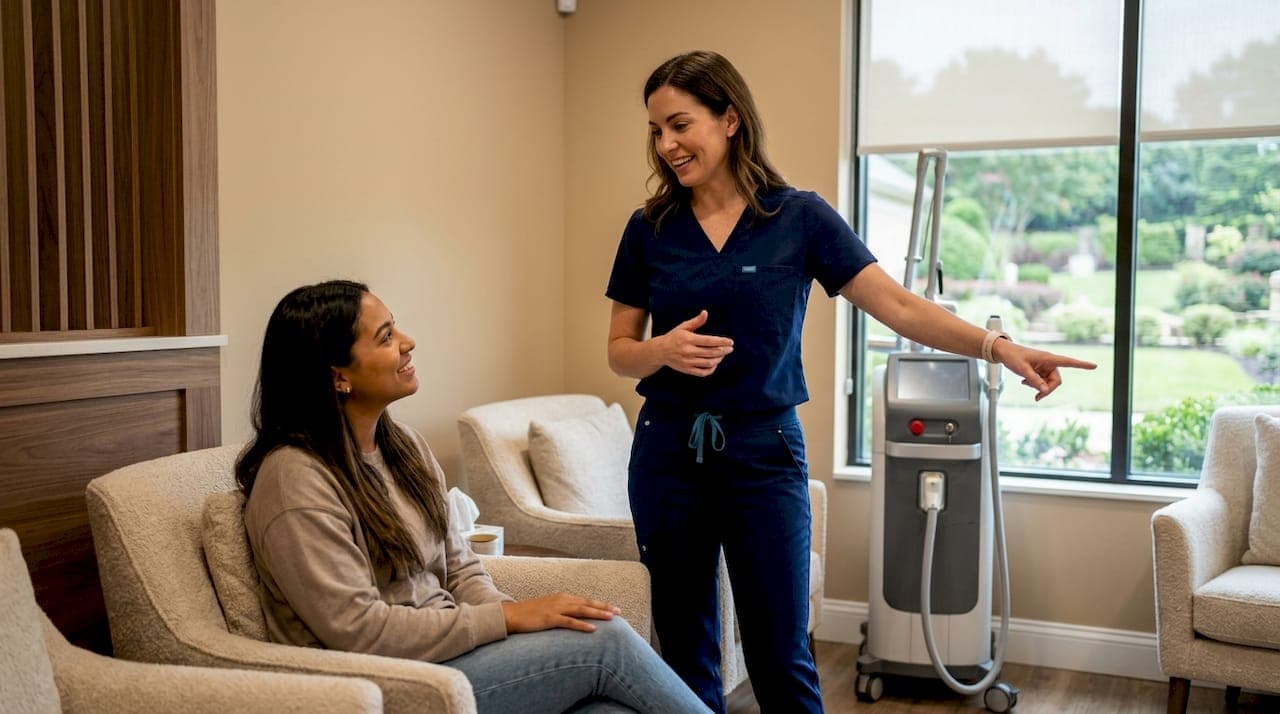
Laser hair removal is defined as a medical procedure that uses concentrated light to destroy hair follicles and permanently reduce unwanted hair growth. The three primary professional laser types are Alexandrite (755 nm), Diode (800–810 nm), and Nd:YAG (1064 nm), each matched to a specific range of skin tones on the Fitzpatrick scale. Choosing the wrong wavelength for your skin type risks poor results or permanent skin damage. The types of laser hair removal treatments available today make it possible to treat nearly every skin tone safely, but only when the technology matches the patient. Most people need 6–16 sessions spaced 3–8 weeks apart to reach the 70–90% hair reduction that defines a successful full course.
1. Types of laser hair removal treatments: Alexandrite
The Alexandrite laser operates at 755 nm and is the fastest option for people with light to medium skin. Its wavelength sits in the peak absorption range for melanin, which means it destroys dark, coarse hair with high efficiency. The larger spot size lets practitioners cover large body areas, such as legs or the back, in significantly less time than other laser types.
Best candidates for Alexandrite:
- Fitzpatrick skin types I, II, and III (fair to light olive skin)
- Dark brown or black hair
- People treating large areas like full legs, chest, or back
- Those who want faster session times
The Alexandrite laser carries a higher risk of hyperpigmentation in skin types IV and above. Melanin in the skin competes with melanin in the hair follicle for the laser energy, which can cause surface burns or discoloration on darker tones.
Pro Tip: Always request a patch test at least 48 hours before your first Alexandrite session. Even within Fitzpatrick I–III, individual skin reactions vary, and a patch test catches sensitivity before it becomes a problem.
2. Diode laser: the versatile everyday workhorse
The Diode laser operates at 800–810 nm, which places it between the Alexandrite and Nd:YAG on the wavelength spectrum. That middle position gives it a broader safety margin across skin types. It penetrates deeper into the dermis than the Alexandrite, reaching follicles more effectively in people with medium to dark skin.
Key features of Diode laser treatment:
- Fitzpatrick skin types II, III, and IV (light olive to medium brown skin)
- Effective on coarse and medium-thickness hair
- Deeper penetration with a wider safety profile than Alexandrite
- Common for facial areas, underarms, bikini line, and full body
- Slightly slower area coverage compared to Alexandrite
The Diode laser is the most widely used professional system for body hair removal because of its flexibility. Practitioners can adjust pulse duration and fluence to accommodate different hair thicknesses and skin tones within its range. People with medium skin tones who were previously told they were "borderline" candidates often respond well to Diode treatments.
3. Nd:YAG laser: the gold standard for darker skin
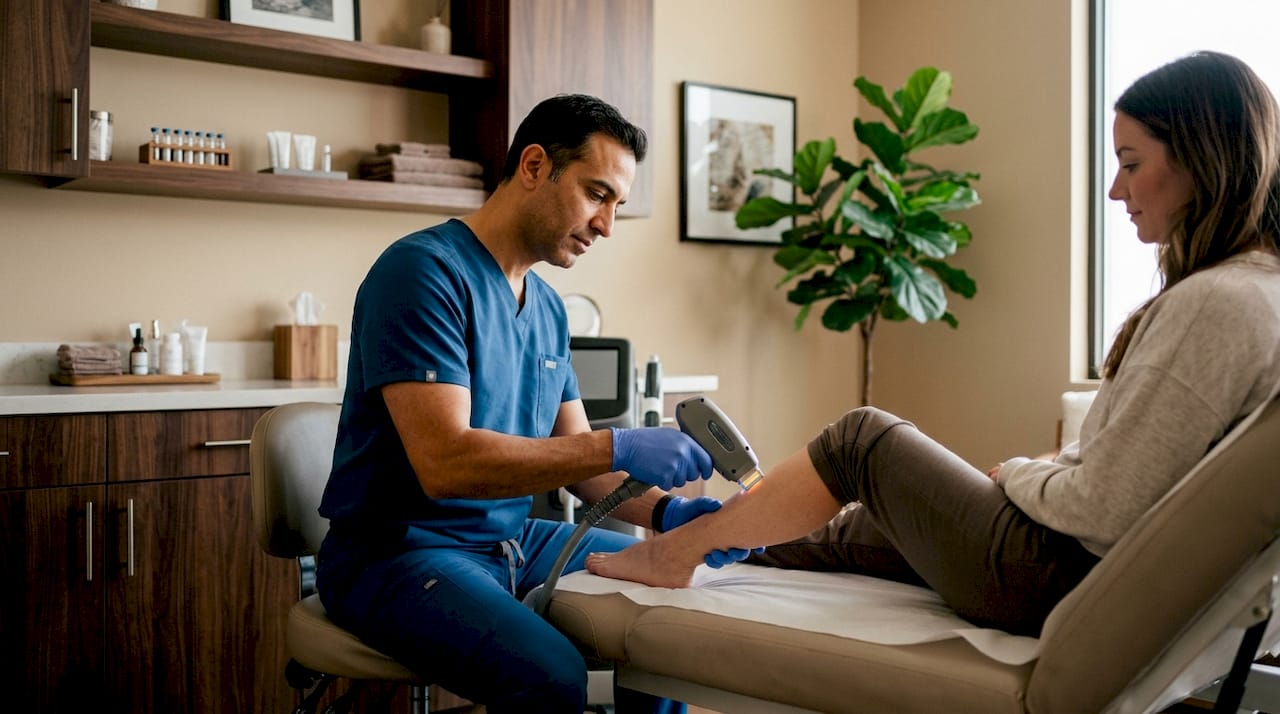
The Nd:YAG laser operates at 1064 nm, the longest wavelength among professional hair removal systems. That longer wavelength bypasses the melanin in the upper skin layers and targets the follicle directly. This makes it the safest option for Fitzpatrick IV–VI skin tones, including many South Asian, Middle Eastern, and African American skin types.
What to expect with Nd:YAG treatment:
- Fitzpatrick skin types IV, V, and VI (medium brown to deep skin)
- Requires integrated cooling to protect the skin surface during pulses
- Typically 6–8 sessions spaced 4–6 weeks apart
- Delivers approximately 80% hair reduction after a full series
- Safe for coarse hair on the face, body, and legs
The Nd:YAG does require more sessions than the Alexandrite for equivalent results, and individual pulses can feel more intense. Cooling systems, whether contact cooling or cold air, are not optional. They protect the epidermis and make the treatment tolerable.
Pro Tip: If you have Fitzpatrick IV–VI skin and a clinic recommends Alexandrite without a thorough skin assessment, get a second opinion. Using the wrong wavelength on darker skin is one of the most common causes of post-treatment hyperpigmentation.
4. Intense Pulsed Light (IPL): not a laser, but worth knowing
Intense Pulsed Light, or IPL, is not technically a laser. It emits broad-spectrum light across multiple wavelengths rather than a single focused beam. That distinction matters because IPL requires more sessions for lasting results and delivers less consistent energy to the follicle than a clinical laser system.
IPL at a glance:
- Broad-spectrum light, not monochromatic laser energy
- Commonly found in at-home devices and some entry-level clinic systems
- Requires more sessions than professional lasers for comparable reduction
- Less effective on darker skin tones or light-colored hair
- Can address surface pigmentation and mild skin tone concerns alongside hair
IPL's main appeal is accessibility. At-home IPL devices are widely available and cost far less than a clinical laser series. The trade-off is effectiveness. Clinical-grade laser systems provide better, faster long-term hair reduction than IPL devices, even when used consistently at home. For people with light skin and dark hair who want a low-cost starting point, at-home IPL can produce modest results. For anyone seeking reliable, lasting reduction, a professional laser system is the more dependable path.
5. How laser hair removal actually works
Laser hair removal targets melanin, the pigment inside the hair follicle. The laser energy converts to heat, which damages the follicle and disrupts future growth. The critical detail is that this process only works on follicles in the active growth phase, called the anagen phase. At any given time, only a portion of your follicles are in anagen, which is why multiple sessions are required to catch each follicle at the right moment.
This biology also explains why laser hair removal does not work on light-colored hair. Blonde, gray, white, and red hair contain little to no melanin, so the laser has no pigment to target. The lack of melanin in these hair types makes them resistant to all current laser and IPL technologies. Hormonal changes can also trigger regrowth in previously treated follicles, which is why maintenance sessions are sometimes needed after the initial series.
6. Choosing the right laser for your skin tone and hair type
The Fitzpatrick scale is the primary tool practitioners use to match laser type to patient. It classifies skin from Type I (very fair, always burns) to Type VI (deeply pigmented, never burns). Selecting the correct laser based on this scale is not a preference. It is a clinical requirement for both safety and results.
| Fitzpatrick Type | Skin Description | Recommended Laser |
|---|---|---|
| I–II | Fair to light, burns easily | Alexandrite (755 nm) |
| III–IV | Light olive to medium brown | Diode (800–810 nm) |
| IV–VI | Medium brown to deep | Nd:YAG (1064 nm) |
Hair color matters as much as skin tone. Dark, coarse hair absorbs laser energy most efficiently and produces the best outcomes across all three laser types. Fine or light-colored hair responds poorly regardless of which system is used. A full leg session with a professional laser takes approximately 45 minutes, while smaller areas like the upper lip take under five minutes.
Pro Tip: Ask your provider which specific laser system they use before booking. A clinic that offers only one laser type may not be the right fit for your skin tone. The best outcomes come from matching the technology to you, not fitting you to the available equipment.
7. Session count, spacing, and realistic outcomes
Most people need 6–16 sessions to achieve lasting reduction, with intervals of 3–8 weeks between appointments. The exact number depends on the treatment area, hair density, and how consistently follicles cycle through the anagen phase. Body areas with slower hair cycles, such as the back or legs, often need more sessions than facial areas.
Realistic expectations matter. A 70–90% reduction in hair growth is the standard measure of success for a completed laser series. That means some hair may remain, particularly fine or light-colored strands that the laser cannot effectively target. Clients with coarse, dark hair consistently see the strongest results. Maintenance sessions once or twice a year help sustain those results long-term, especially for people with hormonal fluctuations.
Key takeaways
The best laser hair removal treatment is not a single technology. It is the one matched accurately to your melanin levels, hair characteristics, and skin type.
| Point | Details |
|---|---|
| Laser type must match skin tone | Alexandrite suits Fitzpatrick I–III; Diode suits II–IV; Nd:YAG suits IV–VI. |
| Multiple sessions are unavoidable | Most people need 6–16 sessions to reach 70–90% hair reduction. |
| IPL is not a clinical laser | IPL uses broad-spectrum light and requires more sessions with less consistent results. |
| Light-colored hair cannot be treated | Blonde, gray, white, and red hair lack the melanin lasers need to work. |
| Practitioner skill affects safety | Wrong parameters increase risks like hyperpigmentation and paradoxical hair growth. |
What I've learned after years of watching people choose the wrong laser
People consistently underestimate how much the laser type matters. They book based on price or proximity, then wonder why their results are uneven or why their skin reacted badly. The technology is only as good as the match between the machine and the person sitting in the chair.
The risk that surprises people most is paradoxical hypertrichosis, where treated areas actually grow more hair after sessions. This occurs in up to 18.3% of certain populations and is almost always linked to incorrect laser parameters or undertreated follicles. Skilled practitioners who select the right fluence and pulse duration for your skin type reduce this risk significantly.
My honest advice: skip the at-home IPL device if you want real, lasting results. Clinical-grade systems are not just more powerful. They are calibrated, monitored, and adjusted session by session. A consultation at a medically supervised clinic, where your Fitzpatrick type is assessed and your medical history is reviewed, is worth more than any device you can buy online.
Post-treatment care also gets ignored too often. Avoiding sun exposure for at least two weeks before and after each session protects your skin from UV-triggered pigmentation changes. Sunscreen is not optional. It is part of the treatment protocol.
— Sharon
Professional laser hair removal at Elitelaserhair
Elitelaserhair operates out of Suffolk County, New York, and has built its reputation on matching the right laser to each patient rather than applying a one-size approach.
The clinic uses Alexandrite, Diode, and Nd:YAG systems, which means your skin tone and hair type determine the treatment plan, not the other way around. Every session is performed under experienced medical supervision, with cooling protocols and safety checks built into each appointment. Elitelaserhair backs its laser hair removal packages with a three-year guarantee, which reflects the confidence the clinic places in its clinical outcomes. If you are ready to move past temporary solutions, a consultation at Elitelaserhair is the right first step.
FAQ
What are the main types of laser hair removal?
The three primary professional types are Alexandrite (755 nm), Diode (800–810 nm), and Nd:YAG (1064 nm). Each targets a different range of skin tones on the Fitzpatrick scale for safe and effective hair reduction.
How many sessions does laser hair removal take?
Most people need 6–16 sessions spaced 3–8 weeks apart. The exact number depends on the treatment area, hair density, and individual hair growth cycles.
Does laser hair removal work on all hair colors?
Laser hair removal is ineffective on light-colored hair, including blonde, gray, white, and red. These hair types lack the melanin that lasers need to generate heat and damage the follicle.
Is IPL the same as laser hair removal?
IPL is not a laser. It emits broad-spectrum light rather than a focused single wavelength, which makes it less precise and generally less effective than clinical laser systems for long-term hair reduction.
Which laser is safest for dark skin?
The Nd:YAG laser at 1064 nm is the gold standard for Fitzpatrick IV–VI skin. Its longer wavelength bypasses surface melanin and targets the follicle directly, reducing the risk of burns and pigmentation changes.