

If you lost weight through diet, exercise, GLP-1 medication, or bariatric surgery, the fix for loose skin depends almost entirely on how much laxity you're dealing with. Mild sagging often responds to strength training, slow and steady habits, and time. Moderate laxity can improve with non-surgical treatments like radiofrequency or ultrasound devices. Severe, hanging excess skin usually only resolves with surgical body contouring, which remains the most reliable way to remove significant tissue.
Before you do anything else:
- Confirm your weight has been stable for at least a few months.
- Book a consultation with a dermatologist or, for surgical questions, a board-certified plastic surgeon.
- Take dated photos of the affected areas now, so you have a baseline.
- Clean up your protein intake and quit smoking if you haven't already.
- Mild sagging (arms, lower belly): try lifestyle changes and non-surgical treatments first.
- Moderate laxity (multiple areas, some hang but skin still has tone): non-surgical devices plus a surgical consult.
- Severe, hanging skin (post-bariatric, 100+ pounds lost): plan for surgery; nothing else will remove it.
Key Takeaways
Matching treatment intensity to your actual degree of skin laxity, mild, moderate, or severe, determines whether you need lifestyle changes, a device-based protocol, or surgery.
| Point | Details |
|---|---|
| Mild laxity responds to lifestyle | Slow weight loss, strength training, and protein intake help skin retract naturally over 1 to 2 years. |
| Non-surgical devices help moderate cases | RF, RF microneedling, and ultrasound need multiple sessions and only produce modest tightening. |
| Surgery is the reliable fix for severe cases | Procedures like abdominoplasty and panniculectomy remove excess skin that no device or cream can. |
| Timing matters more than urgency | Wait six to twelve months of stable weight before scheduling most body-contouring surgery. |
| Elitelaserhair offers a non-surgical starting point | RF microneedling and skin-tightening consultations help assess mild to moderate laxity before considering surgery. |
Table of Contents
- Why Does Skin Get Loose After Weight Loss?
- How Much Weight Loss Causes Loose Skin, and How Fast Does It Show Up?
- Can You Prevent Loose Skin While Losing Weight?
- What Non-Surgical Skin-Tightening Options Actually Do
- Which Surgical Procedures Remove Excess Skin?
- Are You a Good Candidate for Non-Surgical or Surgical Treatment?
- How Do You Choose a Provider for Skin Tightening?
- How a Medical Spa Approaches Post-Weight-Loss Skin Laxity
- What I've Learned Treating Loose Skin After Major Weight Loss
- Ready to Talk Through Your Options?
- Sources
- FAQ
Why Does Skin Get Loose After Weight Loss?
Your skin has three layers, but the one that matters most here is the dermis, home to collagen and elastin fibers that give skin its structure and snap-back ability. When you carry excess weight for years, that dermal layer stretches to accommodate the fat underneath it. Lose the fat quickly, and the skin doesn't always shrink to match. Collagen and elastin degrade with the stretch, and they don't regenerate fast enough to close the gap, which is why you're left with folds and hanging tissue instead of a smooth contour.
Several factors decide whether your skin bounces back or stays loose:
- Age. Collagen production drops steadily after your 20s, so skin in a 50-year-old has less elastic capacity than skin in a 25-year-old carrying the same excess weight.
- Genetics. Some people's skin is simply more elastic than others', regardless of effort.
- Total weight lost and how long it was carried. Skin stretched for a decade behaves differently than skin stretched for two years.
- Speed of loss. Rapid loss (crash diets, some GLP-1 protocols, bariatric surgery) outpaces the skin's ability to adjust.
- Smoking and sun exposure. Both accelerate collagen breakdown independent of weight.
- Pregnancy and low muscle mass. Both add to skin-stretch history and reduce the underlying structure that helps skin look taut.
Pro Tip: If you're deciding between two weight-loss timelines, remember that the speed of loss matters almost as much as the total amount. Slower loss gives collagen more time to remodel around your new shape.
How Much Weight Loss Causes Loose Skin, and How Fast Does It Show Up?
Loose skin becomes increasingly common after weight losses in the range of 50 pounds and up, and the odds climb further past the 100-pound mark. That said, a 35-year-old with elastic skin and a slow six-year weight loss might see almost none, while a 60-year-old who lost 80 pounds in a year could see significant hanging tissue in the same areas. Age and genetics can outweigh the raw number on the scale.
Skin laxity typically shows up on the lower abdomen, upper arms, inner thighs, and under the chin first, since these areas store fat closest to the surface and stretch the most.
If your skin is going to improve on its own, you'll usually see the bulk of that improvement within the first one to two years after reaching a stable weight. Waiting longer rarely produces further natural tightening.
- Does loose skin ever go away by itself? Sometimes, for mild cases in younger people with good genetics. Moderate to severe laxity generally doesn't resolve without treatment.
- How long should I wait before judging the result? Give it a full year at a stable weight before assuming the skin won't retract further.
- Is it different for GLP-1 users versus bariatric surgery patients? Not fundamentally. Both cause rapid fat loss, and both carry similar loose-skin risk when the loss happens quickly.
Can You Prevent Loose Skin While Losing Weight?
You can meaningfully reduce your risk, even if you can't eliminate it. The single biggest lever is pace: losing weight at a gradual and steady pace gives your skin's collagen network time to remodel instead of getting left behind by a shrinking fat layer underneath it.
Strength training matters just as much as pace. Building or preserving muscle mass while you lose fat fills out the space under your skin and supports the collagen production that keeps it firmer. Pair that with adequate protein, since collagen synthesis needs the amino acid building blocks protein provides, plus steady hydration and micronutrients like vitamin C and zinc.
Smoking accelerates collagen breakdown regardless of your weight, so quitting is one of the few changes with an outsized payoff. Sun protection matters for the same reason: UV exposure degrades elastin over time.
- Lose weight gradually rather than crash-dieting.
- Add resistance training two to four times a week.
- Eat enough protein daily to support tissue repair.
- Stay hydrated and don't skip micronutrients.
- Quit smoking and wear sunscreen on exposed skin.
Pro Tip: If you're losing weight through a GLP-1 medication or after bariatric surgery, prioritize muscle-building alongside fat loss rather than treating it as an afterthought. The rapid pace of these methods makes body composition work more important, not less.
What Non-Surgical Skin-Tightening Options Actually Do
For mild to moderate laxity, several energy-based devices can produce visible tightening without surgery. None of them remove skin. They stimulate collagen production and cause mild tissue contraction, which firms what's already there.
Radiofrequency (RF) and RF microneedling heat the deeper skin layers to trigger collagen remodeling. RF microneedling adds tiny needle punctures that deliver energy directly into the dermis, which tends to produce a stronger result than RF alone.
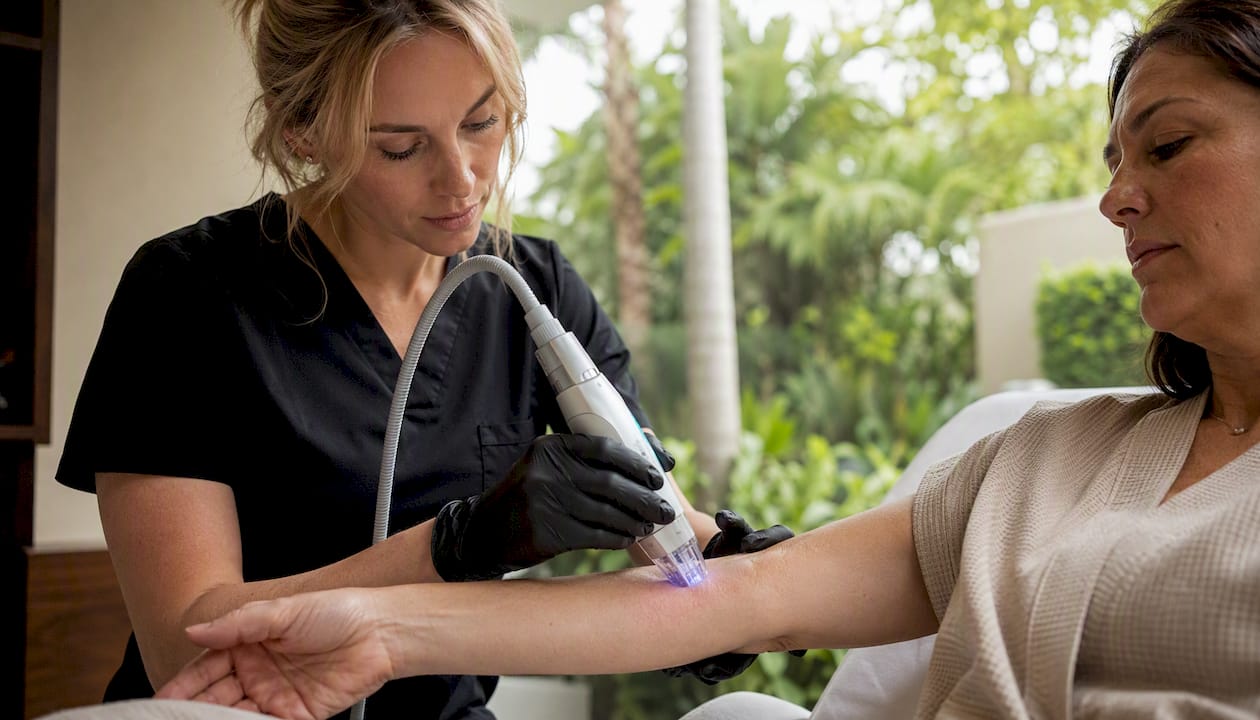
Ultrasound-based devices use focused sound waves to heat tissue at a specific depth, prompting a similar collagen response.
Laser treatments work on the same collagen-stimulation principle, usually targeting more superficial layers than ultrasound.
Low-frequency electromagnetic devices and injectable skin boosters offer more modest, hydration-focused improvements rather than structural tightening.
PDO thread lifts physically lift and suspend a small amount of tissue using dissolvable sutures, useful for localized sagging like under the jawline or brow, though the effect is temporary as the threads dissolve over months.

Clinical reviews consistently describe these treatments as producing modest, variable results for mild laxity, and outcomes depend heavily on the specific device, the provider's skill, and how much natural elasticity your skin has left. None of them address large, hanging folds of excess skin.
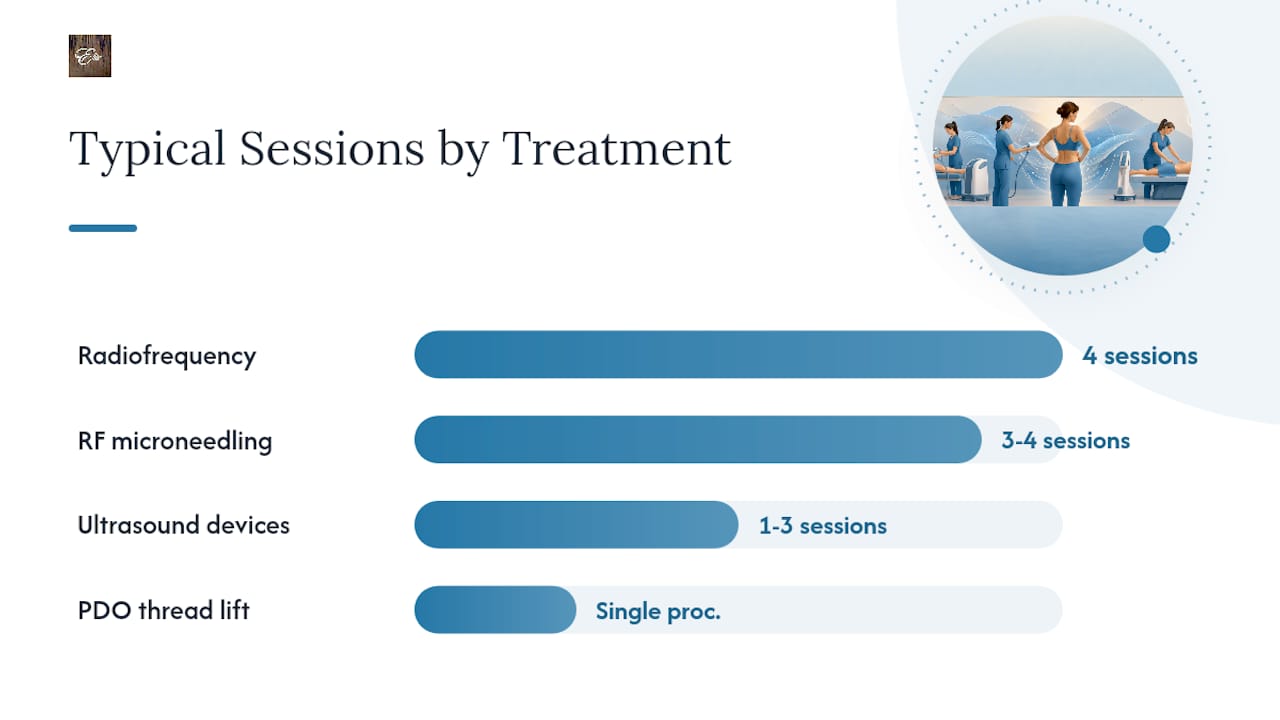
| Treatment | Typical Sessions | Downtime | Time to See Results |
|---|---|---|---|
| Radiofrequency | 4 sessions | None to minimal | 2 to 3 months |
| RF microneedling | 3 to 4 sessions | 1 to 3 days redness | 3 months |
| Ultrasound-based devices | 1 to 3 sessions | None | 2 months |
| PDO thread lift | Single procedure | 3 days swelling | Immediate, refines over weeks |
Which Surgical Procedures Remove Excess Skin?
When laxity is severe, surgery is the most reliable way to remove and reshape excess skin. No cream, device, or exercise routine substitutes for a scalpel when the skin itself needs to come off.
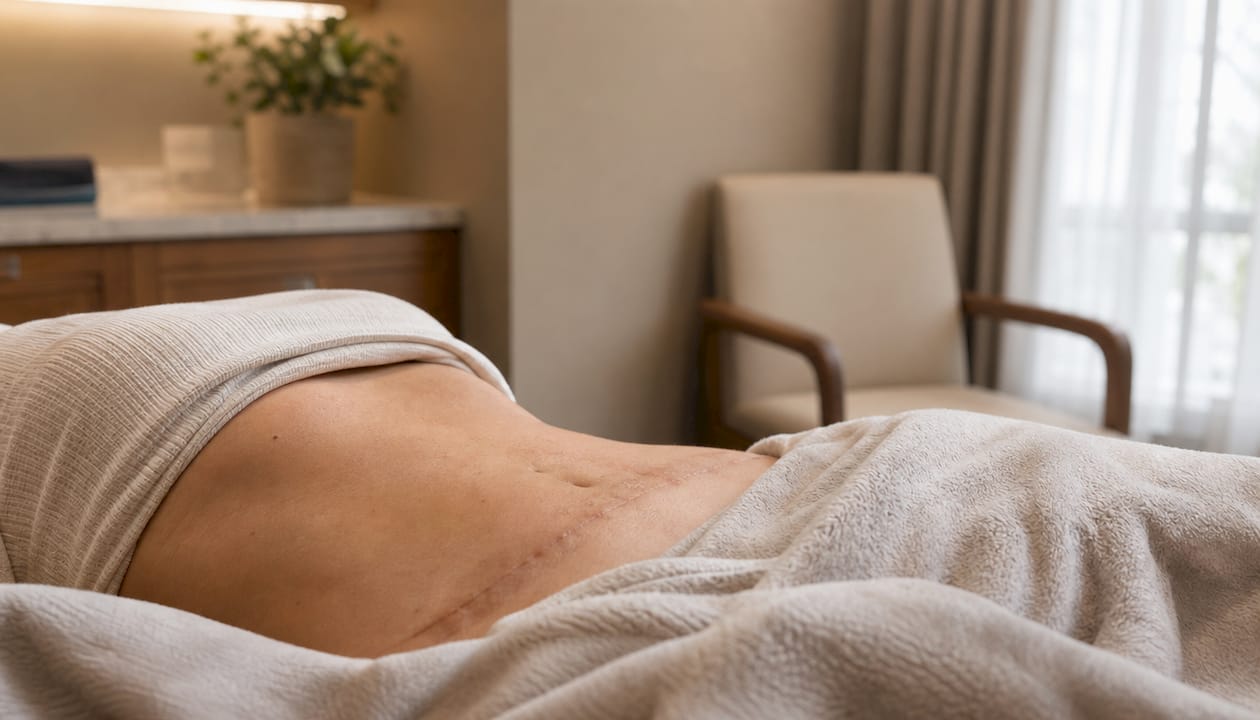
Abdominoplasty (tummy tuck) removes excess abdominal skin and tightens underlying muscle, mostly for cosmetic contouring. Panniculectomy removes the hanging apron of skin (the pannus) that often causes rashes, infections, or mobility problems. This distinction matters for insurance, since panniculectomy addressing a functional medical problem is sometimes covered, while a cosmetic abdominoplasty typically is not. Lower body lifts address the abdomen, hips, thighs, and buttocks in one coordinated procedure. Brachioplasty (arm lift) and thigh lifts target hanging skin on the limbs, while breast or chest lifts address sagging in that area after significant fat loss.
Recovery varies by procedure and by how much tissue is involved.
| Procedure | Typical Recovery Stay | Return to Desk Work | Full Activity Resumed |
|---|---|---|---|
| Panniculectomy | 1 to 2 nights | 3 to 4 weeks | 6 weeks |
| Abdominoplasty | 1 to 2 nights | 2 to 3 weeks | 6 weeks |
| Lower body lift | 2 to 3 nights | 4 weeks | 8 weeks |
| Brachioplasty/thigh lift | Outpatient or 1 night | 2 weeks | 4 weeks |
Surgeons generally stage these procedures rather than combining everything into one operation, since operating on multiple large areas at once increases complication risk and complicates recovery. Expect visible scarring, though a skilled surgeon places incisions to keep them as discreet as clothing allows.
Are You a Good Candidate for Non-Surgical or Surgical Treatment?
Start with weight stability. Most surgeons want to see your weight holding steady for six to twelve months before scheduling body contouring, since operating during continued weight change risks undoing the results. Nutritional status matters too: you need enough protein and overall caloric intake to heal properly, which is why crash-dieting right up to a procedure works against you.
Match your expectations to your laxity level:
- Mild laxity: lifestyle changes and non-surgical devices are usually enough to notice a real difference.
- Moderate laxity: non-surgical treatments help, but many people in this group eventually consult a surgeon for a more complete result.
- Severe, hanging skin: surgery is typically the only path to a meaningfully different contour.
Non-smokers, or those with a firm quit date well before surgery, heal faster and face fewer complications. Controlled comorbidities like diabetes matter for the same reason. Go in expecting scars, the possibility of staged procedures across multiple visits, and a contour change that's real but not necessarily "smooth as it was before you gained weight."
How Do You Choose a Provider for Skin Tightening?
Verify board certification for any surgeon, and confirm that device-based treatments happen under medical supervision, not just an aesthetician working solo. Ask to see real before-and-after photos of patients with a body type similar to yours, not just the practice's best-case gallery.
At your consultation, ask directly:
- How many post-weight-loss body contouring cases have you handled?
- What's your complication rate, and how do you manage them?
- Would you recommend staging my procedures, and in what order?
- What's a realistic timeline for my specific case?
Red flags to walk away from: pressure to purchase a treatment package before any evaluation, vague or absent before-and-after documentation, and reluctance to discuss risks, credentials, or a straightforward answer about who performs the treatment.
How a Medical Spa Approaches Post-Weight-Loss Skin Laxity
A typical non-surgical protocol for moderate laxity looks like this:
- Initial assessment: medical history, weight-stability check, and photo documentation.
- Treatment mapping: matching each area (abdomen, arms, thighs) to the most appropriate device, whether that's RF microneedling or an ultrasound-based option.
- Staged sessions with topical support between visits and a cost estimate laid out upfront.
- Maintenance sessions and reassessment every few months to track progress.
- Every device-based treatment happens under medical supervision, not guesswork.
- Muscle-toning add-ons like CoolTone can complement skin work by improving the underlying contour.
- When someone's laxity looks surgical in scope, the honest answer is a referral, with realistic framing rather than overselling what a device can do.
What I've Learned Treating Loose Skin After Major Weight Loss
The biggest disservice in this space is pretending every case has the same fix. People who lost 100+ pounds are told to "just try a cream" by well-meaning friends, and people with mild sagging get talked into surgery consults they didn't need. Matching the treatment to the actual severity, and being honest when a device won't cut it, is what separates useful advice from wishful thinking. Wait for weight stability, and keep your expectations tied to your starting point, not someone else's transformation photos.
Ready to Talk Through Your Options?
If you're weighing non-surgical treatments against a surgical consult, Elitelaserhair gives you a place to start that doesn't require committing to either path yet. Unlike a surgical practice, a consultation here lets you test whether radiofrequency or RF microneedling gets you meaningful results before you consider anything more invasive.

Bring dated photos of the areas that concern you, a list of current medications and any prior surgeries, and a clear sense of your goals. If you've been on a GLP-1 medication or had bariatric surgery, mention your weight-stability timeline so the treatment plan accounts for it.
Pro Tip: Track your weight weekly for at least six months before your consultation. A stable trend line helps your provider recommend the right skin-tightening protocol instead of guessing at where your weight will land.
Schedule an assessment through Elite Laser Center's services page to map out which non-surgical option fits your skin and timeline.
Sources
- Body Contouring After Weight Loss | Johns Hopkins Medicine
- Ncbi
- Loose Skin After Major Weight Loss: What Actually Helps (2026) | WeightFAQ
- How to Tighten Loose Skin After Weight Loss | UnityPoint Clinic
This article is general information, not a substitute for advice from a qualified doctor. Consult a qualified healthcare professional about your own circumstances before acting on anything here.
FAQ
Will Losing 50 Pounds Cause Saggy Skin?
It can, though it's not guaranteed. Loose skin becomes increasingly common past the 50-pound mark, but age, genetics, and how fast you lost the weight all affect whether you actually see it.
What Is the Best Skin-Tightening Treatment After Weight Loss?
There's no single best option since it depends on severity. Mild laxity responds to non-surgical devices like RF microneedling, while severe, hanging skin usually requires surgical body contouring for a real change.
Can Exercise Alone Tighten Loose Skin?
Strength training helps by building muscle under the skin and supporting collagen production, but it won't fully resolve moderate to severe laxity on its own.
How Long Should I Wait Before Considering Surgery?
Most surgeons recommend waiting until your weight has been stable for several months before scheduling body-contouring procedures.
Does Insurance Cover Skin-Removal Surgery?
Sometimes. A panniculectomy may be covered by insurance when it treats functional medical problems like rashes or mobility problems, but cosmetic procedures such as a standard tummy tuck usually aren't covered.