

A med spa skin consultation is a clinician-led medical assessment and shared decision-making visit where a licensed provider examines your skin, reviews your health history, and documents a personalized treatment plan with informed consent. It is not a spa facial, and it is not a dermatology appointment. It sits between the two.
Why it matters at a glance:
- Establishes your candidacy and safety for specific treatments
- Takes about half an hour to under an hour and ends with a written plan, costs, and timeline
- Produces documented informed consent, not just a verbal recommendation
- Identifies contraindications (pregnancy, active infection, certain medications) before any procedure begins
- Lets you evaluate the provider before committing to treatment
Table of Contents
- What exactly is a med spa skin consultation?
- What happens step by step during a med spa consultation?
- What do diagnostic tools like VISIA® actually show you?
- Who performs the consultation, and what oversight is required?
- What outcomes should you expect after the consultation?
- How to prepare for your med spa skin consultation
- Red flags to watch for during a consultation
- Questions to ask during your consultation
- How Elitelaserhair structures clinician-led consultations
- Key Takeaways
- What the consultation actually protects
- Book a clinician-led consultation at Elitelaserhair
- Useful sources and further reading
What exactly is a med spa skin consultation?
A day spa facial relaxes your skin. A dermatology visit diagnoses and treats disease. A med spa consultation does something different: it determines whether you are a safe, appropriate candidate for aesthetic medical procedures and builds a documented plan to help you get there.
The "medical" part matters. AmSpa practice guidelines describe a useful test: if a procedure affects living tissue beneath the stratum corneum, it requires medical oversight. Botox, laser hair removal, RF microneedling, and chemical peels all clear that bar. A basic facial does not.
| Setting | Focus | Who provides care | Medical oversight |
|---|---|---|---|
| Day spa | Relaxation, surface skin | Esthetician | None required |
| Med spa | Aesthetic medical outcomes | MD, NP, PA, RN, esthetician | Medical director required |
| Dermatologist | Diagnosis and disease treatment | MD/DO | Full physician practice |
Diagnostic technology often plays a supporting role. VISIA® Skin Analysis (by Canfield Scientific) is the most widely used imaging adjunct in med spas. It captures standardized UV, cross-polarized, and parallel-polarized photos to quantify spots, pores, texture, wrinkles, UV damage, and porphyrins. The numbers give a clinician a reproducible baseline, not a diagnosis on their own.
What happens step by step during a med spa consultation?
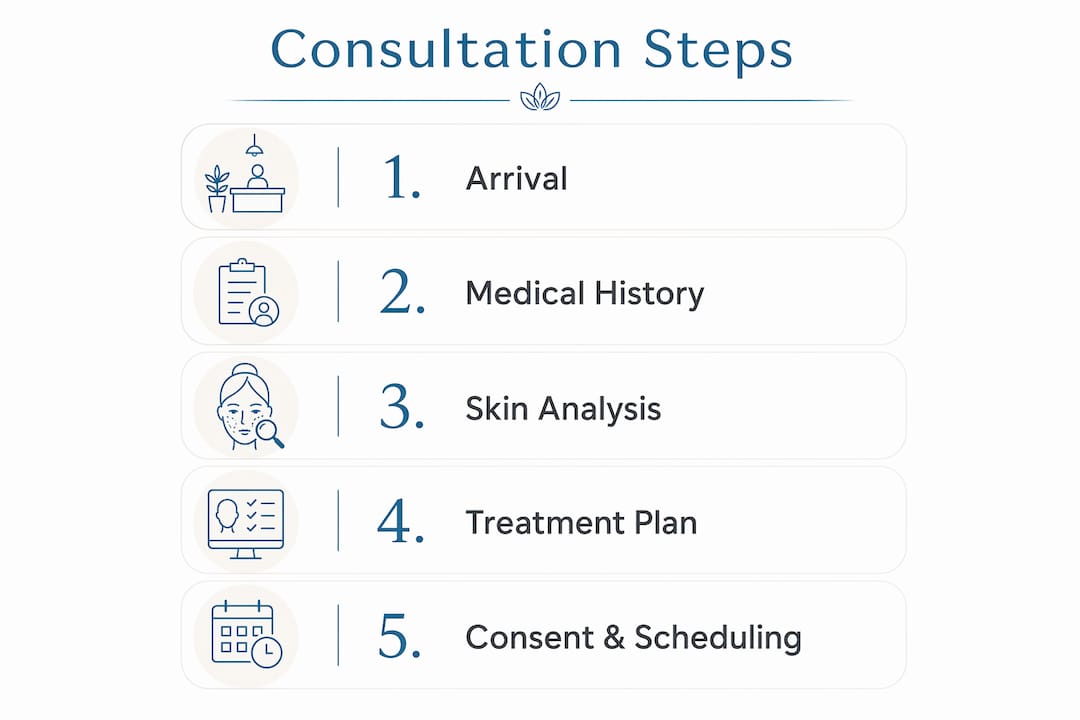
A first med spa appointment typically runs a moderate duration suitable for thorough assessment. Some clinics offer same-day treatment after the consult; others schedule treatment separately. Either approach is acceptable as long as the exam and consent happen first.
Here is the usual flow:
- Booking and fees. Some clinics charge a consultation fee, often credited toward your first treatment. Confirm this when you schedule.
- Intake paperwork. You will complete a medical-history form covering current medications, supplements (especially blood thinners, aspirin, fish oil, and vitamin E), allergies, and prior aesthetic procedures.
- Face-to-face exam. A licensed clinician examines the treatment area, takes clinical photos, and assesses candidacy. Contraindications like active infection, pregnancy, or recent sun damage are identified here.
- Goals discussion. You describe your primary concern. Experienced clinicians often recommend focusing on one main issue first for cleaner outcomes and clearer attribution.
- Recommendations. The provider outlines treatment options, expected number of sessions, recovery time, and total cost, including package or financing options.
- Documentation. The visit closes with a written treatment plan, procedure-specific informed consent, and a scheduled follow-up or treatment date.
AmSpa frames this visit as a "good faith exam" where the practitioner-patient relationship is formally established. That relationship is the legal and clinical foundation for everything that follows.
What do diagnostic tools like VISIA® actually show you?
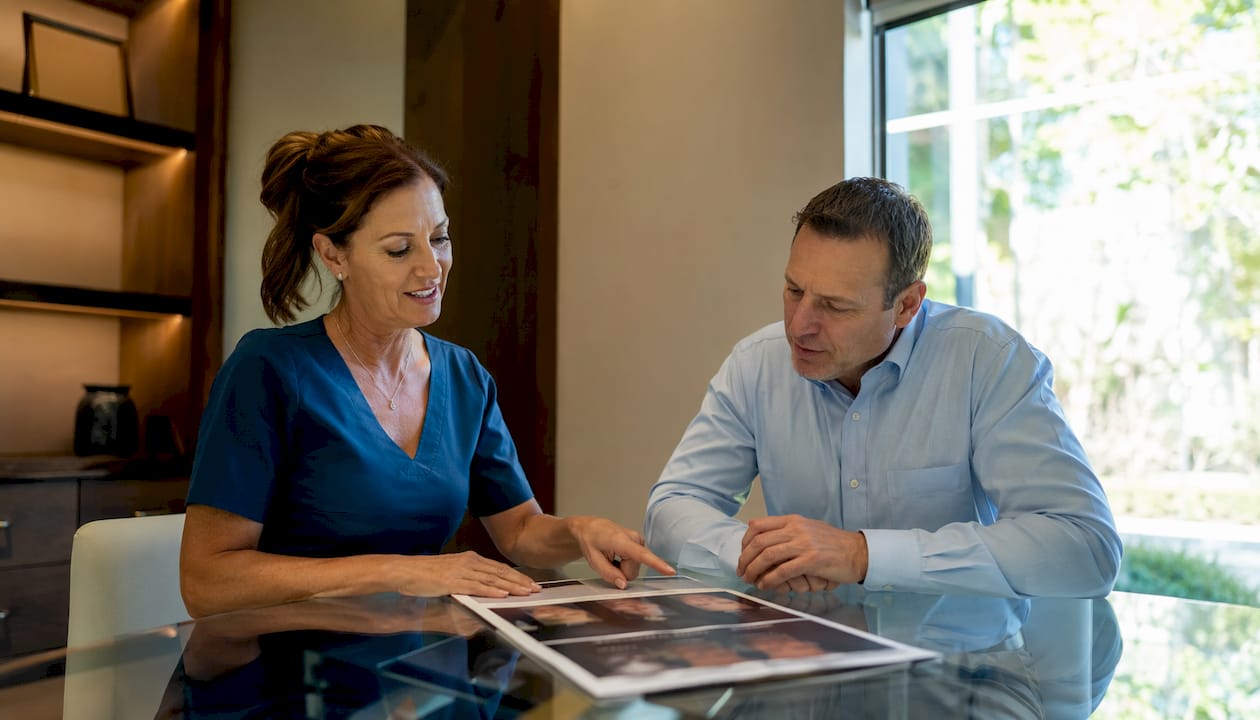
Diagnostic tools give clinicians a reproducible, objective baseline. They do not replace clinical judgment; they sharpen it.
| Tool | What it measures | Clinical use |
|---|---|---|
| VISIA® Skin Analysis | Spots, pores, texture, wrinkles, UV damage, porphyrins | Baseline imaging, progress tracking, patient education |
| Clinical photos | Visual record of treatment area | Before/after documentation, legal record |
| Magnifying lamp | Surface irregularities, hair follicle density | Candidacy for laser or resurfacing |
| Wood's lamp | Pigmentation depth (epidermal vs. dermal) | Melasma assessment, sun damage mapping |
| Dermatoscope | Vascular patterns, pigment structure | Lesion screening before energy treatments |
| Hydration/TEWL meter | Skin barrier function | Identifying compromised barrier before peels or lasers |
VISIA® produces percentile scores comparing your skin to a reference population. A score of 40 for UV spots means 60% of people in your age group have fewer UV spots than you do. That number is a conversation starter, not a verdict. The clinician interprets it alongside your history, your goals, and the physical exam.
Reading a VISIA® report without clinical context is like reading a lab result without a doctor. The device output tells you what is there; the clinician tells you what it means for your specific treatment plan.
Pro Tip: Ask the provider to walk through your top two or three VISIA® scores and explain exactly how each one influences the recommended plan. If they cannot connect the numbers to the treatment, that is worth noting.
Who performs the consultation, and what oversight is required?
AmSpa patient guidance states that most states expect an in-person exam by a prescribing provider before medical treatments begin. In practice, that means:
- MD or DO: Full prescribing authority; can perform or directly supervise all procedures.
- Nurse Practitioner (NP): Advanced practice authority; scope varies by state, but NPs commonly conduct initial consults and perform injectables.
- Physician Assistant (PA): Practices under physician supervision; can perform consults and many procedures within delegated scope.
- Registered Nurse (RN): Can perform certain treatments under physician delegation but should not conduct the initial medical assessment independently.
- Licensed Esthetician: Appropriate for non-medical services (facials, waxing, surface peels); not qualified to conduct a medical intake or assess candidacy for injectables or energy devices.
The medical director is the compliance backbone of any med spa. AmSpa practice guidelines specify that diagnosis and treatment planning should not be delegated to staff who lack prescribing authority, and that certain procedures require physician involvement or direct supervision. A medical director who is never on-site and whose name does not appear in your chart is a red flag, not a formality.
Rhode Island Department of Health guidance reinforces that informed consent must be treated as an educational, shared decision-making process and documented in the patient's medical record, not collected as a generic waiver at the front desk.
Documentation is the differentiator. A valid practitioner-patient relationship requires a recorded exam, a written treatment plan, and procedure-specific informed consent in the medical record. A single generic waiver at intake does not meet that standard.
Before you sign anything, confirm that the consent form is specific to your procedure, that the clinician has explained risks and alternatives, and that a copy goes into your medical record.
What outcomes should you expect after the consultation?
The consultation ends with deliverables, not just a conversation. A well-run visit produces:
- A candidacy decision (approved, deferred, or referred out)
- A recommended treatment or sequence of treatments
- Estimated number of sessions and recovery time per procedure
- A written cost breakdown, including follow-up and touch-up visits
- Aftercare instructions relevant to the proposed plan
- A scheduled next appointment or treatment date
On timing: Botox typically takes 10–15 minutes to administer; filler appointments run 30–45 minutes; a HydraFacial runs 30–60 minutes. Laser series often require 6–8 sessions spaced 4–6 weeks apart. Knowing these timelines upfront helps you plan realistically.
A consultation that ends without a written plan, a cost estimate, and a clear next step is incomplete.
For injectables, a two-week follow-up check-in is standard practice. That visit documents outcomes, addresses any asymmetry, and determines whether a touch-up is needed. For laser treatments, progress photos at each session track cumulative results against the VISIA® baseline.
Pricing is usually communicated as per-unit (Botox), per-session (laser), or package pricing with a discount for pre-purchased series. Ask whether the consultation fee applies toward your first treatment.
How to prepare for your med spa skin consultation
Preparation directly affects the quality of the exam. A clinician who cannot see your baseline skin or does not know your full medication list cannot accurately assess your candidacy.
- Bring a complete medication and supplement list, including over-the-counter blood thinners (aspirin, ibuprofen), fish oil, vitamin E, and herbal supplements. These affect bruising risk for injectables and healing after laser procedures.
- Arrive with a clean face. Skip heavy foundation and concealer so the clinician can examine your actual skin texture, pigmentation, and vascular patterns.
- Bring your current skincare products or a written list. Retinoids, acids, and prescription topicals all affect what treatments are safe and when.
- Write down your goals before you arrive. Vague goals ("I want to look better") produce vague plans. Specific goals ("I want to reduce the brown spots on my left cheek") give the clinician something concrete to work with.
- Bring ID, your allergy list, and any prior procedure records if you have had injectables or laser treatments elsewhere.
- Avoid tanning for at least two weeks before a laser or energy-device consult. Active tan skin changes candidacy and settings.
- Skip aggressive at-home resurfacing (strong retinoids, AHA/BHA peels) for several days before the visit so the clinician sees your normal baseline, not a compromised barrier.
Pro Tip: Photograph your face at home in natural light the morning of your consultation. That image becomes your personal baseline, independent of the clinic's records, and gives you a reference point for tracking your own progress.
Red flags to watch for during a consultation
Most med spas operate professionally. But the ones that do not tend to show the same warning signs.
Watch for these specific medical practice website must-haves that ensure credible clinics clearly display credentials, medical director information, and patient safety assurances.
- No named medical director. Every med spa must have one. If staff cannot tell you who it is, that is a compliance gap.
- Unlicensed staff performing medical procedures. Ask directly: "What is your license, and what procedures are you authorized to perform?"
- Pressure to book immediately. A legitimate consultation gives you time to think. High-pressure tactics around large packages or same-day deposits are a warning sign.
- Generic consent forms. A single waiver covering "all treatments" is not procedure-specific informed consent. Rhode Island DOH guidance and AmSpa both require procedure-specific documentation.
- No medical history intake. If no one asks about your medications, allergies, or prior procedures, the clinic is skipping the exam that makes treatment safe.
- Inability to name the product or show sealed vials. For injectables, you have the right to see the sealed vial and confirm the brand before treatment.
For large investments, such as a full filler plan, ablative laser resurfacing, or a PDO thread lift, always ask about the complication protocol before you commit. A second opinion is reasonable and any reputable clinic will support that decision.
Questions to ask during your consultation
Bring this list. A confident, well-run clinic will answer every one of these without hesitation.
- Who is the medical director, and are they on-site or available by phone during treatments?
- What is your license, and how many times have you performed this specific procedure?
- What brand or product will you use, and can I see the sealed vial or device IFU?
- What device model and settings are planned for my skin type (for laser or energy treatments)?
- How many sessions will I need, and how far apart?
- What are the most common side effects, and how does the clinic handle complications?
- Can I see before-and-after photos from your own patients with my skin type and concern?
- What is the total cost, including follow-up visits and any touch-ups?
- Is the consultation fee credited toward treatment?
- What does the informed consent process look like for my specific procedure?
How Elitelaserhair structures clinician-led consultations
Elitelaserhair at Elite Laser Center in Stony Brook, NY, runs consultations that follow the structure described throughout this article. Every initial visit begins with a face-to-face exam by a prescribing clinician or under direct physician oversight, a documented medical-history intake, and procedure-specific informed consent before any treatment is scheduled.
Diagnostic tools, including clinical photography and skin analysis, are used as adjuncts to the clinician exam, not as substitutes for it. The written treatment plan covers recommended procedures, session counts, costs, and follow-up scheduling.
Services available for consultation include laser hair removal, CoolSculpting, injectables, RF microneedling, and skin tightening. Laser hair removal packages include a three-year guarantee. Elite Laser Center has been recognized as the top CoolSculpting facility in New York.
Key Takeaways
A med spa skin consultation is only as valuable as the clinician conducting it — documented exam, written plan, and procedure-specific consent are the three non-negotiable outputs.
| Point | Details |
|---|---|
| Consultation is clinician-led | An MD, NP, or PA should conduct the initial exam; estheticians cannot assess medical candidacy. |
| Expect 30–45 minutes | The visit covers history, physical exam, goals, recommendations, costs, and consent. |
| Diagnostic tools supplement judgment | VISIA® and clinical photos provide a baseline; the clinician interprets what the numbers mean for your plan. |
| Red flags are structural | Missing medical director, no procedure-specific consent, and pressure to book immediately signal systemic problems. |
| Elitelaserhair as a benchmark | Elite Laser Center structures every consultation with physician oversight, documented consent, and a written treatment plan. |
What the consultation actually protects
Most people walk into a med spa focused on the outcome: fewer wrinkles, less hair, a cleaner jawline. The consultation feels like a formality standing between them and that result. It is not. It is the mechanism that makes the result safe and reproducible.
The AmSpa editorial perspective on this is direct: the consultation is where trust, realistic goals, budget alignment, and safety expectations are set. Clinics that rush past it are not saving you time. They are skipping the step that protects you if something goes wrong.
What I find consistently underestimated is the role of documentation. Patients focus on the treatment. Regulators, and experienced clinicians, focus on the record. A documented exam, a written plan, and procedure-specific consent are not bureaucratic overhead. They are the evidence that the clinic took your safety seriously before touching you. When a complication occurs, that record is what determines whether the clinic acted within the standard of care.
The other thing worth saying plainly: a consultation where you feel rushed, where the provider cannot answer your questions, or where consent is a stack of papers handed to you at the front desk is not a consultation. It is a booking process with extra steps. You are entitled to a real exam, a real conversation, and a real plan. If you do not get those three things, find a different clinic.
Book a clinician-led consultation at Elitelaserhair
If you are ready to move from research to an actual plan, Elitelaserhair offers consultations built around the standards this article describes: a face-to-face exam by a licensed clinician, medical director oversight, diagnostic imaging, and a written treatment plan before any procedure is scheduled.
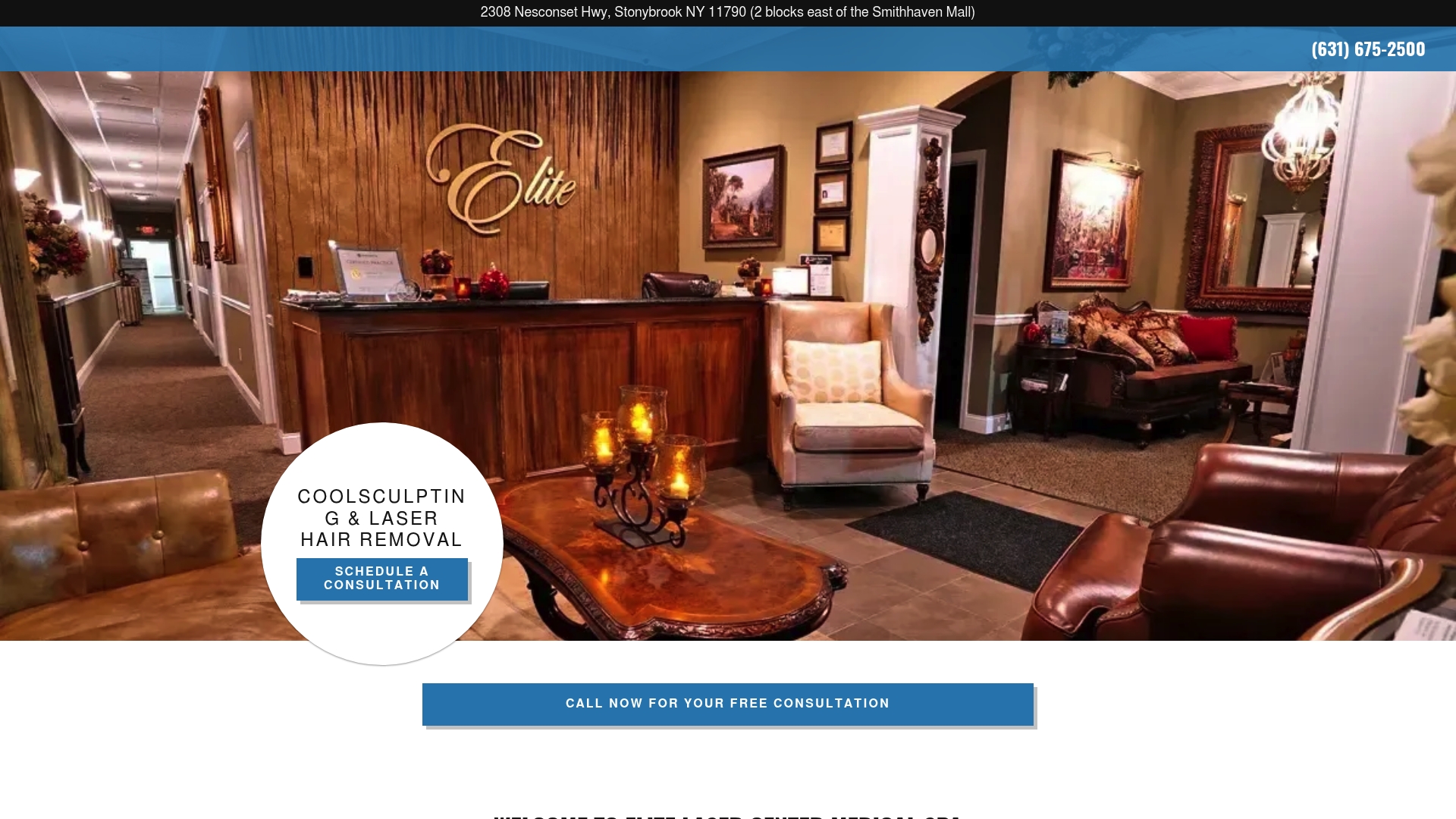
Services span laser hair removal, injectables, CoolSculpting, RF microneedling, and skin tightening, all performed at the Stony Brook, NY location under experienced medical supervision. Laser hair removal packages come with a three-year guarantee. The clinic has been recognized as the top CoolSculpting facility in New York.
Request your consultation directly through the Elitelaserhair website. Bring your medication list, your skincare routine, and the questions checklist from this article. You will leave with a written plan, not just a conversation.
Useful sources and further reading
The sources below are the primary references behind this article. Each one is publicly available and worth bookmarking if you want to verify guidance or dig deeper into med spa regulation and standards.
| Source | What it covers | Why it is useful |
|---|---|---|
| AmSpa Patient Guide | What to expect at a med spa, provider credentials, good-faith exam standards | Best starting point for patients evaluating a clinic |
| AmSpa Practice Guidelines | Delegation rules, supervision requirements, scope of practice by license type | Explains which procedures require physician oversight |
| AmSpa: Vital Role of Consultation | Industry perspective on consultation as the foundation of outcomes and patient experience | Useful for understanding why clinics invest in thorough consults |
| Rhode Island DOH Med Spa Guidance | Informed consent, documentation, and procedure-specific compliance requirements | One of the clearest state-level regulatory frameworks publicly available |
| Medical Spa Locator: First Appointment | Patient-facing overview of a first med spa visit, duration, and what to bring | Practical prep guide for first-time patients |
| Elitelaserhair Services | Full list of treatments available at Elite Laser Center, Stony Brook, NY | Reference for services discussed during a consultation at this clinic |