
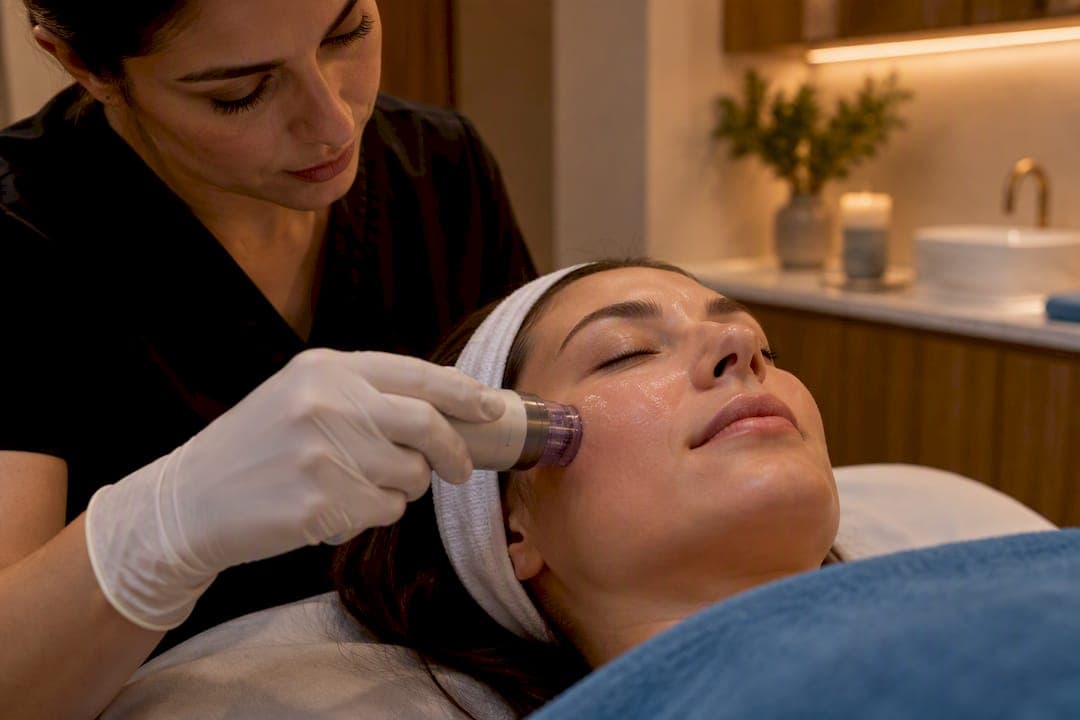
Yes, RF microneedling can measurably reduce how visible large pores look, though it works by tightening the skin around each pore rather than shrinking the pore opening itself. Clinical cohorts show real improvement after a series of 2 to 6 treatments, driven by collagen remodeling deep in the dermis. This is offered as an in-house, medically supervised option for patients who want that evidence behind their decision, not just marketing claims.
TL;DR:
- RF microneedling improves pore appearance mainly by tightening surrounding skin through collagen production, not by shrinking pore openings.
- Most patients see significant results after 2 to 6 treatments, with noticeable changes occurring between 2 and 3 months post-treatment.
- The procedure typically causes redness and swelling lasting 24 to 72 hours, with improvements stabilizing if sessions are spaced 4 to 6 weeks apart.
- Lowering pore size through this method depends on dermal support, not structural pore size, which is largely genetic and influenced by oil glands.
- Combining pore-clearing treatments before RF microneedling can enhance results, especially for pores enlarged by debris or excess oil.
Table of Contents
- How RF Microneedling Works on Pores
- What Does the Clinical Evidence Actually Show?
- What Results and Timeline Should You Expect?
- Building a Treatment Plan: What to Ask at Your Consult
- What to Know About Downtime, Side Effects, and Aftercare
- Should You Combine RF Microneedling With Other Pore Treatments?
- Our Approach to RF Microneedling for Pores
- Book an RF Microneedling Consult at Elite Laser Center
- Sources
- FAQ
How RF Microneedling Works on Pores
Fractional RF microneedling combines two separate injuries on purpose. The needles create tiny mechanical channels in the skin, and radiofrequency energy delivered through those same needles heats the surrounding dermis. That combination triggers a wound-healing cascade that produces new collagen and elastin, a process called neocollagenesis, over the following weeks.
The needle type changes what happens underneath the surface:
- Insulated needles protect the epidermis and concentrate heat only at the needle tip, creating a deeper, more localized coagulation zone.
- Non-insulated needles heat the dermis more broadly along the needle shaft, which some practitioners favor for pore and texture work because it spreads collagen stimulation across a wider area.
- Pulse width (how long the RF energy fires) also matters. Longer settings around 300 milliseconds have been linked to better early results in at least one retrospective study on 75 patients.
Pores themselves do not shrink at the structural level. Their size is largely set by genetics and sebaceous gland activity. What changes is the surrounding tissue: firmer, thicker dermal support pulls the pore's edges taut and reduces the shadowing that makes pores look like dark, visible craters.
What Does the Clinical Evidence Actually Show?
The research on RF microneedling for pores is small in scale but consistent in direction. A preliminary study on non-insulated fractional microneedle RF found measurable improvements in pore size and skin texture after a course of 2 to 6 sessions, with a favorable short-term safety record. The real-world retrospective study of 75 patients found that moderate-to-excellent improvement rates climbed as session counts increased, even though the average patient in that cohort received only 1.7 sessions.
Statistic callout: In a 2024 retrospective cohort of 22 patients treated with three fractional microneedle RF sessions spaced 1 to 3 months apart, the mean photographic enlarged-pore score dropped from 3.55 to 2.59 on a standardized grading scale.
That is a meaningful shift on a scale most dermatologists use to grade pore visibility from photographs, not a subjective before-and-after impression. A 2026 systematic review of RF microneedling across multiple skin conditions, including enlarged pores, concluded the technique shows credible effectiveness and an acceptable safety profile. The same review flagged a real limitation: studies use different devices, settings, and grading methods, which makes head-to-head comparisons difficult. Sample sizes across this body of research tend to run small, and most follow-up windows close well before the one-year mark.
What Results and Timeline Should You Expect?
Two different clocks run at once after RF microneedling. The immediate effect, a temporary glow and slight tightness, comes from swelling and shows up within days. The real effect, the one tied to pore appearance, comes from collagen synthesis and takes considerably longer to show up.
- Weeks 1 to 2: Redness and swelling fade; skin looks brighter but pore change is minimal.
- Weeks 4 to 8: Early collagen remodeling starts softening pore margins and texture.
- Months 2 to 3: Most patients report the most noticeable improvement in pore appearance, matching the 2 to 6 month collagen-remodeling window typical of RF-based skin tightening.
- Beyond 3 months: Results generally plateau unless a new course is started.
Because the underlying pore structure does not disappear, maintenance sessions every 6 to 12 months are common for patients who want to hold onto the improvement long-term.
Building a Treatment Plan: What to Ask at Your Consult
A single RF microneedling session rarely produces the pore improvement patients are chasing. Most protocols call for a series, and the exact numbers should be personalized rather than copied from a generic chart.
- Ask how many sessions your skin type and pore depth typically require. Most published protocols use 2 to 6 sessions spaced 4 to 6 weeks apart.
- Ask about needle type. Non-insulated needles create broader dermal heating, which some practitioners prefer specifically for pore and texture concerns.
- Ask about pulse width settings. Longer pulse durations have shown a link to stronger early results in at least one large observational study.
- Disclose your history. Active acne breakouts, a history of keloid scarring, certain blood thinners, and pregnancy are all reasons a provider may delay or avoid treatment.
Pro Tip: Bring a list of every topical you use, including retinoids and exfoliating acids. Practitioners often adjust your pre-treatment routine a week or two out to lower irritation risk.
What to Know About Downtime, Side Effects, and Aftercare
Redness, mild swelling, and a sunburn-like sensation are the standard, expected reactions after RF microneedling, and they typically fade within 24 to 72 hours. Pain during the procedure varies significantly by device settings and needle depth, which is part of why practitioners adjust protocols per patient rather than running one fixed setting for everyone.
- Transient pain, erythema, and edema are the most commonly reported reactions across published cohorts.
- Acneiform eruptions and temporary pigment changes occur, but as a minority event in most study populations.
- Numbing cream before treatment is standard practice at most clinics to manage discomfort.
Statistic callout: Studies tracking side effects report pain scores that shift meaningfully with device settings, reinforcing why the same "RF microneedling" label can feel like a different procedure depending on where you get it done.
Sun protection is non-negotiable for the first several weeks, since freshly treated skin is more vulnerable to pigment changes. Most providers ask patients to hold off on retinoids and strong exfoliants for about a week after treatment before slowly reintroducing them.
Should You Combine RF Microneedling With Other Pore Treatments?
Clearing congestion out of a pore before you try to tighten the skin around it tends to produce a better end result. If pores look large mainly because they are packed with oil and debris, a pore-clearing facial or extraction session before your microneedling course lets the collagen-driven tightening actually show through.
- Schedule pore-clearing treatments a week or more before an RF microneedling session, not the same day.
- A small case series combining microneedling with topical PDLLA across three sessions reported significant pore-size reduction sustained at 12 to 22 weeks, though the sample was small and the finding needs larger confirmation.
- Emerging interest in topical exosomes as a post-procedure booster is growing, but the evidence base is still thin and largely unpublished at scale.
- Layer actives carefully. Introduce one new product at a time after treatment so any irritation is easy to trace back to its source.
Our Approach to RF Microneedling for Pores
Every RF microneedling protocol starts with a consult, not a fixed package. That matters because pulse width, needle type, and session spacing genuinely change outcomes based on the studies above, and a provider who does not customize those variables is guessing. The provider reviews your skin history, pore pattern, and prior treatments before recommending a course, and every session runs under medical supervision. If you are weighing whether your pores are candidates for RF microneedling versus a pore-clearing facial first, a consult is where that gets answered honestly.
— Sharon
Book an RF Microneedling Consult at Elite Laser Center
The RF Micro-Needling service is built around the same variables clinical studies point to: session count, needle type, and pulse width, adjusted per patient rather than applied as a one-size protocol.
At your consult, bring a list of current skincare actives, any history of acne or keloid scarring, and your goals for pore appearance and texture. A provider will examine your skin, explain what session count and spacing make sense for your case, and walk you through realistic timing before you commit to a course. If pore congestion is part of the picture, we may also discuss pairing your plan with a pore-clearing facial first to get more out of each RF session. Reach out to schedule your consultation and get a personalized treatment plan instead of a guess.
This article is general information, not a substitute for advice from a qualified doctor. Consult a qualified healthcare professional about your own circumstances before acting on anything here.
Sources
- Non‑insulated fractional microneedle radiofrequency treatment with smooth motor insertion for reduction of depressed acne scars, pore size, and skin texture improvement: a preliminary study
- Fractional microneedle radiofrequency treatment for enlarged facial pores: A real-world retrospective observational study on 75 patients
- Effectiveness of Radiofrequency Microneedling in the Treatment of Dermatological Conditions: A Systematic Review
FAQ
Why Do My Pores Look Bigger Right After Microneedling?
Swelling and inflammation from the procedure temporarily stretch and irritate the skin, which can make pores look more prominent for a few days. This is a normal, short-lived reaction, not a sign the treatment backfired, and it typically resolves within a week as swelling subsides.
How Long Does It Take for Pores to Look Smaller After Microneedling?
Most patients start noticing visible change around 4 to 8 weeks as collagen remodeling gets underway, with the most noticeable improvement typically appearing by month 2 or 3. Full results depend on completing the recommended session series rather than judging progress after just one treatment.
Can Microneedling Actually Treat Large Pores?
Yes. Clinical studies, including a preliminary trial and a 2024 retrospective cohort, report measurable drops in photographic pore-grading scores after a series of RF microneedling sessions. It improves visible appearance through dermal tightening rather than shrinking the pore's structure.
How Many Microneedling Sessions Do Open Pores Usually Need?
Most published protocols use 2 to 6 sessions spaced roughly 4 to 6 weeks apart, with improvement rates rising as session count increases according to real-world observational data. The exact number is determined during a consult based on pore depth and skin history.
What Does RF Microneedling for Pores Cost?
Pricing for RF Micro-Needling is available on the service page and discussed in detail during your consult, since session count and settings vary by patient. Current pricing details are listed on the site rather than as a flat rate.
Recommended
- RF Microneedling Downtime: What to Expect Day by Day
- Laser Skin Rejuvenation Explained: What You Need to Know
- Skin Concerns Medical Spas Address: 2026 Treatment Guide
This article was produced with AI assistance and reviewed for accuracy. It is provided for general information, and it is not professional advice.