

A medspa treatment plan is a clinically designed, personalized schedule of non-invasive aesthetic procedures built to achieve your specific skincare, body contouring, and hair removal goals under medical supervision. Unlike a facial at a day spa, a medspa treatment plan explained properly covers session timing, biological rationale, and realistic outcomes. The medspa industry reached $27.6 billion globally in 2026, with over 8,800 facilities operating across the United States. That scale reflects one clear shift: people want results that go beyond surface-level treatments, and they want them delivered safely.
What does a medspa treatment plan actually include?
A medspa treatment plan is a written, provider-reviewed roadmap that outlines which procedures you need, in what order, and how far apart each session should be scheduled. It is not a generic menu of services. Every plan starts with a consultation and ends with a timeline tied directly to your skin biology, anatomy, and goals.
The plan typically covers three core elements: a baseline assessment of your skin or body area, a recommended sequence of treatments, and a realistic timeline for visible results. Providers use clinical tools like the Fitzpatrick skin type scale, which classifies skin into six types based on pigmentation and UV sensitivity, to determine which devices and intensities are safe for you. That classification directly shapes which laser settings, peel strengths, or energy levels your provider selects.
What separates a medspa plan from a salon recommendation is medical oversight. A licensed medical director is mandatory in legitimate medspas, ensuring that every protocol follows clinical standards even when daily treatments are performed by registered nurses or nurse practitioners. That layer of accountability is what makes the plan medically sound, not just cosmetically appealing.

What happens during a medspa consultation?
The consultation is the foundation of the entire plan. A standard medspa consultation lasts 15–20 minutes and includes a skin assessment using the Fitzpatrick scale, a review of your medical history, and a discussion of your aesthetic goals. That time is short, so providers move efficiently through a structured diagnostic process.
During the assessment, your provider evaluates several factors:
- Skin type and sensitivity using the Fitzpatrick scale (types I through VI)
- Medical history, including current medications and prior cosmetic procedures
- Specific concerns, such as unwanted hair, uneven texture, volume loss, or stubborn fat
- Lifestyle factors that affect healing, like sun exposure habits or smoking
- Realistic expectations based on what your anatomy can achieve
Consultations focus on diagnostics, not sales, and you are never obligated to book a treatment on the spot. A provider who pressures you to commit before completing a full assessment is a red flag. The goal of the consultation is to give you a clear picture of what is possible, what it will take, and how long it will realistically require.
Pro Tip: Bring a list of all supplements and medications to your consultation. Certain blood thinners and retinoids affect how your skin responds to laser and injectable treatments, and your provider needs that information before recommending anything.
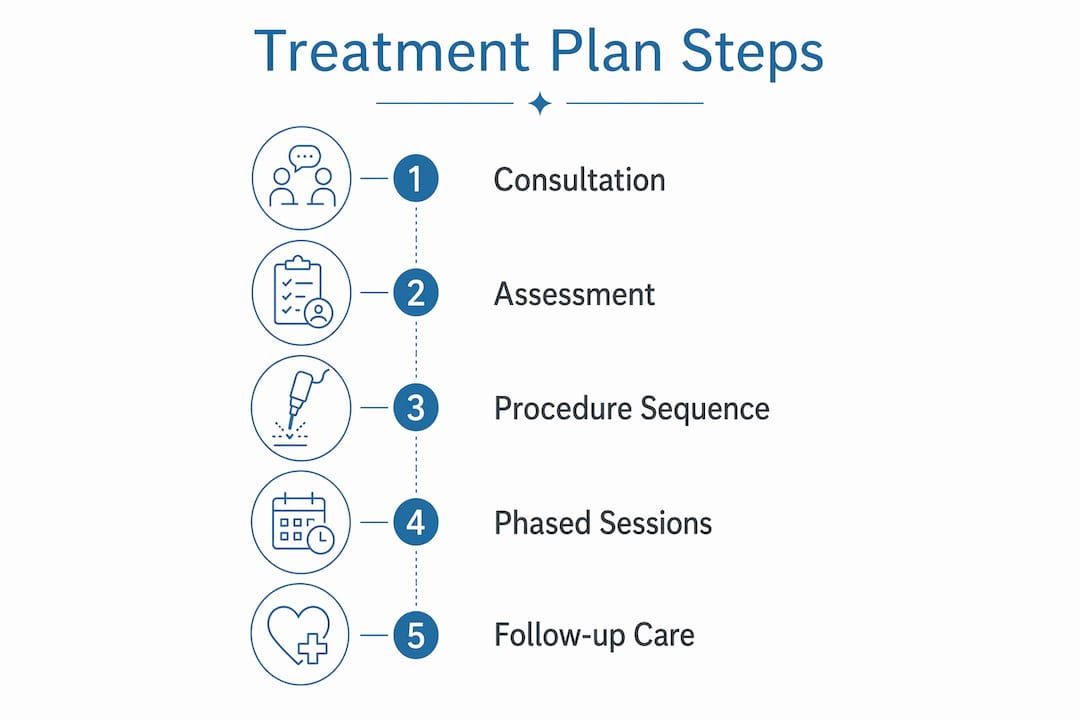
Plans are often phased to address multiple concerns over time. A provider might recommend starting with texture and pigmentation before moving to volume restoration, because treating the surface first gives a cleaner baseline for evaluating deeper corrections.
What treatments fit into a personalized medspa plan?
Medspa procedures explained in the context of a treatment plan fall into several categories, each with its own session requirements and biological rationale.
| Treatment | Typical Sessions | Spacing |
|---|---|---|
| Laser hair removal | 4–10 sessions | 4–8 weeks apart |
| Microneedling | 3–6 sessions | 4–6 weeks apart |
| Chemical peels | 3–6 sessions | 4–6 weeks apart |
| Body contouring (CoolSculpting) | Phased sessions | Per provider protocol |
| Injectables (Botox, fillers) | 1–2 per cycle | 3–6 months apart |
Non-invasive procedures require multiple sessions because the body's biology dictates the pace of results. Laser hair removal targets follicles only during the active growth phase, which is why sessions must be spaced across weeks. Microneedling stimulates collagen production, a process that takes weeks to show visible improvement after each session.
Common treatments within a personalized plan include:
- Botox and dermal fillers to reduce dynamic lines and restore facial volume
- Laser hair removal using FDA-cleared devices calibrated to your Fitzpatrick skin type
- Microneedling with RF to tighten skin and stimulate collagen over multiple sessions
- Chemical peels and HydraFacials to improve tone, texture, and hydration
- CoolSculpting for non-surgical fat reduction in targeted body areas
- Injectables for wrinkle correction and facial contouring
Effective treatment plans combine multiple modalities rather than relying on a single procedure. A plan that pairs laser resurfacing with injectables and medical-grade skincare produces more balanced, lasting results than any one treatment alone. Providers sequence these modalities deliberately to avoid interference between healing timelines.
Why does medical supervision matter in a medspa plan?
Medical supervision is not a formality. It is the structural difference between a medspa and a day spa or salon. The defining difference of a medspa is physician oversight, trained clinical providers, and the use of devices that require informed consent and medical knowledge to operate safely.
"Personalization considers anatomy, lifestyle, and aesthetic goals, often combining neuromodulators, fillers, and medical-grade skincare for natural, lasting results. A one-size-fits-all approach consistently underdelivers."
Day spas and salons operate without a medical director. They cannot legally use prescription-strength treatments, FDA-cleared energy devices, or injectables. That limits what they can offer and, more critically, limits the safety protocols they can follow. A medspa operates under clinical accountability at every step.
Customization within a medically supervised plan covers several dimensions:
- Anatomy-specific protocols that account for facial structure, skin thickness, and body composition
- Lifestyle adjustments such as modifying session timing around sun exposure or travel
- Phased sequencing that monitors your skin's response before advancing to the next treatment
- Informed consent that documents risks, contraindications, and expected outcomes before any procedure begins
Phased treatment plans allow clinicians to monitor skin response and adjust modalities before overcorrection occurs. That flexibility is only possible when a licensed provider reviews your progress at each visit. Rushing through a plan without that oversight produces uneven results and increases the risk of adverse reactions.
How do you read your treatment plan timeline?
Treatment timelines in a medspa plan span weeks to months, and that pace is not arbitrary. Skin biology dictates treatment timelines, not the medspa. Hair follicles cycle through growth phases independently, collagen remodeling takes time, and fat cells respond to cryotherapy over several weeks after each session.
Here is how to interpret a typical plan timeline:
- Week 1–2: Initial consultation, baseline photos, and first treatment session
- Weeks 4–8: Second session, timed to align with biological response from session one
- Months 2–4: Mid-series assessment; provider evaluates progress and adjusts protocol if needed
- Months 4–6: Final sessions in the initial series; results become visible and measurable
- Ongoing maintenance: Periodic sessions to sustain results, typically every 3–12 months depending on the treatment
Some treatments show immediate effects. HydraFacials and certain chemical peels produce visible brightness within 24–48 hours. Others, like skin tightening and microneedling, build results gradually as collagen production increases over 4–8 weeks post-session. Body contouring results from CoolSculpting typically appear 8–12 weeks after treatment as the body processes eliminated fat cells.
Common side effects vary by procedure. Redness and mild swelling are normal after laser treatments and typically resolve within 24–72 hours. Injectables may cause minor bruising at the injection site. Your provider will give you specific aftercare instructions that protect your results and reduce downtime.
Pro Tip: Take baseline photos before your first session and repeat them at the same angle and lighting every 4–6 weeks. Progress in medspa treatments is gradual, and photos reveal changes that are easy to miss day to day.
Key Takeaways
A medspa treatment plan works because it combines medical supervision, biological timing, and phased multi-modality protocols to deliver safe, natural, and lasting aesthetic results.
| Point | Details |
|---|---|
| Consultation is diagnostic | A 15–20 minute assessment using the Fitzpatrick scale sets the foundation for every plan. |
| Biological timing drives scheduling | Session spacing follows hair growth cycles, collagen production, and healing timelines. |
| Medical oversight is non-negotiable | A licensed medical director ensures clinical accountability at every step of your plan. |
| Combination treatments outperform single procedures | Pairing laser, injectables, and skincare produces more balanced and lasting outcomes. |
| Timelines require patience | Most treatment series span 2–6 months; maintenance sessions extend and protect results. |
What I've learned from watching people rush their medspa plans
The most common mistake I see is treating a medspa plan like a restaurant order. People pick the treatments they have heard about, skip the consultation, and expect results in a few weeks. That approach consistently produces disappointment, and sometimes harm.
The providers who deliver the best outcomes are the ones who slow the process down at the start. They spend the consultation asking questions before recommending anything. They phase treatments deliberately, starting with what the skin needs rather than what the client wants first. That sequencing is not a sales tactic. It reflects how skin biology actually works.
Credential verification matters more than most people realize. Ask directly whether the facility has a licensed medical director on staff and whether the person performing your treatment is a registered nurse, nurse practitioner, or physician. That information is not proprietary. Any reputable medspa will answer without hesitation.
The other thing worth knowing: pressure during a consultation is a clinical red flag, not just a customer service problem. A provider who pushes you to book before completing a full assessment is prioritizing revenue over your safety. Walk out and find someone who treats the consultation as the most important part of the process.
Patience with biological timelines is not optional. Collagen does not remodel faster because you want it to. Hair follicles do not synchronize their growth cycles on your schedule. The medspas that produce the results you see in testimonials are the ones that respect those timelines and build plans around them.
— Sharon
Personalized medspa care at Elitelaserhair
Elitelaserhair operates under experienced medical supervision and serves patients across Suffolk County with a full range of non-invasive aesthetic treatments.
Whether your goals involve laser hair removal, body contouring with CoolSculpting, microneedling, injectables, or facial treatments, every plan at Elitelaserhair starts with a no-pressure consultation designed to assess your needs before recommending anything. The center uses FDA-approved technology and has been recognized as the top CoolSculpting facility in New York. Elitelaserhair also backs its laser hair removal packages with a three-year guarantee. Book your consultation and get a personalized treatment plan built around your goals, your skin type, and your timeline.
FAQ
What is a medspa treatment plan?
A medspa treatment plan is a personalized, clinically designed schedule of non-invasive aesthetic procedures that outlines which treatments you need, in what order, and how far apart sessions should be spaced based on your skin type and goals.
How long does a medspa consultation take?
A standard medspa consultation lasts 15–20 minutes and includes a skin assessment using the Fitzpatrick scale, a review of your medical history, and a discussion of your aesthetic goals, with no obligation to book.
How many sessions does laser hair removal require?
Laser hair removal typically requires 4–10 sessions spaced 4–8 weeks apart, because the treatment targets follicles only during the active growth phase and multiple cycles must be addressed for lasting results.
What is the difference between a medspa and a day spa?
A medspa operates under a licensed medical director and uses FDA-cleared clinical devices requiring informed consent, while day spas and salons lack physician oversight and cannot legally offer prescription-strength or energy-based treatments.
How long before I see results from a medspa treatment plan?
Results depend on the procedure. HydraFacials show improvement within 24–48 hours, while microneedling and body contouring results develop over 4–12 weeks as collagen remodels and the body processes treated tissue.