
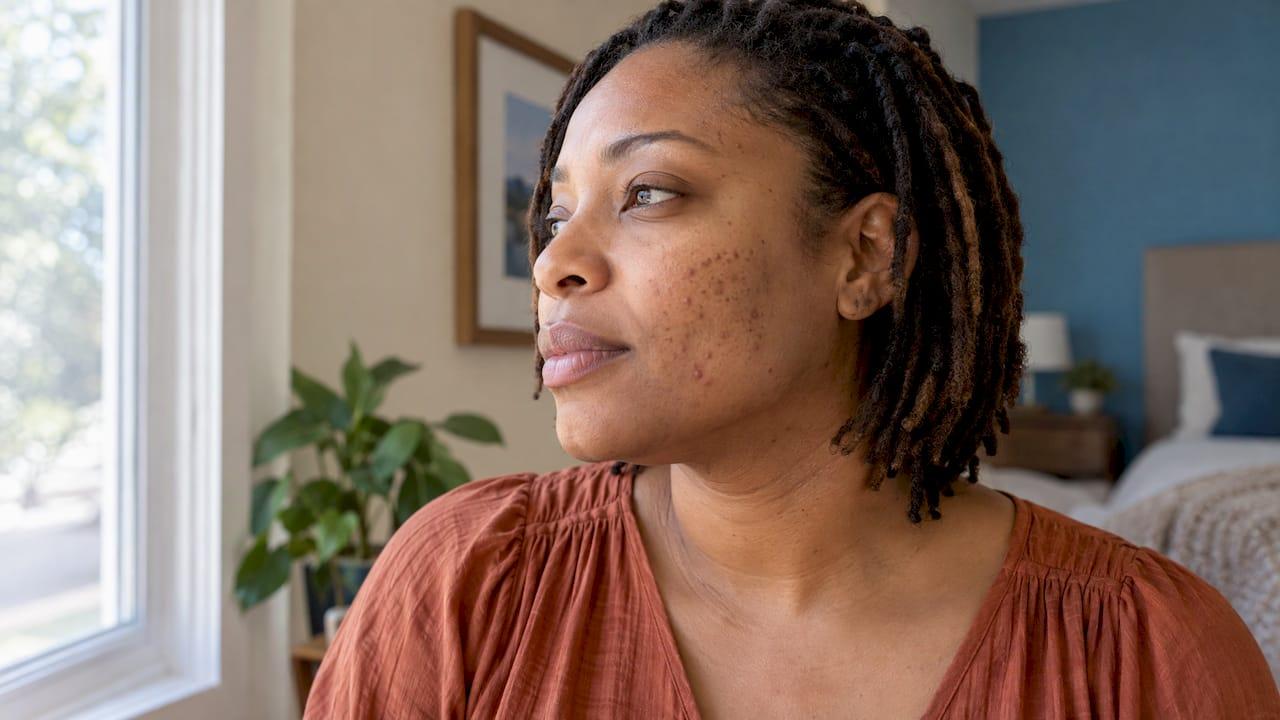
LED light therapy can help mild-to-moderate, inflammatory acne. Blue light targets the bacteria that feed breakouts, and red light calms inflammation. Results build over weeks, not days, and they vary from person to person. The best starting point is a conversation about your skin type, your breakout pattern and what else you use on your face. At Elite Laser Center in Stony Brook, LED light therapy is one of our treatments, and all of our treatments are customized and performed under medical supervision.
Below you will find how the light works, what the research shows, what a realistic timeline looks like, and the safety points worth knowing before you start.
Key Takeaways
-
Blue light (roughly 405 to 420 nm) is used against acne-causing bacteria. Red light (roughly 620 to 750 nm) reaches deeper and is used to calm inflammation.
-
A 2025 JAMA Dermatology meta-analysis found improvement in both inflamed and non-inflamed lesions, typically noticed after 4 to 12 weeks of consistent use.
-
LED light therapy is best matched to mild-to-moderate inflammatory acne. It is not aimed at cysts, and results are not predictable for any one person.
-
Side effects in studies were mostly mild: dryness, redness or discomfort. Light-sensitive conditions and certain medications call for a conversation with a dermatologist first.
-
Professional LED uses stronger devices than most at-home masks, and a clinic can fit it around the rest of your skincare.
How LED Light Therapy Works on Acne
LED stands for light-emitting diode. An LED device gives off a specific color of visible light at a specific wavelength, with no ultraviolet rays. Different colors reach different depths of skin, which is why acne treatment usually involves blue, red or both.
Blue light: the bacteria side
The bacterium C. acnes lives in clogged pores and produces compounds called porphyrins. According to a 2024 review of visible light in acne, porphyrins absorb light and generate reactive molecules that damage the bacteria, and blue light between 407 and 420 nm is the range described as bactericidal. Cleveland Clinic describes blue light as acting on the uppermost layer of skin, which is where this bacterial activity happens.
Red light: the inflammation side
Red light travels deeper than blue. The same 2024 review notes red light has anti-inflammatory effects and reaches the sebaceous glands, the oil glands that sit at the base of each pore. A separate 2021 review of visible light and the skin explains that this depth difference follows from the physics of light: higher-energy blue light stays shallow, while red light penetrates further. That is why red light is associated with the redness and swelling of inflamed pimples, and why many protocols pair the two colors.
Which acne it suits
The 2021 review suggests inflammatory lesions, the red, tender bumps and pustules, may respond better than non-inflammatory ones. Cleveland Clinic adds that LED light therapy does not help with acne cysts, blackheads or whiteheads. If your skin is mostly deep, painful cysts, or if you have scarring, that calls for a medical evaluation, not a light session alone.
What the Research Shows
LED acne research is real but uneven. Studies use different devices, light strengths and schedules, so it helps to read the numbers as a range, not a promise.
The most recent pooled evidence
A March 2025 JAMA Dermatology systematic review and meta-analysis looked at at-home LED devices. Compared with controls, devices produced greater percent improvement in inflammatory lesions (45.3%), non-inflammatory lesions (47.7%) and investigator global assessment (45.7%). Improvement was typically noticed after 4 to 12 weeks. Red, blue and combined-wavelength devices were all found efficacious, and the authors concluded these devices are a safe, effective option for mild-to-moderate acne.

The authors also noted that the studies differed in light source, strength and treatment length, so the findings may not apply to every device on the market. That variability is exactly why an individual assessment matters.
Blue, red and the two together
A 2024 systematic review of 35 studies covering 1,185 people with acne found that most achieved at least partial remission with visible light. Blue light was used in about 64% of cases. In the group that received combined blue and red light, inflammatory lesions improved by 49% and non-inflammatory lesions by 24% at week 4. The JAMA Dermatology paper also points to research in which a red-plus-blue combination produced greater improvement than blue alone.
Where light therapy sits among acne treatments
The American Academy of Dermatology explains that light treatments may contribute to an acne treatment plan, but results differ between people and a series is often needed. LED phototherapy should not replace prescribed acne care. Photodynamic therapy, which adds a light-sensitizing medication, is a separate procedure; its results and aftercare should not be presented as those of a standard LED session.
In practice, this means LED light is best thought of as one part of an acne plan. It often sits alongside a cleansing routine and a professional skin assessment, not in place of them.
What a Realistic Timeline Looks Like
Light therapy rewards consistency. A single session will not clear a breakout, and the studies reflect that.
-
Weeks 1 to 4: In the 2024 review, patients responded on average within about 4 weeks, and combined blue and red treatment showed a mean time to outcome of around 2 weeks. Early changes are often less redness and fewer new inflamed spots.
-
Weeks 4 to 12: The JAMA Dermatology analysis places typical improvement in this window.
-
Beyond 12 weeks: Reassess your response with your provider. Any maintenance schedule depends on the device, your skin and your treatment plan; a schedule for another light-based procedure should not be assumed to apply to LED.
Session length and frequency depend on the device. In the 2024 review, average sessions lasted about 15 minutes for blue light and about 8 minutes for red, with a mean treatment duration of around 7 to 8 weeks. Those are study averages, not a prescription. Your schedule should come from the clinician who assesses your skin and the specific device used, which is why we do not suggest a one-size routine.
One point trips people up: a flare early on does not always mean the treatment failed. The 2024 review notes that light therapy may trigger acne flare-ups in some people, and outcomes depend on the type of lesion and the organism involved. If your skin looks worse after a few sessions, tell your provider so they can adjust the plan.
Professional LED vs. At-Home Masks
At-home masks and professional LED platforms differ in output, wavelengths, dose and treatment protocols. A higher-powered device is not automatically the best choice for every person. The 2025 at-home studies do not establish the results of a specific professional system; an individual assessment and the device-specific protocol matter.
There are practical differences beyond power:
-
Assessment first. A professional can tell whether your breakouts are the inflammatory type light handles well, or whether something else, such as hormonal or cystic acne, is driving them.
-
Pairing with other care. LED is often added to facials and other skin treatments. Our guide to LED light therapy after a facial walks through how it fits into a visit, and at-home devices vs. professional treatment covers the broader comparison.
-
Supervision. Every treatment at our center is performed under medical supervision, so your history, skin type and goals are considered together.
Reading the label: cleared, not approved
Light devices for the skin are typically cleared by the FDA, not approved. Clearance comes through the 510(k) pathway, which is a different standard from approval, and each clearance is tied to specific indications. For example, one 2025 FDA clearance lists a Class II device whose blue and mixed-light modes are indicated for mild-to-moderate inflammatory acne. When you see a device marketed for acne, the question is which specific indication it was cleared for. Our consultations are a good place to ask how a treatment is used for your skin.
Safety: Side Effects, Eyes and Medications
LED light has a good tolerability record in the research, but it is not risk-free, and a few points matter before you begin.
What people commonly notice
In the JAMA Dermatology meta-analysis, no severe adverse reactions were reported. The few effects were mild dryness, redness, or discomfort during treatment. The 2024 review reported minor side effects in 26% of participants, including dryness, redness, an occasional facial rash and headaches, with blue light more often linked to irritation and redness. For light treatments in general, the AAD says redness and swelling usually fade within hours to a day. Rarely, they can leave lingering pain, burns, blisters, skin-color changes or scarring, and the AAD notes that treatment by a board-certified dermatologist who frequently uses lasers and lights can help prevent these. It also stresses following pre- and post-treatment instructions.

Light-sensitive conditions and medications
The AAD advises seeing a board-certified dermatologist before using red light, because it can worsen light-sensitive conditions such as lupus and may interact with medications that make skin more sensitive to light. Tell your provider about every prescription, over-the-counter product and supplement you use, and about any condition that makes your skin react to sun. Decisions about starting or stopping a medication belong to your prescriber, not to a light-therapy provider or an article.
Eye protection
Follow the device-specific eye-protection instructions and your provider’s guidance throughout treatment. The American Academy of Dermatology advises using the recommended protective eyewear when directed; ordinary sunglasses are not a substitute. Tell your provider about eye conditions before treatment.
A note on skin aging
Cleveland Clinic mentions some research suggesting blue light may contribute to skin aging through free-radical damage, which is one reason professional guidance on how much and how often matters, and why sun protection stays part of your routine during any light-based program.
Is LED Light Therapy Right for Your Skin?
You are a good person to ask about LED if:
-
Your breakouts are mild to moderate and mostly red, inflamed bumps.
-
You want a gentle, non-invasive option that adds to a skincare plan.
-
You prefer professional guidance, clear explanations and realistic expectations over trial and error.
-
You are planning ahead for a wedding, photos or a trip and want time to build a routine.
Talk to a dermatologist first if you have painful, deep cysts, scarring, a light-sensitive condition, or you take medications that increase sun sensitivity. That is also the right step if your acne worsens rapidly or does not respond after a sustained period.
Because results vary, your consultation is where expectations get set honestly: what your skin is likely to do, how many sessions it may take, and what to pair the light with. If you would like to understand how redness and tone respond more broadly, our piece on LED red light therapy benefits is a helpful companion.
LED Light Therapy at Elite Laser Center
LED light therapy is part of our skin treatment menu in Stony Brook, alongside HydraFacial-MD, chemical peels and microdermabrasion. Each treatment is customized to the person and performed under medical supervision, and we treat all skin types. If you are curious how LED could fit into your skincare, the professional LED light therapy pageFor individual acne treatment decisions, consult a board-certified dermatologist. is the place to start.

If you prefer ongoing care to one-off visits, our Skin Care Club starts from $99 per month, and you can see what it includes on the Skin Care Club page. Not sure which facial suits your skin? Our comparison of DiamondGlow and HydraFacial can help, and the facial schedule guide explains how often most skin types benefit from visits.
Our Perspective
LED can be one part of a broader skin-care plan. A useful consultation explains which concern the selected wavelength targets, how progress will be assessed, and when a dermatologist’s care is more appropriate. Individual results vary.
Frequently Asked Questions
How often should I do red light therapy for acne?
It depends on the device. Study protocols range widely: the 2024 review found averages of about two sessions a week for combined blue and red light, over roughly 8 weeks. At-home devices have their own instructions, and the AAD notes some call for long sessions twice daily. In a professional setting, your provider sets the schedule after assessing your skin.
Why is my skin getting worse with red light therapy?
Some people notice dryness, redness or a temporary flare-up, and studies report light therapy may trigger acne flare-ups in some cases. If your skin worsens, pause and tell your provider or dermatologist so they can adjust the plan. Persistent irritation, pain, blistering or skin-color changes should be checked promptly.
What are the benefits of using a blue light mask?
Blue LED is used to target acne-associated bacteria and may reduce inflammatory breakouts in some people. Improvement varies by device and individual, and study results should not be read as a personal success rate. It is not a substitute for medical assessment of deep or persistent acne.
Can LED light therapy treat cystic acne, blackheads or whiteheads?
Cleveland Clinic states LED light therapy does not help with acne cysts, blackheads or whiteheads. It is best matched to mild-to-moderate inflammatory acne. For cystic acne or scarring, see a board-certified dermatologist.
Ready to Talk About Your Skin?
We invite you to book a consultation at Elite Laser Center in Stony Brook. We will review your skin, explain whether LED light therapy suits you, and outline what to expect, with no pressure to decide on the spot.
Sources
-
Visible Light in the Treatment of Acne Vulgaris (2024 systematic review)
-
Visible Light Part I: Properties and Cutaneous Effects (2021)
-
At-Home LED Devices for the Treatment of Acne Vulgaris (JAMA Dermatology, 2025)
-
Guidelines of care for the management of acne vulgaris (JAAD, 2016)
-
Eye-protection guidance: see the American Academy of Dermatology red-light safety resource above.
Prepared with AI assistance for general education. This article does not replace personalized medical advice. Treatment suitability, results and recovery vary. Consult a qualified healthcare professional and follow your treating provider’s instructions.