

Electrolysis is the only hair removal method the FDA recognizes as permanent removal, while laser is FDA-cleared for permanent hair reduction, a real regulatory difference, not marketing language. If your goal is total, color-independent permanence on a small area, electrolysis wins. If you want faster results across large areas of dark, coarse hair, laser usually makes more practical sense. The right call depends on your hair color, the area you're treating, your timeline, and how much upkeep you're willing to tolerate, all of which we break down below.
TL;DR:
- Electrolysis provides permanent hair removal for any hair color and is ideal for small, detailed areas needing guaranteed results, but requires more time and sessions.
- Laser offers faster treatment of large areas with effective reduction on dark, coarse hair, but usually results in permanent reduction rather than complete permanence.
- Darker skin tones are better suited to Nd:YAG laser to minimize pigment risks, while light-colored or fine hair treatments benefit more from electrolysis.
- Combining laser and electrolysis can be effective, with laser reducing bulk and electrolysis finishing with precise, permanent removal of resistant hairs.
- Cost varies widely; laser is typically more economical for large areas with package discounts, while electrolysis's hourly billing can add up quickly, especially on bigger regions.
Table of Contents
- Laser vs Electrolysis at a Glance
- How Do Laser and Electrolysis Actually Work?
- Is Laser or Electrolysis More Effective Long-Term?
- Which Method Fits Your Hair Color, Skin Tone, and Body Area?
- How Long Do Laser and Electrolysis Take, and What Does Each Feel Like?
- Laser vs Electrolysis Cost: What Should You Budget?
- Can You Switch Between Laser and Electrolysis, or Combine Them?
- A Clinician's Take on Choosing Between Them
- Ready to Start Your Laser Hair Removal Consultation?
- Sources
- FAQ
Laser vs Electrolysis at a Glance
Laser treats large patches of skin in one pass. Electrolysis treats one follicle at a time with a fine probe. That single mechanical difference explains almost every tradeoff between them.
- Permanence: Electrolysis is FDA-recognized as permanent removal; laser is FDA-cleared as permanent reduction.
- Speed: Laser clears a leg or back in under an hour; electrolysis on the same area could take significantly more time spread across sessions.
- Best hair type: Laser needs melanin (dark hair); electrolysis works on blonde, gray, red, or white hair.
- Best for facial detail: Electrolysis, thanks to precise, single-follicle targeting.
- Best before surgery: Electrolysis, since surgical fields require guaranteed permanence, not gradual thinning.
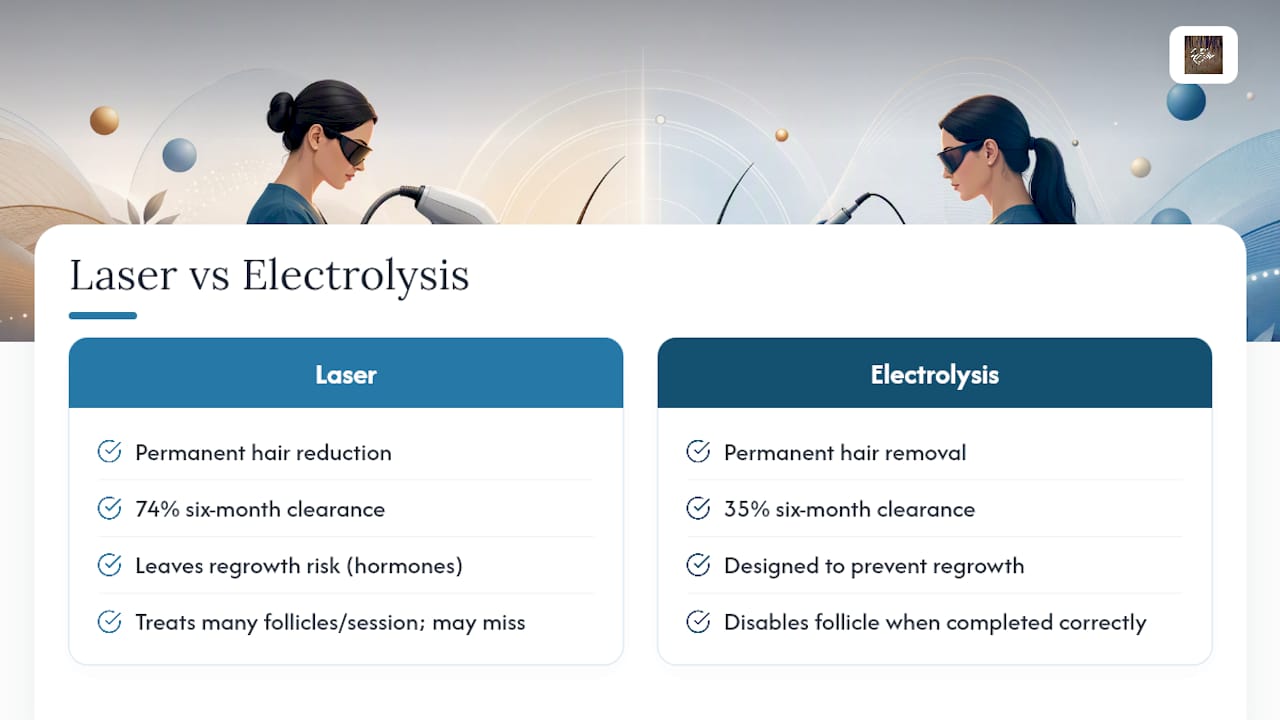
Statistic Callout: One comparative study found laser achieved a 74% hair clearance rate after six months, versus 35% for electrolysis over the same period, though sample sizes and methods varied between studies.
How Do Laser and Electrolysis Actually Work?
Laser hair removal relies on selective photothermolysis: a wavelength of light gets absorbed by melanin in the hair shaft, converts to heat, and damages the follicle. Diode and alexandrite lasers dominate lighter to medium skin tones, while Nd:YAG lasers use a longer wavelength that bypasses surface melanin, which is why Nd:YAG is the preferred choice for darker skin. IPL is a different technology entirely, a broad-spectrum light rather than a true laser, and it tends to be less precise.
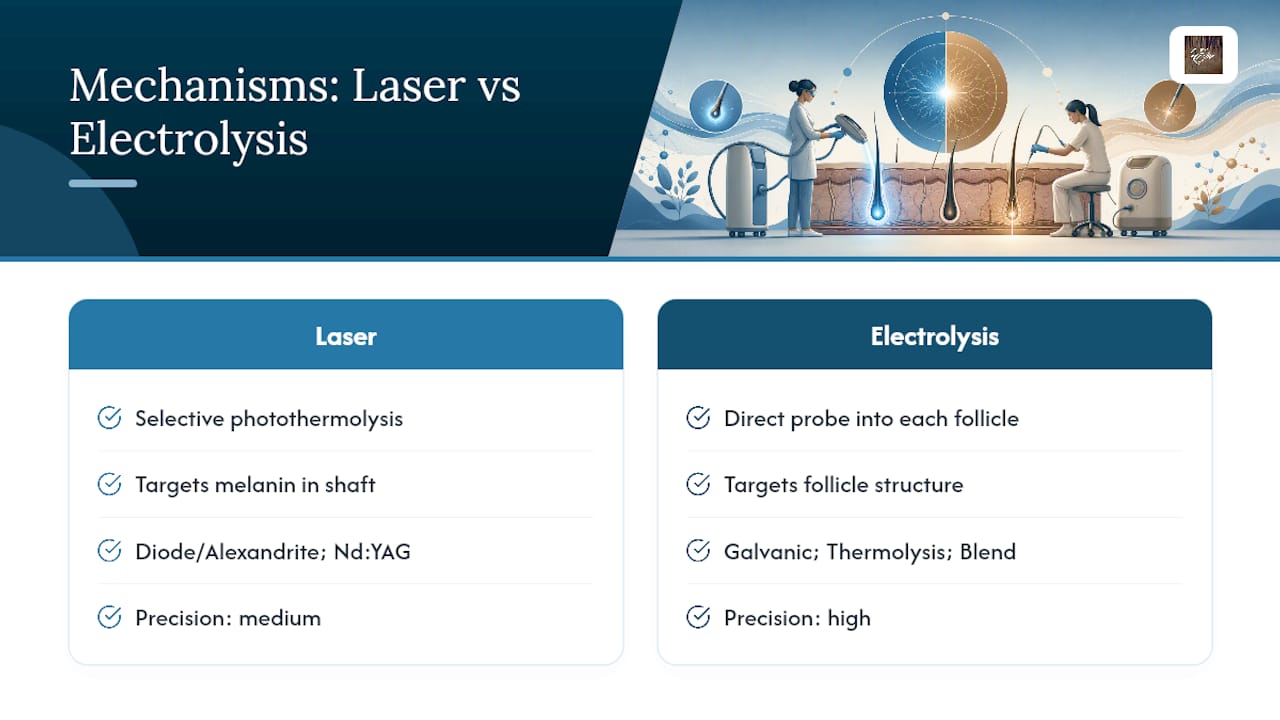
Electrolysis skips melanin altogether. A licensed electrologist inserts a fine probe into each follicle and delivers energy directly to the root using one of three modalities: galvanic (a slower chemical process), thermolysis (faster heat-based destruction), or blend, which combines both for stubborn hair. Because it targets the follicle structure itself rather than pigment, it works regardless of hair color. That precision is also why it's slow: one hair, one probe insertion, one follicle at a time.
For a deeper look at how device wavelength affects results, see this breakdown of types of laser hair removal treatments.
Is Laser or Electrolysis More Effective Long-Term?
The FDA's language matters more than most people realize: electrolysis is cleared as a permanent hair removal method, while laser is cleared only as a method of permanent hair reduction. That's not a technicality. It means laser is expected to leave some regrowth, even after a full course, while a properly completed electrolysis treatment is designed to eliminate the follicle's ability to grow hair again.
The clearance data backs this up directionally. In the comparative study cited above, laser outperformed electrolysis on the six-month clearance rate, 74% versus 35%, largely because laser processes far more follicles per session. But clearance at six months isn't the same as permanence at six years. Hormonal shifts (pregnancy, PCOS, menopause) can reactivate dormant follicles that laser missed, and even successfully treated hairs can occasionally return in thinner, finer form. Mayo Clinic's patient guidance notes that touch-up sessions are common maintenance, not a sign something went wrong. Electrolysis, done correctly on a fully grown follicle, doesn't carry that same regrowth risk once the course is complete.
Which Method Fits Your Hair Color, Skin Tone, and Body Area?
Your candidacy comes down to three variables: hair color, skin tone, and the area you're treating.
- Dark, coarse hair on large areas (legs, back, chest): laser is faster and typically more cost-effective per square inch.
- Blonde, gray, red, or white hair: electrolysis is the clinically appropriate choice since these hairs lack the melanin laser needs to work.
- Darker skin tones (Fitzpatrick IV to VI): Nd:YAG laser reduces the risk of burns and pigment changes compared to shorter wavelengths.
- Small, detailed areas (eyebrows, chin, upper lip): electrolysis offers more precision.
- Hormonal hair growth patterns: either method can work, but expect more sessions and possibly a hybrid approach.
Pregnant patients, anyone with certain implanted medical devices, and people prone to keloid scarring should get medical clearance before either procedure.
Pro Tip: If you have a mix of dark and light hair in the same area, like a chin with a few stray gray hairs among darker ones, laser alone won't finish the job. Plan for electrolysis cleanup on the hairs laser can't see.
How Long Do Laser and Electrolysis Take, and What Does Each Feel Like?
Laser sessions are scheduled around the hair growth cycle, typically every 4 to 6 weeks, with most patients needing 6 to 8 sessions before seeing substantial reduction. Cooling tips and topical numbing cut down the sting, often described as a rubber band snap against the skin.
Electrolysis requires far more visits spaced closer together, sometimes weekly early on, because it processes hair one follicle at a time and catches hairs in different growth phases over months. Each pulse is a brief, localized pinch; topical numbing cream helps for sensitive areas like the upper lip.
- Book laser sessions on the recommended 4 to 6 week cycle to hit hair in its active growth phase.
- Avoid sun exposure and retinoids in the days before and after either treatment.
- Expect mild redness or swelling for 24 to 48 hours; that's normal for both methods.
- Call your provider if you notice blistering, unusual pigment changes, or pain lasting beyond a few days.
Both procedures carry real but manageable short-term side effects, and how well they heal depends heavily on the practitioner's skill and equipment.
Laser vs Electrolysis Cost: What Should You Budget?
Laser is usually priced per treatment area, per session, with the total cost dropping as you commit to a package covering the full course. Electrolysis is priced by time, often in 15 to 30 minute increments, because there's no shortcut for treating follicles one at a time. A large area like full legs can make electrolysis pricing climb fast simply due to the hours required.
Lifetime cost is where the comparison gets interesting. Laser often needs occasional touch-up sessions years later, adding small recurring costs. Electrolysis, once a course is fully completed, generally doesn't need that maintenance. Before committing to either, ask your provider:
- How many total sessions does my hair type and area realistically require?
- Is there a package guarantee or refund policy if results fall short?
- What device or wavelength will you use, and is it appropriate for my skin tone?
- What's included if I need touch-ups after the initial course?
Can You Switch Between Laser and Electrolysis, or Combine Them?
Many people don't pick one method forever. A common approach is laser first for bulk reduction on large areas, followed by electrolysis to finish off the resistant or lighter hairs laser couldn't fully clear. This hybrid strategy is common enough in practice that it's become a standard recommendation for stubborn hair types.
If you're switching direction entirely, experts advise waiting several months between methods so you don't disrupt the natural hair growth cycle and end up restarting your timeline. For anyone preparing for surgery or needing guaranteed permanence in a specific area, like before certain reconstructive procedures, a board-certified dermatologist or licensed electrologist should weigh in before you begin, since surgical-field requirements often rule out anything less than true permanent removal.
A Clinician's Take on Choosing Between Them
Speed, permanence, and comfort rarely all point the same direction, so the right recommendation depends on what the patient actually needs. We tend to recommend laser first when someone wants noticeable reduction across a large area without months of weekly visits. Electrolysis earns the recommendation when permanence isn't negotiable, like light-colored hair or a surgical field. Whichever path you consider, verify the provider's credentials and ask what device or wavelength they're actually using.
— Sharon
Ready to Start Your Laser Hair Removal Consultation?
Elitelaserhair treats laser hair removal as a medical procedure, not a spa add-on, which is the real difference once you've read through the tradeoffs above. Every session is performed under medical supervision with the device and wavelength matched to your skin tone and hair color, and packages come backed by a three-year guarantee on laser hair removal, a claim Elitelaserhair stands behind directly rather than leaving you to guess at outcomes.

If laser looks like the right fit for your hair color and treatment area based on what you've read here, the next step is a consultation to confirm candidacy before you commit to a package. Elitelaserhair's team will assess your skin tone, hair density, and goals, and walk you through what a realistic session count looks like for your specific case. Visit the laser hair removal service page to see what's included, or review what to expect before and after treatment to prepare for your first visit.
Sources
- PubMed: Comparative study on hair removal clearance rates
- Healthline: Laser hair removal vs. electrolysis
This article is general information, not a substitute for advice from a qualified doctor. Consult a qualified healthcare professional about your own circumstances before acting on anything here.
FAQ
Why isn't electrolysis more popular if it's truly permanent?
Electrolysis takes far longer because it treats one follicle at a time, which makes it impractical for large areas like legs or backs. Most people choose laser for speed and reserve electrolysis for small, detailed areas or light-colored hair laser can't target.
Which is cheaper, electrolysis or laser?
Laser is generally more cost-effective for large areas because it's priced per treatment area and processes many follicles per pulse. Electrolysis is billed by time, so treating a large area can become expensive fast, though a small area like eyebrows may cost less overall with electrolysis since fewer sessions are needed for lasting results.
Do celebrities get laser hair removal or electrolysis?
Public figures use both, depending on the goal. Laser tends to be the choice for broad, fast reduction before red carpet events or shoots, while electrolysis gets used for precise facial work or areas where guaranteed permanence matters more than speed.
Can I switch from laser to electrolysis midway through treatment?
Yes, but providers typically recommend waiting several months between methods so you don't disrupt the hair growth cycle and prolong your overall timeline. Many people use laser first for bulk reduction, then finish with electrolysis on resistant or light hairs.
Does Elitelaserhair offer electrolysis?
The center specializes in medically supervised laser hair removal rather than electrolysis. Current details on packages and the three-year guarantee are available on the laser hair removal page.
Recommended
- Guide to Laser Consults
- 1064 nm Nd:YAG: Safe Laser Hair Removal for Fitzpatrick IV, V, and VI
- Laser Hair Removal Sessions: How Many and How Often
This article was produced with AI assistance and reviewed for accuracy. It is provided for general information, and it is not professional advice.