

Laser hair removal is defined as a medical procedure that uses concentrated light to disable hair follicles, producing long-term hair reduction. Waxing, by contrast, mechanically pulls hair from the root for results that last only weeks. The laser hair removal vs waxing debate comes down to more than just preference. It involves real differences in results, cost over time, pain, and skin health. The FDA classifies laser as "long-term hair reduction," not permanent removal, which sets realistic expectations from the start. Understanding these distinctions helps you choose the method that fits your lifestyle, budget, and skin.
How do laser hair removal and waxing compare in results?
Laser achieves 80–95% long-term reduction in hair density after a full treatment course. Waxing removes hair temporarily, with regrowth returning within 3–6 weeks every time.
A standard laser course runs 6–12 sessions, spaced 4–8 weeks apart to align with the hair growth cycle. Hair only responds to laser energy when it is in the active growth phase, called anagen. That is why multiple sessions are required, not because the technology is limited, but because not all follicles are active at the same time.
Waxing requires 12–18 appointments per year, indefinitely. There is no endpoint. Laser, after the initial course, typically needs only 1–2 maintenance visits per year to manage hormonal regrowth. That difference in ongoing commitment is significant for anyone with a busy schedule.
Experts note that results appear gradually over the treatment series, unlike waxing's immediate smoothness after each appointment. Patients who expect overnight results from laser often feel disappointed early on. The payoff comes after session three or four, when hair noticeably thins and grows back slower.
| Feature | Laser hair removal | Waxing |
|---|---|---|
| Hair reduction rate | 80–95% long-term | Temporary, 3–6 weeks |
| Sessions required | 6–12 initial, 1–2 yearly | 12–18 per year, ongoing |
| Session spacing | Every 4–8 weeks | Every 3–6 weeks |
| Long-term maintenance | Minimal | Continuous |
| Hair color suitability | Best on dark, coarse hair | Works on all hair colors |
One practical point worth knowing: laser works best on dark, coarse hair because the technology targets pigment in the follicle. Waxing physically grips and pulls hair regardless of color, making it the only option for blonde, red, or gray hair.
What does laser hair removal vs waxing actually cost over time?
Waxing looks cheaper at first glance. A single leg waxing session costs far less than a single laser session. The math changes completely when you calculate costs over a decade.
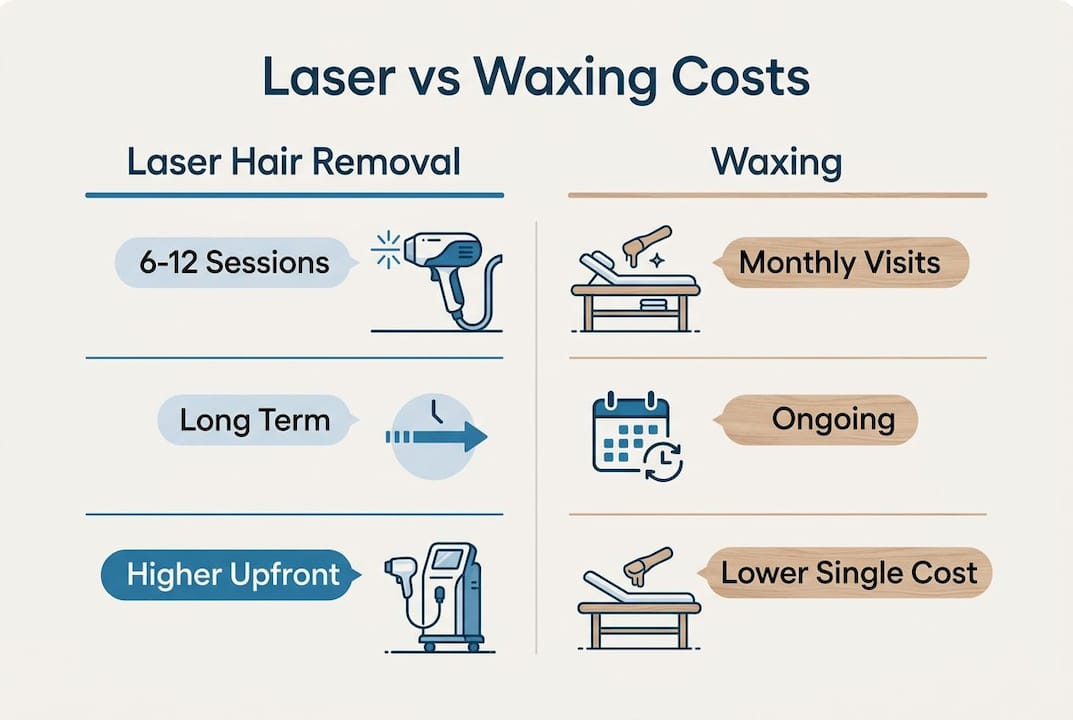
Waxing costs multiply over 10 years with monthly visits, eventually exceeding the total cost of a laser course plus annual maintenance. Laser involves a larger upfront investment, but the number of required appointments drops sharply after the initial series. Over time, laser becomes the more cost-effective choice for most people.
There is also a time cost that rarely gets factored in. Waxing appointments take 30–60 minutes each, and you need them year-round. Laser sessions are often shorter, and once the course is complete, you are largely free from recurring appointments. That recovered time has real value.
Pro Tip: Compare total 5-year costs, not single-session prices. Add up your current annual waxing spend, multiply by five, and compare that number to a full laser package. Most people are surprised by the result.
Dr. Kat Khorrami notes that patients often underestimate long-term laser value by comparing single session costs instead of cumulative waxing appointments. That single-session comparison is the most common financial mistake people make when evaluating these two methods.
Elitelaserhair offers laser hair removal packages with a three-year guarantee, which adds financial protection that waxing simply cannot match. Knowing your results are backed by a guarantee changes the risk calculation entirely.
How do pain levels differ between laser and waxing?
Laser pain is commonly described as a warm rubber-band snap against the skin. Modern devices use integrated contact cooling to reduce discomfort during treatment. Most people tolerate it well, and the sensation decreases as hair thins over successive sessions.

Waxing pain is sharp and immediate. The tearing sensation repeats across every strip, every session, for as long as you continue waxing. There is no improvement over time because the mechanism never changes. You are always pulling hair from the root.
Pain also varies by body area. The upper lip, bikini line, and underarms are more sensitive for both methods. With laser, those areas become progressively less painful as follicles are disabled. With waxing, they stay just as sensitive at appointment 50 as they were at appointment one.
Pro Tip: Apply a numbing cream to sensitive areas 30–45 minutes before a laser session. For waxing, avoid scheduling appointments in the week before your menstrual cycle, when skin sensitivity peaks.
The long-term pain picture strongly favors laser. Waxing pain is perpetual. Laser discomfort is temporary and diminishes with each session.
What are the skin health effects of each method?
Laser reduces ingrown hairs and folliculitis by targeting the follicle directly without injuring the surrounding skin. Waxing causes repeated mechanical micro-trauma to the epidermis, which creates the conditions for both problems.
The skin health differences between these two methods are more significant than most people realize:
- Ingrown hairs: Waxing pulls hair at an angle, increasing the chance that regrowth curls back under the skin. Laser disables the follicle, eliminating regrowth and the ingrown hair cycle entirely.
- Folliculitis: Repeated waxing irritates hair follicles and can introduce bacteria, leading to folliculitis. Laser avoids epidermal injury, reducing this risk substantially.
- Post-inflammatory hyperpigmentation (PIH): Waxing's repeated trauma can cause PIH, especially in people with deeper skin tones. Laser can actually lighten previously darkened areas by breaking the irritation cycle.
- Skin tone considerations: Laser protocols for Fitzpatrick skin types IV–VI require careful calibration to avoid pigmentation changes. A qualified provider adjusts wavelength and energy settings accordingly.
- Between-session care: Hair must remain in the follicle for laser to work. Shaving is the only recommended method between laser sessions. Waxing or plucking between appointments removes the follicle target and reduces treatment effectiveness.
Dermatologist Dr. Mona Gohara notes that waxing suits short-term results with ongoing maintenance, while laser suits those seeking long-term freedom from upkeep. That framing captures the core trade-off clearly.
Key Takeaways
Laser hair removal delivers 80–95% long-term hair reduction after 6–12 sessions, making it more cost-effective and less damaging to skin than indefinite waxing over time.
| Point | Details |
|---|---|
| Results and permanence | Laser reduces hair by 80–95% long-term; waxing results last only 3–6 weeks. |
| Cost over time | Waxing costs more over a decade when cumulative appointments are counted. |
| Pain profile | Laser pain decreases with each session; waxing pain stays constant indefinitely. |
| Skin health | Laser reduces ingrown hairs and PIH; waxing causes repeated micro-trauma. |
| Candidate suitability | Laser works best on dark, coarse hair; waxing works on all hair colors. |
What I have learned from watching clients choose between these two methods
The clients who get the most from laser are the ones who go in with realistic expectations. They understand that session three looks different from session one, and they commit to the schedule. The ones who quit early almost always do so because they expected waxing-speed results from a fundamentally different process.
Waxing is not a bad choice. For someone with light-colored hair, or someone who needs hair removed for an event next week, it is the right tool. The mistake is treating waxing as a long-term strategy when the math and the skin health data both point in the other direction.
What surprises most people is the skin improvement they did not expect. Clients who struggled with chronic ingrown hairs or darkened skin from years of waxing often see those issues resolve during their laser course. That benefit rarely shows up in the initial decision-making conversation, but it becomes one of the most appreciated outcomes.
My honest recommendation: if you have dark, coarse hair and you are tired of recurring appointments, laser is the better investment. If you are not a strong laser candidate, or you need flexibility, waxing remains a practical option. Either way, a consultation with a qualified provider gives you a clearer picture than any article can. The right answer depends on your skin, your hair, and your life.
— Sharon
Professional laser hair removal at Elitelaserhair in Stony Brook, NY
Elitelaserhair at Elite Laser Center in Stony Brook, NY uses FDA-approved technology with experienced medical supervision for every treatment. The center offers laser hair removal packages backed by a three-year guarantee, which removes the financial uncertainty that keeps many people from committing to the full course.
Every treatment plan at Elitelaserhair is customized to your skin type, hair color, and treatment area. The team also offers complementary med spa services, including skin tightening and body contouring, for clients who want to address multiple concerns in one place. Book a consultation to find out whether laser is the right fit for you and get a clear plan before your first session.
FAQ
How many laser sessions does it take to see results?
Most people see noticeable thinning after 3–4 sessions, with full results achieved after a complete course of 6–12 sessions. Sessions are spaced 4–8 weeks apart to align with the hair growth cycle.
Can I wax between laser hair removal sessions?
No. Hair must remain in the follicle for laser energy to reach and disable it. Shaving is the only recommended method between sessions. Waxing or plucking removes the follicle target and reduces treatment effectiveness.
Is laser hair removal permanent?
The FDA classifies laser hair removal as long-term hair reduction, not permanent removal. Most people need 1–2 maintenance sessions per year to manage hormonal regrowth after completing the initial course.
Does laser work on all hair colors?
Laser is most effective on dark, coarse hair because it targets pigment in the follicle. Waxing works on all hair colors, making it the better option for blonde, red, or gray hair.
Which method is better for people with darker skin tones?
Laser can be safely performed on darker skin tones when a qualified provider adjusts the settings for Fitzpatrick skin types IV–VI. Waxing carries a higher risk of post-inflammatory hyperpigmentation in deeper skin tones due to repeated mechanical trauma.