
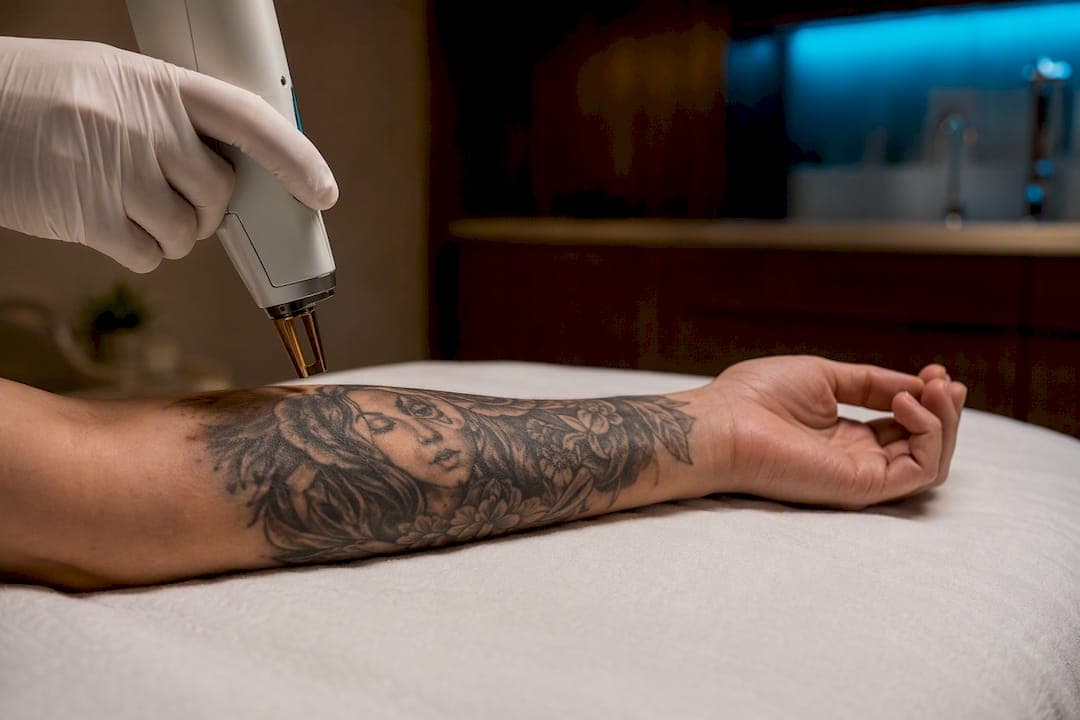
Laser hair removal should never be performed directly over tattoo ink. The pigment in your tattoo absorbs laser energy the same way melanin does and can trigger burns, blistering, or permanent color distortion. The safe path is treating the skin around a tattoo with proper protective margins, while using electrolysis for hair growing directly on the ink, or sticking with shaving and trimming for quick, no-risk upkeep.
TL;DR:
- Laser devices built for hair removal can damage tattoo ink, causing burns, blistering, or permanent color distortion if they pass directly over the ink.
- Darker tattoo inks like black and blue absorb more laser energy, increasing the risk of skin injury during hair removal treatments.
- Proper clinic protocols include mapping tattoos, using barriers, and maintaining safety margins of 1 to 2 centimeters to avoid direct laser contact.
- Electrology remains the safest permanent hair removal method over tattoos because it destroys follicles without targeting pigment.
- Waiting at least 4 to 6 weeks after tattooing and around 6 months after laser tattoo removal is necessary before laser hair removal near a tattoo, to allow healing.
Table of Contents
- Why Hair Removal Lasers React to Tattoo Ink
- What Can Happen if a Laser Hits Tattooed Skin
- How Clinics Protect Your Tattoo During Treatment
- Safer Ways to Remove Hair on Tattooed Skin
- How Long to Wait Before Any Laser Treatment Near a Tattoo
- What to Do if a Tattoo Gets Accidentally Lasered
- Why Clinic Judgment Matters More Than the Laser Itself
- Book a Consultation That Actually Accounts for Your Tattoos
- Sources
- FAQ
Why Hair Removal Lasers React to Tattoo Ink
Laser hair removal works through a process called selective photothermolysis. The laser targets melanin, the pigment inside hair follicles, heats it, and disables the follicle's ability to grow hair. It's precise when the only pigment in range is melanin sitting in a follicle a few millimeters deep.
Tattoo ink complicates that precision. Ink particles sit in the dermis, and many pigments absorb light energy in a similar range to melanin. When a hair-removal laser passes over inked skin, the ink itself becomes a target, pulling in energy that has nowhere productive to go. That energy converts to heat, and heat concentrated in a small area of skin causes tissue damage rather than hair reduction.
The distinction between hair-removal lasers and tattoo-removal lasers matters here. Devices built for hair removal fire in longer pulses, measured in milliseconds, designed to slowly heat a follicle until it's damaged. Tattoo-removal lasers do the opposite: they fire in nanosecond or picosecond bursts specifically built to shatter ink particles into fragments small enough for the body to clear. Running a hair-removal laser's slower, sustained pulse over ink is closer to holding a magnifying glass over a dark patch of paper than it is to a controlled treatment.
A few practical distinctions worth knowing before your consult:
- Diode and alexandrite lasers, common for hair removal, are absorbed strongly by dark pigment, including most tattoo ink.
- Nd:YAG lasers use a longer wavelength and are sometimes chosen for skin near tattoos because they're less reactive to surface pigment, though they're still not considered safe for direct passes over ink.
- Ink color changes the risk profile. Darker inks (black, blue, dark red) absorb more energy across most wavelengths than lighter inks.
Understanding how different laser types work helps explain why a technician's laser choice near a tattoo isn't arbitrary. It's a calculated attempt to reduce, not eliminate, risk to nearby ink.
What Can Happen if a Laser Hits Tattooed Skin
The damage isn't hypothetical. Clinics and dermatology practices have documented burns, blistering, and scarring after hair-removal lasers made direct contact with tattoo ink, and the injuries tend to follow a predictable pattern.
A first-degree burn shows up as redness and stinging within minutes, often resolving in a few days. A second-degree burn brings blistering within hours, and if the blister breaks or the wound isn't managed carefully, scarring becomes likely. Deeper thermal injury can destroy skin structure entirely, leaving a permanently altered patch where the tattoo used to sit.
Beyond burns, the aesthetic damage to the tattoo itself is often the bigger disappointment for clients. Heat can cause:
- Patchy fading where the laser hit unevenly across the design
- Visible distortion of line work and shading
- Ink migration, where damaged pigment particles shift beneath the skin
- Localized swelling that temporarily (or permanently) changes how colors sit against each other
One risk catches almost everyone off guard: white ink. Many white tattoo pigments contain titanium dioxide, and titanium dioxide can undergo an irreversible color change when hit with laser energy, often turning grey or black. A light-colored tattoo is not automatically a safer tattoo to laser near. That assumption trips up more people than any other misconception about tattooed skin and laser treatment.
Infection is a secondary but real concern once skin is compromised, and rare granulomatous or allergic-type reactions have been reported when ink particles are disrupted and provoke an immune response. None of this means every accidental pass causes catastrophic damage, but the range of outcomes runs from mild irritation to permanent scarring, and there's no way to predict in advance which one you'll get.
How Clinics Protect Your Tattoo During Treatment
Providers who regularly work with tattooed clients follow a fairly consistent process, and knowing it helps you evaluate whether a clinic is actually equipped to treat you safely.
- Mapping the tattoo first. A trained technician photographs and measures the tattoo's boundary before touching a laser to your skin, noting ink colors and flagging anything unusual, like white ink or permanent makeup pigment.
- Placing an opaque barrier. A white pencil, marker, or physical cover goes over the tattoo to reflect laser light away from the ink rather than letting it absorb energy.
- Keeping a safety margin. Most clinics maintain roughly a 1 to 2 centimeter buffer between the laser's path and the tattoo's edge, since heat can diffuse into surrounding tissue even without a direct hit.
- Adjusting technique at the border. Technicians angle the handpiece and feather the laser's edge as they approach the tattoo, sometimes lowering energy settings and increasing cooling in that zone.
A provider who understands tattooed skin will refuse to treat directly over ink, full stop, and will tell you so before you're on the table. If a technician offers to "just go over it carefully" without mentioning barriers or margins, that's a signal to ask more questions or walk away.
Pro Tip: Bring a clear photo of your tattoo's exact placement to your consultation, even if the technician will see it in person. It gives them time to plan the treatment map before you're under the laser, not during.

Discussing your tattoos openly during a consultation is the single biggest factor in avoiding a bad outcome.
Safer Ways to Remove Hair on Tattooed Skin
If hair grows directly on top of your tattoo, your options split clearly by permanence and risk.
- Shaving and trimming are immediate, cost nothing beyond a razor, and have zero impact on ink. The tradeoff is regrowth within days.
- Waxing or sugaring removes hair from the root and lasts several weeks, but healed tattoos should still be patch-tested first since pulling on tender or newly settled skin can irritate the area.
- Depilatory creams work chemically rather than mechanically, and some people find they cause more irritation on tattooed skin than on untouched skin, so a patch test matters here too.
- Electrolysis is the only permanent method considered generally safe over tattoo ink, because it destroys the follicle with an electrical current inserted into the hair shaft rather than targeting pigment with light. It takes longer and costs more per session than laser, and results depend heavily on the electrologist's skill, since careless technique can still scar skin and distort a tattoo.
If your goal is both a hair-free area and an eventual clean canvas, the sequence matters. Complete laser tattoo removal first, let the skin fully heal, and then pursue laser hair removal on skin that no longer holds pigment to conflict with.
How Long to Wait Before Any Laser Treatment Near a Tattoo
Timing mistakes cause almost as much damage as laser mistakes. Skin needs real time to settle, both after getting inked and after having ink removed.
- After a new tattoo: wait a minimum of 4 to 6 weeks for visible healing, then longer still before introducing any laser treatment nearby, since the skin barrier and deeper tissue continue remodeling well past the point where a tattoo looks healed.
- After laser tattoo removal: most practitioners recommend around 6 months before running a hair-removal laser over that same spot, allowing the skin to finish clearing fragmented ink and rebuilding normal tissue structure.
Tissue that looks calm on the surface can still be inflamed or remodeling underneath, and a laser doesn't distinguish between healed skin and skin that just looks healed. Rushing the timeline is one of the more common, and most preventable, causes of avoidable injury.
What to Do if a Tattoo Gets Accidentally Lasered
Stop the session immediately and cool the area with a clean, cold compress. Skip home remedies like butter, toothpaste, or essential oils. They tend to trap heat or introduce bacteria rather than help.
- Seek medical evaluation right away for blistering, deep burns, spreading discoloration, or any sign of infection like increasing redness, warmth, or discharge.
- Photograph the area and keep clinic notes as documentation.
- Follow up with a dermatologist for proper wound care, since early, careful treatment improves the odds that a tattoo artist can eventually rework the area.
- Once fully healed, consult a reputable tattoo artist before assuming a touch-up will restore the original design. Some damage is workable; some isn't, and an honest artist will tell you which.
Why Clinic Judgment Matters More Than the Laser Itself
The technology involved in laser hair removal hasn't changed dramatically in years. What separates a safe outcome from a bad one is almost always the person operating the equipment, not the equipment itself. Elite Laser Center Medical Spa performs its treatments under experienced medical supervision, which is the detail worth asking about at any clinic, not just this one: who is actually running the device, and what's their protocol when ink enters the treatment zone?
A clinic willing to map your tattoo, explain its margin policy, and tell you plainly when it won't treat a spot is doing the job correctly. A three-year guarantee on a laser hair removal package means little if the provider behind it can't answer basic questions about tattooed skin. Ask those questions before you book, not after something goes wrong.
— Sharon
Book a Consultation That Actually Accounts for Your Tattoos
Elite Laser Center Medical Spa builds a treatment plan around your tattoos instead of hoping they won't be an issue. Every session happens under medical supervision using FDA-approved devices, and your consultation includes mapping any tattooed areas before a single pulse touches your skin.

That means the surrounding skin gets treated for lasting hair reduction while your ink stays exactly where you left it. If you're weighing your options between electrolysis, waxing, or laser treatment on the skin around a tattoo, a consultation is the fastest way to get a straight answer specific to your placement and ink. Visit the laser hair removal guide to see what the process looks like from first appointment to final session, and book a consultation to get a plan built around the tattoos you already have.
This article is general information, not a substitute for advice from a qualified doctor. Consult a qualified healthcare professional about your own circumstances before acting on anything here.
Sources
- Understanding Laser Hair Removal and Tattoos: What You Need to Know
- Does Laser Hair Removal Damage Tattoos?
- Hair Removal Over Tattoo: Why Laser Can't, but Electrolysis Can
- Laser hair removal and tattoos: risks and protection 2026
- Titanium dioxide and pigment reactions (white ink risk)
FAQ
How do you permanently remove hair growing over a tattoo?
Electrolysis is currently the only permanent method considered generally safe for hair directly on tattoo ink, since it disables the follicle with an electrical current rather than targeting pigment with light.
What disqualifies someone from laser hair removal?
Active tanning, certain photosensitizing medications, some skin conditions, and pregnancy commonly rule out laser hair removal, and tattoos in the direct treatment path require the area to be avoided or specially protected rather than disqualifying the whole session.
Does laser hair removal fade tattoos?
Laser hair removal shouldn't fade a tattoo when performed correctly with a proper safety margin, but a direct pass over the ink can cause fading, distortion, or discoloration, especially in tattoos containing titanium dioxide white ink.
Can you get laser hair removal if you have tattoos?
Yes. Laser hair removal is generally fine on skin near tattoos as long as the provider maps the ink, uses an opaque barrier, and keeps a safety margin of roughly 1 to 2 centimeters, and some medical spas build that mapping into every consultation.
Recommended
- Laser Hair What to Expect
- Laser Hair Removal Side Effects: What to Expect
- Guide to Laser Consults
- Laser Hair Removal Sessions: How Many and How Often
This article was produced with AI assistance and reviewed for accuracy. It is provided for general information, and it is not professional advice.