
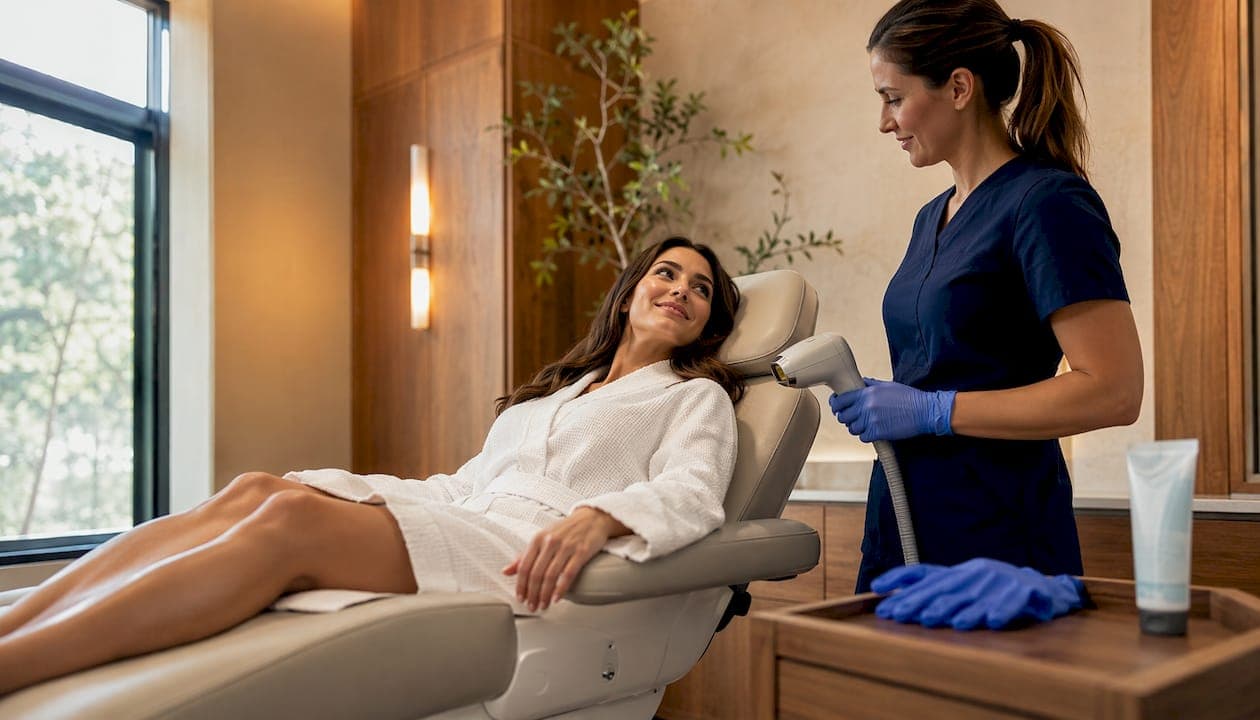
Laser hair removal is highly effective and among the safest options for people with light skin (Fitzpatrick types I–III) who have dark hair. A prospective clinical study reported ~74% mean hair reduction across Fitzpatrick types I–III after six treatments, with results holding at 18-month follow-up. That's not total elimination, but it's a dramatic, lasting change.
A few things to know before you read further:
- Best candidates: Light skin with dark, coarse hair. The contrast between low epidermal melanin and high follicular melanin is what makes the physics work.
- Top devices: Alexandrite (755 nm) for most light-skin patients; Diode (~800 nm) as a versatile alternative; Nd:YAG (1064 nm) when tanning is a factor.
- Light-colored hair (blonde, gray, white): Standard lasers don't work well. Electrolysis is the pigment-independent alternative.
- Non-negotiables: FDA-cleared devices, board-supervised treatments, and a patch test before your first full session.
Table of Contents
- How laser hair removal works on light skin
- Which laser works best for your skin type?
- What results actually look like over time
- Why blonde, red, gray, and white hair don't respond well
- Side effects and safety on light skin
- How to prepare and what to do after each session
- Who should wait or avoid laser treatment
- How to choose a provider you can trust
- Key Takeaways
- What light-skin patients often get wrong about laser
- Laser hair removal at Elite Laser Center in Stony Brook, NY
- Useful sources
How laser hair removal works on light skin
The mechanism is called selective photothermolysis, and it's the reason skin tone matters so much. Laser energy targets melanin, the pigment in your hair follicle, heating and damaging the follicle enough to disrupt future growth while leaving surrounding tissue intact. Wavelength, pulse duration, and fluence are all calibrated to match the follicle's thermal relaxation time, so heat stays where it's needed.
For people with light skin and dark hair, the clinical advantage is real: low epidermal melanin means the laser doesn't waste energy competing with the skin's surface. Clinicians can use higher fluence with shorter pulses, which improves follicle targeting and reduces the risk of surface burns. The safety margin is genuinely wider.
Selective photothermolysis on light skin: Because epidermal melanin is minimal in Fitzpatrick types I–III, practitioners can apply higher fluence settings that more effectively destroy the follicle while keeping epidermal injury risk low. This is why light skin with dark hair is the ideal clinical candidate for conventional laser hair removal.
Hair grows in cycles: anagen (active growth), catagen (transition), and telogen (resting). Laser only disrupts follicles in the anagen phase, which is why a single session never catches every hair. Multiple sessions, spaced weeks apart, are required to intercept each follicle during its active phase.
Pro Tip: Even if you have naturally fair skin, a recent tan raises your epidermal melanin enough to require adjusted device settings or a postponed appointment. Avoid sun exposure and self-tanners for at least four weeks before treatment.
Which laser works best for your skin type?
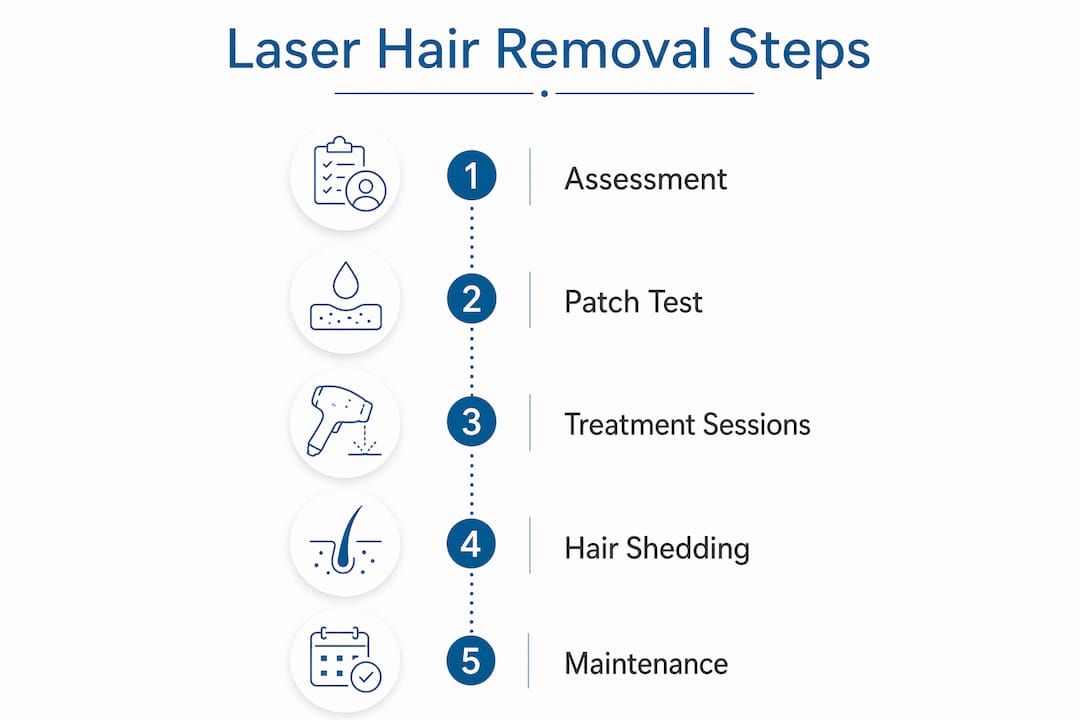
The short answer: Alexandrite (755 nm) is the most common first choice for Fitzpatrick I–III with dark hair. Its wavelength sits in the peak melanin absorption range, which means efficient energy delivery to the follicle and fewer sessions needed overall. Clinical data support 70–80% long-term hair reduction after a full course with this device.
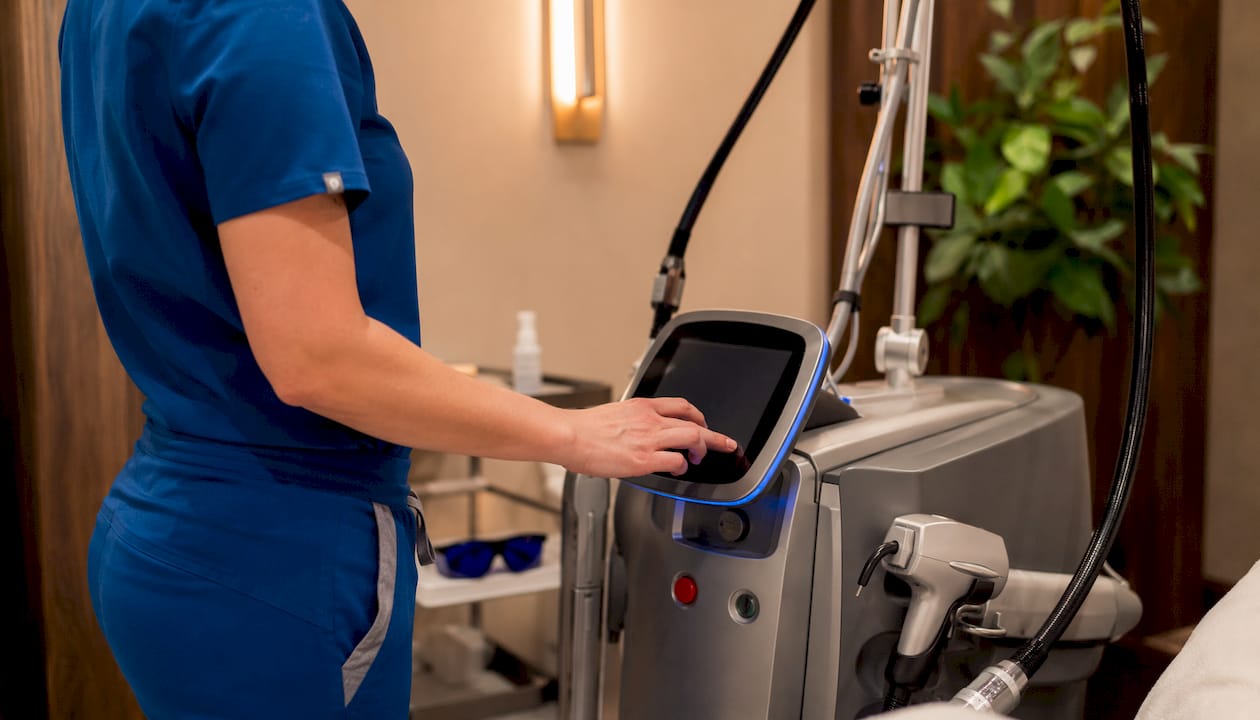
The Diode laser (~800 nm) penetrates slightly deeper and delivers strong fluence control, making it a solid option for coarser hair and for clinics treating a mixed-skin population. It's less aggressive at the surface, which some practitioners prefer for patients who are borderline on tanning or have slightly more pigmented skin.
The Nd:YAG (1064 nm) is the safest device for darker or recently tanned skin because its longer wavelength is less absorbed by epidermal melanin. For pure Fitzpatrick I–III patients, it's slightly less efficient per session than Alexandrite, but it becomes the right call when a patient has a recent tan or is closer to Fitzpatrick IV.
IPL (Intense Pulsed Light) and BBL systems use broad-spectrum light rather than a single wavelength. They cover larger areas and cost less per session, but they're generally less effective on very light-colored hair and require more sessions. For dark hair on light skin, a true laser outperforms IPL in most clinical comparisons.
| Device | Wavelength | Best skin types | Hair-color response | Sessions needed | PIH risk on light skin |
|---|---|---|---|---|---|
| Alexandrite | 755 nm | Fitzpatrick I–III | Dark, coarse hair | Several | Low |
| Diode | ~800 nm | Fitzpatrick I–V | Dark to medium hair | Several | Low to moderate |
| Nd:YAG | 1064 nm | Fitzpatrick I–VI | Dark hair (less efficient) | Several | Very low |
| IPL/BBL | — | Fitzpatrick I–IV | Dark hair only | Multiple | Low to moderate |
Key device considerations to raise at your consult:
- Ask for the specific device model and confirm FDA clearance.
- Verify that cooling (contact, cryogen, or air) is built into the system or used alongside it.
- Larger spot sizes treat faster but require precise calibration; ask how parameters are individualized.
What results actually look like over time
After a single session, expect some reduction in hair density. That number climbs with each subsequent treatment as more follicles are caught in the anagen phase. A prospective study tracking Fitzpatrick I–III patients reported approximately 74% mean hair reduction after six treatments, with results persisting at 18 months.
Stat to know: ~74% mean hair reduction at 18-month follow-up after six treatments in a prospective study of Fitzpatrick skin types I–III.
Most people need several sessions with the Alexandrite laser, spaced weeks apart. Diode and Nd:YAG protocols often run a comparable number of sessions depending on the area and hair density. Hormonal factors (PCOS, thyroid conditions) can drive new follicle activity and require additional sessions or periodic maintenance.
One thing that surprises many patients: treated hair doesn't fall out immediately. The damaged shaft sheds over 1–3 weeks post-treatment. That shedding phase is normal and expected, not a sign that the treatment failed. Understanding this keeps people on schedule instead of abandoning the process after session two.

Results also vary by body area. Coarser, denser hair (underarms, bikini line) tends to respond faster than finer hair on the arms or face. Hormonal areas like the chin or upper lip often need more sessions and occasional touch-ups.
Why blonde, red, gray, and white hair don't respond well
Laser hair removal is generally ineffective for blonde, white, gray, or some red hair. The reason is straightforward: these colors contain insufficient eumelanin (the dark pigment) to absorb laser energy. Without that absorption, the follicle doesn't heat up enough to be damaged.
Here's what to expect at a clinic assessment if your hair color is in question:
- Visual pigmentation check. A trained clinician examines your hair color under good lighting, sometimes with a dermatoscope, to assess melanin content.
- Test patch. A small area is treated at the proposed settings and evaluated at a follow-up visit, usually 4–6 weeks later, to confirm follicular response before committing to a full course.
- Honest outcome discussion. If the patch shows minimal response, a good clinician will say so directly rather than sell you a package that won't deliver.
- Electrolysis referral. For hair with insufficient pigment, electrolysis is the recommended alternative. It destroys each follicle individually using electrical current, making it pigment-independent and FDA-accepted for permanent hair removal.
- Combined approach consideration. Some patients with mixed hair color (mostly dark with scattered light strands) may benefit from laser for the pigmented hairs and electrolysis for the rest.
Electrolysis is slower, treating one follicle at a time, and requires more total appointments for large areas. But for white, gray, or blonde hair, it's the only method with a genuine permanence claim. Ask your clinician specifically: "Given my hair color, what response do you realistically expect from a test patch?"
Side effects and safety on light skin
The most common immediate effects are erythema (redness) and swelling around the follicle, which typically resolve within a few hours. Transient pigment changes, either lightening or darkening of the treated skin, can occur but are usually temporary on Fitzpatrick I–III. Rarer and more serious effects include blistering, crusting, and permanent dyspigmentation, which are significantly more likely when device settings are wrong or the patient has a recent tan.
On light skin, the risk profile is favorable, but not zero. Tanning before treatment raises epidermal melanin even in Fitzpatrick I–III patients, narrowing the safety margin and increasing the chance of surface burns or post-inflammatory hyperpigmentation (PIH). The same physics that makes light skin a good candidate also means any added pigment changes the equation.
Sun exposure timing matters both before and after treatment. Avoid direct sun, tanning beds, and self-tanners for at least four weeks before each session. After treatment, apply broad-spectrum SPF 30+ daily to the treated area for several weeks.
Medications and topicals that increase photosensitivity require disclosure at your consult:
- Isotretinoin (Accutane): Most clinics require a waiting period of 6–12 months after stopping before treating.
- Photosensitizing antibiotics: Doxycycline and tetracycline increase UV and light sensitivity; discuss timing with your clinician.
- Retinoids: Topical retinol or tretinoin should be paused before treatment as directed.
- Blood thinners and NSAIDs: May increase bruising risk in sensitive areas.
Do not treat over active infections, open wounds, or areas with tattoos. Laser energy can interact unpredictably with tattoo pigment and cause serious burns. Eye protection is mandatory during every session.
How to prepare and what to do after each session
The single most important pre-treatment step: shave the treatment area 24 hours before your appointment. Shaving removes the surface hair shaft while leaving the follicle intact for the laser to target. Waxing, plucking, threading, or depilatory creams remove the follicle's melanin target and must be avoided for at least four weeks before treatment.
Pre-session checklist:
- Shave 24 hours prior; do not wax or pluck.
- Avoid sun exposure and tanning for four weeks before each session.
- Pause retinoids and photosensitizing topicals as directed by your clinician.
- Arrive with clean, dry skin; no lotions, deodorants, or makeup on the treatment area.
- Wear loose, comfortable clothing that allows easy access to the treatment area.
Day-of expectations: your clinician will provide protective eyewear. The sensation during treatment is often described as a rubber band snap combined with heat, varying by area and device. Cooling (contact cooling, cryogen spray, or cold air) is typically applied simultaneously to protect the epidermis.
Post-session care:
- Apply a cool compress or aloe vera gel to reduce immediate redness and swelling.
- Use a gentle, fragrance-free cleanser for the first 48 hours.
- Apply broad-spectrum SPF 30+ daily to treated areas.
- Avoid heat: no hot showers, saunas, or intense exercise for 24–48 hours.
- Expect hair shedding over 1–3 weeks; this is the treated follicle releasing the damaged shaft.
- Contact your clinic if you notice blistering, significant crusting, or prolonged pain.
Who should wait or avoid laser treatment
Not everyone is a good candidate, even with light skin and dark hair. Common disqualifiers include:
- Active pregnancy: Most clinics defer laser treatment during pregnancy as a precaution.
- Recent isotretinoin use: A waiting period (often 6–12 months post-course) is standard before treatment.
- Active skin infection or open wounds in the treatment area.
- Recent significant tanning (within four weeks), including self-tanners.
- Photosensitizing medications that haven't been discussed and cleared with the treating clinician.
- Tattoos or permanent makeup in or adjacent to the planned treatment area.
- Certain dermatologic conditions (active eczema, psoriasis, or herpes simplex in the treatment area) may require postponement.
- Very light hair (blonde, white, gray): not a safety disqualifier, but a candidacy issue. Laser is unlikely to produce meaningful results.
Every reputable clinic conducts a full medical history review and patch test before starting a treatment course. This isn't optional paperwork; it's how complications get prevented.
How to choose a provider you can trust
Medical supervision is the single most important safety factor in laser hair removal. The AAD emphasizes that this is a medical procedure, and outcomes depend heavily on who is operating the device and how parameters are set. A board-certified dermatologist or a medically supervised clinic with trained laser technicians is the standard you should hold providers to.
What to verify before booking:
- Device model and FDA clearance: Ask specifically which laser platform is used and confirm it's FDA-cleared for hair removal.
- Medical oversight: Is a physician or board-certified provider involved in treatment planning and parameter setting?
- Patch test policy: Any clinic worth your time offers a patch test before a full course.
- Documented outcomes: Before-and-after photos, realistic reduction estimates, and written pre/post-care instructions.
- Transparent pricing: Package pricing, session counts, and what's included in a "touch-up" or maintenance visit.
A thorough first consult includes a medical history review, a medication check, a prompt about hormonal conditions if you have excessive or rapidly regrowing hair, and a written treatment plan with realistic outcome estimates.
Pro Tip: Ask your provider: "What device will you use on me, and why is it the right choice for my skin and hair type?" A clinician who can answer that specifically, naming the wavelength and explaining the rationale, is one who actually knows what they're doing.
Elitelaserhair at Elite Laser Center in Stony Brook, NY operates under experienced medical supervision, uses FDA-cleared platforms, and offers a three-year guarantee on laser hair removal packages. Every patient receives individualized parameter settings and a patch test before their first full session, which is exactly the standard of care the research supports.
Key Takeaways
Laser hair removal on light skin (Fitzpatrick I–III) with dark hair delivers the highest success rates of any skin type, with clinical studies reporting approximately 74% mean hair reduction after six sessions at 18-month follow-up.
| Point | Details |
|---|---|
| Best skin and hair combination | Fitzpatrick I–III with dark, coarse hair achieves the highest reduction rates, with clinical studies reporting approximately 74% mean reduction after six sessions at 18-month follow-up. |
| Alexandrite is the top device | The 755 nm Alexandrite laser is the most common first choice for light skin; Diode offers versatility for mixed populations. |
| Light hair needs electrolysis | Blonde, gray, and white hair lack sufficient melanin for laser to work; electrolysis is the pigment-independent, FDA-accepted alternative. |
| Plan for 4–6 sessions | Sessions are spaced 4–6 weeks apart; expect 10–25% reduction per session and ongoing shedding between appointments. |
| Elitelaserhair in Stony Brook | Elite Laser Center offers medically supervised laser hair removal with FDA-cleared devices and a three-year package guarantee. |
What light-skin patients often get wrong about laser
Most people with Fitzpatrick I–III skin walk into a laser consult thinking they're the easy case, and in many ways they are. But the assumption that light skin means zero risk is where things go sideways.
The physics is real: low epidermal melanin gives clinicians more room to work. What patients underestimate is how quickly that margin shrinks. Two weeks at the beach before a session, a bottle of self-tanner, or a course of doxycycline for acne can shift the risk profile enough to cause a burn that wouldn't have happened otherwise. The device doesn't know you're "naturally fair." It reads the melanin present at the time of treatment.
The other thing worth saying plainly: laser hair removal is not a one-and-done procedure, and the clinics that frame it that way are doing their patients a disservice. Roughly 74% mean reduction after six sessions is a genuinely impressive clinical outcome. But that remaining fraction of hair, plus the hormonal regrowth that happens over years, means most people will need occasional maintenance. That's not a failure of the technology. It's just biology.
The patients who get the best outcomes are the ones who go in with accurate expectations, follow the pre/post-care protocol without shortcuts, and choose a provider who individualizes their settings rather than running everyone through the same program. Those three things matter more than which device is in the room.
Laser hair removal at Elite Laser Center in Stony Brook, NY
If you're ready to move from research to results, Elite Laser Center in Stony Brook offers medically supervised laser hair removal using FDA-cleared devices, with every treatment plan individualized to your skin type, hair color, and treatment area. The clinic's three-year package guarantee means you're not left on your own if you need additional sessions.
The first step is a consultation and patch test, where your clinician reviews your medical history, assesses your candidacy, and determines the right device and settings for your skin. Package pricing and financing options are available. Book your consult at elitelaserhair.com and come in with your questions ready.
Useful sources
The clinical claims in this article draw from the following authoritative sources. Each is worth reading if you want study-level detail before your consult.
| Source | What it covers |
|---|---|
| StatPearls / NCBI Bookshelf — Laser Hair Removal | Mechanism, device comparisons, Fitzpatrick skin typing, session protocols, and adverse effects; the most comprehensive clinical reference available. |
| Mayo Clinic — Laser Hair Removal | Patient-facing overview of how the procedure works, what to expect, and safety considerations including medication interactions. |
| PMC — Laser Treatment in Hirsutism: An Update | Wavelength-specific device comparisons (Alexandrite, Diode, Nd:YAG, IPL) and clinical tradeoffs across skin types. |
| American Academy of Dermatology — Hair Removal | Board-level patient guidance on candidacy, light-colored hair limitations, and electrolysis as an alternative. |
| UCSF Health — Laser Hair Removal | Institutional overview of candidacy criteria, with emphasis on light skin and dark hair as the optimal combination. |
Bring specific questions from these sources to your consult. A clinician who welcomes that conversation is one worth trusting.