
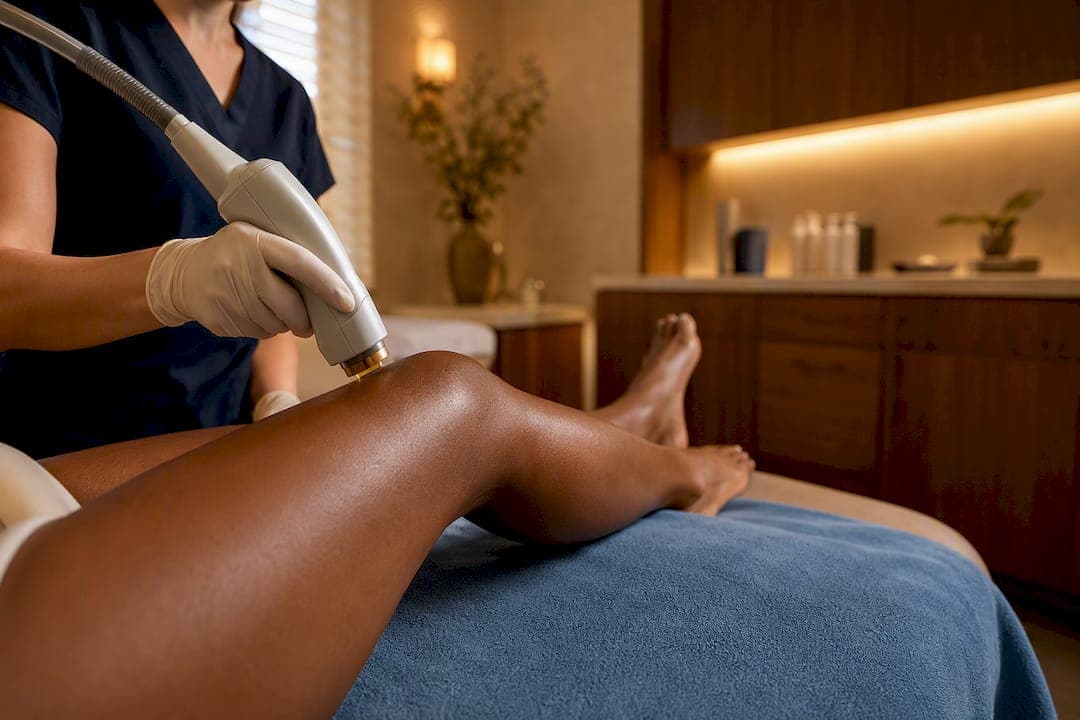
Laser hair removal works on dark skin, and it does so safely when a clinic uses the right wavelength, conservative settings, a patch test, and an operator who has treated Fitzpatrick IV to VI skin before. The tradeoff is more sessions and slower, more careful settings than a lighter-skinned client might get. That's not a compromise; it's the whole point.
TL;DR:
- Modern laser devices using 1064 nm Nd:YAG effectively treat dark skin when used with conservative settings and proper cooling, requiring more sessions than lighter skin.
- A thorough consultation should include a Fitzpatrick skin type assessment, device specifics, patch testing, and a realistic treatment timeline based on individual response.
- Risks like hyperpigmentation, hypopigmentation, and burns are primarily caused by incorrect wavelength choice and aggressive settings, not skin color itself, and can be minimized with proper protocols.
- Multiple sessions are necessary due to hair growth cycles, with darker skin typically needing lower energy and potentially more sessions to achieve optimal results.
- Choosing an experienced, medically supervised provider who customizes treatment plans and performs patch tests is crucial for safe and effective laser hair removal on dark skin.
Table of Contents
- Laser Hair Removal Dark Skin Myths vs. Facts
- Why Wavelength, Pulse Duration, and Cooling Actually Matter
- What Your First Laser Hair Removal Appointment Should Include
- The Real Risks for Melanin-Rich Skin, and How to Prevent Them
- How to Choose a Provider When You Have Dark Skin
- Elite Laser Center's Approach to Safety-First Treatment
- Laser vs. Other Hair Removal Methods for Dark Skin
- Pre-Treatment Prep That Actually Reduces Side Effects
- How Fitzpatrick IV, V, and VI Skin Respond Differently
- New Laser Technology Designed for Darker Skin
- What Drives the Cost of Laser Hair Removal for Dark Skin
- The Gap Between Laser Marketing and Laser Reality
- Book a Consultation Built Around Your Skin, Not a Generic Chart
- Sources
- FAQ
Laser Hair Removal Dark Skin Myths vs. Facts
Most of the bad information circulating about laser hair removal for dark skin dates back to devices that stopped being standard practice years ago. The technology moved on. A lot of the fear didn't move with it.
Here's where the myths break down against the current evidence:
- "Dark skin can't be treated with lasers." False, and outdated. Early lasers and IPL devices used shorter wavelengths that got absorbed heavily by skin pigment instead of the hair follicle, which is why this myth stuck around. Modern platforms using the 1064 nm Nd:YAG wavelength solve that absorption problem directly.
- "IPL is basically the same as laser." It isn't, especially for Fitzpatrick IV to VI. IPL emits a broad, unfocused spectrum of light that's harder to control and more likely to be absorbed by epidermal melanin, which raises burn and pigment-change risk on darker skin.
- "A few sessions and you're done forever." Unrealistic for anyone, but especially misleading for darker skin, where clinics intentionally use lower energy per session and need more rounds to get the same follicle damage.
- "Any pigment change means the treatment failed." Temporary darkening or lightening can happen, but it's manageable and often preventable with the right pre- and post-care, not a sign the whole approach is wrong for your skin tone.
The real story is that skin tone changes the settings and the timeline, not the outcome.
Why Wavelength, Pulse Duration, and Cooling Actually Matter
Laser hair removal works through a principle called selective photothermolysis. The laser targets melanin in the hair follicle, heats it enough to disable future growth, and ideally leaves the surrounding skin alone. The problem for darker skin is that the epidermis itself contains a lot of melanin too, so a laser that isn't picky can heat the skin surface right along with the hair.
This is where wavelength choice becomes the whole game. Shorter wavelengths get absorbed almost immediately by surface pigment, which is efficient for treating hair on pale skin but risky on skin with more melanin throughout the epidermis. The 1064 nm Nd:YAG wavelength travels deeper and gets absorbed less by epidermal melanin, so it reaches the follicle with less collateral heating on the surface. That's why it's widely regarded as the safest choice for Fitzpatrick IV to VI skin.
Pulse duration and cooling do the rest of the work. A longer pulse spreads the same energy over more time, giving heat a chance to dissipate from the skin surface while still cooking the follicle. Active cooling, whether it's a contact-cooled handpiece or a cold air system running during the pulse, pulls heat away from the epidermis in real time. One pilot comparative study found that combined-wavelength diode platforms using 1064 nm settings with conservative protocols delivered meaningful hair reduction on darker skin without significant epidermal injury.
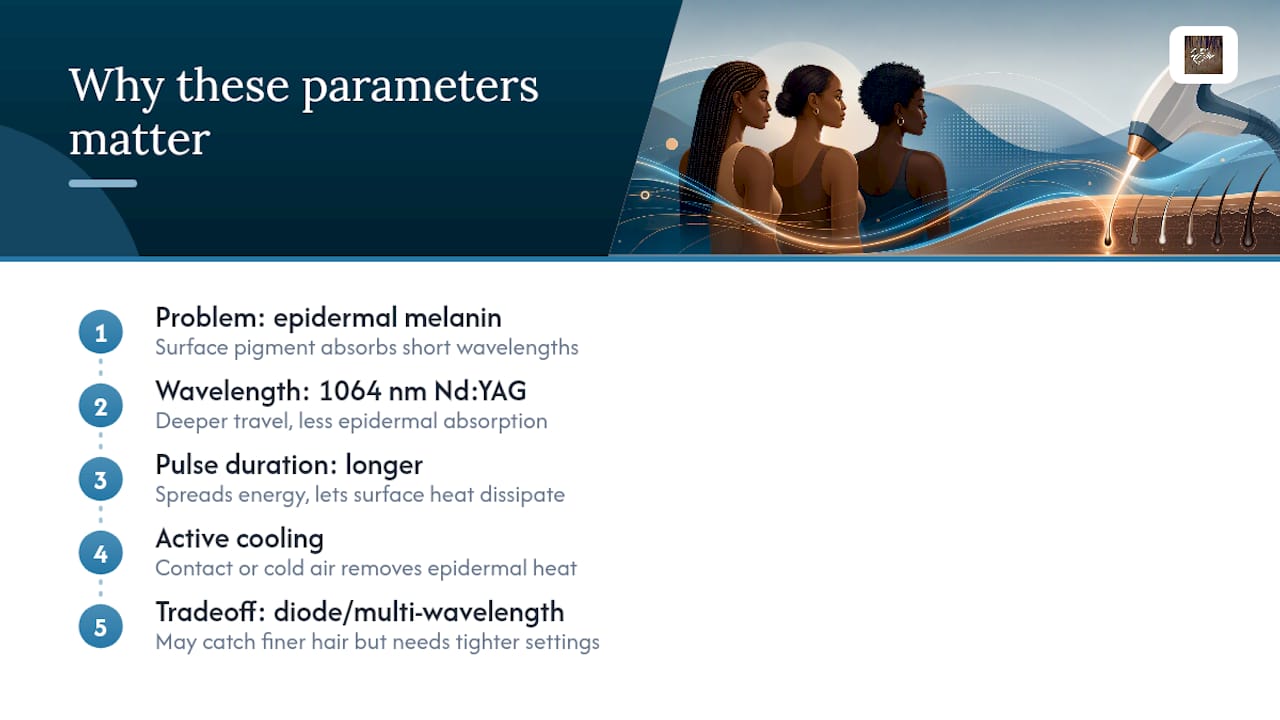
Diode and multi-wavelength systems still have a place, particularly for medium-dark tones or finer hair, where a shorter wavelength can sometimes catch what Nd:YAG misses. The tradeoff is that these systems demand tighter settings and more operator judgment the darker the skin gets.
What Your First Laser Hair Removal Appointment Should Include
A rushed consultation is the biggest red flag in this whole process. A responsible provider treats the first visit as an assessment, not a sales pitch.
Here's what should happen before anyone touches a laser to your skin:
- Fitzpatrick skin type assessment. Your provider should classify your skin type formally, not just glance and guess, since this determines wavelength and fluence.
- Device and cooling discussion. Ask what wavelength the machine runs and what cooling method it uses. If they can't answer specifically, that's a problem.
- Patch test. A small test spot gets treated first, then observed for adverse reactions before a full session is scheduled. Clinics generally want to watch that spot for 48 to 72 hours, since delayed pigment changes don't always show up immediately.
- Photo review. Ask to see real before-and-after results specifically from clients with skin tones similar to yours.
- Session plan. Expect a realistic timeline, not a promise of instant results.
Multiple sessions are non-negotiable because hair grows in cycles, and only a portion of your follicles are in the active growth phase at any given time. Clinical reports show many patients see their biggest visible gains around the sixth session, and darker skin often needs energy dialed down per session, which stretches the total number of sessions out a bit further than it would for lighter skin.
Aftercare in the first 48 hours matters as much as the treatment itself: avoid direct sun exposure, skip exfoliants and retinoids for a few days, use cool compresses if there's irritation, and apply sunscreen faithfully once you're back to normal activity.
The Real Risks for Melanin-Rich Skin, and How to Prevent Them
The three complications that matter most for Fitzpatrick IV to VI skin are post-inflammatory hyperpigmentation, hypopigmentation, and burns or blistering. All three trace back to the same root cause: too much heat reaching the epidermis. Research on darker skin outcomes links these adverse effects specifically to incorrect wavelength selection and overly aggressive fluence settings, not to darker skin being inherently fragile.
Post-inflammatory hyperpigmentation shows up as darkened patches where the skin overreacted to heat and inflammation. Hypopigmentation is the opposite: lighter patches where pigment-producing cells got damaged. Burns and blistering are the most acute version of the same problem, direct thermal injury to the skin surface.
Prevention comes down to a short list of practices:
- Conservative fluence settings, especially in the first one or two sessions
- Longer pulse durations paired with active cooling
- A patch test before any full treatment area is touched
- Strict sun avoidance before and after sessions
- Pausing retinoids, exfoliating acids, and other photosensitizing products in the days around treatment
If you notice darkening, a burning sensation, or blistering after a session, cool the area immediately and contact the clinic. A topical corticosteroid or a dermatology referral may be needed if the reaction doesn't settle quickly.
Pro Tip: Recent sun exposure or tanning is one of the most common reasons a session gets postponed. Tanned skin has more active melanin at the surface, which raises burn risk regardless of the laser's wavelength. If you've been outside a lot, tell your provider before your appointment, not after.
Certain conditions rule treatment out entirely, at least temporarily: active skin infections, recent tanning, and isotretinoin use within the past six months are standard contraindications any responsible clinic should ask about upfront.
How to Choose a Provider When You Have Dark Skin
The provider matters more than the marketing. A machine capable of treating dark skin safely can still cause harm in inexperienced hands, and a clinic with good intentions but the wrong device can't compensate for that gap with technique alone.
Ask these questions before you book anything:
- What exact wavelength does your device use, and does it include 1064 nm Nd:YAG?
- What's your pulse width range, and what cooling system is built in?
- What's your patch test policy, and how long do you wait before a full session?
- Can I see before-and-after photos of clients with skin tones like mine?
- Is a medical director or dermatologist supervising treatment protocols?
A recent review of hair removal technology for darker skin types specifically calls for Fitzpatrick-stratified protocols rather than one-size-fits-all settings, which underscores why a generic answer to any of these questions should worry you.
Watch for red flags: a clinic that claims to "work on all skin types" without naming a specific device or wavelength, any use of IPL or short-wavelength lasers for Fitzpatrick IV to VI, no documented experience with skin of color, or pressure to skip the patch test and book a full session immediately. If a provider hesitates to demand a patch test before treating you, that hesitation tells you more than anything on their website.
Elite Laser Center's Approach to Safety-First Treatment
Elite Laser Center Medical Spa specializes in non-surgical aesthetic treatments, including laser hair removal, using advanced FDA-approved technology built around the safety principles that matter most for darker skin: patch testing, conservative ramp-up protocols, and treatment plans customized to each client's skin type and hair pattern.
Every treatment plan is developed and performed under experienced medical supervision rather than left to a generic settings chart. [Sharon's professional credentials and experience related to laser hair removal] inform how the clinic approaches Fitzpatrick IV to VI clients specifically, starting conservative and adjusting as the skin responds across sessions rather than pushing for speed on day one.
reflect a pattern that shows up across the clinical literature too: darker skin responds well to laser hair removal, it just needs a provider willing to go slower to get there safely.
Laser vs. Other Hair Removal Methods for Dark Skin
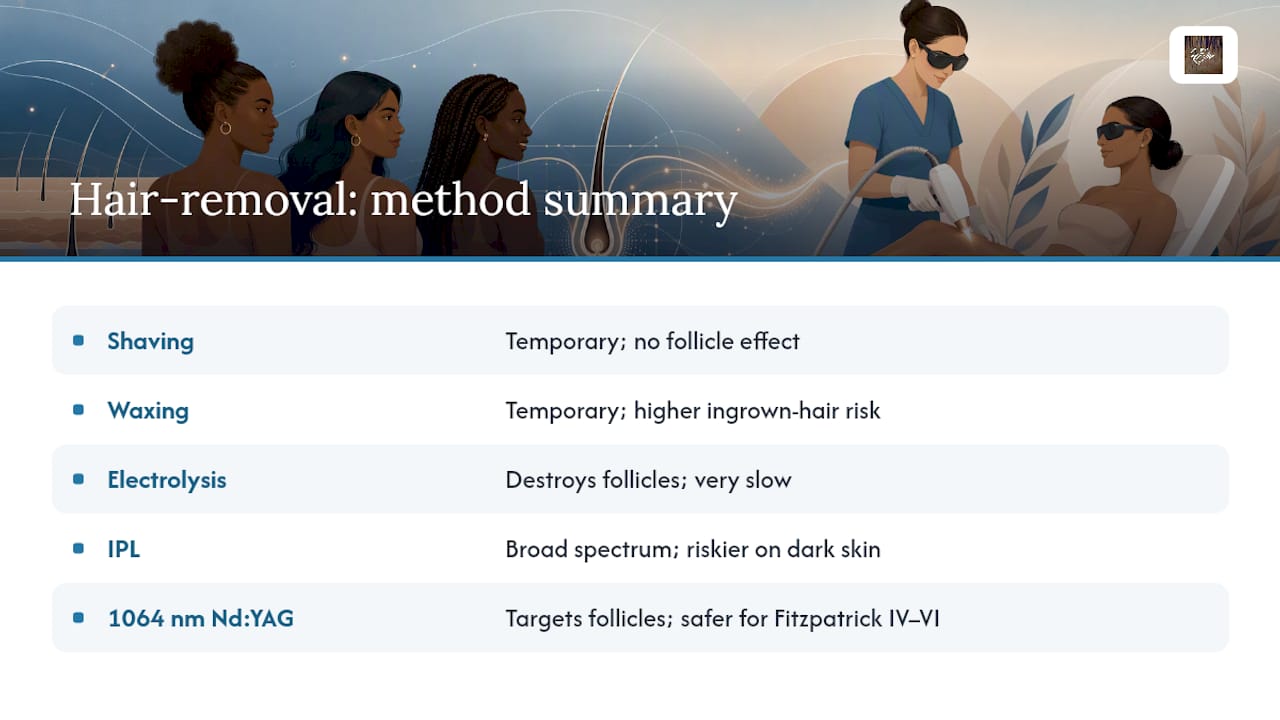
Laser hair removal isn't competing with shaving or waxing on the same axis. Shaving and waxing remove hair temporarily and do nothing to the follicle itself, so hair returns within days to a few weeks, and for many people with coarse or curly hair, waxing and shaving both raise the risk of ingrown hairs and razor bumps, a particular problem for skin prone to post-inflammatory hyperpigmentation.
Electrolysis destroys individual follicles with an electric current and works regardless of hair or skin color, since it doesn't rely on pigment absorption at all. It's genuinely effective, but it's also slow, treating one follicle at a time, which makes large areas impractical for most people on any reasonable timeline.
IPL sits in an awkward middle ground. It's marketed as a laser alternative, but its broad, unfocused wavelength spectrum makes it harder to control on melanin-rich skin, and the evidence base for its safety on Fitzpatrick IV to VI is thinner than it is for properly selected laser wavelengths.
Laser hair removal using 1064 nm Nd:YAG, when done with conservative settings, offers the best combination of effectiveness and manageable risk for darker skin among the professional options. It requires more sessions than it might for lighter skin, and it costs more upfront than a razor. But it's the only method on this list built specifically to target the follicle while working around, rather than through, epidermal melanin.
Pre-Treatment Prep That Actually Reduces Side Effects
What you do in the weeks before your appointment matters almost as much as the settings your provider chooses.
Sun avoidance is the single biggest factor. Tanned or sunburned skin carries more active melanin at the surface, and Mayo Clinic guidance specifically recommends avoiding sun exposure around treatment sessions because it raises the risk of pigment changes. If a tan is unavoidable, tell your provider. A good clinic will delay treatment rather than risk a burn.
Stop using retinoids, alpha and beta hydroxy acids, and other exfoliating actives several days before your appointment. These ingredients thin the outer skin layer and make it more reactive to heat, which raises complication risk exactly where you don't want it.
Skip self-tanners and spray tans entirely in the days leading up to treatment. They don't just mislead the technician about your natural tone, they can also interfere with how the laser reads your skin.
Shave the treatment area the day before your appointment, not weeks in advance. Laser hair removal targets the follicle below the surface, and long hair on the skin surface just burns off and adds unnecessary heat without contributing to the treatment.
If you're prone to cold sores or have a history of skin infections in the treatment area, mention it during consultation. Some clinics recommend antiviral prophylaxis for facial treatments in susceptible patients.
None of this is complicated, but skipping it is one of the most common reasons a session gets postponed or a mild reaction shows up afterward.
How Fitzpatrick IV, V, and VI Skin Respond Differently
Fitzpatrick IV, V, and VI aren't interchangeable categories, even though they all fall under the umbrella of "dark skin" in most conversations about laser safety.
Fitzpatrick IV skin, often described as olive or moderate brown, tends to tolerate a slightly wider range of settings than V or VI. Some clinics can use diode platforms alongside Nd:YAG for IV skin with reasonable safety margins, particularly for finer or lighter-colored hair where Nd:YAG alone might underperform.
Fitzpatrick V and VI skin, deeper brown to very dark brown, carries the highest concentration of epidermal melanin and the narrowest safety margin for wavelength and fluence errors. This is where 1064 nm Nd:YAG stops being a preference and becomes close to a requirement, and where the most conservative starting settings and the longest patch test observation windows apply.
Hair coarseness interacts with skin tone in ways that complicate treatment planning further. Coarse, densely pigmented hair on very dark skin gives the laser a strong target in the follicle, but the safety window between "enough energy to damage the hair" and "too much energy for the skin" narrows accordingly. Fine, lighter hair on the same skin tone is harder to treat effectively regardless of wavelength, since the laser has less pigment to grab onto in the follicle itself.
This is exactly why a Fitzpatrick assessment during consultation isn't a formality. It changes the plan.
New Laser Technology Designed for Darker Skin
The device landscape for treating darker skin has shifted meaningfully in the past several years, and the changes go beyond just "using Nd:YAG instead of IPL."
Multi-wavelength platforms now let a single device switch between 1064 nm Nd:YAG and shorter wavelengths depending on the treatment area and hair characteristics, giving providers more flexibility than older single-mode machines that locked them into one setting. Independently adjustable pulse-width controls paired with robust contact cooling are becoming the standard for equipment purchased with a mixed client base in mind, according to device procurement guidance aimed at clinicians.
Radiofrequency-based hair reduction methods are emerging as an adjunct rather than a replacement for laser. Because RF technology doesn't rely on melanin absorption at all, it sidesteps the epidermal heating problem entirely, which makes it particularly useful for conditions like pseudofolliculitis barbae that disproportionately affect people with coarse, curly hair. A 2025 review notes RF approaches showing promise for these cases, sometimes combined with topical agents, though laser remains the primary tool for broad hair reduction.
The bigger shift is in testing standards. That same review calls for devices to be tested and validated specifically across the full Fitzpatrick range rather than extrapolating dark-skin safety from studies run mostly on lighter skin, a gap that's shaped a lot of the outdated caution still floating around.
What Drives the Cost of Laser Hair Removal for Dark Skin
Price varies clinic to clinic, but a few factors consistently push cost up or down for darker-skinned clients specifically.
Treatment area size is the most obvious variable. Small areas like the upper lip cost less per session than large areas like the back or full legs, and that scales regardless of skin tone.
Session count changes the total investment more for darker skin than lighter skin, since conservative settings and hair-cycle biology often mean more total sessions to reach comparable reduction. A quote for "six sessions" on paper may not reflect the full course a Fitzpatrick V or VI client actually needs to see results comparable to a lighter-skinned client at the same session count.
Device type affects pricing too. Clinics running true multi-wavelength Nd:YAG platforms with advanced cooling generally price sessions higher than clinics using older or single-mode diode equipment, partly reflecting equipment cost and partly reflecting the operator expertise required to run those settings safely.
Provider expertise and medical supervision carry a real cost that shows up in the price. A clinic with a supervising medical director and staff experienced in treating skin of color typically charges more than a walk-in chain, and that difference often correlates directly with lower complication rates.
Geographic location and package structure round out the picture. Many clinics offer multi-session packages at a lower per-session rate than paying individually, which can meaningfully reduce the total cost of a full course when session count is already higher than average.
The Gap Between Laser Marketing and Laser Reality
Most of the anxiety around laser hair removal for dark skin isn't really about the technology anymore. It's about outdated marketing and outdated fear existing in the same conversation, years after the equipment that justified the fear stopped being standard practice.
The conventional advice you'll find online still treats "safe for dark skin" as a binary label a clinic either has or doesn't, when the real determining factor is a combination of device, settings, and operator judgment working together session by session. A clinic can own the right machine and still get it wrong if the technician defaults to settings built for lighter skin. That's the detail most guides skip past.
What actually deserves priority isn't finding the clinic with the most confident marketing copy. It's finding the one willing to slow down: patch test first, start conservative, and adjust based on how your specific skin responds rather than a settings chart built for someone else's Fitzpatrick type. The sessions might take longer to show full results. That's not a failure of the treatment. It's what doing it correctly on darker skin actually looks like.
— Sharon
Book a Consultation Built Around Your Skin, Not a Generic Chart
Medically supervised laser hair removal often involves patch testing and conservative, session-by-session protocols tailored for clients with darker skin tones. Instead of applying a one-size-fits-all setting across every skin type, treatment plans are built around your Fitzpatrick classification, hair pattern, and how your skin responds during the initial patch test.

A first consultation covers the device and wavelength being used, walks through the patch test process, and sets realistic expectations for how many sessions your specific skin and hair type will likely need. You'll leave with an actual timeline instead of a vague promise. If you're ready to see what a safety-first approach to laser hair removal looks like for your skin, find out what to expect at your first visit and book a consultation to get your patch test scheduled.
This article is general information, not a substitute for advice from a qualified doctor. Consult a qualified healthcare professional about your own circumstances before acting on anything here.
Sources
- Safety and efficacy for hair removal in dark skin types with combined-wavelength diode laser (pilot comparative study) — PubMed
- Adverse effects and safety considerations of laser hair removal in darker skin — PubMed
- Hair removal options in darker skin types through laser innovation — IJORD (2025 review)
FAQ
Will laser hair removal work on dark skin?
Yes. Laser hair removal is effective on Fitzpatrick IV to VI skin when a provider uses 1064 nm Nd:YAG or an appropriately selected diode platform with conservative settings, though it typically requires more sessions than lighter skin needs for comparable results.
What disqualifies you from laser hair removal?
Active skin infections, recent tanning or sunburn in the treatment area, and isotretinoin use within the past six months are standard reasons a provider will postpone or decline treatment. Certain medical conditions and medications may also require a physician's clearance first.
What's the downside of laser hair removal on dark skin?
The main risks are post-inflammatory hyperpigmentation, hypopigmentation, and burns, all linked to incorrect wavelength selection or overly aggressive settings rather than darker skin itself. These risks drop significantly with a proper patch test, conservative fluence, and an experienced operator.
Does IPL work for brown skin?
IPL is generally considered less safe and less predictable than properly selected laser wavelengths for Fitzpatrick IV to VI skin, because its broad light spectrum is absorbed more readily by epidermal melanin. Most dermatology sources recommend 1064 nm Nd:YAG laser over IPL for medium to dark skin tones.
How many sessions does laser hair removal take for dark skin?
Most patients need multiple sessions spaced weeks apart, with many seeing their most noticeable results by the sixth session, since hair grows in cycles and only a portion of follicles are active at any given time. Darker skin often needs more conservative energy per session, which can extend the total number of sessions compared to lighter skin.
Recommended
- Types of Laser Hair Removal Treatments: 2026 Guide
- Skin Type Categories and Aesthetic Treatments: 2026 Guide
- Laser Hair Removal in Summer: Safety, Timing & Tips
This article was produced with AI assistance and reviewed for accuracy. It is provided for general information, and it is not professional advice.