
By the Elite Laser Center & Med Spa team, Stony Brook, NY. Medical review pending before publication.
Juvéderm and Restylane are not two single products you can line up and score. Each is a family of hyaluronic acid (HA) gels, and every gel in each family has its own thickness, cross-linking, and FDA-labeled uses. The better question is not "which brand?" but "which formulation, for which area, placed by whom?" That answer depends on your anatomy and your goals.
Below, we walk through how the two families differ, what the labeling says, what recovery and risk look like, and how to think about cost. We offer Restylane products, including Restylane Kysse and Restylane Contour. We do not offer Juvéderm, so we describe it from published labeling and studies rather than from our own clinical experience with it.
Key takeaways
- Both brands are made of cross-linked hyaluronic acid. Differences live at the product level (for example Kysse vs. Contour), not the brand level.
- FDA labeling is area-specific. A gel approved for lips is not automatically approved for cheeks, and the reverse is also true.
- Duration varies by product, area, and person. Any single "lasts X months" claim for a whole brand is too blunt to rely on.
- Swelling and bruising are common and usually temporary. Vascular occlusion is rare but serious, so who injects matters as much as what is injected.
- HA fillers can be dissolved with hyaluronidase, but that is a medical treatment with limits, not a guaranteed undo button.
Table of Contents
- Why "Juvéderm or Restylane" is the wrong first question
- How the two families compare at a glance
- What Restylane products do we use, and for what?
- What about Juvéderm?
- Duration: why a single number misleads
- Recovery: swelling, bruising, and what to plan for
- Risks you should know before any filler
- Cost factors, without made-up prices
- Our perspective
- Where HA in skincare fits
- What about Sculptra?
- Considering filler in Stony Brook?
- Frequently asked questions
- Sources
Why "Juvéderm or Restylane" is the wrong first question
Both lines are made of hyaluronic acid, a sugar-like molecule your body already produces. In fillers it is cross-linked, most often with a chemical called BDDE, so the gel holds its shape longer than natural HA would. The FDA's clinical overview of dermal fillers notes that duration depends on material properties such as the degree of cross-linking and the molecular weight of the HA. That is why one brand can contain a soft, flowing gel for fine lip lines and a firm, lifting gel for the cheeks.
Restylane has a long regulatory history: the same FDA overview lists Restylane as the first HA filler approved by the FDA, in 2003. Juvéderm is the other widely used family in the US. Neither brand name tells you what is in the syringe. The product name does.
A note on "approved" and "cleared"
Dermal fillers are regulated as medical devices and go through premarket approval, which is why you see "approved" for them. Each approval comes with specific indications, the areas and ages the FDA reviewed. Using a filler in an area outside its labeled indication is called off-label. That is legal and sometimes done thoughtfully by experienced clinicians, but you should know when it is happening and why. Ask your injector which indication applies to your plan.
How the two families compare at a glance
This table sticks to what the labeling and published studies support. Juvéderm details should be confirmed against the current product instructions for use before you decide, because labeling is updated over time.
| Factor | Restylane family | Juvéderm family |
|---|---|---|
| What it is | Cross-linked HA gels | Cross-linked HA gels |
| Example products | Restylane (original), Lyft, Silk, Kysse, Contour | Ultra, Ultra Plus, Voluma, Volbella, Vollure |
| Labeled uses, examples | Original Restylane: moderate to severe facial wrinkles and folds such as nasolabial folds, and lip augmentation in patients over 21. Kysse: lips and upper perioral lines, over 21. Contour: cheek augmentation and midface contour deficiencies, over 21 | Varies by product. Ultra Plus has been studied for severe nasolabial folds. Volbella has been studied for lip and perioral enhancement over 12 months |
| Duration | Product- and area-specific; no one number for the brand | Product- and area-specific; no one number for the brand |
| Reversible with hyaluronidase | Yes, HA-based, with variable response | Yes, HA-based, with variable response |
| Offered at Elite | Yes (Kysse, Contour) | No |
What Restylane products do we use, and for what?
We offer Restylane products, including Kysse and Contour. Here is what each is for, based on FDA documents.
Restylane Kysse for lips
Kysse was approved in March 2020 for lip augmentation and correction of upper perioral lines in patients over 21. It is the kind of gel chosen when the goal is soft, natural-looking lip shape and hydration rather than dramatic size. If lip lines are your main concern, read our local guide on lip line fillers in Stony Brook.
Restylane Contour for cheeks
Contour is labeled for cheek augmentation and correction of midface contour deficiencies in patients over 21. It is designed to add support and definition, which suits a different goal than a lip filler does. Mixing these goals up is the reason a gel that looked wonderful on a friend can look wrong on you.
Why we do not pick a gel before the consultation
The right product depends on three things: the area, the amount of structure or softness you need, and how your face moves. A gel that supports the cheek would feel stiff in a thin, mobile lip. A very soft gel would not hold in an area that needs lift. That is exactly why one brand cannot be "better" overall.

What about Juvéderm?
Juvéderm is a respected family too, with products designed for different depths and areas. Published studies describe, for example, Ultra Plus for severe nasolabial folds and Volbella for lip and perioral enhancement, as linked in the table above. Because we do not use Juvéderm in our practice, we will not rank its gels against ours or tell you how they feel in the hand. If you are weighing it, ask whoever treats you for the specific product name, its labeled indication for your area, and why it suits your face.
Duration: why a single number misleads
Many articles claim one brand lasts longer. The evidence is more cautious. Duration depends on the gel's cross-linking and HA content, how deep it is placed, how much moves in that area (lips are busy, cheeks less so), and your own metabolism. FDA documentation says the duration reported in approved labeling is tied to the specific product and study. Treat any figure as a typical range, not a promise.
There is also a difference between how long you can see a result and how long filler material remains in tissue. Our piece on filler longevity explains that gap.
Recovery: swelling, bruising, and what to plan for
Expect some swelling, redness, tenderness, and possible bruising where needles went in. For many people these settle within days, but lips often swell more and for longer than other areas, and bruising can last longer in some people. We never promise "no downtime": plan a few days with lighter social plans if you have a big event coming, and book well ahead of weddings or photographs rather than the week of.
For a realistic timeline, see our day-by-day lip filler swelling guide.
Call your provider if swelling is one-sided and growing, if pain is out of proportion, or if you notice lumps or color change. Those are not "wait and see" signs.
Risks you should know before any filler
All dermal fillers carry risks. The American Society of Plastic Surgeons lists them on its filler safety page, and you should read it before a consultation. In general they include:
- Swelling, bruising, redness, and tenderness
- Lumps or asymmetry
- Allergic reactions
- Infection
- Vascular occlusion, which is the most serious
Vascular occlusion
Vascular occlusion happens when filler blocks or compresses a blood vessel. It can cause skin damage and, in the rarest and worst cases, vision problems. A presentation to the FDA's 2021 filler safety panel described it as a complication of filler entering or obstructing a vessel and cited literature estimating roughly 1 in 6,000 syringes. That figure is one estimate from a panel presentation, not a rate for any given clinic or product, and it should not be read as a guarantee for you. The same presentation reported that occurrences were lower with more experienced injectors.
What that means in practice: choose a medically supervised practice that can explain its anatomy training and its plan if something goes wrong. Seek urgent care right away for severe pain, blanching or a mottled look, or any vision change after filler.

Hyaluronidase: helpful, but not magic
HA fillers are the type that can be dissolved with hyaluronidase, an enzyme. As the ASPS explains, the body has its own hyaluronidase that breaks down HA, and clinicians use it for reasons such as an unwanted look, a nodule, migration, or vascular injury.
Here is the honest part. Response differs between gels. A prospective study compared how three HA gels from both families responded to different doses of hyaluronidase, and the FDA panel presentation notes that susceptibility depends on cross-linking, concentration, and manufacturing. So dissolving may take more than one session, may not remove everything, and does not undo every complication. We do not give dosing guidance, because that belongs to the treating clinician after examining you. If you want to understand the process, see our dissolving lip filler checklist.
Cost factors, without made-up prices
We are not listing a price for filler here because we do not publish one on this page. For context, the ASPS reports an average of $715 for HA dermal fillers and $743 for lip augmentation with dermal fillers. Those are national averages of the physician or surgeon fee, so they will not match what any one practice charges on Long Island.
What actually moves the cost:
- Product. Different gels cost different amounts per syringe.
- Area and amount. Cheeks may need more volume than a subtle lip refresh.
- Touch-ups. A planned follow-up can be part of getting a balanced result.
- Maintenance. HA fillers are absorbed over time, so keeping a result means repeating treatment.
- Injector and setting. Training and medical supervision are worth asking about.
Ask for a written plan listing the product, the number of syringes, and the total, before you agree to anything.
Our perspective
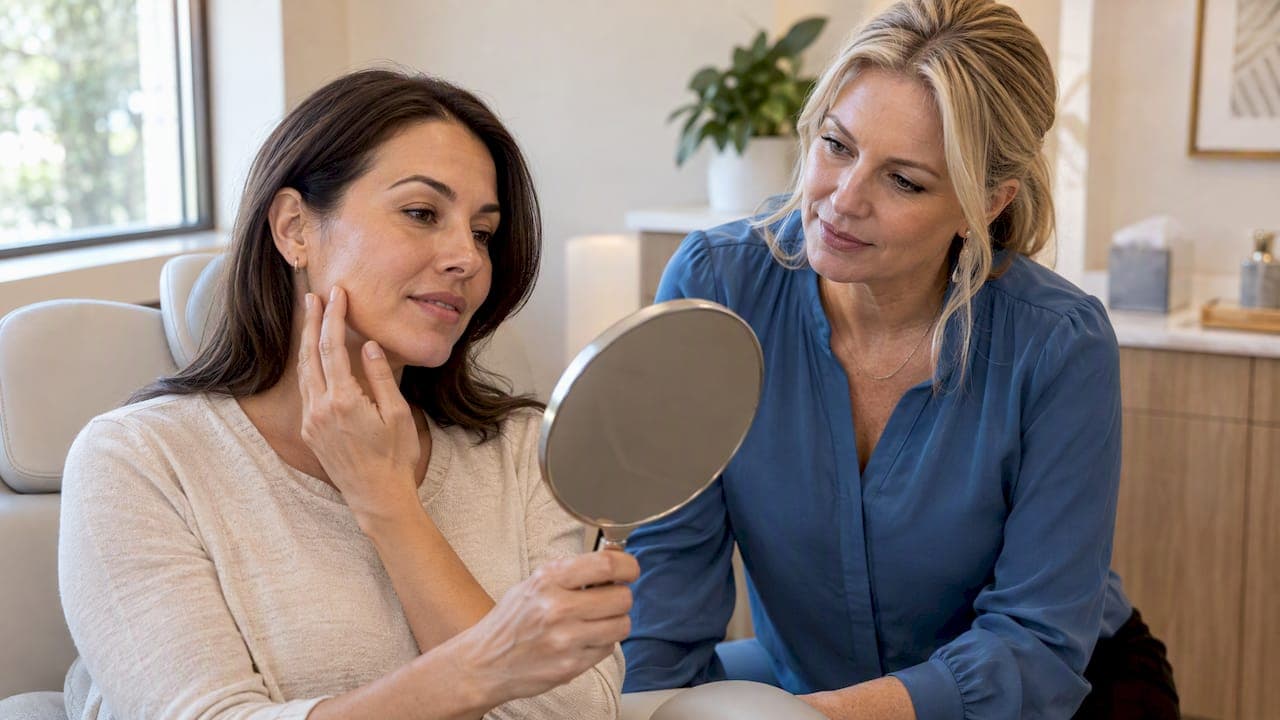
We see people arrive with a brand name and a photo. We understand why: the internet makes it sound like a product choice. But in our experience the best conversations start with your face. What bothers you in the mirror? Which area? How natural do you want it to look? Then we talk product.
We use Restylane products such as Kysse and Contour because they let us match a gel to a specific area and goal. Everything we do is customized and performed under medical supervision, and we would rather explain candidacy, limits, and risks clearly than sell you something quickly. Sometimes the right answer is a smaller amount, a different treatment, or waiting.
— Sharon
Where HA in skincare fits
If you have seen "hyaluronic acid" on a moisturizer and wondered about the connection, they are related molecules but very different products. Topical HA hydrates the skin's surface; filler is a cross-linked gel placed beneath it. For a plain-language look at the skincare side, see this overview of hyaluronic acid in a skincare routine.
What about Sculptra?
People often search Sculptra alongside these two. Sculptra is a different kind of product: it is not an HA gel, so it works differently and is not dissolved with hyaluronidase. The FDA panel presentation states that HA fillers can be broken down with hyaluronidase while others are not reversible. That alone changes how you weigh it. We cover the details in our guides to Sculptra in Stony Brook and Radiesse vs. Sculptra.
Considering filler in Stony Brook?
We offer Botox, Dysport, and dermal fillers, including Restylane products, to adults across Suffolk County. Your first visit is a consultation: we look at your anatomy, talk through your goals, and explain suitability, benefits, risks, and recovery before any decision. Learn more on our injectables page.
Frequently asked questions
Which is better, Juvéderm or Restylane?
Neither is better across the board. Each is a family of HA gels with different products for different areas, so the useful comparison is product to product, for your specific goal. Your anatomy and the injector's skill often matter more than the brand.
Which lasts longer?
There is no honest brand-wide answer. Duration is tied to the specific gel, the area treated, and your own body. Lips tend to be shorter-lived than less mobile areas, and the FDA notes duration depends on properties like cross-linking and molecular weight.
Can either filler be dissolved?
Both are HA-based, so hyaluronidase can break them down. Response varies by gel and situation, and more than one visit may be needed. It is a medical treatment decided by a clinician, not a guaranteed reset.
Does Elite offer Juvéderm?
No. We offer Restylane products, including Kysse and Contour. If you are set on a specific Juvéderm product, we are glad to talk through whether a Restylane option fits your goal instead.
What is the difference between Sculptra and these fillers?
Sculptra is not a hyaluronic acid filler, so it works differently from both Juvéderm and Restylane and cannot be dissolved with hyaluronidase. It is worth a separate consultation, because the timeline and the way results build are different.
Sources
- FDA: Clinical Overview of Dermal Fillers
- FDA panel presentation: Filler Safety (March 23, 2021)
- FDA Summary of Safety and Effectiveness: Restylane Kysse and Contour
- Restylane US Instructions for Use
- ASPS: Dermal Fillers Cost
- ASPS: Dermal Fillers Risks and Safety
- ASPS: Risks and rewards of dissolving filler
- Journal of Plastic, Reconstructive & Aesthetic Surgery: hyaluronidase response of three HA gels
- Safety and effectiveness of Juvéderm Ultra Plus in severe nasolabial folds (PMC)
- Journal of Drugs in Dermatology: Volbella lip and perioral study
This article was prepared with AI assistance and reviewed by Elite Laser Center & Med Spa for accuracy and consistency with our services. It is intended for general education and does not replace personalized medical advice. Treatment suitability, results, and recovery vary. Consult a qualified healthcare professional and follow your treating provider’s instructions.