
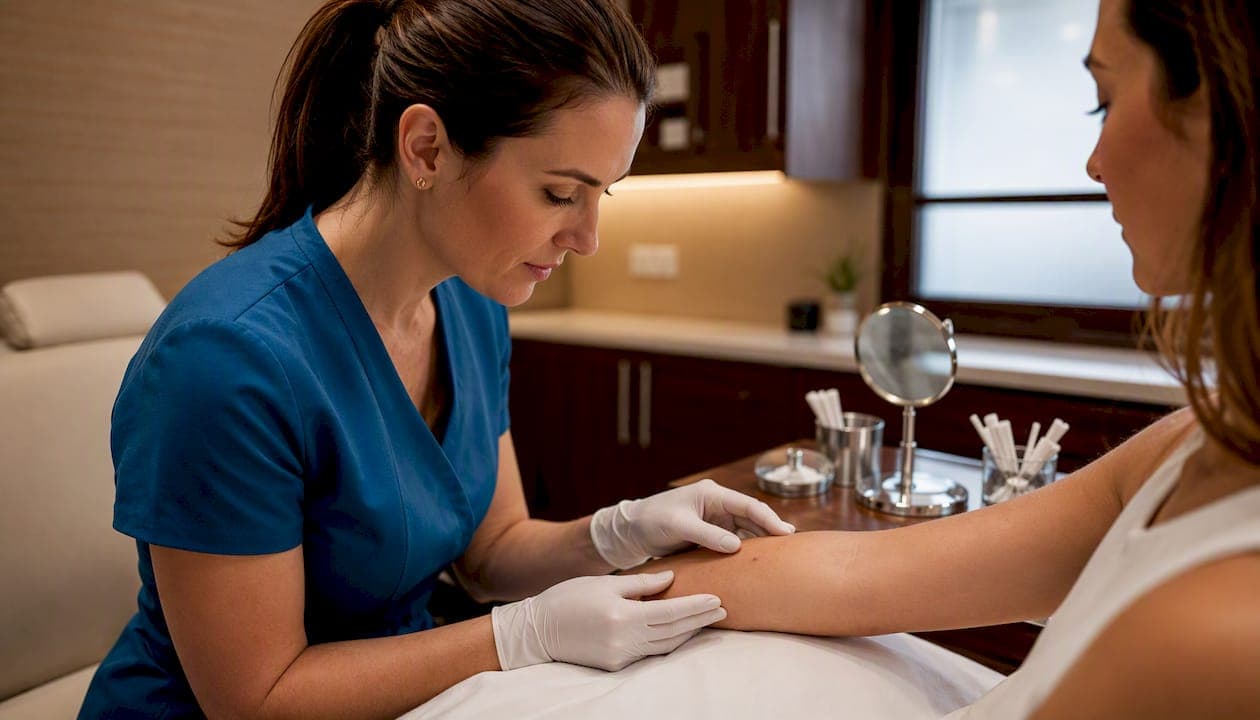
Laser hair removal is one of the most effective long-term solutions for chronic ingrown hairs. It works by disabling the follicle itself, so there is no hair left to curl back into the skin. According to StatPearls/NCBI, most patients complete an initial course of several sessions spaced weeks apart, then schedule maintenance visits periodically to keep results holding. That is the short version.
Two things to know before you go further:
- If your ingrown hairs are currently infected (warm, swollen, or pus-filled), you need to clear the infection first. Lasering over active infection can make it worse.
- If you are ready to move forward, the right next step is a consultation with a board-supervised practitioner who can assess your skin tone, hair color, and the specific areas giving you trouble.
Table of Contents
- What are ingrown hairs and why do they keep coming back?
- How does laser hair removal stop ingrown hairs at the source?
- Which laser is right for your skin tone and hair color?
- What does a full treatment course look like, and what does it cost?
- What are the risks, and when can laser make ingrown hairs worse?
- How to prepare for your session and care for skin afterward
- When should you delay treatment or get medical clearance first?
- What the clinical research actually says
- Key Takeaways
- Why realistic expectations matter more than the sales pitch
- What Elite Laser Center offers for ingrown hair treatment
- Useful sources and further reading
What are ingrown hairs and why do they keep coming back?
An ingrown hair forms when a hair that has been cut or removed grows back in the wrong direction, either curling into the follicle wall or piercing the surrounding skin instead of exiting cleanly. The result is a red, sometimes tender bump that can look like a pimple.
Several factors drive this pattern:
- Shaving and close cutting leave a sharp-edged hair tip that easily re-enters the skin on regrowth.
- Waxing and epilation can break the hair below the surface, leaving a fragment that grows sideways.
- Curly or coiled hair types are especially prone because the natural curl of the shaft pulls it back toward the skin. This is the mechanism behind pseudofolliculitis barbae, the chronic ingrown condition common along the beard line and bikini area.
- Dead-skin buildup blocks the follicle opening, forcing the hair to redirect.
- Tight clothing and friction compress the follicle and push emerging hairs off course.
A simple ingrown hair looks like a small red or skin-colored bump, sometimes with a visible hair loop beneath the surface. An infected one is warm to the touch, may contain pus, and can spread redness to the surrounding skin. That distinction matters clinically because the two require different first steps.
The reason surface-only hair removal methods keep failing is straightforward: they remove the hair but leave the follicle intact and fully capable of producing another one. Treating the follicle directly is the only way to stop the cycle.
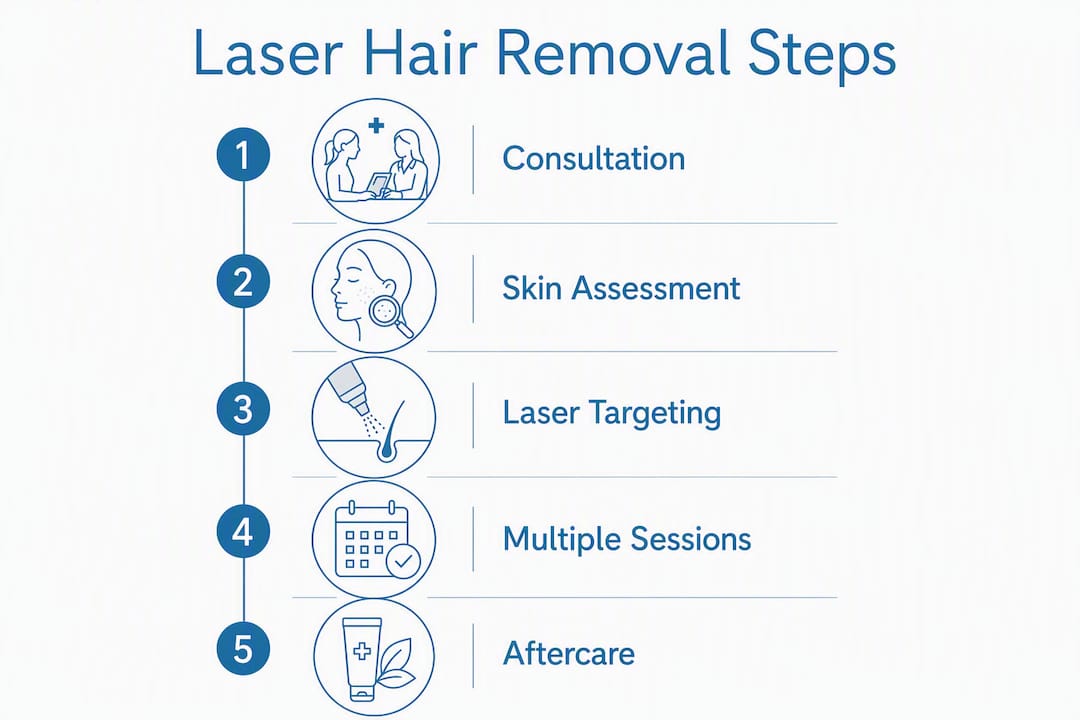
How does laser hair removal stop ingrown hairs at the source?
The mechanism is called selective photothermolysis. Laser light at a specific wavelength is absorbed by melanin, the pigment in the hair shaft and follicle. That absorption converts to heat, which damages the follicle's growth cells. A damaged follicle produces thinner, weaker hair or stops producing hair entirely.
Once the follicle is disabled, there is no hair to curl, no sharp tip to re-enter the skin, and no trapped strand to trigger inflammation. That is why laser works as a prevention strategy, not just a temporary fix.
Key clinical point: Laser reduces and often eliminates ingrown hair occurrences over a full treatment course, but it is not a same-day cure for deeply infected cysts or scarred follicles. Those need medical attention before laser can help.
A few real limitations worth knowing:
- White, blond, or gray hair contains little melanin, giving the laser minimal target. Results on these hair colors are poor regardless of skin tone.
- Follicles in the resting phase (telogen) do not respond well during that session. Multiple sessions are necessary to catch follicles during their active growth phase (anagen), which is why a single treatment never finishes the job.
- Deep, scarred follicles from repeated infections may not respond fully even after a complete course.
Which laser is right for your skin tone and hair color?
Candidacy depends primarily on the contrast between hair color and skin tone, and on which device the clinic uses. Thick, dark hair on lighter skin responds fastest. But that does not mean darker skin tones are excluded. It means device selection becomes more critical.
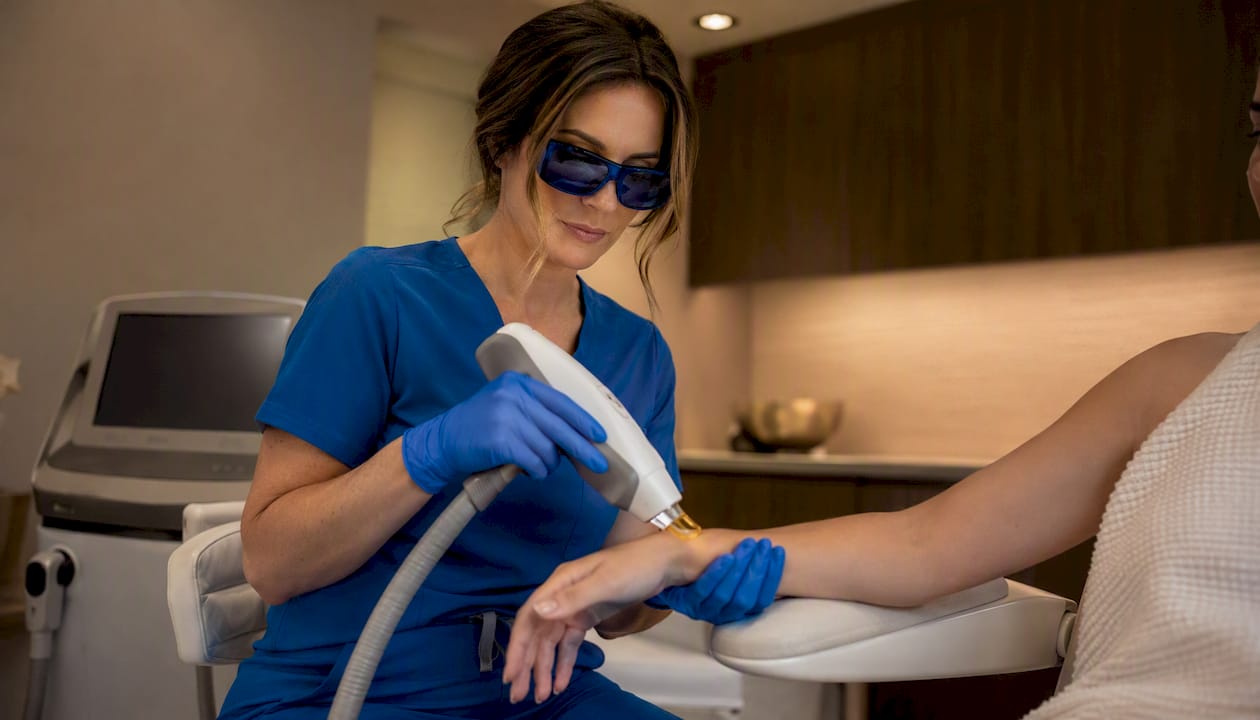
Nd:YAG (1064 nm) lasers are safe and effective across all Fitzpatrick skin types, including the darkest tones, and are the preferred choice for melanated skin and for conditions like pseudofolliculitis barbae. The longer wavelength penetrates deeper and is less absorbed by epidermal melanin, which lowers the risk of burns and discoloration when parameters are set correctly.
Here is how the main options compare:
- Nd:YAG (1064 nm): Safe for Fitzpatrick types I–VI. The go-to for darker skin and for ingrown-prone areas like the beard line and bikini zone.
- Diode (800–810 nm): Broad applicability across types I–V. Effective and widely available.
- Alexandrite (755 nm): Best results on types I–III (lighter skin). Fast and effective on that range, but carries higher risk of pigmentation changes on darker tones.
- IPL (intense pulsed light): Not a true laser. It emits a broad spectrum of light rather than a single wavelength, making it less precise. IPL can reduce ingrown hairs for light-to-medium skin with dark hair, but it is generally less effective per session than medical-grade lasers and is not recommended for darker skin tones.
Hair color matters just as much as skin tone. If your hair is white, blond, or gray, no current laser or IPL device will deliver meaningful results. A qualified clinician will tell you this at consultation rather than take your money for sessions that will not work.
Pro Tip: Bring photos of your problem areas to your consultation, along with a list of any recent hair removal methods you have used. This helps the clinician select the right device and set realistic expectations before your first session.
What does a full treatment course look like, and what does it cost?
Most people need multiple initial sessions, with spacing of several weeks depending on the body area and hair growth cycle. Facial hair cycles faster than body hair, so facial sessions are often spaced closer together.
Typical results timeline:
- After sessions 1–2: reduced hair density, some ingrown hairs still appearing but less frequently.
- After sessions 3–4: visible improvement in skin texture; most patients notice significantly fewer bumps.
- After the full initial course: substantial reduction in both hair growth and ingrown occurrence. Some patients see near-complete clearance.
- Maintenance sessions (every 6–12 months): vellus hair can regrow over time, so periodic touch-ups sustain results.
Laser hair removal is not classified as permanent hair removal by the FDA. The correct term is permanent hair reduction. Setting that expectation upfront prevents disappointment.
Typical cost ranges (United States):
| Area | Approximate per-session range | Notes |
|---|---|---|
| Bikini / Brazilian | $75–$150 | High-ingrown-risk zone; Nd:YAG often used |
| Underarms | $50–$100 | Fewer sessions often needed |
| Legs (full) | $150–$350 | Larger surface area; package pricing common |
| Face / beard line | $75–$150 | Faster cycle; may need more sessions |
| Back or chest | $150–$350 | Variable density |
Package pricing typically offers a discount compared to paying per session. Compare total package cost against per-session rates before committing, and ask whether the package includes a maintenance session.
What are the risks, and when can laser make ingrown hairs worse?
Short-term side effects after a session are common and expected: redness, mild swelling around the follicles (perifollicular edema), and a sensation similar to a mild sunburn. These usually resolve within 24–48 hours.
Less common but real risks include:
- Blistering: Usually from incorrect parameters or inadequate cooling, more likely on darker skin with the wrong device.
- Dyspigmentation: Both hyperpigmentation (darkening) and hypopigmentation (lightening) can occur, particularly when the laser is not matched to the skin tone or when the patient has recent sun exposure.
- Scarring: Rare, but possible with blistering or if the treated area is picked or infected post-session.
- Paradoxical hypertrichosis: In some cases, laser stimulates rather than destroys follicles, causing increased hair growth. This is uncommon but documented, particularly on the face and neck in certain hormonal profiles.
Red flags that require stopping treatment and seeking medical care: increasing pain after a session, spreading redness beyond the treated area, fever, or pus-filled lesions developing at treated sites. These suggest infection and need prompt clinical attention.
Laser can actively worsen problems in specific situations. Treating over an actively infected ingrown hair risks spreading bacteria deeper into the tissue. Using the wrong wavelength or fluence on dark skin without adequate cooling can cause burns and permanent discoloration. Recent isotretinoin (oral retinoid) use alters skin healing and increases complication risk. Clinicians should assess and may skip actively infected spots during a session rather than treat through them.
How to prepare for your session and care for skin afterward
Getting the preparation right makes a measurable difference in both safety and results.
Before your appointment:
- Stop waxing, threading, and epilation at least 4–6 weeks before your first session. The laser needs the hair root present in the follicle.
- Shave the treatment area 24–48 hours before your session. This removes surface hair while leaving the follicle intact.
- Discontinue retinoids and strong exfoliants (glycolic acid, salicylic acid) 48–72 hours before treatment.
- Disclose all medications, especially photosensitizing drugs, antibiotics, and any recent isotretinoin use.
- Avoid sun exposure and self-tanner for at least two weeks before treatment.
After your session:
- Cleanse gently with a fragrance-free cleanser for the first 48 hours.
- Avoid heat: no saunas, hot showers, or intense exercise for 48 hours post-treatment.
- Apply a broad-spectrum SPF 30+ sunscreen daily on treated areas, without exception.
- Use a soothing, fragrance-free emollient. Skip strong actives (retinoids, AHAs, BHAs) until the skin has fully settled.
- Do not pick at any bumps that surface in the days after treatment. These are often hairs being shed from treated follicles, not new ingrowns.
Between sessions, consistent gentle exfoliation (a soft washcloth or a mild chemical exfoliant once the skin has healed) helps prevent dead-skin buildup from blocking follicles. Breathable, loose-fitting clothing on treated areas reduces friction-related ingrown triggers. For post-treatment skin recovery, at-home LED light therapy devices can help calm inflammation between sessions.
Pro Tip: If you develop a bump between sessions that feels warm or is growing, do not wait until your next appointment. Contact your provider. Treating a minor infection early prevents it from becoming a contraindication for your next session.

When should you delay treatment or get medical clearance first?
Some situations call for a pause before proceeding with laser:
- Active skin infection or inflamed, pustular ingrown hairs in the target area. The infection must be fully resolved before that area is treated. Warm compresses, topical salicylic acid, or prescription antibiotics may be needed first.
- Recent isotretinoin use. Most clinicians recommend waiting at least 6 months after stopping oral isotretinoin before undergoing laser treatment, though individual protocols vary. Disclose this at your consultation.
- Pregnancy. Laser hair removal is generally avoided during pregnancy due to insufficient safety data.
- Photosensitizing medications. Certain antibiotics, diuretics, and other drugs increase skin sensitivity to light. Your clinician needs a full medication list.
- Persistent or recurrent deep cysts, including pilonidal disease. A 1064 nm protocol has been used to reduce ingrown hairs and prevent pilonidal cyst recurrence, but active or complex pilonidal disease typically requires surgical or medical management before preventive laser is appropriate.
This is general information, not medical advice. Confirm your specific situation with a licensed clinician before beginning treatment.
What the clinical research actually says
The evidence base for laser as an ingrown hair solution is solid, particularly for chronic conditions. StatPearls/NCBI confirms that laser hair removal is an effective long-term strategy for managing chronic ingrown hairs, with an initial course of 4–6 sessions and ongoing maintenance every 6–12 months to sustain results.
For darker skin tones, the research is equally clear. PubMed evidence supports Nd:YAG (1064 nm) as safe and effective for Fitzpatrick types V and VI, with meaningful improvement in pseudofolliculitis barbae and reduced recurrence of inflammatory bumps compared to epilation methods. The key is appropriate parameter selection and cooling, not avoidance of laser altogether.
UCSF Health confirms that laser targets melanin to damage follicles and stop future hair growth, improving the inflamed, bumpy skin that chronic ingrown hairs produce. Cleveland Clinic notes that maintenance sessions are a normal part of the long-term plan, not a sign that the treatment failed.
One consistent clinical caution across all sources: active infection is a contraindication for treating that specific area. Practitioners should assess each site individually and skip or defer infected spots rather than treating through them.
Key clinical evidence points:
- Initial course: 4–6 sessions minimum, spaced 4–6 weeks apart.
- Maintenance cadence: every 6–12 months for sustained reduction.
- Nd:YAG (1064 nm): preferred for Fitzpatrick V–VI and pseudofolliculitis barbae.
- Active infection: treat and resolve before lasering the affected area.
- Laser-induced folliculitis is a documented but manageable complication when it occurs, typically addressed with topical or oral antibiotics.
Key Takeaways
Laser hair removal is the most effective long-term method for treating and preventing chronic ingrown hairs, requiring a minimum of 4–6 sessions and periodic maintenance every 6–12 months to sustain results.
| Point | Details |
|---|---|
| How laser stops ingrowns | It disables the follicle via selective photothermolysis, so no hair remains to curl or re-enter the skin. |
| Typical session count | An initial course of 4–6 sessions spaced 4–6 weeks apart, followed by maintenance every 6–12 months. |
| Best laser for darker skin | Nd:YAG (1064 nm) is the preferred device for Fitzpatrick types V–VI and pseudofolliculitis barbae. |
| Treat infections first | Active, infected ingrown hairs must be fully resolved before laser treatment begins in that area. |
| Elitelaserhair's approach | Elite Laser Center offers medically supervised, device-diverse laser services with a three-year package guarantee in Suffolk County. |
Why realistic expectations matter more than the sales pitch
Most articles about ingrown hair laser treatment sell the outcome without mentioning the nuance. The truth is more useful: laser works very well for the right candidate, and it works poorly or not at all for the wrong one.
White or blond hair, hormonal conditions driving rapid regrowth, and skin that has been repeatedly scarred from years of infected ingrowns can all limit how much improvement laser delivers. That does not mean laser is not worth trying. It means the consultation conversation needs to be honest, and the provider needs to be willing to say "this area may not respond as well" rather than promise full clearance.
The other thing most people underestimate is the maintenance commitment. The initial course gets you most of the way there. The 6–12 month touch-up is what keeps you there. Skipping maintenance because the results look good is exactly when regrowth quietly starts. Treating laser as a one-and-done procedure is the most common reason people feel let down by results that were actually on track.
Choosing a provider with medical oversight, the right device for your skin tone, and a realistic follow-up plan is not a luxury. It is the difference between a treatment that holds and one that fades.
What Elite Laser Center offers for ingrown hair treatment
Chronic ingrown hairs are one of the most common reasons people come to Elitelaserhair. The clinic's intake process starts with a thorough skin and hair assessment, covers your full medication history, and matches you to the right device before any treatment begins. For patients with darker skin tones or pseudofolliculitis barbae, Nd:YAG (1064 nm) is available and used routinely. A patch test is offered when there is any uncertainty about skin response.
Every treatment plan at Elitelaserhair is built under medical supervision, with session spacing and device parameters set to your specific skin and hair profile. Laser hair removal packages come with a three-year guarantee, and maintenance sessions are built into the long-term plan rather than treated as an afterthought. If your ingrown hairs are currently active or infected, the team will advise on clearing them first and schedule your first laser session once the area is ready.
To get started, request a consultation or visit the laser hair removal service page to review what the process looks like and what to bring to your first appointment.
Useful sources and further reading
- Laser Hair Removal — StatPearls/NCBI Bookshelf: Comprehensive clinical overview of laser mechanisms, device types, session protocols, and safety considerations across skin tones.
- Nd:YAG Safety and Efficacy — PubMed: Peer-reviewed evidence supporting Nd:YAG (1064 nm) for darker skin types and pseudofolliculitis barbae.
- Folliculitis Induced by Laser Hair Removal — PMC: Case study and discussion of laser-induced folliculitis, its proposed mechanism, and management strategies.
- Laser Hair Removal — UCSF Health: Patient-education resource covering how laser targets melanin, expected results, and pre/post-care guidance.
- Laser Hair Removal — Cleveland Clinic: Authoritative patient guide on realistic outcomes, maintenance needs, and what to expect across a full treatment course.
- Ingrown Hair: Causes, Treatment and Prevention — Cleveland Clinic: Clinical overview of ingrown hair causes, signs of infection, and when to consider laser as a management option.
- 1064 nm Laser for Pilonidal Cyst Prevention — Candela Medical: Case spotlight on using deeper-penetrating Nd:YAG wavelength to reduce ingrown hairs and prevent pilonidal cyst recurrence.
- Laser Hair Removal — Elite Laser Center: Service page detailing the clinic's consultation process, device options, package guarantee, and booking pathway.