

Yes, Botox works for a gummy smile, but only the kind caused by an overactive upper lip. When hyperactive lip muscles pull too high during a smile, botulinum toxin A relaxes them and cuts gum display within 1 to 2 weeks, with results holding for a few months. It does nothing for a gummy smile caused by bone structure or overgrown teeth. A proper exam of your smile mechanics, not a generic injection pattern, determines whether you're a candidate.
TL;DR:
- Botox reduces gum display by relaxing overactive upper lip muscles, but it does not address bone structure or gum overgrowth causes.
- The typical improvement is around 3 millimeters at two weeks, with effects declining to baseline by six months, depending on individual muscle activity.
- Candidates are best suited if their gummy smile results from muscle hyperactivity, with most non-muscular causes requiring surgical or orthodontic solutions.
- Proper diagnosis and personalized dosing are crucial because injection technique varies widely, and behavior of lip muscles differs among individuals.
- Risks include mild temporary side effects like lip weakness or asymmetry, which experienced providers mitigate through conservative dosing and precise placement.
Table of Contents
- How Botox for a Gummy Smile Actually Reduces Gum Show
- What Studies Show: Expected Improvement and How Long It Lasts
- Who Is a Good Candidate for Gummy Smile Botox?
- What Happens During a Gummy Smile Botox Appointment
- Safety and Side Effects: What's Common and What's Rare
- Aftercare, Follow-Up, and What to Expect Long-Term
- Alternatives to Botox: When Surgery or Orthodontics Makes More Sense
- Why Individualized Assessment Matters More Than the Injection Itself
- Ready to Talk to Someone About Your Smile?
- Sources
- FAQ
How Botox for a Gummy Smile Actually Reduces Gum Show
Botulinum toxin A blocks the release of acetylcholine at the nerve endings that trigger muscle contraction. Injected into the right spot, it temporarily stops the targeted muscle from pulling as hard, which is exactly the mechanism behind a botox lip flip vs gummy smile treatment decision: a lip flip relaxes the orbicularis oris to roll the lip outward for fullness, while gummy smile Botox specifically targets the muscles that hike the upper lip too high.
Three muscles usually do the damage in a muscle-driven gummy smile:
- Levator labii superioris, the main lip elevator
- Levator labii superioris alaeque nasi, which also flares the nostril
- Zygomaticus minor, a secondary elevator that contributes to the pull
Many injectors target the intersection of these three muscles, a location often called the Yonsei point, because it addresses the shared source of excess elevation with fewer injection sites. But diagnosis matters more than technique here. A gummy smile can also come from a short upper lip, overerupted front teeth, an enlarged jaw (vertical maxillary excess), or gum tissue that's simply overgrown. Botox injection for gums only changes muscle behavior. If your excess gum show comes from bone or tooth position, no amount of toxin fixes it, which is why an accurate exam has to come before any needle touches your lip.
What Studies Show: Expected Improvement and How Long It Lasts
A systematic review and meta-analysis published in the Journal of Clinical Medicine pooled results across multiple trials and found an average gum-display reduction of about 3.22 millimeters at two weeks, settling to roughly 2.70 millimeters by three months. That drop from peak effect to the three-month mark tells you something important: the muscle is already regaining strength well before most patients think about a touch-up.
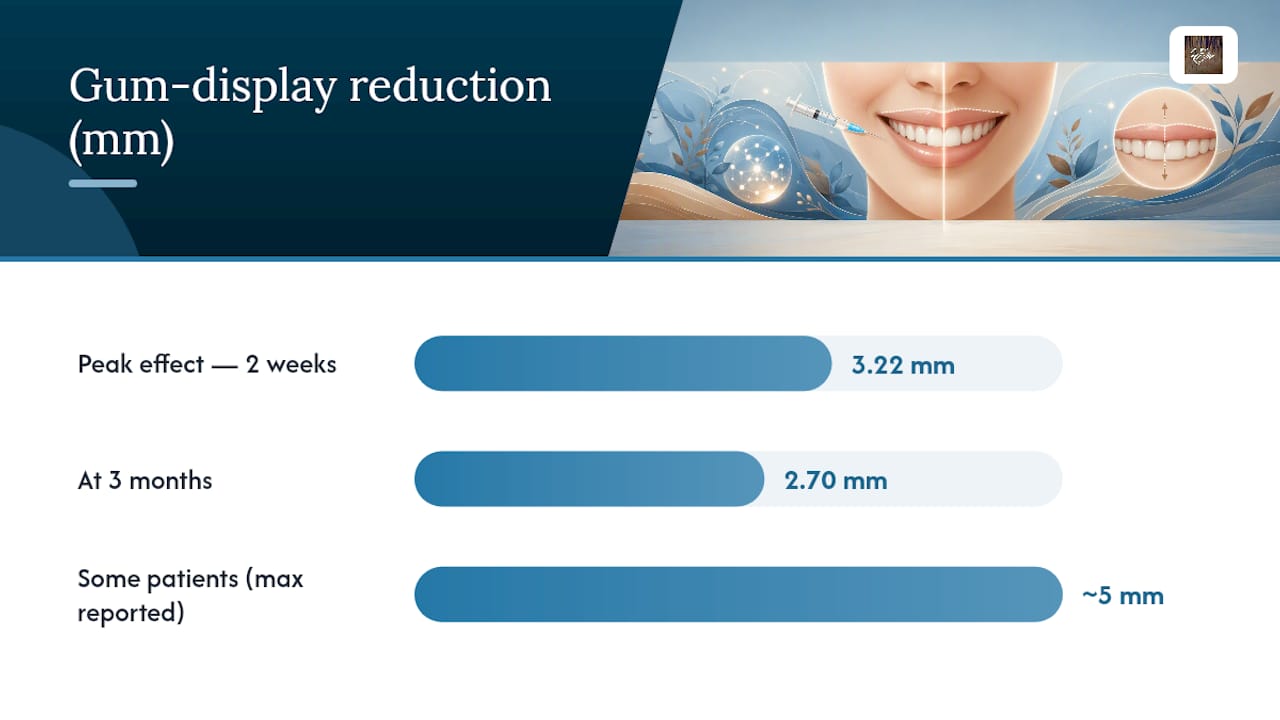
Individual studies report a wider spread, with some patients seeing improvement closer to 5 millimeters and others considerably less. The same meta-analysis flagged high heterogeneity across the pooled studies, meaning injection technique, dosing, and how gum display was measured varied enough that no single number applies to everyone.
What the numbers mean for you:
- Peak effect typically lands around the 2-week mark, once the toxin has fully taken hold
- Noticeable decline in effect often begins by month 3, with most patients back near baseline by month 6
- Results depend heavily on how active your specific elevator muscles were to begin with. A more hyperactive lip tends to show a bigger relative improvement
That variability isn't a flaw in the treatment. It's a reflection of how differently people's lip muscles behave, which is exactly why a cookie-cutter injection plan underperforms a personalized one.
Who Is a Good Candidate for Gummy Smile Botox?
The best candidates have a clearly muscle-driven gummy smile: gum tissue that shows more when the lip lifts high and fast during a genuine smile, without major underlying dental or skeletal issues. If a provider watches your dynamic smile and sees an overactive lip snap upward well beyond the tooth line, Botox for gummy smile correction is a reasonable, low-commitment first step.
Certain signs point away from Botox and toward a dental or surgical referral instead:
- Vertical maxillary excess, where the upper jaw itself is too long
- Overeruption of the front teeth, pushing gum tissue into view regardless of lip position
- A naturally short upper lip that can't fully cover the gums even at rest
- Gingival hypertrophy, where the gum tissue itself is enlarged
Contraindications matter just as much as candidacy. Botox generally shouldn't be used during pregnancy or while breastfeeding, and it's not appropriate for anyone with a diagnosed neuromuscular disorder like myasthenia gravis. Certain antibiotics, particularly aminoglycosides, can amplify the toxin's effect and increase risk. Anyone with a known allergy to botulinum toxin products or its formulation components should skip it entirely. A thorough medical history review before treatment isn't optional paperwork. It's how a provider catches these issues before they become a problem.
What Happens During a Gummy Smile Botox Appointment
A typical visit runs 10 to 20 minutes once the exam is done, and the process follows a predictable sequence:
- Dynamic smile assessment. The provider watches you smile naturally, sometimes photographing or measuring gum display in millimeters, to map exactly which muscles are overactive.
- Discussion of expectations. This is where realistic outcomes, timeline, and cost get covered before any needle is involved.
- Site marking and topical numbing. A numbing cream is optional for most patients since the injections are shallow and quick.
- Injection. Using a fine needle, the provider delivers the toxin to one or more points, often at or near the Yonsei point, sometimes extending to the zygomaticus minor for a broader smile pattern.
- Immediate aftercare instructions. You're clear to leave right away, though mild pinpoint redness is common for the first hour.
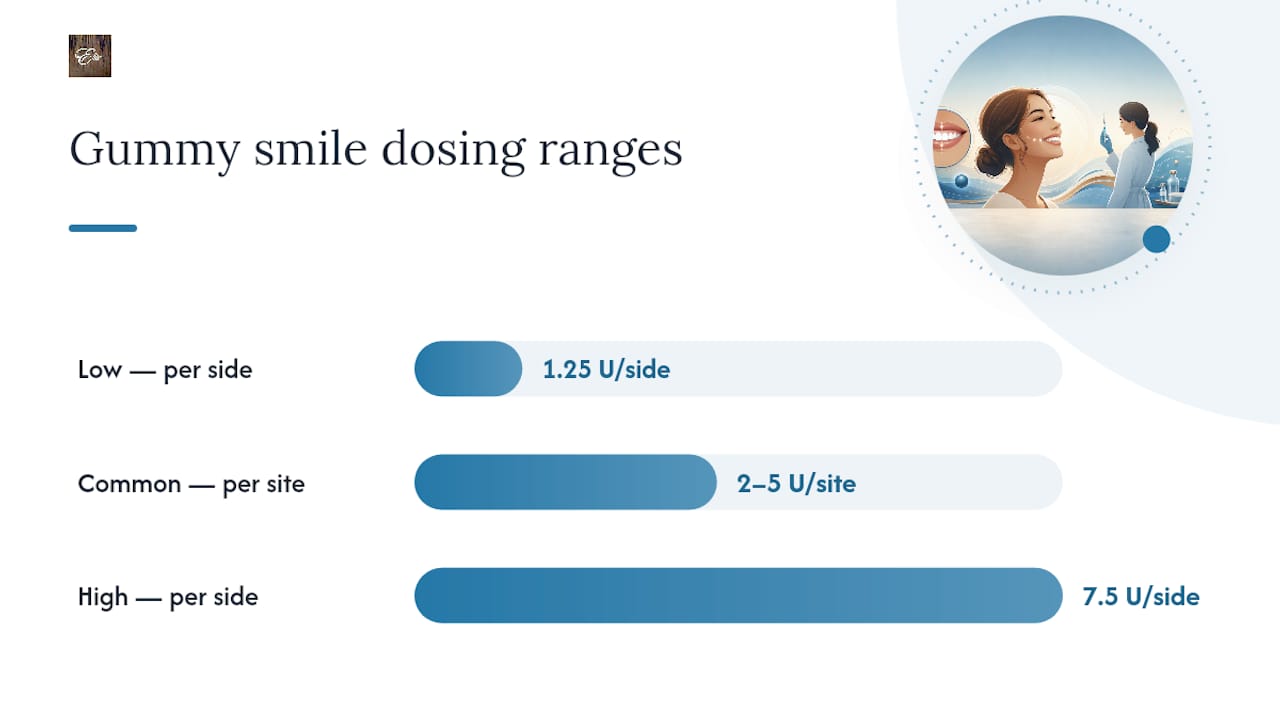
Dosing has no universal standard. Published protocols report doses ranging from about 1.25 to 7.5 units per side, with many clinical approaches landing around 2 to 5 units per injection site. Research also shows unit count doesn't scale predictably with millimeters of improvement. Muscle anatomy and injection depth influence outcome more than the raw dose. Some providers combine this with an orbicularis oris technique, essentially a botox for gummy smile approach paired with subtle lip-flip elements, when a patient wants both reduced gum show and a fuller-looking lip. Understanding how providers determine unit counts for other facial areas helps explain why gummy smile dosing is similarly individualized rather than fixed.
Pro Tip: Bring a mirror to your consultation and practice your natural smile in front of the provider rather than a forced one. The muscle behavior that matters is the one that shows up when you laugh, not when you pose.
Safety and Side Effects: What's Common and What's Rare
Most side effects from gummy smile Botox are mild and short-lived. A narrative review of gummy smile treatment with botulinum toxin A found that bruising, tenderness at the injection site, and mild transient asymmetry account for the bulk of reported issues, and all typically resolve on their own within days to a couple of weeks.
Less common but worth knowing about:
- Temporary lip weakness, which can make certain sounds or lip movements feel slightly off for a short stretch
- Persistent asymmetry, rare but possible if dosing between sides isn't well balanced
- Functional issues with lip movement, such as difficulty fully closing the lips, in cases of overly aggressive dosing
- Systemic reaction, extremely uncommon with the small doses used for this treatment
Experienced injectors reduce these risks through conservative starting doses, precise injection depth, and a dynamic assessment that adjusts the plan to your actual muscle pattern rather than a fixed template. The riskiest mistakes tend to involve overdosing or placing injections too close to the mouth's corners, which can affect nearby muscles involved in speech and eating. Before treatment, it's worth asking your provider directly how they calculate dosing for your anatomy and what their protocol looks like if you notice unexpected side effects afterward.
Pro Tip: If one side of your smile looks slightly different from the other after treatment, don't panic. Mild asymmetry in the first few days is common and often evens out as the toxin fully settles into the muscle over the following week.
Aftercare, Follow-Up, and What to Expect Long-Term
Recovery from gummy smile Botox is minimal, but a few aftercare steps genuinely reduce complications:
- Avoid touching or massaging the treated area for several hours to keep the toxin from migrating to nearby muscles.
- Use ice and an over-the-counter pain reliever if bruising or tenderness shows up.
- Call your provider promptly if you notice significant asymmetry, drooping, or difficulty with normal lip movement beyond the first day or two.
- Expect onset around day 7, with peak effect near the two-week mark and gradual decline setting in by month 3 or 4.
Reviewing aftercare timelines from injectable treatments more broadly helps set expectations, since the general recovery curve mirrors what patients see with other facial Botox uses. Retreatment typically falls in the 3 to 6 month window, once the muscle regains enough strength to bring gum display back.
One important caveat: a 1-year follow-up study on repeated botulinum toxin injections found that while repeated treatment kept delivering temporary satisfactory results, relapse occurred by around the 4-month mark each cycle, and there wasn't strong evidence that repeated dosing produces any lasting muscle change. Don't plan on Botox eventually "training" the muscle into permanent submission. It's maintenance, not a cure.
Alternatives to Botox: When Surgery or Orthodontics Makes More Sense
Botox is the least invasive option on the table, but it's not the only one, and it's not always the right one.
- Gingivectomy or crown lengthening trims excess gum tissue surgically, offering a permanent fix for gum-driven cases with durable, measurable improvement.
- Lip repositioning surgery limits how high the upper lip can rise, delivering long-term results for lip-driven cases without ongoing injections.
- Orthodontic intrusion repositions overerupted teeth, addressing dental causes that Botox can't touch.
- Orthognathic surgery corrects true vertical maxillary excess, the most invasive route but often the only durable fix for skeletal cases.
Botox can also serve as a diagnostic trial. If temporarily relaxing the lip muscles produces a real improvement, that confirms the cause is muscular and helps a patient decide whether to commit to a permanent surgical option down the line or simply repeat the less invasive treatment. For patients weighing an approach that also affects facial muscle function elsewhere, it's worth understanding how Botox principles apply to other facial muscles to grasp the broader logic providers use when balancing aesthetics against function.
Why Individualized Assessment Matters More Than the Injection Itself
The research on gummy smile Botox is consistent on one point that gets lost in most marketing: the technique matters less than the diagnosis. Every meta-analysis on this topic flags the same issue, wide variability between studies because dosing, injection points, and patient anatomy differ so much. That's not a weakness in the treatment. It's a signal that gummy smile correction is fundamentally a personalization problem, not a units-per-side formula.
At Elite Laser Center, treatments are performed under medical supervision with an emphasis on assessing each patient's actual muscle behavior before recommending an injection plan, consistent with the clinic's broader approach to personalized injectable treatments. That means starting with a conservative dose, watching how the smile responds, and adjusting on follow-up rather than defaulting to a fixed protocol because it's simpler to standardize. It won't turn a skeletal gummy smile into a muscular one, and it won't promise permanent results Botox was never designed to deliver. What it can offer is an honest, anatomy-first read on whether Botox is even the right tool for your particular smile.
— Sharon
Ready to Talk to Someone About Your Smile?
If you've read this far wondering whether your gummy smile is a muscle problem or something else, the honest answer is that you probably can't tell from a mirror alone. A dynamic exam settles it in minutes, and it costs you nothing to find out where you stand before committing to any treatment, surgical or otherwise.
A consultation for gummy smile Botox starts with a dynamic smile assessment, photos to document your baseline, and a conversation about realistic timelines and cost based on your specific muscle pattern, not a generic price sheet. Bring any relevant dental records if you have them, especially if a dentist or orthodontist has already flagged tooth or jaw involvement. Injections are performed under medical supervision, with dosing tailored to what your provider actually observes during your exam rather than a fixed unit count. If your gummy smile has bothered you for a while, book a consultation and get a straight answer on whether Botox is the right first move for your smile.
This article is general information, not a substitute for advice from a qualified doctor. Consult a qualified healthcare professional about your own circumstances before acting on anything here.
Sources
- An Approach for Gummy Smile Treatment Using Botulinum Toxin A: A Narrative Review of the Literature
- Non-Surgical Management of the Gingival Smile with Botulinum Toxin A—A Systematic Review and Meta-Analysis
FAQ
Can Botox Fix a Gummy Smile?
Botox can significantly reduce a gummy smile when the cause is an overactive upper lip, typically cutting gum display by several millimeters within 1 to 2 weeks. It won't correct a gummy smile caused by bone structure, overerupted teeth, or gum overgrowth.
What Is the Riskiest Place for Botox?
Injections placed too close to the corners of the mouth carry the highest risk of affecting speech and lip function, since that area involves muscles used for everyday movements like eating and talking. Experienced injectors avoid this zone and use conservative depth and dosing near the mouth.
Where Should Botox Be Injected for a Gummy Smile?
Providers commonly target the levator labii superioris, levator labii superioris alaeque nasi, and zygomaticus minor, often using the Yonsei point where these muscles converge. The exact injection pattern depends on which muscles show the most activity during your dynamic smile exam.
Is 40 Too Late for Botox?
Age alone doesn't disqualify anyone from gummy smile Botox. What matters is whether your gum display is still primarily driven by muscle activity rather than age-related tissue or bone changes, which a provider can determine during a smile assessment regardless of your age.
Recommended
- Masseter Botox: Jaw Slimming and TMD Relief Guide
- Botox Aftercare: Your Timeline for the First Two Weeks
- Botox Side Effects: Clinic-Backed Safety Steps and When to Seek Care
This article was produced with AI assistance and reviewed for accuracy. It is provided for general information, and it is not professional advice.