

Epilators win for cheap, temporary, at-home smoothness. Professional laser wins for long-term hair reduction and fewer ingrown hairs over time. The American Academy of Dermatology notes most laser patients need 2 to 8 sessions to see lasting results, while an epilator gives you smooth skin in 20 minutes but nothing that survives past a few weeks. The real decision comes down to pain tolerance, hair and skin tone, and whether you want a device or a treatment plan.
TL;DR:
- Laser hair removal offers long-term reduction with 2 to 8 sessions needed, but results are less dramatic and slower with home devices due to lower power.
- Epilators provide temporary smoothness for two to four weeks and are a lower-cost, on-demand routine requiring frequent use.
- The effectiveness of laser depends on hair and skin contrast, with darker hair on lighter skin responding best, while light or grey hair suits epilators better.
- Proper laser treatment requires experienced, medical supervision to minimize risks like pigment changes or burns, especially for darker skin tones.
- Both methods demand maintenance or multiple sessions, with laser being more cost-effective over time but requiring more initial investment.
Table of Contents
- Epilator vs Laser: A Side-By-Side Comparison
- How Does Laser Hair Removal Work?
- How Do Epilators Work, and What Should You Expect?
- Which Is Better for Your Hair Color, Skin Tone, and Pain Tolerance?
- What Are the Safety Risks of Each Method?
- How Much Does Each Method Cost Over Time?
- Why Medically Supervised Laser Changes the Outcome
- The Bottom Line on Choosing Your Method
- What This Comparison Gets Wrong in Most Buying Guides
- Book a Laser Hair Removal Consultation With Elite Laser Center
- Sources
- FAQ
Epilator vs Laser: A Side-By-Side Comparison
The two methods solve different problems, and that's the part most comparison charts skip. An epilator is a maintenance tool. Laser is a reduction treatment. Here's how they stack up across the factors that actually change someone's decision:
- Effectiveness and duration: Epilators pull hair from the root, giving you two to four weeks of smoothness before regrowth starts. Laser and IPL damage the follicle itself, producing a 10% to 25% reduction in hair after just the first session, with cumulative reduction building over a full treatment course.
- Pain and comfort: Epilation feels like a series of quick, sharp plucks, worse on bony areas like the shin or ankle. Laser feels more like a rubber band snap or a hot pinprick, but numbing cream and cooling tips at a clinic make it more tolerable than most people expect.
- Cost shape: An epilator is a one-time purchase, usually somewhere in the $30 to $100 range depending on the brand and attachments. Laser is a course of sessions, so the upfront cost is higher, but it's not a recurring purchase every few weeks for years.
- Convenience: Epilators work whenever you want, no appointment needed. Laser requires booking a series of visits spaced six to eight weeks apart, which is a bigger time commitment upfront but a much smaller one over the following years.
- Safety: Epilators carry a real risk of ingrown hairs and folliculitis from repeated root trauma. Laser carries a small risk of burns or pigment changes, mostly tied to inexperienced operators or the wrong device for a given skin tone.
Statistic Callout: Some patients notice a 10% to 25% drop in visible hair after their very first professional laser session, according to the AAD. That number climbs with each follow-up treatment, which is why dermatologists frame laser as a course, not a single fix.
Home IPL devices sit in between these two extremes. They use broadband light rather than a single focused wavelength, which makes them meaningfully weaker than clinic-grade lasers. A comparison from the Telegraph points out that home devices trade power for safety, so results tend to be slower and less dramatic than what a trained provider can deliver.
How Does Laser Hair Removal Work?
Laser and IPL both rely on a process called selective photothermolysis. The device fires light that gets absorbed by melanin in the hair shaft, converts to heat, and damages the follicle enough to slow or stop future growth. Mayo Clinic explains that this only works well when there's real contrast between hair color and skin tone, because the light needs a clear target to lock onto.
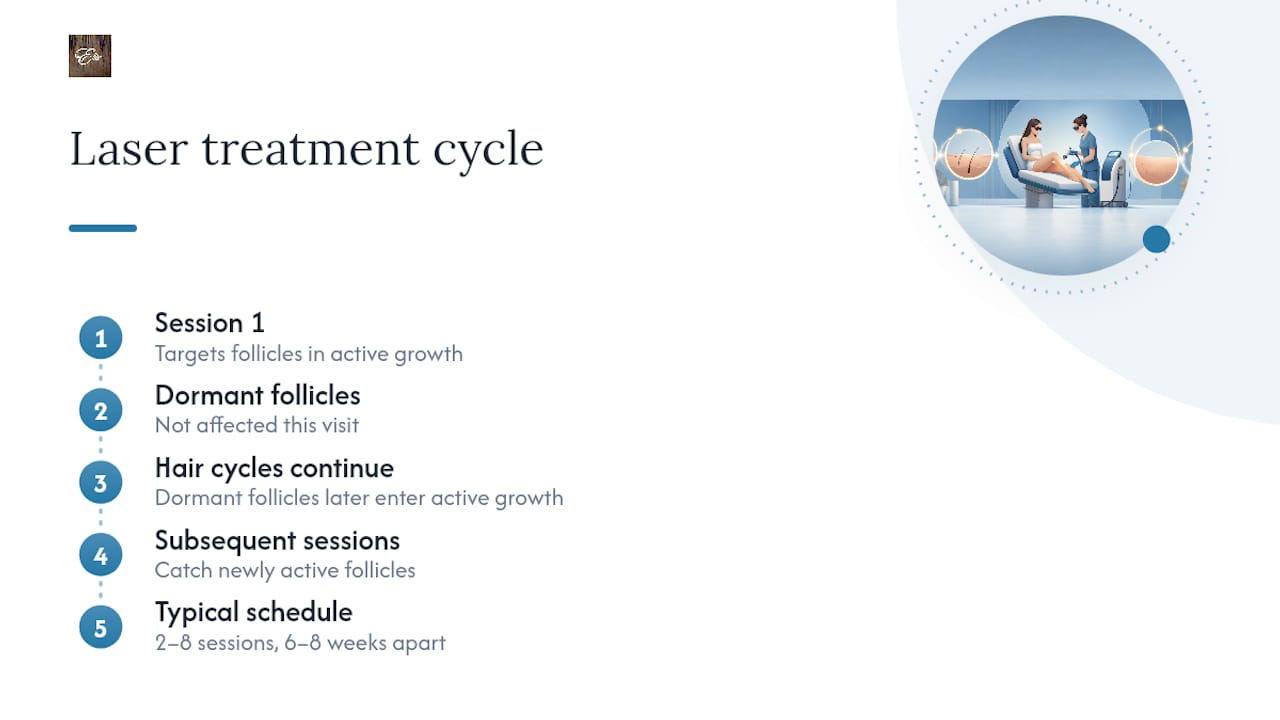
That contrast requirement is also why one session rarely finishes the job. Hair grows in cycles, and a laser only affects follicles that are actively producing hair at the moment of treatment. Dormant follicles get missed entirely, which is why the AAD recommends 2 to 8 sessions spaced 6 to 8 weeks apart to catch hair across its different growth phases.
Not every laser is built the same. Clinics use several types, including Ruby, Alexandrite, Diode, and Nd:YAG, and each has a different wavelength and depth of penetration. According to a technical review published through NCBI, Nd:YAG lasers penetrate deeper and scatter less at the surface, which makes them the safer choice for darker skin tones where other lasers risk pigment changes. That's a meaningful detail, because a clinic using the wrong laser for a given skin tone is a bigger risk factor than the technology itself.
Home IPL devices skip this precision entirely. They use a broader spectrum of light at lower energy, which is less potent and less targeted than a single-wavelength medical laser. That's not necessarily a flaw. It's a tradeoff that trades speed and strength for something you can use in your bathroom without training.
How Do Epilators Work, and What Should You Expect?
An epilator is a mechanical device, not a light-based one. Rotating discs or spring coils grab hairs and yank them out from the root, the same basic action as tweezing, just automated and much faster. Most epilators can grab hair as short as about 0.5 millimeters, which is shorter than what most waxing services require.
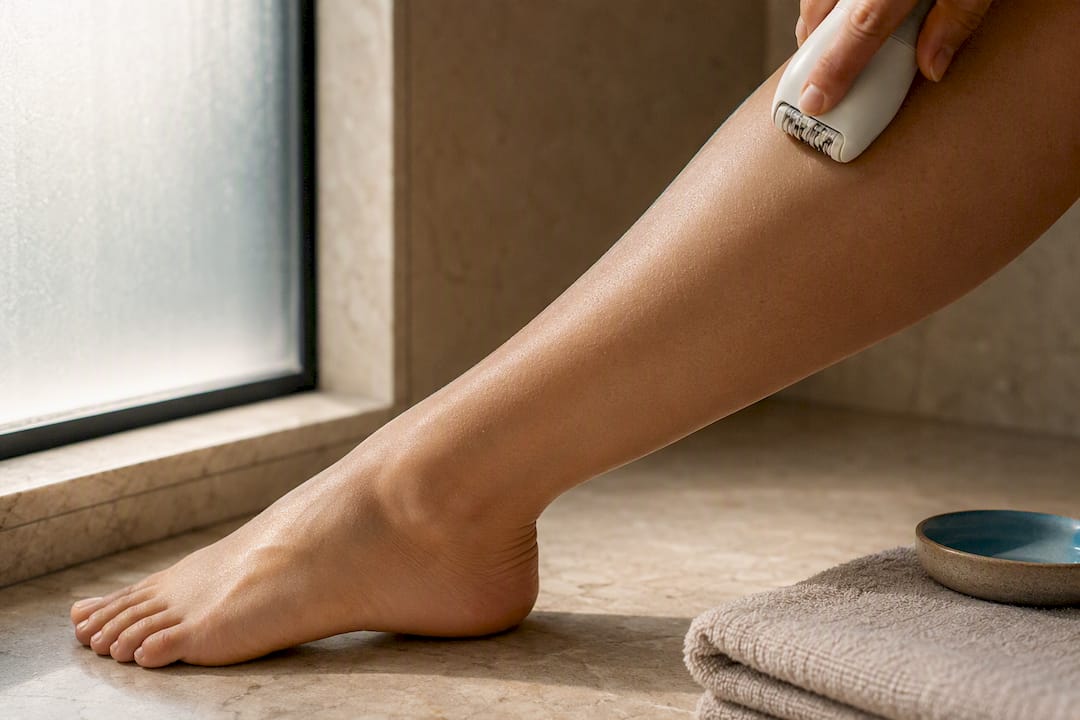
Because the hair comes out at the root rather than being damaged at the follicle, regrowth follows a normal cycle. Expect smoothness for two to four weeks before hair starts becoming visible again, depending on your natural growth rate and the body area. Nothing about epilation changes the follicle itself, so this is a maintenance routine, not a countdown to permanent reduction.
Common side effects include:
- Ingrown hairs, especially on curved or curly hair growth patterns
- Temporary redness or small bruising, particularly for first-time users
- Skin irritation on sensitive areas like the underarms or bikini line
Pro Tip: Exfoliate gently two to three times a week between sessions to prevent trapped hair, and always do a patch test on a small area first, especially if you're trying a new epilator model or treating a sensitive zone for the first time.
Which Is Better for Your Hair Color, Skin Tone, and Pain Tolerance?
Your hair and skin combination matters more than personal preference here, because the physics of each method only works under certain conditions. Use this as a rough guide before committing to either approach:
- Dark hair, fair to medium skin: This is the ideal candidate profile for laser or IPL, since the contrast between hair pigment and skin gives the light a clear target to absorb, per Mayo Clinic.
- Blonde, red, gray, or very light hair: Laser and IPL struggle here because there's not enough melanin to absorb the light efficiently. An epilator, or a consult about electrolysis for permanence, tends to be the more realistic option.
- Coarse or dense hair: Laser tends to show faster visible reduction over a full treatment course, since thicker follicles hold more melanin and respond more predictably session to session.
- Darker skin tones: Standard lasers carry a higher risk of pigment changes on deeper skin tones. A 1064 nm Nd:YAG laser is generally the safer choice, and it's worth confirming with a clinician which device they use before booking.
- Low pain tolerance or sensitive areas: Epilation on the face or bikini line tends to hurt more than on legs or arms. If pain is the deciding factor, ask a clinic about numbing options for laser, since topical anesthetic can make treatment far more comfortable than most people assume.
When in doubt, a patch test or a professional consultation beats guessing. A five-minute conversation with a trained provider can save you months of frustration with a device that was never going to work for your hair type.
What Are the Safety Risks of Each Method?
Laser and IPL are generally safe when performed correctly, but they're still medical procedures with real risks attached. Documented side effects include redness, burning sensations, blistering, crusting, and changes in skin pigment, with scarring listed as rare but possible according to the NCBI technical review. The AAD is direct about the fix for most of these risks: choose a board-certified dermatologist or an experienced medical professional rather than an unregulated storefront.
Epilators carry a different, lower-stakes risk profile, but it's not nothing. Ingrown hairs and folliculitis (infected hair follicles) are the most common complaints, along with bruising on sensitive skin. Cleaning the epilator head between uses and avoiding epilation on broken or irritated skin cuts down on infection risk considerably.
Statistic Callout: Even under ideal conditions, most laser patients still need multiple visits. The AAD puts the typical range at 2 to 8 treatments, and that number, not a single dramatic session, is what actually predicts long-term results.
Aftercare matters for both methods. Avoid direct sun exposure on treated skin, apply moisturizer regularly, and skip harsh exfoliants for a few days after either an epilator session or a laser appointment.
How Much Does Each Method Cost Over Time?
An epilator is a fixed, one-time cost, typically landing somewhere between $30 and $100 depending on features. That's the entire budget, aside from replacement heads every year or two. Home IPL devices cost more upfront, often several hundred dollars, and still require repeat use indefinitely since they're less powerful than clinic equipment.
Professional laser works differently. You're paying for a course of sessions rather than a single device, and the total cost depends on the treatment area, the number of sessions needed, and the clinic's pricing structure. Where laser earns back its higher upfront cost is in the years afterward: no more razors, no more waxing appointments, no more replacement epilator heads.
When comparing clinic offers, ask these questions before booking anything:
- What type of laser do they use, and is it appropriate for your skin tone?
- Who actually performs the treatment, a licensed technician or medical staff?
- Is there a guarantee or package structure if results fall short after the expected number of sessions?
- How many total sessions does the clinic recommend for your specific hair and skin type?
Why Medically Supervised Laser Changes the Outcome
The gap between a mediocre laser experience and a genuinely effective one usually comes down to who's holding the device. Laser hair removal treatments performed under medical supervision, using FDA-approved technology matched to the client's actual skin tone and hair type, can offer a guarantee on laser hair removal packages.
That supervision isn't a formality. Choosing the correct laser type, particularly Nd:YAG for darker skin tones, is one of the biggest factors separating a safe outcome from a pigment-change complication. Trained staff also know how to adjust settings session to session as hair thins, which is where a lot of the 10% to 25% early reduction turns into meaningful long-term results instead of stalling out after two visits.
The Bottom Line on Choosing Your Method
Pick an epilator if you want low-cost, on-demand smoothness and don't mind repeating the process every few weeks indefinitely. Pick professional laser if long-term reduction, fewer ingrown hairs, and less time spent on hair removal over the coming years matter more to you than avoiding an upfront cost.
- Assess your hair color and skin tone honestly, since that combination predicts laser response more than anything else.
- Do a patch test with an epilator, or book a consultation to discuss laser candidacy and pricing.
- Compare clinic technology, staff credentials, and guarantees before committing to a package.
- Plan for maintenance either way, whether that's a new epilator head or an occasional laser touch-up.
What This Comparison Gets Wrong in Most Buying Guides
Most articles treat this as a binary choice, epilator or laser, when the more honest framing is that they solve different problems on different timelines. The mistake I see most often is people buying a home IPL device expecting clinic-level results, then feeling burned when a lower-energy, broadband device underperforms a focused medical laser. That's not a device failure. It's a mismatch between expectation and physics.
The overlooked factor in most comparisons is operator skill, not hardware. A mediocre laser used by a trained provider on the right skin tone will outperform an expensive device used incorrectly, every time. That's the part conventional wisdom skips when it frames this purely as a product comparison.
If I had to prioritize one thing for readers: stop asking "which device is better" and start asking "which follicle-damage timeline fits my life." Someone who hates recurring appointments should lean epilator, full stop, regardless of how tempting long-term laser numbers look on paper. Someone tired of buying razors every month for the next decade should treat the laser course as the actual cheaper option, not the pricier one.
— Sharon
Book a Laser Hair Removal Consultation With Elite Laser Center
If this comparison left you leaning toward long-term reduction rather than another epilator purchase, Elitelaserhair is built for exactly that decision. Every laser hair removal treatment is performed under medical supervision using FDA-approved technology, matched to your specific hair and skin tone rather than a one-size-fits-all setting, and backed by a three-year guarantee on laser hair removal packages.

That guarantee matters because it removes the biggest risk in this whole comparison: paying for a course of sessions and not seeing results. You can read more about what to expect during your first laser hair removal appointment before booking, including how sessions are spaced and what aftercare looks like. If you're ready to stop budgeting for razors and epilator heads every few months, book a laser hair removal consultation and get a treatment plan built around your actual hair and skin type.
This article is general information, not a substitute for advice from a qualified doctor. Consult a qualified healthcare professional about your own circumstances before acting on anything here.
Sources
- American Academy of Dermatology: Laser hair removal overview
- Mayo Clinic: Laser hair removal
- StatPearls / NCBI: Laser hair removal technical review
FAQ
Do Dermatologists Recommend Epilators?
Dermatologists generally consider epilators a safe, low-risk option for temporary hair removal, but they don't offer any long-term reduction since they don't damage the follicle. Most skin care guidance focuses on using them correctly, exfoliating regularly and avoiding irritated skin, rather than recommending them over laser for anyone seeking permanent results.
What Are the Downsides of Using an Epilator?
The main downsides are pain during the first few uses, a real risk of ingrown hairs and folliculitis, and the fact that results only last two to four weeks before regrowth starts. Unlike laser, epilators never reduce future hair growth since they pull hair from the root without damaging the follicle.
What Is the Healthiest Hair Removal Method?
There's no single "healthiest" method, since the right choice depends on your skin tone, hair color, and how the treatment is performed. Medically supervised laser hair removal, using the correct laser type and technique, reduces risks and improves outcomes compared to unsupervised at-home devices, according to the Cleveland Clinic.
Does Epilating Eventually Stop Hair Growth?
No, epilating does not stop hair growth long term, because it removes hair from the root without damaging the follicle itself. Some people notice regrowth becomes slightly finer or sparser over years of consistent use, but this is not a reliable or guaranteed effect the way follicle-damaging treatments like laser can be.
How Many Laser Sessions Will I Actually Need?
Most patients need between 2 and 8 sessions, spaced roughly 6 to 8 weeks apart, to see lasting reduction. The exact number depends on your hair color, skin tone, and the treatment area, which is why a consultation matters more than a generic estimate.
Recommended
- Laser Hair Removal Sessions: How Many and How Often
- Laser Hair What to Expect
- Laser Hair Removal vs Waxing: Which One Wins?
- Laser vs Electrolysis: Clinician Guide to FDA Backed Permanence
This article was produced with AI assistance and reviewed for accuracy. It is provided for general information, and it is not professional advice.