
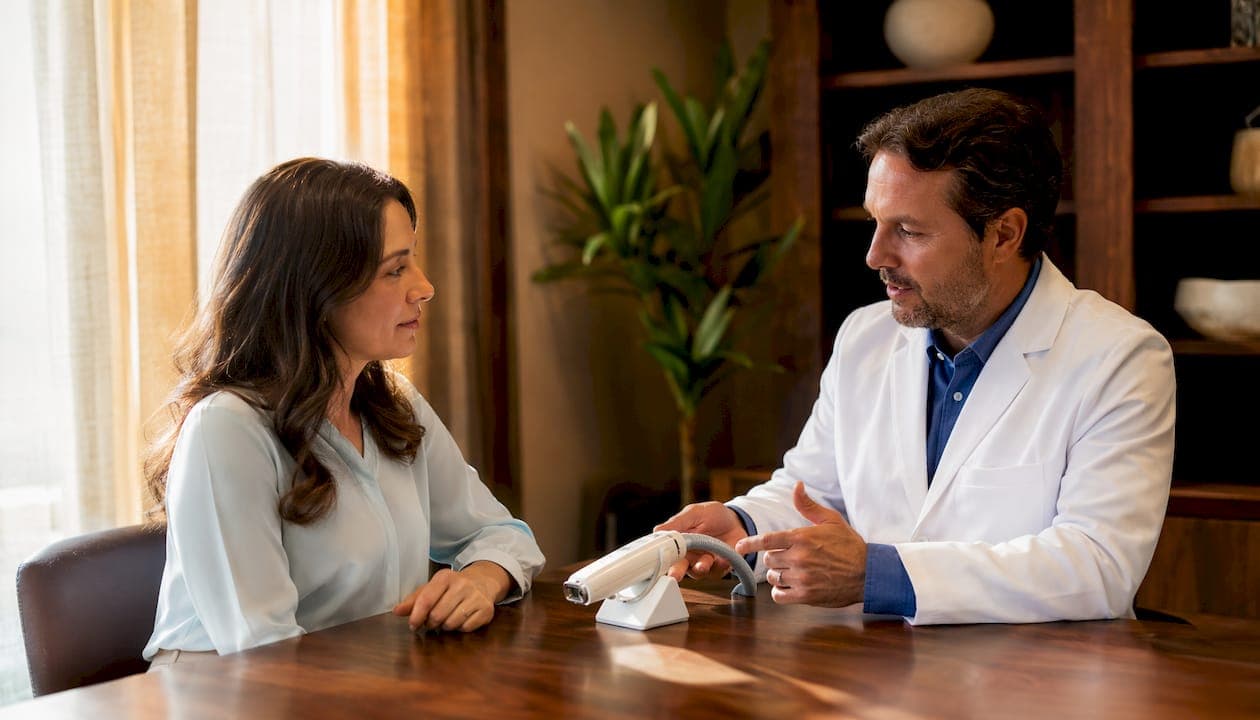
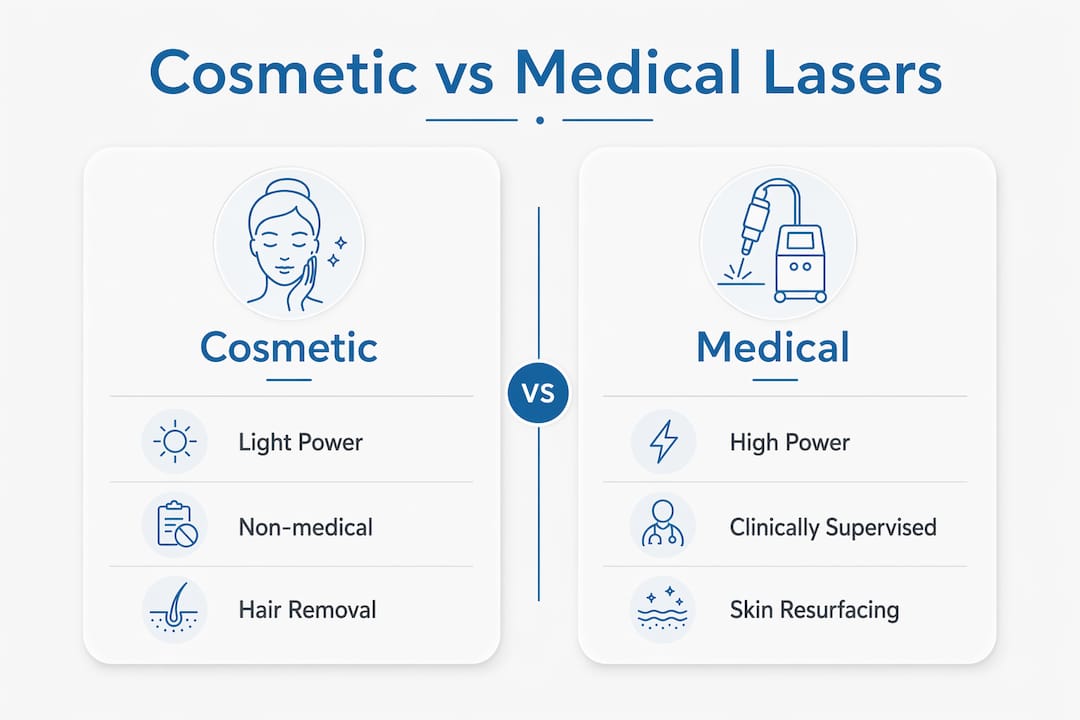
Medical lasers are higher-power, wavelength-specific systems used for clinical indications under medical supervision. Cosmetic devices are lower-power and aimed at surface-level aesthetic tasks. Knowing that distinction upfront saves you from booking the wrong treatment or walking into a facility that isn't equipped for your actual concern.
Here's how to use this guide: match your treatment goal, skin type (Fitzpatrick scale I–VI), and recovery tolerance to the device characteristics described below.
Main laser categories covered:
- Ablative: CO2 (fractional CO2), Erbium YAG — vaporize the epidermis, strongest resurfacing results
- Non-ablative: Nd:YAG 1064 nm, Diode 810 nm, Alexandrite 755 nm — heat the dermis without surface removal
- Vascular: Pulsed Dye Laser (PDL) — targets hemoglobin in blood vessels
- Pigment/tattoo: Q-switched lasers — shatters ink and melanin deposits
- Non-laser comparator: IPL (Intense Pulsed Light) — broad-spectrum, not a true laser
Table of Contents
- What does each laser type actually treat?
- How wavelength and chromophores determine what a laser can treat
- Ablative vs. non-ablative vs. fractional: what's the real tradeoff?
- How do you choose the right laser for your concern?
- What are the real risks, and how do you reduce them?
- What should you expect for sessions, recovery, and costs?
- What does a medically supervised clinic do differently?
- Key Takeaways
- The case for conservative, staged treatment
- Elitelaserhair: medically supervised laser care in Suffolk County
- Useful sources for further reading
What does each laser type actually treat?
No single laser handles everything. Lasers and light sources are effective across a wide range of conditions including rosacea, melasma, hemangiomas, sun damage, acne scars, broken blood vessels, unwanted hair, and tattoos. That's exactly why established clinics keep multiple devices on hand.
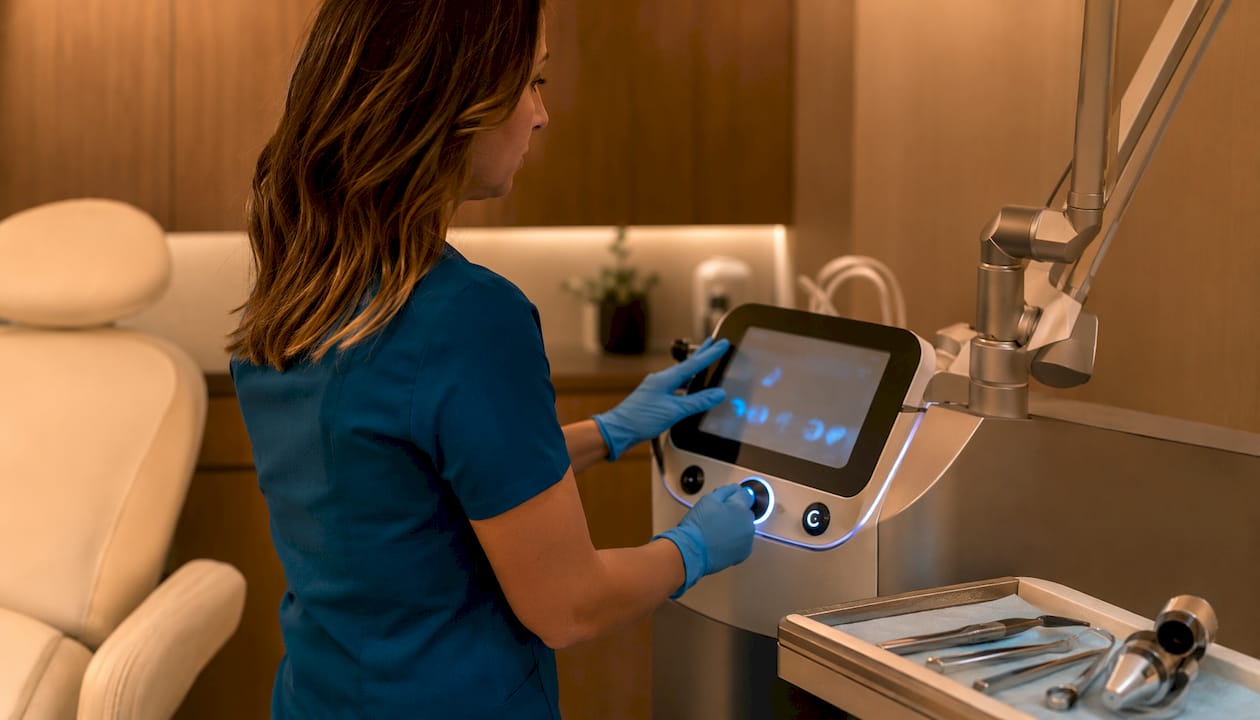
CO2 laser (10,600 nm — ablative)
CO2 targets water in skin cells, vaporizing tissue layer by layer. It's the workhorse for deep resurfacing: significant wrinkles, acne scars, and sun damage. Fractional CO2 delivers the same energy through microscopic columns rather than a full-field pass, which cuts downtime considerably while still producing meaningful collagen remodeling. Expect several days of recovery for fractional, and longer for full-field.
Erbium YAG (2,940 nm — ablative)
Erbium YAG has a stronger affinity for water than CO2, so it ablates more precisely with less collateral thermal damage. That translates to a slightly faster recovery and a better safety profile for medium-toned skin. It's a strong choice for moderate wrinkles, superficial scars, and skin texture when you want ablative results without the full CO2 recovery burden.
Nd:YAG (1064 nm — non-ablative)
The 1064 nm wavelength penetrates deeply and bypasses melanin in the epidermis, which makes it one of the safest options for darker Fitzpatrick types (IV–VI) and is an effective feature of the CurrentBody RF radio frequency device used for skin tightening treatments. It's used for hair removal on darker skin, vascular lesions, deep pigmentation, and skin tightening. Long-pulse Nd:YAG is also the go-to for leg veins and deeper vascular structures.
Alexandrite (755 nm — non-ablative)
Alexandrite has a strong affinity for melanin, making it highly effective for hair removal on lighter skin tones (Fitzpatrick I–III) and for superficial pigmented lesions. It's faster than Nd:YAG for hair removal on fair skin but carries a higher risk of pigment changes on darker skin. Not the right device if your Fitzpatrick type is IV or above.
Diode (810 nm — non-ablative)
The 810 nm diode sits between Alexandrite and Nd:YAG on the melanin-absorption curve, giving it a workable balance of efficacy and safety across Fitzpatrick I–IV. It's one of the most widely used wavelengths for laser hair removal and handles a broader range of skin tones than Alexandrite. Cooling systems built into modern diode handpieces have made treatments more comfortable.
Pulsed Dye Laser (585–595 nm — non-ablative, vascular)
PDL targets oxyhemoglobin in blood vessels. It's the clinical standard for port wine stains, facial telangiectasias, rosacea-related redness, and hypertrophic scars. The 595 nm variant reduces post-treatment purpura (bruising) compared with the older 585 nm. Multiple sessions are typically needed for vascular lesions, and insurance may cover treatment when the indication is medical rather than cosmetic.
Q-switched lasers (various nm — non-ablative, pigment/tattoo)
Q-switched technology delivers extremely short, high-energy pulses that shatter pigment particles without heating surrounding tissue. Different wavelengths target different ink colors: 1064 nm for dark inks, 532 nm for red and orange, 694 nm (Ruby) for blue-green. Tattoo removal typically requires 6–10 or more sessions. Q-switched Nd:YAG is also used for melasma and nevus of Ota in darker skin types.
IPL — not a laser
IPL uses multiple wavelengths in broad-spectrum pulses rather than a single laser wavelength. That makes it useful for diffuse redness, mild sun damage, and superficial pigmentation, but less precise than a true laser for deep or targeted treatments. It's a reasonable maintenance option for photodamage on lighter skin, but it cannot replicate what a PDL does for a port wine stain or what a Q-switched laser does for tattoo ink.
Comparison table
| Device | Primary target | Wavelength (nm) | Ablative / Non-ablative | Best uses | Typical downtime | Sessions needed | Fitzpatrick safety | Common side effects |
|---|---|---|---|---|---|---|---|---|
| CO2 | Water | 10,600 | Ablative (fractional option) | Deep resurfacing, acne scars, wrinkles | 5 days | 1–3 | I–III (caution IV+) | Redness, swelling, PIH risk |
| Erbium YAG | Water | 2,940 | Ablative (fractional option) | Moderate resurfacing, texture, scars | 3–7 days | 1–3 | I–IV | Redness, mild swelling |
| Nd:YAG | Melanin / hemoglobin | 1064 | Non-ablative | Hair removal (dark skin), vascular, tightening | Minimal | 3–6 | I–VI | Temporary redness, swelling |
| Alexandrite | Melanin | 755 | Non-ablative | Hair removal, pigmented lesions | Minimal | 4 | I–III | PIH on darker skin |
| Diode | Melanin | 810 | Non-ablative | Hair removal, skin tones I–IV | Minimal | 4 | I–IV | Redness, mild discomfort |
| PDL | Hemoglobin | 585–595 | Non-ablative | Vascular lesions, rosacea, scars | 1–7 days (purpura) | 2–6 | I–IV | Purpura, swelling |
| Q-switched | Pigment / ink | 532 / 694 / 1064 | Non-ablative | Tattoo removal, melasma, pigment | 1–5 days | 6–10+ | I–VI (varies) | Blistering, PIH, ink scatter |
| IPL | Broad spectrum | 500 | Non-ablative | Diffuse redness, mild sun damage | Minimal | 3–5 | I–III | Redness, mild swelling |
PIH = post-inflammatory hyperpigmentation
How wavelength and chromophores determine what a laser can treat
Wavelength is essentially color, and each wavelength is absorbed preferentially by a specific tissue target called a chromophore. The three main chromophores in skin are melanin (pigment), oxyhemoglobin (blood), and water. Match the wavelength to the chromophore you want to affect, and the laser does its job. Miss the match, and you either get no result or collateral damage to surrounding tissue.
Pulse duration is the other critical variable. Every tissue target has a thermal relaxation time — the time it takes to dissipate half the heat absorbed. A pulse shorter than that relaxation time confines the heat to the target. A pulse longer than it lets heat spread to neighboring structures. That's why Q-switched lasers use nanosecond pulses to shatter pigment without burning skin, while long-pulse Nd:YAG uses millisecond pulses to heat a hair follicle thoroughly enough to disable it.
Key physics in plain language:
- Wavelength = color (target depth): shorter wavelengths (e.g., 532 nm) are absorbed at the surface; longer ones (e.g., 1064 nm) penetrate deeper
- Chromophore = the lock: melanin absorbs 755 nm and 810 nm well; hemoglobin absorbs 585–595 nm; water absorbs 2,940 nm and 10,600 nm
- Pulse duration = delivery speed: nanosecond pulses shatter pigment; millisecond pulses heat follicles or vessels
- Fractional delivery: the beam is divided into microscopic columns (microthermal zones), leaving untreated skin between them to accelerate healing and reduce downtime
Fractional delivery, introduced with fractional laser resurfacing, changed the risk-benefit calculation for resurfacing. By treating only a fraction of the skin surface at once, it produces meaningful collagen remodeling while cutting recovery time compared with full-field ablative treatments.
Ablative vs. non-ablative vs. fractional: what's the real tradeoff?
Ablative lasers remove the epidermis and heat the dermis. Non-ablative lasers heat the dermis while leaving the surface intact. Fractional sits between them, treating microscopic columns of tissue to balance efficacy with reduced downtime.
Ablative CO2 and erbium lasers vaporize layers of skin to stimulate collagen. Non-ablative lasers stimulate collagen without removing surface skin and usually have shorter recovery but subtler results. That's the core tradeoff: stronger result versus faster return to normal life.
Approach comparison

| Approach | Result strength | Typical downtime | Sessions (typical) | Example indications |
|---|---|---|---|---|
| Full-field ablative | High | extended downtime | 1 | Deep wrinkles, severe acne scarring |
| Fractional ablative | Moderate–high | moderate downtime | multiple sessions | Moderate scars, resurfacing with less risk |
| Non-ablative | Moderate | short downtime | multiple sessions | Mild laxity, tone, early pigment changes |
| Fractional non-ablative | Mild–moderate | minimal downtime | multiple sessions | Maintenance, mild texture, collagen stimulation |
For deep acne scarring, a provider might recommend fractional CO2 because the result justifies the recovery. For brown spots on a patient who can't take a week off, a non-ablative Q-switched or IPL session makes more practical sense. The indication and the patient's life situation both drive the decision.
Pro Tip: For Fitzpatrick types IV–VI, fractional non-ablative approaches are usually the conservative starting point. Full-field ablative treatments carry a meaningfully higher risk of post-inflammatory hyperpigmentation on darker skin, and staged fractional sessions let the provider monitor the skin's response before committing to more aggressive settings.
Darker skin types have more melanin competing for laser energy, which raises the risk of unintended pigment changes. Conservative fractional strategies, longer wavelengths (Nd:YAG 1064 nm), and lower fluences with more sessions are the standard approach for Fitzpatrick IV–VI patients. Any provider who dismisses skin type as a minor variable is a red flag.
How do you choose the right laser for your concern?
Match the device to your goal, your skin type, and how much downtime you can realistically manage. That's the short answer. The longer answer involves verifying the provider's credentials and the specific device being used.
Questions to ask at your consultation
- What is the exact device name and wavelength, and is it FDA-cleared for this specific indication?
- How many sessions will I need, and how far apart?
- What is the expected downtime, and what will my skin look like during recovery?
- Can I see before-and-after photos of patients with my skin type and concern?
- Who will perform the treatment, and what is their training and certification?
- What pre-treatment and post-treatment protocols are required?
- What happens if I have an adverse reaction?
Provider credentials to verify
- Board-certified dermatologist, plastic surgeon, or physician overseeing the practice. Certain ablative procedures should only be performed by a board-certified cosmetic surgeon; fractional approaches allow more providers to participate under medical oversight.
- Licensed operators with documented training on the specific device
- Written informed consent and a documented treatment plan
- Patch testing protocol before full treatment, especially for hair removal and pigment work
Red flags
- No patch test offered before hair removal or pigment treatment
- Aggressive promises of results in a single session for conditions that typically require multiple
- Inability to name the device or its FDA clearance status
- No pre-treatment photos or medical history review
- A "cosmetic spa" setting for procedures that require medical supervision
When to prefer a medically supervised setting
Medically supervised settings are the right choice for ablative resurfacing, vascular lesion treatment, tattoo removal, and any procedure on Fitzpatrick types IV–VI. Non-ablative hair removal on lighter skin in a supervised cosmetic spa can be appropriate, but the operator's training still matters as much as the device. For complementary non-laser options, RF micro-needling and injectables are sometimes combined with laser treatments in a full aesthetic plan.
What are the real risks, and how do you reduce them?
Side effects range from temporary redness and swelling to burns and permanent pigment changes. Serious eye injury is possible when lasers are used near the eyes without proper shielding. Operator training and clinical safety protocols are what separate acceptable short-term effects from preventable complications.
Common, short-term side effects
- Redness and swelling (hours to days, depending on treatment intensity)
- Mild crusting or peeling after ablative treatments
- Temporary darkening of treated pigmented lesions before they shed
- Purpura (bruising) after PDL treatments, resolving in 7–10 days
- Itching during healing
Rarer but serious complications
- Burns and scarring from incorrect settings or untrained operators
- Post-inflammatory hyperpigmentation (PIH), especially on Fitzpatrick IV–VI
- Post-inflammatory hypopigmentation (permanent lightening), more common with aggressive ablative treatments
- Infection if post-care protocols are not followed
- Ocular injury if eye protection is not used
Safety checklist for your clinic visit
- Patch test performed before full treatment
- Complete medical history reviewed (medications, isotretinoin history, autoimmune conditions)
- Written informed consent with documented risks
- Appropriate eye protection for both patient and operator
- Cooling system active during treatment
- Emergency protocols in place and visible
- Device clearance documentation available on request
Medical lasers must comply with Title 21 Code of Federal Regulations (Subchapter J). That regulatory framework covers device classification, performance standards, and labeling requirements. A clinic using a medical-grade laser should be able to confirm the device's FDA clearance for the specific indication being treated, not just a general claim that the device is "FDA-approved."
What should you expect for sessions, recovery, and costs?
Non-ablative and fractional series typically require multiple treatments spaced weeks apart. Full-field ablative treatments may achieve significant results in fewer sessions, but recovery is longer. Fractional or non-ablative procedures usually need 2–4 treatments over weeks or months; full-field ablative may need only one.
Recovery timeline
| Phase | Timeframe | What to expect |
|---|---|---|
| Immediate | hours | Redness, swelling, warmth; ablative treatments may weep slightly |
| Short-term | 3 days | Peeling, crusting (ablative); mild flaking (non-ablative) |
| Intermediate | 2–6 weeks | Pinkness fades; new skin surface stabilizes |
| Full remodeling | 2–6 months | Collagen continues building; final result visible |
Ballpark U.S. cost ranges by indication
These are general ranges based on publicly available U.S. market data. Actual costs vary significantly by provider, geography, device, and number of sessions.
- Laser hair removal: roughly $200–$500 per session depending on treatment area; full packages for larger areas run higher
- Fractional resurfacing: typically $1,000–$3,000 per session for fractional CO2 or Erbium
- Vascular lesion treatment (PDL): roughly $300–$600 per session for facial telangiectasias
- Tattoo removal: typically $200–$500 per session; multi-session packages vary widely by tattoo size and ink colors
Insurance may cover medically necessary laser procedures, including treatment of port wine stains, hemangiomas, and certain scarring conditions. Cosmetic indications — hair removal, resurfacing for aesthetic reasons, pigment correction — are not covered. If your concern has a medical component (e.g., a vascular birthmark), ask your provider whether a letter of medical necessity is appropriate.
For skin-prep and aftercare support, facials and peels are often used alongside laser treatments to maintain results and support healing between sessions.
What does a medically supervised clinic do differently?
Medically supervised clinics combine licensed operators, documented device records, and clinical protocols that reduce complications and improve outcomes. That's not marketing language; it's the structural difference between a setting where someone can intervene if something goes wrong and one where they cannot.
What patients should expect from a qualified clinic
- Pre-treatment photos documented and stored
- Patch test performed and results recorded before full treatment
- Complete medical history reviewed, including medications and prior treatments
- Device settings documented for each session
- Written care plan with pre- and post-treatment instructions
- Follow-up schedule with a protocol for managing adverse reactions
- Emergency protocols in place and staff trained to use them
How to verify a clinic's qualifications
- Board-certified physician on staff and available for consultation
- FDA-cleared devices confirmed for the specific indication being treated
- Written care plans provided before treatment begins
- Visible clinical credentials and a clean, clinical environment
- Transparent about device names, wavelengths, and operator training
Certain skin resurfacing treatments should only be performed by a board-certified cosmetic surgeon. Fractional approaches allow more providers to participate, but medical oversight remains the standard for anything beyond low-intensity non-ablative work. When a clinic cannot tell you who the supervising physician is, that's a meaningful gap.
Key Takeaways
Matching the laser to the chromophore, the Fitzpatrick skin type, and the patient's recovery tolerance is the single most important decision in any laser treatment plan.
| Point | Details |
|---|---|
| Match device to chromophore | Melanin, hemoglobin, and water each absorb different wavelengths — the right match determines results. |
| Ablative vs. non-ablative tradeoff | Ablative delivers stronger results with more downtime; non-ablative is gradual with minimal recovery. |
| Fractional for darker skin | Fractional non-ablative approaches reduce PIH risk for Fitzpatrick IV–VI compared with full-field ablative. |
| Verify FDA clearance by indication | Ask for the specific device name and its clearance for your exact concern, not a general "FDA-approved" claim. |
| Elitelaserhair for supervised care | Elitelaserhair performs treatments under experienced medical supervision with FDA-cleared devices in Suffolk County, NY. |
The case for conservative, staged treatment
The most common mistake patients make isn't choosing the wrong laser. It's choosing the right laser in the wrong hands, or pushing for aggressive settings when a staged approach would have gotten them to the same result with far less risk.
There's a real pressure in aesthetic medicine to promise dramatic outcomes quickly. Patients come in having seen before-and-after photos online, and they want that result in one session. But the physics of laser treatment don't bend to impatience. Collagen remodeling takes months. Pigment correction on darker skin types requires conservative fluences and careful monitoring between sessions. A provider who tells you otherwise is either inexperienced or prioritizing the sale over your skin.
The tradeoff between an aggressive result and a safe one is real, and it falls differently depending on your skin type. For Fitzpatrick I–III, a more aggressive fractional CO2 session may be entirely appropriate. For Fitzpatrick IV–VI, the same settings could cause hyperpigmentation that takes longer to resolve than the original concern. Conservative, staged approaches aren't a lesser option for higher-risk skin types. They're the correct clinical strategy.
Elitelaserhair: medically supervised laser care in Suffolk County
Elitelaserhair at Elite Laser Center in Stony Brook, NY, offers laser and aesthetic treatments performed under experienced medical supervision using FDA-cleared technology. The difference from a standard cosmetic spa is structural: every treatment plan is customized to the patient's skin type, concern, and recovery tolerance, with device settings documented and a follow-up protocol in place.
The clinic's laser hair removal program includes a three-year guarantee on packages, which reflects the kind of commitment you don't find at facilities treating hair removal as a commodity service. Treatments span hair removal, skin tightening, and complementary services including LED light therapy for recovery support. Elite Laser Center has been recognized as the top CoolSculpting facility in New York and serves patients across Suffolk County.
If you're ready to match a treatment to your actual concern, book a consultation at Elitelaserhair to review your skin type, goals, and the specific devices that fit your situation.
Useful sources for further reading
These are the primary and professional sources used to build this guide. Bring them to your consultation if you want to discuss the evidence with your provider.
-
FDA: Medical Lasers — The FDA's overview of medical laser regulation under Title 21 CFR Subchapter J, including device classification and performance standards. Use this to verify that a device is cleared for a specific indication.
-
Mayo Clinic: Laser Resurfacing — Patient-facing clinical overview of ablative, non-ablative, and fractional laser resurfacing, including recovery timelines, risks, and expected results.
-
Mayo Clinic: Laser Hair Removal — Covers how laser hair removal works, which skin and hair types respond best, and what multiple sessions involve.
-
American Board of Cosmetic Surgery: Skin Resurfacing — Professional society guidance on which resurfacing procedures require board-certified surgeons and which can be performed under medical oversight by trained providers.
-
American Society of Plastic Surgeons: Laser Skin Resurfacing — Overview of laser resurfacing from a plastic surgery perspective, including precision, collagen stimulation, and patient selection.
-
Mass General: Laser Skin Treatments — Clinical overview of the range of conditions treatable with lasers and light sources, from rosacea to tattoos.
-
Stanford Health Care: Laser Surgery — Explains the types of lasers used in surgical and medical contexts, including CO2 and Nd:YAG, and their clinical applications.
Bring specific questions about device clearance and your skin type to your consultation. A qualified provider should be able to answer them directly.