

Yes, CoolSculpting commonly causes short-term, reversible side effects like swelling and bruising. Rare but serious complications, most notably paradoxical adipose hyperplasia (PAH), can occur and are best avoided with a medically supervised, experienced provider. The sections below break down exactly how common each reaction is, what warrants a call to your provider, and how to screen for the practices that keep complication rates low.
TL;DR:
- Most side effects like swelling, bruising, and numbness are temporary and typically peak within the first few days to weeks, resolving without intervention.
- Paradoxical adipose hyperplasia is a rare complication that appears 2 to 5 months post-treatment, causing firm, enlarged fat areas in about 1 in every 3,000 sessions.
- Patients with certain cold-related blood and circulation conditions should avoid CoolSculpting, and comprehensive medical screening is essential before proceeding.
- Choosing a provider with medical supervision, proven experience, and transparent protocols significantly reduces the risk of complications and ensures safer outcomes.
- Multiple sessions are often necessary for desired results, and diligent follow-up helps detect abnormal reactions like PAH early, improving treatment success.
Table of Contents
- Coolsculpting Risks: The Common Side Effects You Should Expect
- Paradoxical Adipose Hyperplasia and Other Rare Complications
- Who Should Skip CoolSculpting: Contraindications and Poor Candidates
- How to Vet a Provider and Cut Your Risk
- What Actually Happens in a Session and During Recovery
- Managing Complications: When to Call, When to Go to the ER
- When to Consider an Alternative to CoolSculpting
- A Straight Answer on Whether It's Worth the Risk
- Book a Medically Supervised CoolSculpting Consultation
- Sources
- FAQ
Coolsculpting Risks: The Common Side Effects You Should Expect
Most people who go through CoolSculpting deal with a predictable, short list of reactions in the treated area. Redness, swelling, bruising, tenderness, and a deep aching or cramping sensation show up in the vast majority of sessions, and none of it signals anything has gone wrong. The applicator pulls tissue into a cooling panel for close to an hour, and your body reacts to that suction and cold the way it would to any localized trauma.
The timeline follows a fairly consistent pattern. Numbness, tingling, and stinging tend to start within minutes of the applicator coming off, as nerve endings react to the temperature change. Swelling and bruising usually peak in the first few days, then fade over one to two weeks. Numbness is the outlier: sensory changes in the treated area can linger for several weeks, and occasionally longer, before normal sensation fully returns.
Here's what typically shows up, in roughly the order patients report it:
- Intense cold and pinching during the first 5 to 10 minutes, which fades as the area numbs.
- Redness and firmness in the treated zone immediately after the applicator is removed.
- Bruising and swelling that peaks around day 2 to 4 and resolves within one to two weeks.
- Numbness or tingling that can persist for several weeks as nerve endings recover.
- Cramping or aching, often described as similar to a deep muscle soreness, lasting several days.
- Temporary skin sensitivity to touch or temperature in the treated area.
Aftercare is straightforward. Gentle massage of the treated area right after the session (a technique many providers use in-office) helps with fat cell breakdown and can ease swelling. Over-the-counter pain relievers handle the cramping for most patients, and loose clothing over the area avoids unnecessary friction while it's tender. Ice is not necessary since the tissue has already been through an intense cold cycle, but plenty of water and normal activity as tolerated support recovery.
What separates "expected" from "concerning" comes down to direction and degree. Swelling that keeps growing after the first week, pain sharp enough to disrupt sleep beyond the first few days, skin that blisters or discolors instead of simply bruising, or numbness that shows no improvement at all after a month are all reasons to contact your provider rather than wait it out.
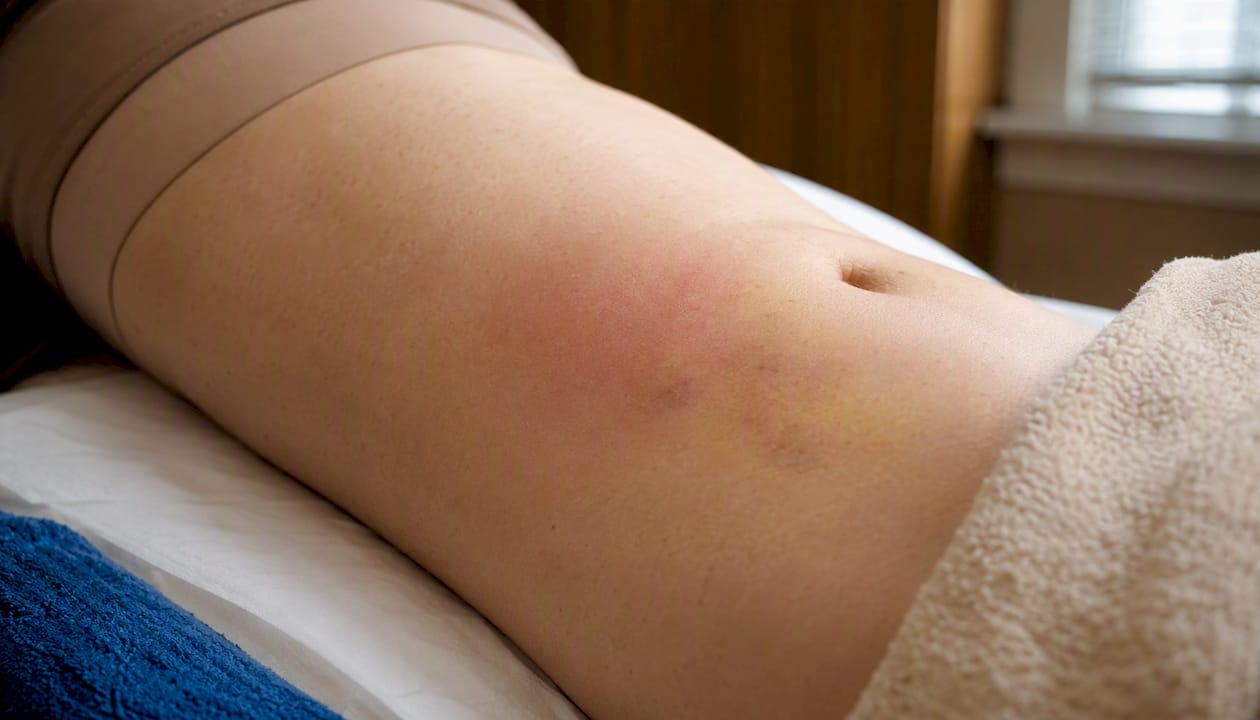
Pro Tip: Take a photo of the treated area on day one and again at two weeks. Side by side, it's much easier to tell whether swelling is trending down normally or whether something looks off enough to call your provider.
Paradoxical Adipose Hyperplasia and Other Rare Complications
Paradoxical adipose hyperplasia, or PAH, is the complication that gets the most attention in CoolSculpting discussions, and for good reason: it's the opposite of what the treatment is supposed to do. Instead of shrinking fat cells in the treated zone, PAH causes them to grow larger and more numerous, producing a firm, visibly enlarged area that doesn't resolve on its own.
PAH is not swelling that overstays its welcome. Normal post-treatment inflammation is soft, tender, and shrinks steadily over two to three weeks. PAH shows up later, typically 2 to 5 months after treatment, as a firm, well-defined mass with distinct edges. Once it's noticeable, it tends to stay that way, and it does not shrink with time, diet, or exercise the way normal fat would.
PAH by the numbers: CoolSculpting's manufacturer estimates PAH occurs in about 0.033% of treatments, or roughly 1 in every 3,000 sessions. That figure comes from company safety documentation, and independent researchers have raised concerns that passive adverse-event reporting systems may understate the true rate, since many patients and providers never file a formal report.
That gap between reported and actual incidence is worth sitting with. Reviews in the medical literature note that PAH estimates have shifted over time as awareness grew and reporting improved, which suggests the earliest numbers circulated after the treatment launched were probably too low. Transparency around PAH has genuinely improved since a handful of high-profile cases pushed the issue into public view, and most reputable providers now walk through it explicitly during consent.
PAH isn't the only rare event on the list, though it's the one with the clearest incidence data. Other complications reported at low frequency include:
- Freeze burn, a cold-related skin injury that can cause blistering or, in severe cases, scarring.
- Severe or prolonged pain that outlasts the typical week-or-two recovery window.
- Temporary array or device (TAD) marks, superficial indentations from the applicator that usually fade.
- Pigment changes in the treated skin, ranging from lightening to darkening.
- Contour irregularities, where fat reduction is uneven across the treated zone.
Treatment for PAH is almost always surgical. Liposuction or direct surgical excision are the standard corrective options, and outcomes are generally good once the tissue is removed. What providers do not do is retreat the same area with another round of CoolSculpting. Repeat cryolipolysis on a site that developed PAH is considered contraindicated, since it risks feeding the same abnormal growth response rather than correcting it. Freeze burns and pigment changes are managed more conservatively, often with topical treatment and time, though severe cases may need dermatologic referral.
Who Should Skip CoolSculpting: Contraindications and Poor Candidates
Some medical conditions rule CoolSculpting out entirely, and no amount of provider skill changes that. Cryolipolysis works by cooling fat cells to the point of controlled cell death, and that same cold exposure can trigger dangerous reactions in people with certain blood and circulatory conditions.
- Cold agglutinin disease — a condition where cold temperatures cause red blood cells to clump, which cryolipolysis can trigger systemically, not just locally.
- Cryoglobulinemia — abnormal proteins in the blood that thicken in cold conditions, creating circulation risks when a large body area is chilled.
- Paroxysmal cold hemoglobinuria — a rare disorder where cold exposure destroys red blood cells, making cold-based treatments unsafe.
- Cold urticaria — a cold-triggered allergic reaction that can cause hives, swelling, or in severe cases, a body-wide response.
- Raynaud's disease — impaired blood flow to extremities under cold exposure, which raises concern for treated-area circulation.
These five sit on the FDA's safety guidance as clear exclusions, and any provider worth booking will screen for them directly rather than relying on a checkbox form.
Beyond these absolute contraindications, a longer list of relative exclusions call for a conversation, not necessarily a hard no. Pregnancy, active skin infection in the treatment area, hernias near the treatment site, significant loose or lax skin, impaired circulation, and bleeding disorders all warrant a closer look before proceeding. Body mass index matters too, though not in the way people assume: CoolSculpting targets isolated fat pockets, not overall weight, so patients expecting broad weight loss are usually poor candidates regardless of their BMI number. Mayo Clinic's overview is direct on this point, framing the treatment as body contouring for specific bulges rather than a weight-loss method.
A responsible pre-treatment screening covers your full medical history, current medications (particularly blood thinners), any history of skin conditions in the treatment area, and a physical assessment of the fat pocket itself to confirm it's a good match for suction-based cooling. If a provider skips straight to scheduling without asking about any of this, that's worth noticing. Our candidate eligibility checklist walks through the same questions a thorough consultation should raise.
How to Vet a Provider and Cut Your Risk
The single biggest lever you control in CoolSculpting risk isn't the device. It's who's holding it. Cleveland Clinic's overview of CoolSculpting points directly to patient selection and operator experience as the two factors that separate a smooth outcome from a complicated one, and applicator placement plays a bigger role than most patients realize. Incorrect sizing or poor positioning shows up repeatedly in case discussions of PAH, which makes a skilled, well-trained operator your best protection against it.
Before booking, look for:
- Medical supervision on-site, not just a technician working alone with no clinician available.
- Documented experience, meaning the practice can show you session volume and specific credentials, not just a general claim of expertise.
- Current-generation devices, since applicator design and cooling calibration have improved across device generations.
- Real before-and-after records tied to session counts, so you can see results tied to a specific number of treatments rather than vague promises.
- A clear adverse-event policy, meaning they can tell you exactly what happens if you develop a complication, including who follows up and how.
Your consultation should cover informed consent in real depth, meaning PAH and other rare risks get named and explained, not buried in a form you sign without reading. A good provider sets realistic expectations about timeline and results rather than promising dramatic transformation, and lays out a follow-up plan before you ever get on the table.
A few things should make you walk away. Pricing far below what comparable providers in your area charge often means corners are being cut somewhere, whether that's device maintenance, staff training, or session time. Vague or dismissive answers about what happens if something goes wrong are a red flag on their own. And aggressive upselling, where a "consultation" turns into a sales pitch for five additional treatments before you've even finished discussing your goals, suggests the visit is about revenue, not your outcome.
Pro Tip: Ask directly: "Has anyone at this practice had a patient develop PAH, and what did you do about it?" A confident, specific answer tells you more about a provider's competence than any before-and-after photo on their wall.
What Actually Happens in a Session and During Recovery
A typical CoolSculpting session follows the same basic sequence regardless of the treatment area, though timing varies by applicator and body zone.
- Marking and positioning. Your provider marks the treatment zone and positions the applicator over the fat pocket to make sure it's pulling the right tissue.
- Suction and initial cooling. The applicator draws the tissue in with gentle suction, and the intense cold sensation of the first several minutes is usually the most uncomfortable part of the entire process.
- The cooling cycle. The device holds the area at a controlled cold temperature for roughly 35 to 60 minutes, depending on the applicator, while the area numbs and discomfort fades.
- Removal and massage. Once the cycle ends, the applicator comes off and the treated tissue often gets a brief manual massage, which helps disrupt the frozen fat cells further.
- Immediate aftercare. You're free to leave right after, since CoolSculpting requires no downtime. Most patients return to normal activity, including exercise, the same day.
Results are not immediate, and that's by design. Fat cells damaged by the cooling process are cleared out gradually by your body's own lymphatic system, so visible changes start appearing around three weeks post-treatment and continue building for one to three months. Manufacturer FAQs note that treated areas can look temporarily fuller right after the session due to inflammation, which sometimes confuses patients expecting instant slimming. That puffiness is not a sign fat reduction failed. It's just swelling settling in before the real work begins.
Many patients need more than one session on a given area to hit their goal, and a responsible provider will tell you this upfront rather than after you've already paid for round one. Follow-up appointments matter for two reasons: they let your provider track progress against your original fat pocket measurements, and they create a checkpoint where any unusual changes, including early signs of PAH, get caught sooner rather than later. Skipping follow-up doesn't just mean missing a status update. It means losing your earliest opportunity to catch a problem while it's still easiest to address.
Managing Complications: When to Call, When to Go to the ER
Most side effects resolve with nothing more than patience. But knowing the difference between "wait it out" and "get evaluated now" protects you if something doesn't follow the normal script.
For suspected PAH, diagnosis starts with a physical exam of the firm, enlarged area, sometimes supported by imaging to rule out other causes. Once confirmed, the standard corrective path is surgical: liposuction or direct excision to remove the abnormal tissue. Outcomes tend to be good once treated, though it does mean an additional procedure you didn't originally plan for.
Other complications have their own management paths:
- Freeze burns typically call for wound care and, if blistering occurs, a dermatology referral to minimize scarring.
- Signs of infection (increasing redness, warmth, discharge, or fever) need prompt medical evaluation, since skin infections can escalate quickly if untreated.
- Severe or worsening pain beyond the first week deserves a call to your provider rather than continued over-the-counter management.
- Numbness with no improvement after several weeks should be reassessed, even though most sensory changes eventually resolve on their own.
Call your treating clinic first for anything that looks like a normal complication trending in the wrong direction, since they have your treatment records and can assess against your specific baseline. Reserve urgent or emergency care for anything that suggests a body-wide reaction, severe uncontrolled pain, spreading infection, or symptoms that feel genuinely alarming rather than merely uncomfortable.
If you experience a complication, documenting it matters beyond your own records. Photos with dates, a written timeline of symptoms, and a note of exactly which applicator and settings were used all help your provider make the right call. Ask directly whether your case should be reported to the manufacturer's adverse-event system, since under-reporting in these databases is part of why incidence estimates remain uncertain. Every documented case helps sharpen the numbers for the next patient weighing this decision. Our deeper explainer on PAH specifically covers the corrective process in more detail if you want to understand what that surgical path actually looks like.
When to Consider an Alternative to CoolSculpting
CoolSculpting isn't the only body contouring option, and it isn't the right fit for every goal. If you're looking to remove a larger volume of fat rather than refine a specific pocket, most clinical guidance points toward surgical options as the more medically appropriate route.
Other non-surgical approaches worth knowing about include:
- Deoxycholic acid injections, which chemically break down fat cells in small, targeted areas like under the chin.
- Radiofrequency or laser body contouring, which uses heat rather than cold to reduce fat and tighten skin.
- Muscle-toning treatments, often used alongside fat reduction to build definition in the same area rather than replace it.
On the surgical side, liposuction removes fat directly and delivers more dramatic, immediate results, though it comes with real downtime, anesthesia risk, and a longer recovery than anything non-surgical. Abdominoplasty (a tummy tuck) goes further still, combining fat removal with skin tightening for patients dealing with excess skin that no fat-reduction device can address. Surgery becomes the better call when the volume of fat is substantial, skin laxity is part of the problem, or you want results faster than the gradual, months-long timeline non-surgical methods require. Our comparison of CoolSculpting versus liposuction breaks down that decision in more depth.
A Straight Answer on Whether It's Worth the Risk
CoolSculpting risk data doesn't support the alarmist headlines that occasionally circulate, but it doesn't support blind confidence either. The honest middle ground is this: common side effects are genuinely minor and self-resolving, and PAH, while rare, is real enough that any provider who glosses over it during consent isn't doing their job.
What frustrates me about a lot of consumer coverage on this topic is the framing. Either CoolSculpting gets treated as risk-free because it's non-surgical, or it gets treated as dangerous because one rare complication has a scary name. Neither is accurate. The actual risk profile depends heavily on who's operating the device and whether they screened you properly beforehand. At Elite Laser Center, every CoolSculpting Elite session happens under medical supervision, with a full risk conversation before anyone books a treatment. If you're weighing whether this procedure fits your situation, an evidence-based consultation, not a generic FAQ page, is where that answer actually gets found.
— Sharon
Book a Medically Supervised CoolSculpting Consultation
The gap between a smooth CoolSculpting experience and a complicated one usually comes down to what happens before the applicator ever touches your skin. Elite Laser Center performs every CoolSculpting® Elite treatment under medical supervision, with the kind of full screening and informed-consent conversation this article just walked you through, not a rushed intake form.
A consultation at Elite Laser Center starts with a real medical screening to rule out contraindications, followed by an honest conversation about what results you can realistically expect for your specific fat pocket and how many sessions that will likely take. You'll also get a personalized treatment plan and a clear follow-up schedule, so any unusual reaction gets caught early rather than discovered months later. Elite Laser Center treats CoolSculpting as a medical procedure first and an aesthetic one second. If you're ready to find out whether you're a good candidate, schedule a consultation and get a straight answer instead of a guess.
This article is general information, not a substitute for advice from a qualified doctor. Consult a qualified healthcare professional about your own circumstances before acting on anything here.
Sources
- CoolSculpting important safety information (manufacturer PDF)
- CoolSculpting’s risks and side effects | Cleveland Clinic
- CoolSculpting: Side effects, results, and safety | Medical News Today
- Non‑invasive body‑contouring technologies | FDA
FAQ
Is CoolSculpting worth the risk?
For most people targeting a specific, stubborn fat pocket, yes: common side effects are mild and temporary, and serious complications like PAH occur in roughly 0.033% of treatments. The real risk factor isn't the technology itself, it's whether your provider screens you properly and uses correct technique.
Why is CoolSculpting not as popular as it used to be?
Growing public awareness of PAH, alongside newer alternatives like injectable and RF-based fat reduction, has made some patients more cautious and given them more options to compare. That shift reflects better-informed consumers, not necessarily a change in how safe the treatment is when performed correctly.
Can CoolSculpting go wrong?
Yes. While most patients experience only expected swelling, bruising, and numbness, rare complications including PAH, freeze burns, and contour irregularities can occur. Choosing a medically supervised provider with documented experience is the most effective way to reduce that risk.
What's the difference between normal swelling and PAH?
Normal swelling is soft, appears immediately, and steadily shrinks within one to two weeks. PAH shows up later, typically 2 to 5 months after treatment, as a firm, defined mass that doesn't resolve on its own and requires surgical correction.
How much does CoolSculpting cost at Elite Laser Center?
Elite Laser Center doesn't publish CoolSculpting Elite pricing online, since treatment plans and session counts vary by patient. Current pricing is available by scheduling a consultation directly with the clinic.
Recommended
- 78% Report Little CoolSculpting Pain: Evidence and Clinic Questions
- CoolSculpting Eligibility: The Quick Candidate Checklist
- CoolSculpting Explained: Science, Results, and Safety
- CoolSculpting Paradoxical Adipose Hyperplasia Explained
This article was produced with AI assistance and reviewed for accuracy. It is provided for general information, and it is not professional advice.