
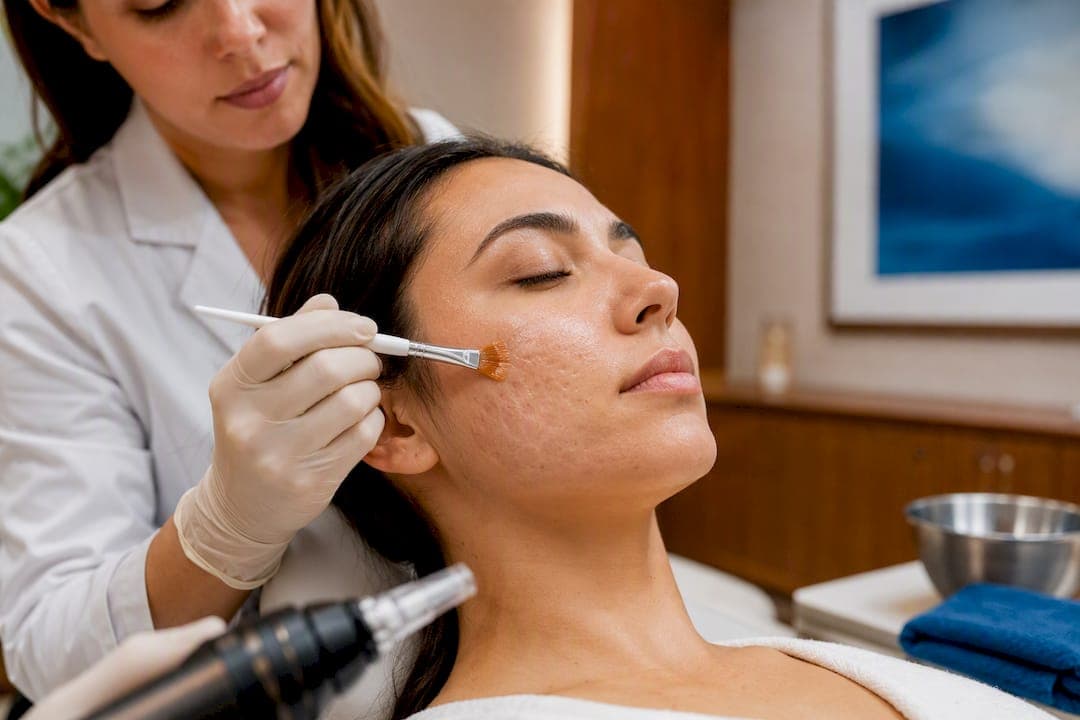
Chemical peels typically work best for surface pigment, sun damage, and fine lines, while microneedling is usually the better call for atrophic acne scars, texture, and pore size. The right pick depends on your skin tone, downtime tolerance, and medical history, and a clinician's assessment matters more than the category label. For stubborn acne scarring, research increasingly points to combining both rather than picking just one.
TL;DR:
- Combining microneedling and chemical peels yields better results for atrophic acne scars than using either treatment alone, especially when scheduled with proper spacing.
- Superficial peels cause minimal downtime and are suitable for surface issues like dullness and sunspots, while medium and deep peels address more extensive damage but require longer recovery.
- RF microneedling with deeper needle settings or RF energy introduces additional risks such as burns, scarring, and nerve damage, which require careful provider experience.
- Treatment choice depends on skin concern, with surface pigment responding best to peels and scarring or pore issues responding to microneedling, but skin tone influences risk of post-inflammatory pigmentation.
- Pricing varies based on treatment depth, provider expertise, and location, and it's crucial to obtain detailed, written estimates and ask about specific protocol details beforehand.
Table of Contents
- Chemical Peel vs Microneedling: How Each Treatment Works
- Which Concerns Fit Which Treatment?
- Recovery Time and Safety Risks Compared
- Sessions, Timeline, and What Drives the Cost
- Combining Peels and Microneedling: What the Evidence Shows
- How to Choose a Provider for Peels or Microneedling
- Inside a Medically Supervised Skin Resurfacing Practice
- How Clinicians Actually Decide Between These Two Treatments
- Book a Personalized Peel or Microneedling Consultation
- Sources
- FAQ
Chemical Peel vs Microneedling: How Each Treatment Works
The two treatments attack skin damage from opposite directions. A chemical peel uses acids to dissolve or injure the outer layers of skin, triggering the body to shed damaged cells and grow smoother tissue in their place, according to the American Academy of Dermatology. Microneedling does the opposite: it creates hundreds of controlled micro punctures that kick off a wound healing response, prompting the skin to rebuild its own collagen and elastin.
Peels come in three depth categories, and the depth changes everything about the result and the recovery:
- Superficial peels use mild acids like glycolic or salicylic acid and barely touch below the top skin layer.
- Medium peels typically use trichloroacetic acid (TCA) and reach the upper dermis.
- Deep peels, often phenol based, penetrate further and produce the most dramatic change, along with the longest recovery.
Microneedling has its own depth variable. Standard rollers or pens adjust needle length from roughly 0.5mm to 2.5mm, and some devices add radiofrequency (RF) energy to heat deeper tissue layers. Neither "peel" nor "microneedling" describes a single treatment. The exact acid, concentration, needle depth, or RF setting determines what you actually get.
Which Concerns Fit Which Treatment?
Matching the treatment to the problem is where most of the confusion sits. Here's how dermatology guidance breaks it down.
Microneedling tends to be the pick for atrophic and rolling acne scars, uneven texture, and enlarged pores. The gradual collagen rebuild it triggers can visibly fade scarring and tighten texture over a series of sessions, per AAD research on microneedling. Most people need multiple sessions before they see the full effect.
Chemical peels generally win for surface pigment, dullness, sun damage, and some fine lines. Melasma is trickier. It responds to peels in many cases, but it's a hormonally driven condition prone to relapse, so a peel that works beautifully one season can need repeating the next.
Wrinkles split down the middle. Peels can smooth fine lines effectively, but deep, static wrinkles usually need something more aggressive than even a strong peel, whether that's a deeper resurfacing approach or an entirely different modality, based on findings from The Aesthetic Society.
- Atrophic/rolling acne scars → microneedling
- Surface pigment and sun spots → chemical peel
- Melasma → chemical peel, with relapse monitoring
- Fine lines → chemical peel; deep wrinkles → often neither alone
Skin tone changes the calculation for both treatments. Darker skin tones face a higher risk of post inflammatory pigment changes with aggressive peels, so agent selection and provider experience matter more than usual.
Pro Tip: Ask your provider to name the exact acid or needle depth they plan to use, not just the treatment category. "TCA peel at 15%" tells you far more than "medium peel."
Recovery Time and Safety Risks Compared
Downtime scales directly with how deep the treatment goes, and that's true for both peels and microneedling.
Superficial peels usually mean little to no visible downtime beyond mild flaking. Medium peels typically peel for about five days, according to AAD guidance on peel recovery, and deep peels can require an extended period of wound care as well as prolonged sun avoidance while new skin matures. Non-RF microneedling generally falls in a one to seven day recovery window, depending on needle depth and how aggressively the provider treats the area.
Common, temporary side effects across both treatments include:
- Redness and swelling for the first day or two
- Flaking or tightness as skin sheds or heals
- Mild sensitivity to sun and skincare products for one to two weeks
Rare but serious risks include infection, scarring, and permanent pigment change. RF microneedling carries its own distinct warning: the FDA issued a safety communication flagging burns, scarring, fat loss, and nerve damage tied to certain RF microneedling uses. That's a meaningfully different risk profile than standard needling, and it's worth asking directly whether a device uses RF energy before you book.
Before either treatment, disclose isotretinoin use, active cold sores, a history of keloid scarring, and recent sun exposure or tanning. Any of these can change whether the treatment is safe to proceed.
Sessions, Timeline, and What Drives the Cost
Microneedling for acne scars usually runs multiple sessions spaced over several weeks, with collagen remodeling continuing to improve results for months after the last visit. Peels split into two paths: a series of superficial peels done every few weeks, or a single medium or deep peel that delivers a bigger result in one sitting, at the cost of more downtime.
Pricing has no fixed universal number. Cost depends on:
- Treatment depth and exact protocol
- Facility type and geographic location
- Provider's experience level
- Whether anesthesia or sedation is used
The American Society of Plastic Surgeons tracks a broad average benchmark for skin resurfacing procedures generally, but that figure isn't a quote for any specific peel or microneedling session. Get a written estimate at consultation rather than relying on a number you saw online.
Combining Peels and Microneedling: What the Evidence Shows

For atrophic acne scars specifically, the research increasingly favors combination therapy over picking one treatment. A systematic review and randomized controlled trials found that pairing microneedling with a chemical peel produced higher responder rates and stronger scar-score improvement than either treatment used alone.
Clinicians don't typically stack both treatments in the same visit. Sequencing them, often weeks apart, reduces the risk of compounding inflammation on skin that's already working to heal. This is also why combination protocols should stay clinician planned rather than something you attempt with over the counter peel kits and a derma roller at home.
- Microneedling + peel outperformed monotherapy for acne scars in trial data
- Staggered scheduling limits inflammation stacking
- FDA guidance notes cleared microneedling devices are not approved to deliver topical drugs or biologics through the punctures they create
How to Choose a Provider for Peels or Microneedling
A good consultation should answer more than "does this work." Bring these questions:
- What exact acid, concentration, or needle depth are you using, and why for my skin?
- What's my realistic downtime, and what does aftercare look like day by day?
- Do you have before and after photos of patients with my skin tone?
- Is anesthesia or numbing involved, and what does that add to the visit?
- What's your plan if I have a reaction or slower healing than expected?
Tell your provider about isotretinoin use in the past six to twelve months, antibiotics, aspirin or blood thinners, cold sore history, and any past scarring from procedures. These change what's safe to do and how aggressive the protocol should be.
Watch for red flags: no medical oversight offered for a deep peel, pressure to book immediately, or a vague answer when you ask about the recovery plan. A provider who can't name their exact protocol is asking you to trust a guess.
Pro Tip: If a clinic hesitates to show you a written aftercare plan before you book, treat that as a decision point, not a formality.
Inside a Medically Supervised Skin Resurfacing Practice
Elite Laser Center Medical Spa builds its resurfacing menu, including chemical peels and RF micro-needling, around FDA-approved technology performed under experienced medical supervision. Every plan is customized rather than pulled from a fixed menu, which matters given how much skin tone, scar type, and downtime tolerance change the right protocol. The center reflects a broader track record in non-surgical treatment delivery across its service lines.
How Clinicians Actually Decide Between These Two Treatments
Providers weigh scar type, skin tone, and how much downtime a patient can realistically absorb before naming a protocol. A single aggressive peel might be tempting, but a staged approach, sometimes microneedling first, sometimes a lighter peel repeated over months, often gets safer, steadier results. That's the real argument for a consult over a quick online decision: your skin's history changes the math every time.
— Sharon
Book a Personalized Peel or Microneedling Consultation
Elite Laser Center treats resurfacing as a medical decision, not a menu pick, which is the real gap in most DIY peel kits and generic spa packages: nobody assessing your scar depth, skin tone, or medication history before you apply anything.

Both chemical peels and RF microneedling at Elite Laser Center are performed under experienced medical supervision, with the protocol built around your scarring pattern, pigment concerns, and downtime window rather than a one-size treatment. If dullness and sun damage are the main issue, the HydraFacial and peel menu covers lighter resurfacing options alongside deeper peel protocols. Members of the Skin Care Club get ongoing access to treatments that support results between sessions. Book a consultation to get a specific recommendation for your skin instead of guessing between two categories that both cover a wide range of actual protocols.
This article is general information, not a substitute for advice from a qualified doctor. Consult a qualified healthcare professional about your own circumstances before acting on anything here.
Sources
- Chemical peels: Overview — American Academy of Dermatology (AAD)
- Double-blind RCT and related trials: microneedling + chemical peel vs monotherapy — PMC
- Deep chemical peels — The Aesthetic Society / American Society of Plastic Surgeons
FAQ
Should I do a chemical peel or microneedling first?
It depends on your primary concern: surface pigment and sun damage usually point to a peel first, while textural scarring points to microneedling first. A provider typically sequences the two rather than combining them in a single visit to avoid stacking inflammation.
Why does my skin look older after microneedling?
Temporary swelling, redness, and crusting right after microneedling can make skin look worse before it improves, since the treatment relies on a controlled wound healing response. This is expected during the first several days and should resolve within the typical recovery window rather than persist.
Will a chemical peel get rid of deep wrinkles?
Superficial and medium peels mainly improve fine lines and surface texture, not deep static wrinkles. Deep chemical peels can produce more dramatic improvement but come with significantly longer recovery and higher complication risk.
What's better than microneedling for acne scars?
For atrophic acne scars, research suggests combining microneedling with a chemical peel often works better than either treatment alone, based on randomized trial data. Neither treatment alone is guaranteed to outperform the other. It comes down to scar type and provider protocol.
How much does microneedling or a chemical peel usually cost?
There's no fixed universal price for either treatment, since cost depends on depth, provider experience, and location. Elite Laser Center's current pricing for RF micro-needling and chemical peels is available directly on the site.
Recommended
- Skin Type Categories and Aesthetic Treatments: 2026 Guide
- Types of Medical Spa Skin Treatments: 2026 Guide
This article was produced with AI assistance and reviewed for accuracy. It is provided for general information, and it is not professional advice.