
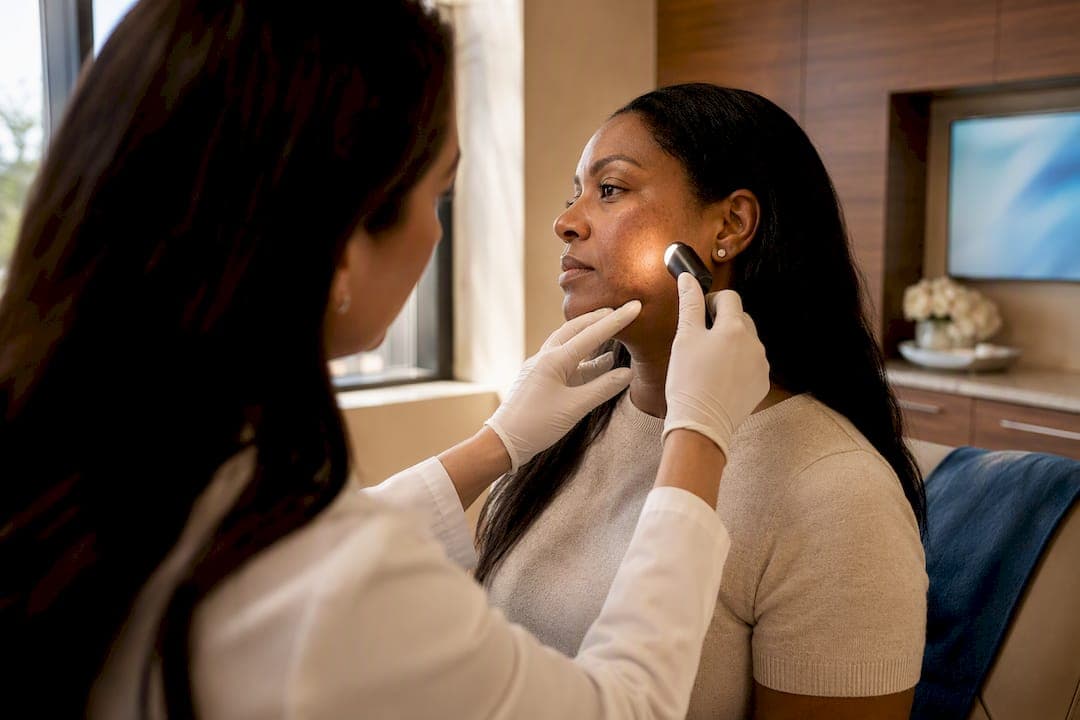
Yes. Appropriately selected chemical peels can reduce many kinds of hyperpigmentation, including sun spots, post-inflammatory marks, and melasma. They work best as a staged, clinician-supervised program rather than a single fix, paired with topical maintenance and strict daily sun protection. The one caveat that matters most: darker skin tones carry a real risk of post-inflammatory hyperpigmentation from overly aggressive peeling, which is why medical supervision changes the outcome.
TL;DR:
- Lighter peels, usually performed in a series of three to six sessions spaced three weeks apart, effectively treat mild hyperpigmentation with minimal recovery time.
- Medium-depth peels can target more stubborn discoloration in fewer treatments but require longer healing periods and are less suitable for darker skin tones due to increased PIH risk.
- Deep peels provide dramatic results in a single session but come with significant downtime and safety concerns, making them less common for hyperpigmentation.
- Combining chemical peels with topical therapies such as hydroquinone or retinoids and strict sun protection greatly enhances long-term outcomes.
- Professional supervision and personalized treatment plans reduce the risk of hyperpigmentation recurrence or adverse effects, especially for darker skin types or complex pigment issues.
Table of Contents
- How Chemical Peel Depth Determines Results for Hyperpigmentation
- Which Ingredients and Concentrations Actually Target Dark Spots
- How Many Peel Sessions Does Hyperpigmentation Actually Need?
- Matching Peel Choice to Your Skin Type and Pigment Cause
- Why Post-Inflammatory Hyperpigmentation Is the Risk to Watch
- Peels, Topicals, and Lasers: What the Evidence Actually Supports
- What Happens During a Peel Appointment and How to Recover Well
- Elite Laser Center's Clinical Approach to Pigment Correction
- Is a Chemical Peel Right for Your Pigment Right Now?
- Book a Peel Consultation Built Around Your Skin Type
- Sources
- FAQ
How Chemical Peel Depth Determines Results for Hyperpigmentation
A chemical peel works by creating a controlled injury to the skin, which triggers the shedding of damaged, pigment-carrying cells and stimulates fresher skin underneath. The acid essentially tells the outer layers of skin to let go faster than they normally would, taking discolored cells with them. That mechanism is identical across peel types. What changes is how deep the acid travels, and depth is the single biggest factor in how much pigment correction you'll actually see.
Superficial, or light, peels only affect the epidermis, the skin's outermost layer. Glycolic acid, lactic acid, and low-strength salicylic acid peels fall into this category. They're the workhorse for early sun spots, uneven tone, and mild post-inflammatory marks. Recovery is minimal, typically several days of light flaking or pinkness, according to the Mayo Clinic's overview of chemical peel depth and recovery. You can usually return to normal activity the same day.
Medium peels, most often trichloroacetic acid (TCA) at moderate concentrations, reach into the upper dermis. This is where clinicians target more stubborn discoloration: deeper sun damage, some forms of melasma, and acne scarring with associated pigment change. Expect more visible peeling, several days of redness, and a longer window before makeup can fully cover the skin.
Deep peels, using higher-concentration phenol formulations, reach the mid-dermis and produce the most dramatic changes in texture and pigment. They're also the least commonly used for routine hyperpigmentation because the tradeoff is steep. Initial healing takes about two weeks, and redness can linger for an extended period in some patients, per the same Mayo Clinic data. Deep peels are typically a one-time procedure rather than part of a repeated series, which matters when you're planning around work, travel, or events.
Here's the part most people miss when they're peel shopping: matching depth to problem is not a strength contest. Going deeper does not mean better results for every kind of hyperpigmentation. Melasma, in particular, can worsen with aggressive peeling because it's driven by hormonal and inflammatory triggers, not just surface pigment. A superficial peel repeated on a schedule often outperforms a single aggressive one for this specific condition, which is one reason clinicians favor staged treatment over a one-and-done approach.
Which Ingredients and Concentrations Actually Target Dark Spots
Not all acids do the same job, and the concentration a clinic uses matters as much as which acid is on the label.
Glycolic acid is an alpha hydroxy acid (AHA) that works at the skin's surface, loosening the bonds between dead cells so they shed faster. It's the most studied option for facial melanosis and sun-related dark spots, and clinical concentrations typically run from 20% up to 70%, with most therapeutic protocols landing in the 30% to 50% range for a series of treatments. A randomized trial found that multiple sessions of glycolic acid peels at regular intervals, combined with topical therapy, produced a statistically significant improvement in melasma and facial melanosis by week 12, compared with topical treatment alone, according to a study published in the Journal of Cutaneous and Aesthetic Surgery.
Lactic acid, another AHA, tends to be gentler and better tolerated in drier or more reactive skin, making it a common choice for early-stage priming.
Salicylic acid, a beta hydroxy acid (BHA), is oil-soluble, which lets it penetrate clogged pores. That makes it a strong fit for post-inflammatory hyperpigmentation tied to acne, since it treats the underlying breakouts while also addressing the pigment left behind.
TCA sits in the medium-depth category and is chosen when a clinician needs more correction than an AHA can deliver, but without the extended downtime of phenol.
Phenol is reserved for deep peels and isn't typically the first, second, or even third-line choice for routine hyperpigmentation given the recovery demands and the fact that lighter methods usually get the job done with less risk.
Concentration selection is a clinical judgment, not a fixed formula. A dermatology provider weighs your skin type, the type of pigment problem, how your skin reacted to any prior peels, and how much downtime you can tolerate. This is precisely where at-home products create trouble. The FDA has warned that high-strength chemical peel products sold directly to consumers, including high-concentration TCA and lactic acid formulations, have caused serious burns, scarring, and permanent pigment changes when used without supervision, in a warning letter targeting online sellers of professional-grade peels. The agency also requires "Sunburn Alert" labeling on AHA-containing cosmetics, since these acids increase sun sensitivity during use and for roughly a week after stopping, per FDA guidance on AHA labeling.

How Many Peel Sessions Does Hyperpigmentation Actually Need?
There's no single number, but the pattern by depth is consistent across clinical practice.
Light peels are built around repetition. A typical course runs three to six sessions, spaced two to four weeks apart, allowing the skin to fully recover between treatments while cumulative acid exposure gradually lifts pigment. This spacing isn't arbitrary. Skin needs time to regenerate, and rushing the schedule raises irritation risk without speeding up results.
Medium peels usually need far fewer visits, often just one to three sessions, but each one carries longer recovery and requires more spacing between treatments to let the deeper injury heal properly.
Deep peels are typically a single procedure. The depth of injury is enough to produce lasting change in one pass, which is also why the recovery period stretches so much longer.
The clearest evidence for a defined protocol comes from that same glycolic acid trial: four sessions of 35% glycolic acid peels at three-week intervals, layered onto a standardized topical regimen, delivered measurable improvement in melasma and facial melanosis scores by the 12-week mark, outperforming topical therapy used alone. That's a useful benchmark for anyone wondering what a realistic timeline looks like. Twelve weeks, not two.
Melasma tends to need the longest runway of any pigment condition, partly because it's driven by hormonal and heat-related triggers that keep resupplying pigment even as you treat it. Sun spots and superficial post-inflammatory marks often respond faster, sometimes showing visible fading within the first two or three sessions of a light peel series. Severity, skin type, and how consistent you are with sunscreen between visits all shift these numbers, which is exactly why a clinician sets the schedule rather than a generic chart.
Matching Peel Choice to Your Skin Type and Pigment Cause
The Fitzpatrick scale classifies skin into six types based on how it responds to sun exposure, ranging from Type I (pale, always burns) to Type VI (deeply pigmented, rarely burns). This scale matters enormously for peel selection because it correlates directly with post-inflammatory hyperpigmentation risk. The more melanin-active your skin is, the more reactive it can be to inflammation, including the controlled inflammation a peel creates.
Dermatology guidance is direct about this: patients with Fitzpatrick IV through VI should generally start conservative. Glycolic and lactic acid peels are considered relatively safer choices in skin of color, provided they're used with proper priming and maintenance, according to a clinical review on chemical peels in dark-skinned patients. "Priming" means applying agents like retinoids or mild tyrosinase inhibitors for several weeks before the first peel, which conditions the skin and reduces the inflammatory response during treatment.
Escalating too fast is the most common mistake. A patient with Type V skin who jumps straight into a medium-depth TCA peel without priming is taking on meaningfully more PIH risk than one who spends a month on preparatory topicals first. Clinical practice favors this gradual approach specifically because it front-loads safety instead of chasing speed, according to American Academy of Dermatology guidance on melasma treatment.
If your pigment issue is mixed, some melasma layered over sun damage, for instance, or long-standing acne scarring with active breakouts, a peel alone may not be the right first move. That's a case for an in-person evaluation rather than guessing which acid to try next, since the diagnosis itself changes the treatment plan.
Why Post-Inflammatory Hyperpigmentation Is the Risk to Watch
PIH is the most common complication tied to chemical peels for pigment problems, and understanding why it happens helps explain the safety rules around it. When skin experiences inflammation, whether from a peel, an injury, or a breakout, melanocytes in darker skin types tend to respond by producing extra pigment. That means the very treatment meant to fade dark spots can, if done too aggressively, create new ones.
Other risks include prolonged redness, unexpected scarring, infection, and in rarer cases hypopigmentation, where skin loses too much pigment and develops lighter patches. Deep peels carry the highest risk profile across all of these categories, which is part of why they're used sparingly for pigment concerns specifically.
Clinicians reduce PIH risk through a consistent set of practices:
- Priming skin for two to four weeks with retinoids or mild tyrosinase inhibitors before the first peel
- Performing a test spot on a small area before committing to full-face treatment
- Choosing conservative acid concentrations for higher-risk skin types rather than defaulting to standard strength
- Requiring strict sun avoidance and daily sunscreen before and after every session
- Spacing sessions appropriately so skin fully recovers before the next treatment
Pro Tip: If you're using an at-home retinoid or acid product and notice new darkening, redness that won't settle, or unusual sensitivity, stop the product and get evaluated in person before adding a professional peel on top. Layering a clinical peel onto skin that's already irritated is one of the more common ways PIH gets triggered.
Peels, Topicals, and Lasers: What the Evidence Actually Supports
Chemical peels rarely work best as a stand-alone fix. The same randomized trial that established the four-session, 35% glycolic acid protocol also showed the treatment worked significantly better when layered onto standardized topical therapy than either approach used by itself. That combination, peel plus consistent topical treatment, is the closest thing dermatology has to a proven formula for facial melanosis, and it's backed by clinical trial evidence rather than anecdote.
Topical maintenance typically includes hydroquinone, retinoids like tretinoin, or other tyrosinase inhibitors that slow new pigment production, along with daily broad-spectrum sunscreen. Peels rarely cure chronic pigment disorders on their own; they accelerate cell turnover while the topical regimen keeps new pigment from replacing what's been treated. Skip the topicals and sunscreen, and a lot of the peel's benefit gets undone within weeks.
How do peels stack up against laser treatment for the same problem? Meta-analysis data shows lasers often produce faster reductions in melasma severity, but they also carry a meaningfully higher risk of adverse effects, particularly PIH, compared with chemical peels, according to a comparative meta-analysis published in the Journal of Cosmetic Medicine. For pigment-prone or darker skin specifically, that tradeoff often favors the slower, safer route. Speed isn't the only variable worth optimizing for when a bad outcome means new dark patches instead of fewer.
A sensible sequence looks like this: prime the skin with topicals, proceed with a peel series matched to your skin type and pigment cause, then maintain results with ongoing topical treatment and daily sun protection. Skipping any one of those three steps tends to shorten how long results last.

What Happens During a Peel Appointment and How to Recover Well
A professional peel visit follows a fairly predictable structure, and knowing it in advance takes most of the anxiety out of a first appointment.
- Medical history review. Your provider asks about pregnancy status, recent isotretinoin use, active skin infections, autoimmune conditions, and any prior reaction to peels or topicals.
- Skin priming assessment. If you haven't already been on a preparatory retinoid or tyrosinase-inhibitor regimen, your provider may delay the peel until your skin is properly primed, especially for Fitzpatrick IV through VI.
- Patch test, if indicated. A small test area confirms your skin tolerates the chosen acid and strength before full application.
- Application. The acid is applied in even layers, and you'll likely feel tingling, warmth, or mild stinging depending on concentration. Your provider watches the skin's color change closely, since that's how they judge peel depth in real time.
- Neutralization, when applicable. Some acids, glycolic acid in particular, are neutralized with a specific solution to stop the reaction at the right point.
- Immediate aftercare instructions. You leave with a written plan covering cleansing, moisturizing, and sun protection for the coming days.
Aftercare in the following days typically includes gentle cleansing, a bland moisturizer, strict avoidance of retinoids or exfoliants until cleared, and daily sunscreen without exception. Watch for red flags: blistering, pain that worsens rather than improves, pus, or fever, all warrant a call to your provider rather than waiting it out.
Elite Laser Center's Clinical Approach to Pigment Correction
Chemical peels should be treated as a staged, medically supervised process rather than a single transaction. Peels are typically customized to skin type, pigment diagnosis, and prior treatment history, and performed under medical supervision rather than by a technician working off a fixed protocol.
The typical workflow mirrors the safety practices outlined earlier in this piece. A consultation establishes your Fitzpatrick type and the likely cause of your pigment, whether that's sun exposure, melasma, or post-acne marks, before any acid touches your skin. From there, providers can layer in complementary Hydrafacial and resurfacing options alongside a peel series, since combination approaches consistently outperform single treatments in the pigment literature.
Clients considering a chemical peel program can review the Skin Care Club membership for ongoing maintenance between sessions, an important detail given that peels work best as part of a longer plan rather than a one-time event. Case-specific results and detailed testimonials from clients treated for hyperpigmentation may be available through direct consultation with medical staff at treatment centers.
Is a Chemical Peel Right for Your Pigment Right Now?
Before booking, run through this short checklist. You want a clear diagnosis of what's actually causing your discoloration, not just a guess. You need to know your Fitzpatrick type, since that changes which acid and strength are appropriate. You have to be honest about whether you'll commit to daily sunscreen and a multi-session schedule, because inconsistency undercuts results fast.
Seek an in-person consult rather than self-treating if you have mixed pigment causes, a history of PIH from any prior treatment, are pregnant, or have used isotretinoin in the past six to twelve months. Any one of those factors changes the safest path forward, and a clinician needs to see your skin directly to set it.
— Sharon
Book a Peel Consultation Built Around Your Skin Type
Elite Laser Center Medical Spa is the clinician-supervised alternative to the high-strength, direct-to-consumer peels the FDA has specifically warned against. Every treatment plan starts with an assessment of your skin type and pigment cause, not a fixed-strength product pulled off a shelf.
Consultations cover chemical peels and skin resurfacing, Hydrafacial and DiamondGlow treatments, and how these can be sequenced or combined based on whether your pigment is sun-related, hormonal, or post-inflammatory. A provider will walk you through expected sessions, spacing, and realistic timelines before you commit to anything, and explain how priming and maintenance fit into your specific plan. For readers layering in their own topical actives at home between visits, resources like this guide to combining peptides with AHAs and BHAs are worth reviewing so your at-home routine supports rather than fights your in-office results. Book a consultation through the facials and peels page to get a personalized assessment of your skin and a treatment schedule built around it, not a generic one.
This article is general information, not a substitute for advice from a qualified doctor. Consult a qualified healthcare professional about your own circumstances before acting on anything here.
Sources
- Efficacy of glycolic acid peels in combination with topical therapy in common facial melanosis: A randomized clinico-dermoscopic study
- Comparative meta-analysis: lasers vs peels for melasma and hyperpigmentation (Journal of Cosmetic Medicine, 2024)
- Chemical peel — Mayo Clinic
- Amazon.com, Inc. — FDA warning letter concerning sale of high-strength chemical peels
FAQ
Which is the best chemical peel for hyperpigmentation?
There's no single best peel for every case. Glycolic acid peels have the strongest clinical trial support for melasma and facial melanosis, especially when combined with topical therapy, per the randomized study on combination treatment, while salicylic acid tends to fit acne-related dark marks better. A clinician matches the acid to your specific pigment cause and skin type.
What fades hyperpigmentation fastest?
Lasers generally produce faster visible reductions in pigment severity than chemical peels, but they carry a higher risk of complications like PIH, according to comparative meta-analysis data. For most patients, especially those with darker skin, a staged peel series combined with topical treatment offers a safer, if slower, path to the same result.
Who cannot get a chemical peel?
Peels are generally not recommended for people who are pregnant, have an active skin infection or open wound, or have used isotretinoin within the past several months. Anyone with a history of severe PIH from a prior treatment should also get an in-person evaluation before scheduling one.
What are the downsides of a chemical peel?
The main risks are post-inflammatory hyperpigmentation, prolonged redness, and in rare cases scarring or hypopigmentation, with deeper peels carrying the highest risk. Unsupervised use of high-strength, at-home peel products has led to serious burns and permanent pigment changes, which is why the FDA has warned against consumer use of professional-grade peels.
Recommended
- Chemical Peels & Skin Resurfacing Stony Brook NY | Elite Laser
- Medical Supervision in Skincare: Why It Matters
- What Is Skin Brightening Treatment? Your 2026 Guide
This article was produced with AI assistance and reviewed for accuracy. It is provided for general information, and it is not professional advice.