
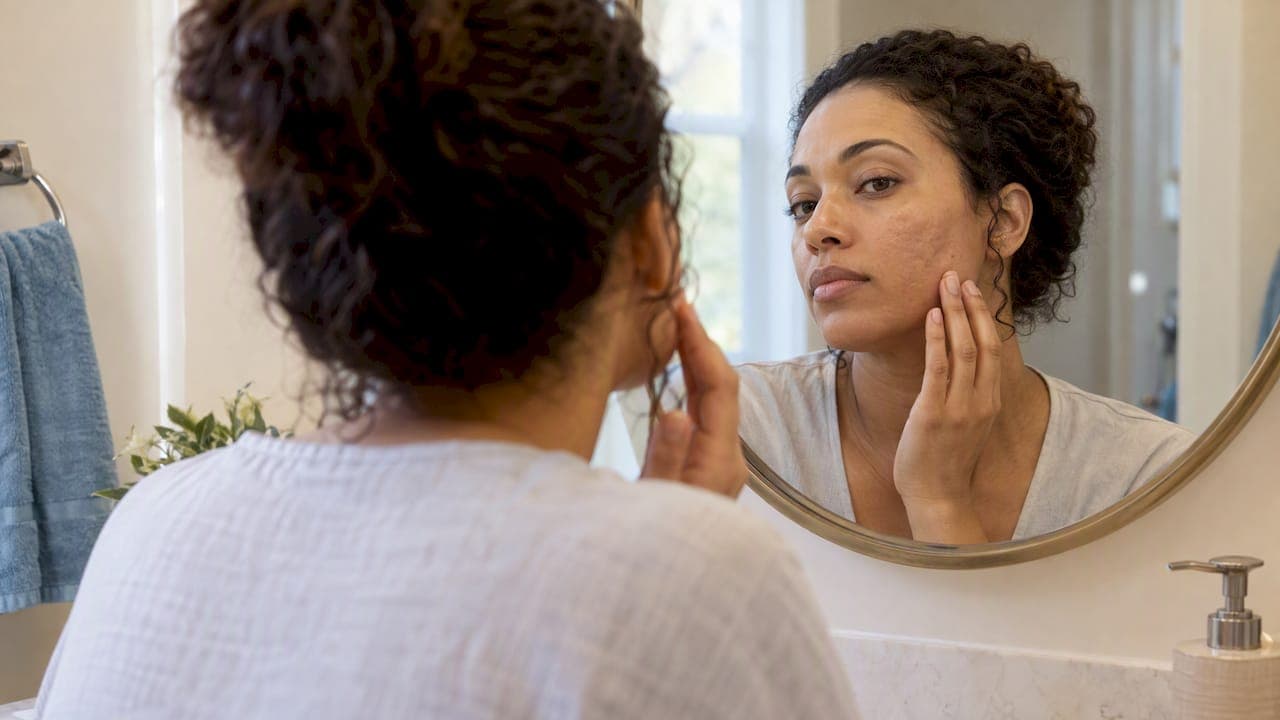
Acne can leave behind several different concerns: flat discoloration, small depressions, uneven texture, or raised scars. Finding the right treatment starts with identifying which changes you have.
A chemical peel may help improve post-acne discoloration and selected texture concerns. It should not be presented as a way to erase every scar. At Elite Laser Center & Med Spa in Stony Brook, a consultation helps determine whether a peel fits your goals or whether another approach deserves consideration.
Are You Seeing Acne Marks or Acne Scars?
Flat brown or grayish marks after a breakout often involve post-inflammatory hyperpigmentation, or PIH. These are pigment changes rather than indentations. Red or pink marks also need assessment; color alone does not establish the cause or the right treatment.
Structural scars change the skin's contour. Ice pick scars are narrow and deep, rolling scars create broader dips, and boxcar scars have more defined depressions. Hypertrophic scars and keloids are raised. A person can have more than one type, alongside discoloration.
The American Academy of Dermatology's acne-scar guide explains why flat spots and scars require different expectations. Photographs can help document concerns, but a selfie or a finger test cannot replace an examination.
What Can a Chemical Peel Improve?
Professional chemical peeling uses a selected formulation to produce controlled exfoliation and skin renewal. Depending on the treatment, it may improve uneven tone, superficial texture, and the appearance of some depressed scars. Results depend on scar depth, formulation, skin response, and provider experience.
The AAD includes chemical peels among acne-scar treatments, often as part of an individualized plan. That does not mean a routine facial peel will remove deep pits or raised tissue. More peeling is not proof of a better result.
If new breakouts are continuing, acne management may need to come first to help prevent additional scars. Your plan should address what is happening now as well as what earlier breakouts left behind.
Chemical Peel Options at Elite Laser Center
Elite's professional chemical-peel services include several formulations with different goals:
| Option | Concerns to discuss during consultation |
|---|---|
| VI Peel Original or Advanced | Overall tone, texture, and selected rejuvenation goals |
| VI Peel Precision Plus | Pigmentation and uneven tone |
| VI Peel Purify | Acne-prone or congested skin |
| VI Peel Purify with Precision Plus | Acne-related concerns together with post-breakout pigmentation |
| SkinMedica Illuminize, Vitalize, or Rejuvenize | Different intensities of professional exfoliation and resurfacing |
| SkinCeuticals Red Carpet Peel | Professional MicroPeel for dullness and selected tone or texture concerns |
These are options for assessment, rather than interchangeable acne-scar treatments. VI Peel involves visible shedding that commonly begins several days after application. Plan around the specific product's recovery instructions.
When Might RF or Another Treatment Be Considered?
If depressions and texture are the main concern, your consultation may include discussion of Legend Pro+ RF treatment. Elite uses the Lumenis Legend Pro+ platform, with RF-based technologies selected according to the treatment goal. VoluDerm uses RF-assisted electrodes to create controlled microchannels and thermal effects that support skin remodeling.
RF is not automatically the next step after a peel, and it is not interchangeable with traditional microneedling. Treatment intensity, recovery, suitability, and cost need separate discussion.
The FDA's RF microneedling safety communication describes reports of serious complications with certain uses, including burns, scarring, fat loss, disfigurement, and nerve damage. Ask about the device, provider training, anticipated benefit, and alternatives.
Deep, tethered, or raised scars may warrant a dermatologist's assessment. Some scars need specialist techniques rather than repeated surface treatments. A recommendation for referral can be a useful outcome of your consultation.
Preparing for Your Consultation
Bring your skincare and medication lists, including current or recent acne treatments. Mention previous peels, resurfacing procedures, reactions, cold sores, unusual scarring, and pigment changes after irritation. Also discuss pregnancy, breastfeeding, recent tanning, and upcoming events.
The AAD's peel-preparation guidance emphasizes reviewing your health history and treatment goals. Ask what preparation is needed and which products to pause or restart. Keep prescription changes coordinated with your prescriber.
For medium and darker skin tones, ask specifically about the provider's experience treating similar skin. An overly aggressive treatment can create lasting pigment changes. The strongest available peel is not necessarily the appropriate choice.
Recovery and Aftercare
Recovery varies. The AAD's chemical-peel FAQs describe healing periods of approximately one to seven days for light peels and seven to fourteen days for medium peels. These are general categories, not a promised timeline for a particular product or person.
Follow your written instructions for cleansing, moisturizer, sun protection, makeup, and returning to active skincare. Avoid picking flakes or adding scrubs to speed shedding. Contact your treating provider about burning, increasing swelling, significant pain, or other unexpected symptoms.
Skip high-strength home experiments. The FDA warns against unsupervised chemical-peel products because they can cause severe burns, infection, permanent pigment changes, and scarring. Professional supervision matters even when a product is easy to buy online.
Build a Plan Around Your Skin
Before committing to a series, ask what the first treatment is intended to improve, when progress will be reassessed, and what would change the recommendation. Request a written estimate that identifies the treatment and any recommended follow-up.
For clients in Stony Brook and throughout Suffolk County, a useful starting point is a clear assessment of marks, texture, and ongoing breakouts. Schedule a personalized skin consultation at Elite Laser Center & Med Spa or call (631) 675-2500.

Frequently Asked Questions
Can chemical peels remove acne scars completely?
Complete removal should not be promised. A peel may improve selected discoloration, texture, or depressed scars, but deep or raised scars often need a different treatment plan.
Are dark acne marks the same as scars?
No. Flat dark marks often involve post-inflammatory hyperpigmentation. Scars change the skin's contour. Discoloration and structural scars can occur together, so an assessment helps identify both.
Is RF microneedling always better than a peel?
No. Elite's Legend Pro+ RF treatments and chemical peels address different goals and have different risks and recovery. Your provider should explain why either option fits your particular concerns.
Can I combine a chemical peel with microneedling?
Combination treatment requires a specific professional protocol. Do not assume separate services can safely be performed together. The provider must assess suitability, timing, and recovery, and distinguish traditional microneedling from RF treatment.
How far apart should chemical peels be scheduled?
There is no universal interval. Timing depends on the formulation, treatment intensity, skin recovery, and your provider's protocol. Let the skin recover and follow the recommended schedule rather than booking by peeling alone.
How much does treatment cost at Elite?
Pricing depends on the selected treatment and whether a series is recommended. Call (631) 675-2500 or request a consultation for current pricing and an individualized estimate.
Sources
-
American Academy of Dermatology: Acne scars—signs and symptoms
-
American Academy of Dermatology: Acne scars—consultation and treatment
Prepared with AI assistance for editorial and clinical review before publication. This article provides general education and does not replace individualized medical advice. Treatment suitability, results, and recovery vary.