

For most people seeking real, long-term hair reduction, professional laser treatment is the better choice. Clinical data shows professional diode lasers can achieve around 85.5% permanent hair reduction in five sessions, a result consumer devices rarely match. Here's why the gap exists:
- Professional clinics use medical-grade diode, alexandrite, and Nd:YAG lasers with calibrated energy settings, active cooling, and trained clinicians who adjust treatment to your skin tone and hair type.
- At-home devices are FDA-cleared for consumer use, but most rely on IPL technology at lower energy levels, which produces slower and less complete results.
- Clinics like Elitelaserhair operate under medical supervision, which reduces the risk of burns, pigment changes, and missed candidacy issues.
That said, at-home devices are a reasonable trade-off if you have fair-to-medium skin with dark hair, a small treatment area, and the patience for a longer regimen. For everyone else, especially those with darker skin tones or larger areas to treat, professional care is worth the investment.
Pro Tip: Before buying any at-home device, check that it carries an FDA-clearance number (not just "FDA-registered"), includes a skin-tone sensor, and lists compatible Fitzpatrick skin types in its documentation.
Table of Contents
- How at-home IPL devices and professional lasers actually work
- What results you can realistically expect from each option
- Safety, side effects, and who should not use each option
- Cost and time: what you actually spend over the long run
- Quick side-by-side: at-home vs professional laser
- How to choose: the right questions to ask before you commit
- When an at-home device is a reasonable choice
- What to expect from professional care at Elitelaserhair
- Regulatory standards: what the FDA actually requires from each option
- Key Takeaways
- The case for slowing down before you buy
- Ready to skip the guesswork? Book a consultation at Elitelaserhair
- Sources and further reading
How at-home IPL devices and professional lasers actually work
The technology gap between a $300 consumer device and a clinic laser is wider than most people expect.
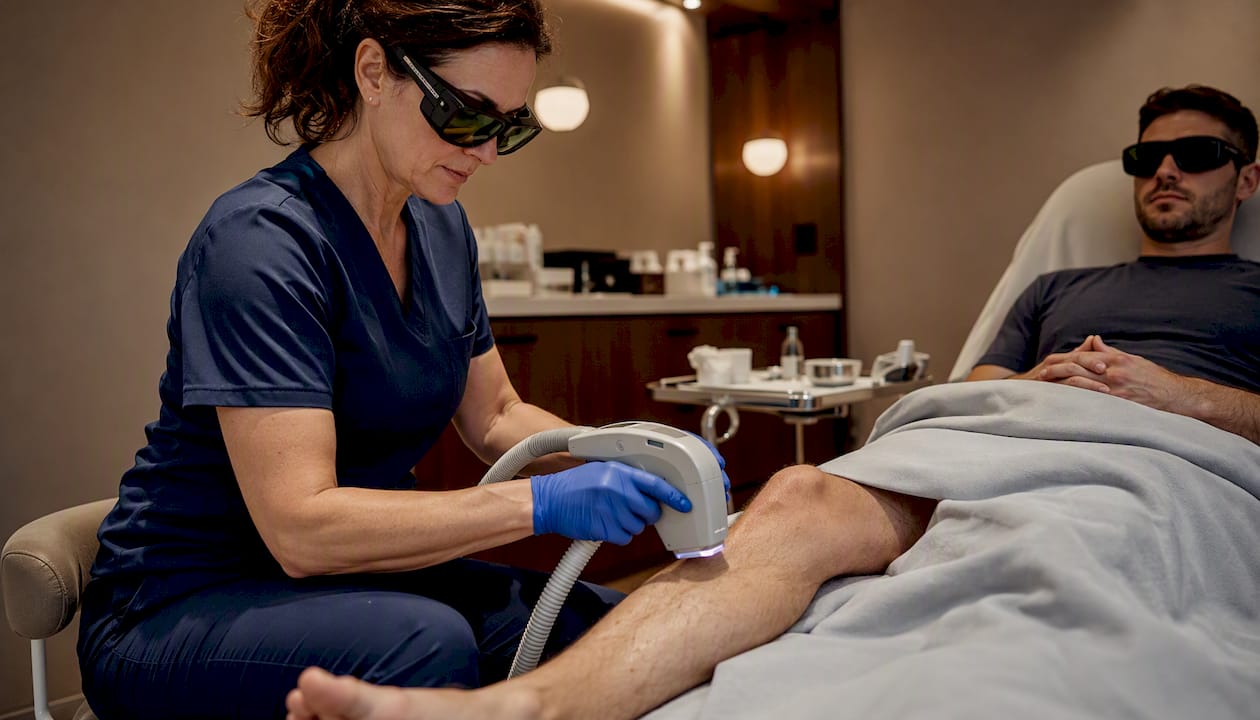
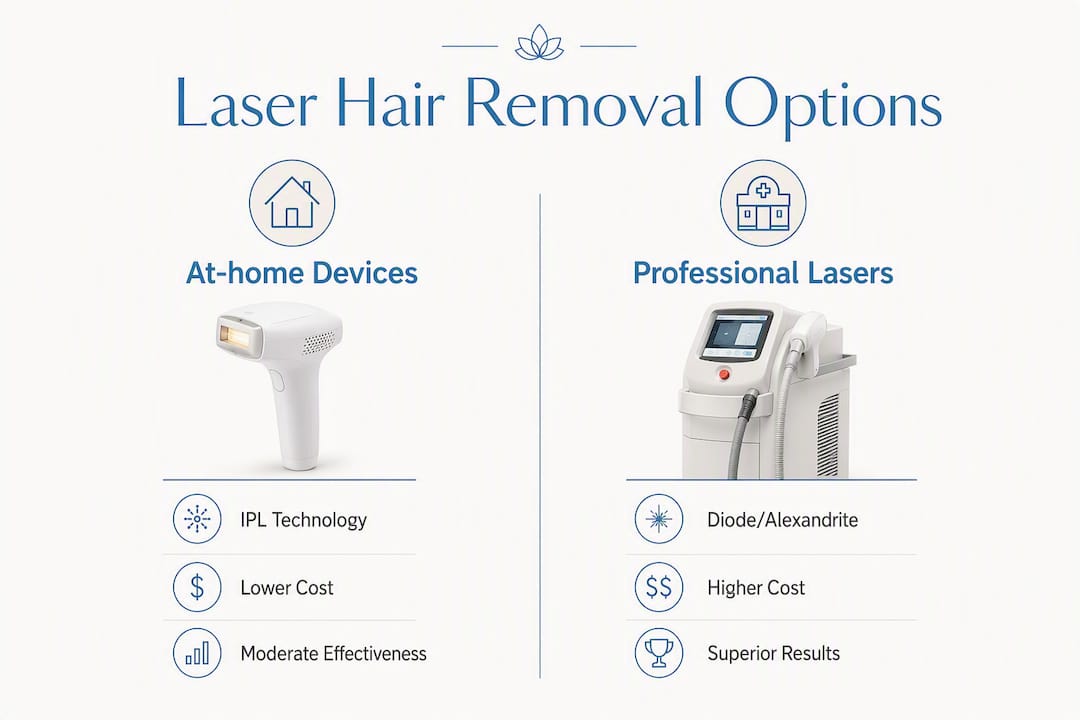
At-home devices are almost always IPL, which stands for intense pulsed light. IPL emits a broad spectrum of scattered wavelengths rather than a single focused beam. That broad scatter means the energy is less precisely targeted at the hair follicle and more dependent on strong contrast between dark hair and light skin. Consumer-level devices typically operate at lower energy densities, which tends to push follicles into temporary dormancy rather than permanently deactivating them.
Professional lasers work differently. A diode laser fires at a single wavelength (typically 800–810 nm) that penetrates to the exact depth of the hair follicle. An alexandrite laser (755 nm) works well on lighter skin tones with fine hair. An Nd:YAG laser (1064 nm) bypasses surface melanin, making it the safest option for darker skin tones. Clinicians can also adjust pulse duration, spot size, and energy density per session based on how your skin responds.
| Feature | IPL (at-home) | Diode | Alexandrite | Nd:YAG |
|---|---|---|---|---|
| Wavelength focus | Broad spectrum | Single (800–810 nm) | Single (755 nm) | Single (1064 nm) |
| Typical power | Low–moderate | High | High | High |
| Skin-tone suitability | Fitzpatrick I–IV | I–V | I–IV | I–VI |
| Best clinical use | Maintenance, lighter tones | General hair removal | Fine hair, lighter tones | Darker skin tones |
Active cooling is another dividing line. Professional handpieces often integrate contact cooling or cryogen spray, which protects the skin surface while the laser energy reaches the follicle. Most at-home devices have minimal or no active cooling, which is one reason burns and irritation are more common with consumer use.
Pro Tip: When evaluating an at-home device, look for three things on the spec sheet: an FDA-clearance number (not just "FDA-registered"), a built-in skin-tone sensor that locks out unsafe settings, and at least three adjustable energy levels.
What results you can realistically expect from each option
Professional treatments consistently outperform at-home devices on both speed and depth of reduction. Clinical studies support around 85.5% permanent hair reduction after five professional diode laser sessions for suitable candidates. Consumer IPL devices can produce measurable reduction, but results vary significantly by model, user technique, and skin-hair contrast, as Consumer Reports testing of multiple devices confirmed.
Hair grows in cycles: anagen (active growth), catagen (transition), and telogen (resting). Laser energy only affects follicles in the anagen phase, which is why multiple sessions spaced weeks apart are non-negotiable for both options. Skipping sessions or spacing them too far apart lets resting follicles re-enter the growth cycle untreated.
Typical timelines:
- Professional laser: 6–8 sessions spaced 4–6 weeks apart, with occasional maintenance once or twice a year. Most people see significant reduction after sessions 3–4.
- At-home IPL/laser (e.g., Tria Hair Removal Laser, Philips Lumea, Silk'n devices): 8–12 initial sessions spaced 2–4 weeks apart, followed by monthly or bimonthly maintenance indefinitely. Results plateau at a lower reduction percentage than professional treatment for most users.
Hormonal factors, polycystic ovary syndrome, and certain medications can cause regrowth regardless of which method you use. Clinics can identify these variables at consultation and adjust the plan. A consumer device cannot.
Key stat: A small 2010 clinical trial using a portable IPL unit administered by a professional reported 95% hair reduction across six biweekly sessions in 20 participants. Consumer self-application of the same device category produces far less predictable outcomes, underscoring that operator skill matters as much as the device itself.
Safety, side effects, and who should not use each option
Both options carry real risks, but the risk profile is different. Common side effects for at-home devices include minor redness and irritation at the low end, and moderate to severe burns, hyperpigmentation, and hypopigmentation when instructions are not followed. Professional treatments share some of those risks, but trained clinicians reduce them through candidacy screening, patch testing, and real-time adjustments.
"Professional clinics use sophisticated laser systems and can treat patients of any skin color safely when properly configured, while many at-home devices limit skin-tone suitability." — Cleveland Clinic
Darker skin tones face the highest risk with at-home devices. IPL's broad spectrum struggles to distinguish hair pigment from skin pigment on Fitzpatrick skin types V and VI, raising the risk of surface burns and permanent discoloration. Professional Nd:YAG lasers are specifically configured for darker tones under medical oversight, which is why clinic treatment is strongly preferred for those skin types.
Who should see a clinician before any laser or IPL attempt:
- Fitzpatrick skin types V–VI (deep brown to black skin)
- Anyone with a recent tan or sunburn
- People with inflammatory skin conditions (active eczema, psoriasis, rosacea)
- Those with a history of keloid scarring
- Anyone with increased light sensitivity or taking photosensitizing medications
Body areas to avoid with at-home devices: around the eyes, over tattoos, on inflamed or broken skin, and directly over bony prominences.
Pro Tip: A professional candidacy assessment before your first session, whether at a clinic or before purchasing a device, is the single most effective way to avoid a preventable complication.
Cost and time: what you actually spend over the long run
Upfront, at-home devices look cheaper. A Tria Hair Removal Laser retails around $400–$500; Philips Lumea and Silk'n devices typically run $200–$350. Some require replacement cartridges, which add ongoing cost. Professional per-session pricing varies by area and market, but a full-body package at a reputable clinic can run into the thousands.
The math shifts when you factor in long-term maintenance. At-home devices require indefinite monthly or bimonthly touch-ups to maintain results. Professional packages often include follow-up sessions, and the higher reduction rate means fewer maintenance appointments over time.
| At-home device | Professional laser | |
|---|---|---|
| Upfront cost | Typically lower | Typically higher per session (varies by area) |
| Sessions required | Multiple initial sessions plus ongoing maintenance | Several sessions plus occasional annual touch-up |
| Time per large area | 45–90 min (small applicator) | 20–45 min (large-spot handpiece) |
| Maintenance frequency | Monthly to bimonthly, indefinitely | Once or twice per year |
| Skin-tone suitability | Limited (Fitzpatrick I–IV typically) | All skin tones with right device |
Clinics can treat full legs in 20–45 minutes. The same area with a consumer device's smaller applicator can take 90 minutes or more per session.
To estimate your own break-even point: add the device cost plus cartridge replacements over three years, then compare it to a professional package price that includes the same areas. For small areas like the upper lip, at-home devices often win on cost. For legs, back, or full-body, professional packages frequently come out ahead within two to three years.
Quick side-by-side: at-home vs professional laser
| Dimension | At-home IPL/laser | Professional laser |
|---|---|---|
| Effectiveness / long-term reduction | Moderate; slower, less complete | High; ~85.5% permanent reduction in five sessions |
| Safety / side-effect risk | Higher with user error | Lower with medical supervision |
| Sessions / maintenance | 8–12 initial + indefinite upkeep | 6–8 sessions + annual touch-up |
| Cost | Lower upfront; higher long-term | Higher upfront; lower long-term |
| Convenience / time per session | Flexible schedule; slow large areas | Clinic visit required; fast large areas |
| Pain / comfort | Mild to moderate; minimal cooling | Mild to moderate; active cooling available |
| Skin tone & hair color suitability | Best for Fitzpatrick I–IV, dark hair | All skin tones with correct device |
| Best for | Fair-medium skin, small areas, tight budget | Most people, especially darker tones or large areas |
How to choose: the right questions to ask before you commit
For at-home devices
- Does the device carry an FDA-clearance number (not just "FDA-registered")?
- Does it include a skin-tone sensor that prevents use on incompatible skin types?
- Does it offer at least three adjustable energy settings?
- Are replacement cartridges required, and what do they cost annually?
- Does the brand provide clinical evidence or independent test results?
For a professional clinic
- What laser type does the clinic use (diode, alexandrite, Nd:YAG), and which is appropriate for your skin tone?
- Are treatments performed by licensed, credentialed clinicians?
- Does the clinic conduct a patch test and candidacy assessment before the first full session?
- What cooling method is used?
- What does the package include, and is there a written guarantee?
Red flags to walk away from:
- Any clinic or device brand that promises 100% permanent hair elimination (the American Academy of Dermatology describes laser hair removal as long-term reduction, not guaranteed permanent removal for everyone)
- No patch-test protocol mentioned
- High-pressure sales on multi-session packages before a consultation
- At-home devices with no skin-tone guidance, no FDA-clearance documentation, and no adjustable settings
Numbered decision flow:
- Identify your Fitzpatrick skin type and natural hair color.
- If you are Fitzpatrick V–VI or have a relevant medical history, book a professional consultation before anything else.
- If you are Fitzpatrick I–IV with dark hair and want to start at home, choose a device with a skin-tone sensor, FDA clearance, and adjustable settings.
- For large areas (legs, back, chest), compare total three-year cost before deciding.
- If you have tried an at-home device for 12+ sessions without satisfying results, consult a clinic.
When an at-home device is a reasonable choice
At-home devices are not the wrong answer for everyone. They make the most sense for a specific profile: fair to medium skin (Fitzpatrick I–IV), naturally dark hair, small or isolated treatment areas, and a willingness to commit to a longer, more hands-on regimen.
Practical use cases where at-home devices hold up well:
- Upper lip and chin maintenance between professional sessions
- Small patches like the bikini line or underarms for lighter skin tones
- Touch-ups after completing a professional course of treatment
- People in areas with limited clinic access who understand the limitations
Devices like the Tria Hair Removal Laser use diode technology rather than IPL, which puts them closer to professional-grade on the spectrum. The Philips Lumea and Silk'n lines use IPL but include skin-tone sensors and are among the more rigorously tested consumer options per Consumer Reports evaluations.
Realistic expectations matter here. You will need to treat every two to four weeks for the first three months, then maintain monthly. Results will plateau, and some hair will return over time. Following the patch-test instructions and starting at the lowest energy setting is not optional.
Pro Tip: If you are using an at-home device as a maintenance tool after professional treatment, you will likely need far fewer sessions and lower energy settings than the device's default program suggests. Ask your clinician for a post-treatment maintenance protocol.
What to expect from professional care at Elitelaserhair
Elitelaserhair operates as a medical spa in Suffolk County, NY, with all laser hair removal performed under experienced medical supervision using FDA-approved technology. That distinction matters practically: every client goes through a candidacy assessment before treatment begins, which includes a review of skin tone, hair type, medical history, and any contraindications.
What the clinic experience includes:
- A pre-treatment consultation and patch test to confirm your skin's response
- Customized settings per session based on your Fitzpatrick type and hair characteristics
- Medical-grade lasers with active cooling for comfort and safety
- Clear pre- and post-treatment instructions, including sun avoidance and skincare guidance
- A three-year guarantee on laser hair removal packages, covering follow-up appointments and maintenance sessions
That three-year guarantee is worth noting specifically. It means if you complete your package and see regrowth within the guarantee window, the clinic addresses it. That kind of commitment is rare in the consumer device market.
What to bring to your consultation:
- A list of current medications (especially photosensitizers or retinoids)
- Your skin and hair history (previous laser treatments, reactions to IPL)
- Photos of the areas you want treated, if helpful
- Questions about the specific laser type used for your skin tone
Elitelaserhair also offers complementary skin care services that can support skin health before and after laser sessions, which is useful for clients managing sensitivity or post-treatment redness.
Regulatory standards: what the FDA actually requires from each option
The regulatory gap between at-home devices and professional lasers is significant and often misunderstood.
At-home laser and IPL devices sold in the U.S. must obtain FDA 510(k) clearance as Class II medical devices before going to market. Clearance means the FDA has reviewed the device and found it substantially equivalent to a legally marketed predicate device. It does not mean the FDA has independently tested the device for efficacy or that it performs as well as clinical equipment. Manufacturers set their own energy limits to meet safety thresholds for untrained consumer use, which is a primary reason consumer devices operate at lower power than clinic systems.
Professional laser systems used in medical spas and dermatology offices are also FDA-cleared or FDA-approved, but they are classified for use by trained practitioners. There is no federal law in the U.S. that uniformly requires a physician to be present for laser hair removal, but state regulations vary considerably. Some states require a licensed physician or nurse practitioner to supervise all laser procedures; others permit licensed aestheticians to operate laser equipment under a physician's oversight. Clinics operating under a medical director model, as Elitelaserhair does, provide a layer of oversight that purely aesthetician-run facilities may not.
The American Academy of Dermatology recommends that anyone considering laser hair removal, at home or in a clinic, verify that the device or system is FDA-cleared and that the provider is trained in laser safety and skin-type assessment.
Key Takeaways
Professional laser treatment delivers higher, more durable hair reduction than at-home IPL devices for most people, with lower risk when performed under medical supervision.
| Point | Details |
|---|---|
| Professional results are measurably higher | Clinical diode lasers achieve significant permanent reduction in five sessions; consumer IPL results are lower and slower. |
| Skin tone determines your safest option | Fitzpatrick V–VI skin types should use professional Nd:YAG lasers; most at-home devices are not safe for darker tones. |
| Long-term cost often favors the clinic | At-home devices require indefinite maintenance; professional packages with guarantees reduce total sessions over time. |
| Regulatory clearance is not the same as efficacy | FDA clearance for consumer devices confirms safety thresholds, not clinical performance equal to professional systems. |
| Elitelaserhair offers supervised care with a guarantee | Medical supervision, patch testing, and a three-year guarantee on packages distinguish clinic treatment from DIY options. |
The case for slowing down before you buy
The at-home laser market has grown fast, and the marketing has outpaced the evidence for many devices. Brands lean on before-and-after photos and "clinical-grade" language that technically means nothing without an FDA-clearance number and independent test data behind it. The devices that actually work, the Tria, the Philips Lumea, the better Silk'n models, are the ones with documented skin-tone sensors, published clinical references, and realistic claims. The rest are noise.
What most comparison articles miss is this: the biggest variable in laser hair removal is not the device. It is the operator. The 2010 clinical trial that showed 95% reduction with a portable IPL unit? That was administered by a professional in a controlled setting. The same device category in consumer hands produces far less predictable results. Clinics do not just bring better hardware. They bring trained judgment about when to treat, when to wait, and when to refer out.
If you are on the fence, the honest answer is to book a consultation first. A good clinic will tell you whether you are a strong candidate for professional treatment or whether an at-home device is genuinely sufficient for your situation. That conversation costs nothing and could save you from buying a device that does not work for your skin type, or from a treatment that causes a complication a patch test would have caught.
Ready to skip the guesswork? Book a consultation at Elitelaserhair
If the comparison above points toward professional treatment, the next step is a consultation, not a commitment. At Elitelaserhair in Stony Brook, NY, every new client starts with a medical assessment that covers skin tone, hair type, and candidacy before any session is scheduled.
The clinic uses FDA-approved laser systems under medical supervision, conducts a patch test before your first full treatment, and backs every laser hair removal package with a three-year guarantee. That means if regrowth occurs within the guarantee window, you are covered. Elitelaserhair also offers a full range of medical spa services alongside hair removal, so your skin health is supported at every stage of the process.
Book your consultation at Elitelaserhair's laser hair removal page to get a personalized treatment plan built around your skin and goals.
Sources and further reading
- Cleveland Clinic — "The Pros and Cons of At-Home Laser Hair Removal": covers safety risks, side effects, skin-tone limitations, and long-term cost considerations for consumer devices.
- TrustedReviews — "Does At-Home Laser Hair Removal Work?": covers IPL vs true laser mechanics, clinical reduction data, and device feature recommendations.
- Consumer Reports — "Best At-Home Laser Hair Removal Devices": independent device testing across skin tones and hair types; used for effectiveness and device-selection guidance.
- American Academy of Dermatology — "Laser Hair Removal Overview": authoritative guidance on what laser hair removal achieves, candidacy, and what to expect.
- U.S. FDA — "Laser Products and Instruments": regulatory framework for consumer and professional laser devices in the U.S.
- Elitelaserhair — Laser Hair Removal, Stony Brook NY: clinic-specific details on medical supervision, FDA-approved technology, packages, and the three-year guarantee.
This article is general information, not medical advice. Confirm your candidacy and current treatment options with a licensed clinician or the relevant primary source before beginning any laser or IPL program.